Chapter 1: The Man Behind the Mirror
Phoenix, Arizona, 1973. The desert heat clung to the asphalt like a physical presence, distorting the air above car hoods into mirage-like waves. In that landscape of relentless sun, ancient cacti, and sprawling suburbs, in a modest, single-story house that was barely distinguishable from its neighbors, resided the best-kept secret of American psychotherapy. There was no bronze plaque on the door, no institutional facade announcing a center of excellence. Just an address on Cypress Street and a name whispered with a mixture of reverence and skepticism in the most cutting-edge circles of psychology: Milton Hyland Erickson.
The man who arrived at that door was not a desperate patient, but an emissary from a different intellectual world. Jay Haley, a sharp researcher and central figure in the influential Palo Alto Group, had traveled from California on a mission to decipher an enigma. He was a man immersed in the study of systems, cybernetics, and communication, a protégé of the great Gregory Bateson, who for years had insisted that his colleagues study Erickson if they wanted to understand the deepest levels of human interaction. For Bateson, Erickson was not simply a skilled clinical hypnotist; he was a phenomenon of nature, a master of communication whose operational acuity existed on a plane that conventional academic theory could scarcely begin to categorize. Haley, pragmatic, analytical, and possessed of a healthy skepticism, had finally decided to see for himself if the man was as extraordinary as the myth suggested.
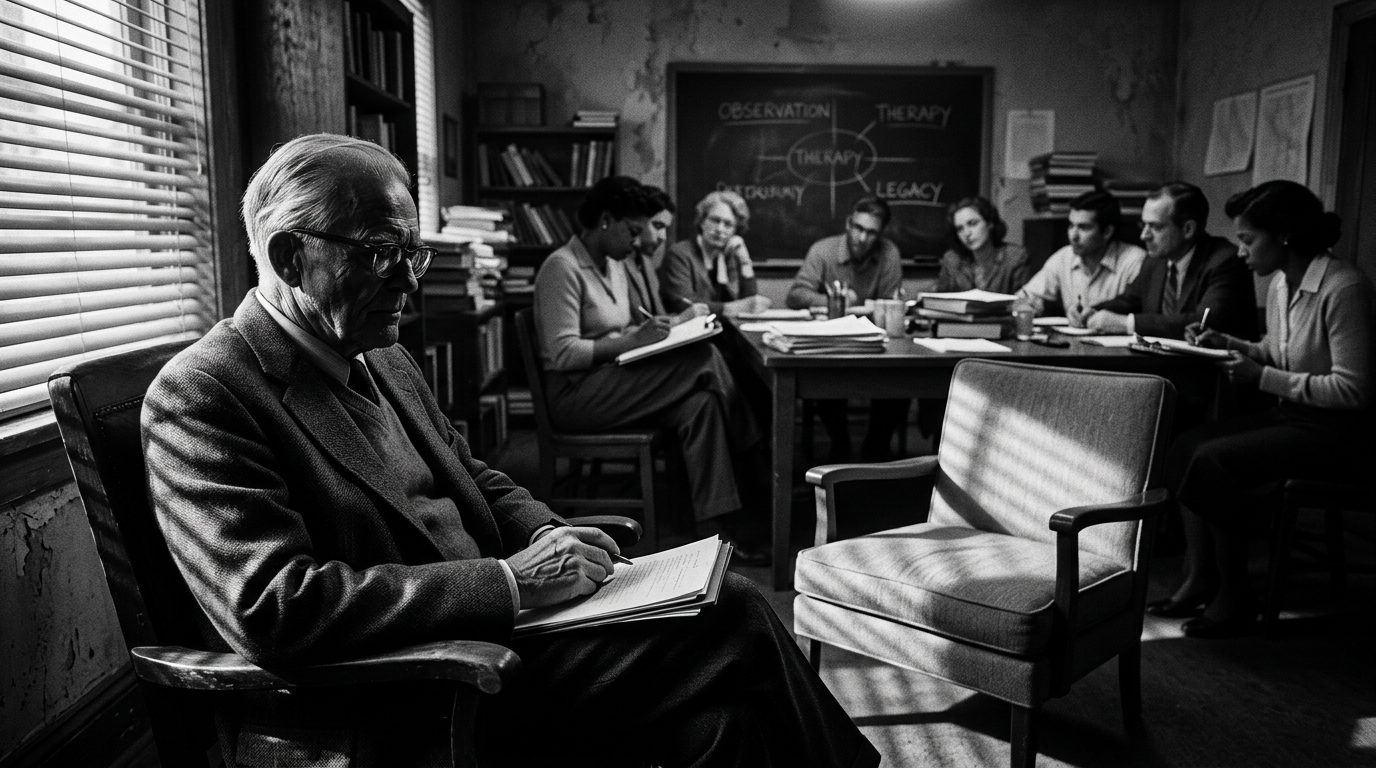
Upon entering, the contrast with the outside world was immediate and overwhelming. Outside lay the bright, noisy, and fast-paced world of 1970s America. Inside, a dense, contained universe resided in the person of a 71-year-old man, confined to a wheelchair, whose body was a vivid map of lost battles against polio. The first attack at age 17 had left him paralyzed, and a second assault decades later—the insidious post-polio syndrome—had robbed him of what little mobility he had left, plunging him into a state of chronic pain that would have broken anyone else. His face was etched with the lines of age and physical suffering, but his eyes, a piercing, crystalline blue, shone with a disconcerting vivacity. They observed everything with a calmness and intensity that seemed to register not only what Haley said, but how he said it: the subtle rhythm of his breathing, the almost imperceptible tension in his shoulders, the pauses between words, and the unspoken thoughts that stirred behind his technical questions.
What Haley would witness in the following years would change her career trajectory and, more broadly, transform the foundations of modern psychotherapy. Erickson was not a theorist building systems from an ivory tower, but a profoundly pragmatic clinician whose daily work challenged all assumptions about how human change actually occurs. His approach was not about confronting the patient, endlessly analyzing their past, or interpreting their dreams. It was, instead, a radical art of utilization: the ability to work with whatever the patient brought to the consultation—however strange or difficult—transforming the resistance itself into the fuel for healing. Erickson saw in every gesture a doorway and in every symptom a potential solution waiting to be redirected.
Chapter 2: Forging on the Frontier — Foundations of an Atypical Genius
The story of Milton Erickson doesn’t begin in the refinement of an East Coast academy, but on the harsh and isolated frontier of the American West. He was born on December 5, 1901 in Aurum, Nevada, a name that evoked gold but was actually an ephemeral silver mining camp, now a ghost town buried by desert dust. His father, Albert Erickson, was a man with calloused hands who earned his living extracting precious metals from the earth. Seeking the stability that the mines couldn’t offer and better educational opportunities for their large family, the Ericksons loaded their belongings into a wagon and traveled east to settle in the agricultural heartland of America: Beaver Dam, Wisconsin.
It was on that Midwestern farm, surrounded by eight siblings and the cyclical tyranny of the seasons, that the peculiarities of Erickson’s mind began to manifest. Not as gifts, but as a series of profound sensory deficiencies that isolated him from the common experience of his peers. For young Milton, the sensory world was not a fluid, colorful film, but a confusing jigsaw puzzle full of missing pieces:
- Musical and Arrhythmic: Milton was pitch-deaf to an extreme degree. Unable to follow a melody, reproduce a note, or even distinguish the rhythm of a popular song, the world of musical harmony was to him nothing but unstructured white noise.
- Colorblind: His perception of the color spectrum was minimal. Purple, for example, only became his lifelong favorite color after his sister explained to him conceptually that it was “the color of royalty.” Milton did not see purple; He saw a hue that others called by that name, learning to navigate the world of color through verbal descriptions and logical associations rather than by sight.
- Dyslexic: In an age when learning difficulties were not understood, Milton struggled with letters that refused to stay still on the page. The symbols danced and reversed themselves, making reading an intellectually exhausting task.
Paradoxically, this set of limitations became the cornerstone of his therapeutic genius. Unable to rely on the cues others took for granted—the intonation of a sentence, the color of a blushing cheek, the ease of written text—Erickson was forced to develop alternative channels of perception. He became a prodigious observer of the structure of human behavior. While other children listened to what was said, Milton “read” what was being communicated: he noticed the microdynamics of body language, the almost imperceptible change in pupil dilation, the subtle rhythm of breathing, or the tension of a jaw muscle that contradicted the kind words of a listener.
His struggle with dyslexia illustrates his almost legendary tenacity. Frustrated by his inability to read fluently, he set himself the Herculean task of reading the family dictionary from cover to cover, over and over again. He wasn’t just trying to memorize words; He sought to understand the architecture of language, the roots of concepts, and the multiple layers of meaning that a single word could hold. It was an exercise in neurological self-repair that not only overcame his dyslexia but also granted him a linguistic precision and a talent for wordplay that he would later use to circumvent the conscious defenses of his patients.
At the age of eight, influenced by the respected figure of the local doctor who visited the farm, he made the unwavering decision to follow in his footsteps. Shortly afterward, a chance encounter sealed his vocation: a traveling entertainer gave a demonstration of hypnosis in the area. While the crowd laughed or were frightened by the spectacle, young Milton was fascinated by the inner workings of what he saw. He perceived that what was happening on stage was not magic or charlatanism, but the use of an immensely powerful communication tool. At that moment, an ethical conviction was born within him that he would maintain until his death: a tool capable of influencing the human mind and body in such a way should be rescued from entertainment, studied with scientific rigor, and placed at the service of healing.
Chapter 3: The Trial by Fire — Polio, Self-Hypnosis, and the Canoe Trip
In the sweltering summer of 1919, the life of 17-year-old Milton Erickson came to an abrupt halt with the most dreaded diagnosis of his time: poliomyelitis. Within days, his body, accustomed to the strenuous work of the farm, became a prison of immobile flesh. His condition was so severe that, as he lay in bed, he overheard the doctor telling his mother in the next room that her son would not survive until dawn. With a quiet defiance that would define his life, Erickson asked his mother to move the dresser in his room so he could watch the sunset; not as a final farewell, but as a challenge. “I’ll be here tomorrow,” he vowed. Not only did he survive that night, but he transformed his near-total paralysis into an unprecedented scientific laboratory for self-observation.
Confined to viewing the world through a strategically placed mirror, Erickson began to study human behavior with microscopic intensity. His primary subject was his young sister, who was learning to walk at the time. As she wobbled around the room, Milton analyzed every minute adjustment of balance, the shift of weight from one heel to the other, and the coordination required to activate the correct muscles in the precise order. He then understood that “knowing how to walk” did not reside in the conscious mind, but in a complex set of unconscious programs that his body had forgotten but that still existed somewhere in his nervous system.
That period of forced isolation led to one of the most revolutionary discoveries in modern psychology: ideomotor movements. One afternoon, while intensely longing to be sitting in his bedroom rocking chair, he noticed with astonishment that the chair began to rock slightly. He realized that simply vividly imagining a movement triggered imperceptible micro-contractions of his muscles. Armed with this revelation, he began an exhaustive process of self-hypnosis: he spent hours mentally reliving the sensation of his muscles working, searching his memories for the “echo” of the action of standing up. By imagining the movement again and again, he was, quite literally, retraining his brain to reconnect the neural pathways that the virus had tried to destroy.
However, his recovery was not a passive miracle, but an act of strategic will. Almost a year later, although he could speak and move his arms, his legs remained extremely weak. To solidify his recovery, he devised a plan his doctors deemed suicidal: a 1,200-mile canoe trip down Wisconsin’s rivers to the Mississippi. With only four dollars in his pocket, no strength in his legs, and an iron will, he set off. His philosophy was that of a brutal pragmatist: “If I put myself in a situation where walking is an absolute necessity for survival, my subconscious will find a way to make my legs work.”
The journey was an odyssey of pain and overcoming adversity. He paddled until he was exhausted, using his upper body to compensate for his lower body. When he reached the portages—sections of land where he had to carry the canoe—he crawled and pushed his craft inch by inch, refusing any help. By the end of the summer, Erickson returned transformed. He had not only paddled hundreds of miles, but he had also regained the ability to walk. Although he would need crutches for the rest of his life, his body was no longer a prison, but a living testament to human potential. He was ready to enter medical school, carrying with him the most valuable lesson he would ever receive: the boundless power of the unconscious to mediate physical healing.
Chapter 4: The Mind as a Laboratory — Academic Years and the Eloise Experiments (1928–1948)
After emerging from the transformative experience of polio, Milton Erickson entered academia not as a novice theorist, but as an empiricist forged in the harsh reality of his own physiology. His formal training began at the University of Wisconsin, where he set out to simultaneously obtain his medical degree and a master’s degree in psychology. It was in this environment that his fascination with hypnosis clashed head-on with the methodological rigor of the behaviorism of the time. Erickson had the privilege—and the challenge—of studying under Clark L. Hull, one of the most influential figures in 20th-century scientific research on hypnosis.
Hull was a scientist obsessed with standardization. His goal was to strip hypnosis of any trace of mysticism and transform it into a measurable and universal psychological variable. For Hull, hypnosis had to follow strict protocols: the same words, the same tone, the same environment. Erickson, however, began to question this “mechanical” view almost immediately. While Hull sought the “average subject” to validate his statistics, Erickson was drawn to atypical cases and idiosyncratic responses. He realized that hypnosis was not something “done” to the patient, but a dynamic collaboration that depended entirely on the subject’s individuality. This early divergence sowed the seeds of his revolutionary approach: therapy should adapt to the patient, not the patient to the therapy.
After graduating as a doctor, his career took off at the Eloise Hospital and Infirmary in Michigan, a sprawling institution that functioned almost like a self-contained city, housing thousands of patients with the most severe psychiatric disorders. For nearly fifteen years, Erickson used this environment as a vast clinical laboratory. He didn’t just treat patients; he designed ingenious experiments to explore the limits of perception and mental control. He investigated phenomena such as induced amnesia, hypnotic deafness, and age regression in a level of detail that filled the pages of academic journals. He conducted, for example, experiments in which he induced hypnotic “color blindness” in normal subjects to observe how the brain processed visual information under suggestion, building brick by brick an empirical database on the power of the unconscious.
The outbreak of World War II expanded his laboratory beyond the hospital walls. The United States government, in need of experts in communication, propaganda, and wartime morale, summoned Erickson to collaborate on psychological intelligence projects. This context brought him into contact with two of the most brilliant minds of his generation: the anthropologist Margaret Mead and her husband, the systems theorist Gregory Bateson.
The encounter was a true intellectual firestorm. Mead, accustomed to observing cultural patterns in distant societies, was fascinated by Erickson’s ability to detect patterns of behavior in the microcosm of the individual. Bateson, for his part, found in Erickson’s clinical work living validation of his theories on cybernetics and feedback loops in human communication. Erickson taught them that change is not a matter of conscious willpower, but of altering the structure of the system’s internal communication. Bateson would go so far as to say that Erickson was a “communication genius,” someone who operated intuitively at levels that science was only beginning to theorize. This interdisciplinary collaboration not only influenced the war effort but also provided Erickson with a systemic conceptual framework that would elevate his clinical practice from a hypnotic technique to a philosophy of life and change.
Chapter 5: The Wounded Healer — Post-Polio Syndrome and the Birth of ASCH
In the late 1940s, Milton Erickson was at the height of his institutional career. As Director of Research at the prestigious Eloise Hospital, he was an authority figure, a respected researcher, and a mentor to a new generation of psychiatrists. Yet, while his professional influence grew, his body was waging a silent, losing war. Polio, the adversary he had vanquished in his youth with almost superhuman willpower, had returned: not as a reinfection, but as a cruel, degenerative echo known as post-polio syndrome.
This physiological phenomenon was, in a sense, the price of his earlier victory. The Herculean effort he had made to rebuild his neural pathways over decades had overloaded the surviving motor neurons. The muscles he had trained so diligently to regain function began to fail systematically. Chronic pain, once a background annoyance, became a constant, sharp, and debilitating companion, while overwhelming fatigue drained his vital energy. The prospect of a wheelchair, which in his youth had represented surrender, now loomed as an inescapable certainty.
The irony was both brutal and poetic: at the very moment his clinical mind reached its zenith of wisdom and acuity, his physical vessel was abandoning him. Michigan’s unforgiving climate, with its bone-chilling, wet winters, exacerbated his daily suffering. Erickson faced an existential crossroads: he could remain at the epicenter of institutional psychiatry, surrounded by status and financial security as his mobility dwindled, or he could make a radical gamble on life. He chose the latter. In 1948, at the age of 47, he resigned his prestigious position at Eloise, packed his family’s belongings, and moved across the country to Phoenix, Arizona. The logic behind that decision echoed the one that guided his canoe journey thirty years earlier: to drastically change his environment to force a new biological and mental adaptation. The desert, with its dry air and constant heat, offered the only hope of relief for his exhausted nerve endings.
This move wasn’t simply a change of postal code; it was a complete reinvention of his professional identity. His second wife, Elizabeth Moore, emerged as a central and heroic figure in this chapter. Elizabeth wasn’t just his life partner; she was his intellectual collaborator, his transcriber, and the logistical anchor that allowed him to navigate a world no longer designed for his legs. With working in a traditional hospital physically unsustainable, Erickson made a decision that would change the history of psychotherapy: he would establish his private practice in his own home. Beginning in 1949, the Erickson home on Cypress Street was transformed into a clinical sanctuary, an informal classroom, and the epicenter of a therapeutic revolution.
This enforced domesticity had a profound impact on his methodology. By receiving patients in his living room, surrounded by the normal bustle of a large family and everyday objects, Erickson dismantled the sterile hierarchy of the traditional medical model. Therapy was no longer a surgical intervention on the psyche performed in an aseptic environment; it was a human encounter. This informality became one of his most powerful tools: it allowed him to observe patients in a more natural state and to “use” elements of the environment—a noise in the street, a dog barking, or a family interruption—as an integral part of the trance or suggestion. Furthermore, his own physical fragility acted as a catalyst for rapport: patients were not before an omnipotent “medical God,” but before a visibly wounded and confined human being, which generated a level of empathy and trust that accelerated the healing process.
While rebuilding his life in the desert, Erickson remained active in the Society for Clinical and Experimental Hypnosis (SCEH), but friction with academic orthodoxy was inevitable. Erickson viewed hypnosis as a natural and flexible communication skill; the majority faction within the SCEH sought rigid protocols and laboratory standardization. Erickson insisted that hypnosis should be a practical tool in the hands of field doctors and dentists to alleviate pain and facilitate change, not a purely theoretical object of study reserved for academic elites. The tension reached its ideological breaking point in 1957. Frustrated by what he perceived as a restrictive elitism that stifled the evolution of the discipline, Erickson staged a definitive act of professional rebellion. Along with a group of visionary colleagues, he broke away from the SCEH to found the American Society of Clinical Hypnosis (ASCH).
As founding president and editor of the American Journal of Clinical Hypnosis, he ensured that the new organization prioritized clinical teaching and efficacy over dogmatic speculation. This schism was not an act of ego, but rather the creation of a space where innovation could flourish without censorship, solidifying his position as the leader of a movement that valued the uniqueness of each patient above any preconceived theory.
Chapter 6: The Silent Revolution — Innovative Techniques and the Milton Model
With the founding of the ASCH in 1957, Milton Erickson not only created an organization but also built a platform of intellectual resistance. From his modest home in Phoenix, he commanded a movement that challenged the foundations of conventional psychiatry. His first and most powerful instrument of change was the American Journal of Clinical Hypnosis, of which he was the founding editor for a decade. Erickson made the journal his pulpit, his classroom, and his trench: a vehicle for disseminating a “pragmatic gospel” that prioritized the relief of suffering over theoretical purity. In an act of astonishing productivity, he published at least one original article or case report in every issue during his ten years as editor, ensuring that his voice was the most influential and disruptive in the field of clinical hypnosis.
This period, spanning from 1957 until his massive “discovery” in 1973, was the true era of the quiet revolution. While American culture was being shaken by tumultuous changes—the struggle for civil rights, the Vietnam War, and the birth of the counterculture—Erickson, physically confined by his body but boundless in his mental acuity, was carrying out an equally profound transformation in the microcosm of psychotherapy. It was during those years of “productive solitude” in the desert that his techniques, developed over decades of hospital experimentation, crystallized into a coherent and radically innovative therapeutic arsenal. His Phoenix home ceased to be merely a dwelling and became a living laboratory where the observation of human patterns was elevated to a precision science.
The cornerstone of his revolutionary approach was the principle of utilization. Unlike dominant therapies that sought to correct, confront, or eradicate a patient’s “problems” or “resistances,” Erickson taught that everything the patient brought to the session—their religious beliefs, nervous tics, skepticism, and even delusions—was a potential resource to be validated and incorporated to facilitate change. Erickson did not fight the symptom; he allied himself with it to redirect its energy. If a patient was a devout Catholic, Erickson did not analyze their faith as a neurosis; he framed his suggestions in terms of “inner miracles,” saints, and divine mandates, using the patient’s worldview to guide them toward healing. It was the judo of psychotherapy: not opposing force with force, but absorbing the other’s momentum to achieve the desired goal.
From this guiding principle blossomed an arsenal of specific techniques that baffled traditionalists with their elegance and apparent simplicity:
- Indirect suggestions: Instead of giving direct commands (“Close your eyes”), Erickson used the language of possibility and curiosity (“I wonder if you’ll notice your eyelids feel heavier now… or perhaps in a moment”). This allowed him to bypass the critical judgment of the conscious mind and gave the patient an illusion of choice, facilitating an involuntary and authentic response.
- Therapeutic metaphors and isomorphism: Erickson understood that stories are Trojan horses for change. His seemingly rambling narratives were actually isomorphic metaphors: stories whose internal structure exactly reflected the structure of the patient’s problem, offering a symbolic solution that the unconscious could adopt without the defenses raised by direct instruction.
- Technique of Confusion: By overloading the conscious mind with vague, complex, contradictory, or irrelevant language, Erickson induced a momentary state of confusion that allowed the patient’s critical faculty to be bypassed, opening a window into their subconscious mind.
- Therapeutic Double Bind: Unlike Bateson’s pathological double bind, Erickson designed situations where the patient had two options, but both inevitably led to the desired therapeutic outcome. The classic question, “Do you wish to enter a trance now or after we finish this story?” leaves no option for “not entering a trance,” but rather presupposes that the phenomenon will occur, occupying the conscious mind with a trivial decision while the unconscious accepts the fundamental premise.
It was this astonishing mastery of language that, in the early 1970s, attracted two young academics at the University of California: Richard Bandler and John Grinder. Obsessed with the question, “What is the underlying structure of Erickson’s magic?”, they settled into his living room to conduct an unprecedented modeling process. They were less interested in theory than in his patterns of verbal and nonverbal behavior. The result was the birth of the Milton Model, the first formal codification of Erickson’s linguistic patterns. Bandler and Grinder identified the systematic use of “artistic vagueness”: Erickson’s ability to speak so generally and ambiguously that the patient was forced to fill in the gaps with their own internal meanings and resources. The Milton Model revealed that Erickson’s genius was not a mystical gift, but a highly sophisticated communication technology that used generalizations, deletions, and distortions of language to guide human attention toward its own sources of power.
Chapter 7: The Creative Unconscious — Therapeutic Philosophy and Divergence from Freud
To understand the magnitude of Milton Erickson’s revolution, it is necessary to place him within the context of mid-20th-century psychotherapy, a field dominated by a titanic figure: Sigmund Freud. Freudian psychoanalysis was the reigning paradigm, and its view of the unconscious was bleak and conflicted. For Freud, the unconscious was a dark cellar of the soul, a seething cauldron of repressed impulses, socially unacceptable desires, and forgotten childhood traumas. Therapy, therefore, was an arduous archaeological process, a slow and painful excavation to bring these hidden contents into the light of consciousness.
Erickson, from his office in Phoenix, contemplated this model and, based on his own life experience and thousands of hours of clinical practice, rejected it outright. His divergence from Freud was not a minor theoretical revision; it was a fundamental philosophical schism. Where Freud saw a well of pathology, Erikson saw a spring of resources. Where Freud saw conflict, Erikson saw creativity. This was his most radical and enduring contribution: the complete redefinition of the nature and function of the unconscious mind.
For Erickson, the unconscious was not the enemy to be conquered, but the wisest and most powerful ally in the healing process. It was not a cesspool of repressed desires, but a vast and benevolent reservoir containing every learning acquired since birth: from the complex mechanics of holding a spoon to the emotional wisdom needed to process grief. This “deep mind” was seen as a creative entity capable of processing information at a speed and with a complexity that the conscious mind, limited by linear logic and social judgment, could never achieve. If a patient had managed to learn to walk after falling a thousand times, or had developed the patience to fish or the skill to play an instrument, those resources were not lost over time; they remained latent, like tools in a workshop waiting to be called upon to resolve present conflicts.
“Trust your unconscious. It knows more than you do.” This Ericksonian maxim was not simply a motivational phrase, but a clinical axiom. This implied that the solution to a client’s problem lay not in the therapist’s interpretations, but in the individual’s own capacity to reorganize their internal experiences. Erickson trusted this wisdom so much that he often allowed the patient to enter a trance without giving them specific suggestions for change, letting the “deep mind” make its own connections and repairs outside the radar of the critical ego.
This philosophy gave rise to his celebrated utilization approach. If the unconscious is a storehouse of resources, the therapist’s primary task is not to “cure,” but to act as a facilitator who builds such exquisite and fluid rapport that it allows the barrier of the “conscious sentinel” to be bypassed. By speaking the language of the unconscious—a language of symbols, rhythms, and associations—the therapist can invite these stored resources to flow into the area of the problem. Rapport was not merely cordiality; it was a rhythmic dance where the therapist matched the patient’s breathing, tone of voice, and posture to “open a direct line” to their inner reservoir.
A fundamental pillar of this vision was radical individuation. Erickson vehemently rejected theories that attempted to confine human behavior to pre-established molds. He criticized what he called the “Procrustean bed” of traditional psychiatry: the tendency of clinicians to force the patient to fit their theory—be it Freudian, behavioral, or systemic—by cutting or stretching the individual’s reality to conform to the dogma. For Erickson, if a patient loved gardening, the therapy should focus on seeds and seasons; if they were an engineer, it should focus on flows and structures. Success depended on finding the specific key for the specific lock of each individual.
The impact of this vision was seismic, acting as the Big Bang of modern therapies in the late 20th century. Solution-Focused Brief Therapy, for example, is a direct descendant of this thinking: it adopted the premise that it is not necessary to delve into the historical “why” of the trauma if we can identify and expand upon “how” the patient is already surviving and what resources they have to move forward. Similarly, Strategic Family Therapy, championed by Jay Haley and Cloe Madanes, borrowed from Erickson the notion that the symptom is often a failed attempt at adaptation that can be “reframed” and used for the well-being of the entire family system.
Chapter 8: The Discovery of the World — Jay Haley and International Fame
For more than two decades, Milton Erickson operated as something of an underground legend, a secret shared among a growing but still exclusive circle of psychiatrists, anthropologists, and cutting-edge therapists. His influence spread primarily through word of mouth and his meticulous technical articles in the American Journal of Clinical Hypnosis, read with devotion by specialists but ignored by the general public. Traveling to Phoenix to see Erickson felt, for many, like a pilgrimage to a modern-day oracle nestled in the Arizona wilderness. However, in 1973, this productive isolation came to a definitive and explosive end with the publication of Uncommon Therapy: The Psychiatric Techniques of Milton H. Erickson, M.D., written by Jay Haley.
Haley, with his keen background in systemic communication and his close collaboration with Gregory Bateson, proved to be the perfect translator for Erickson’s multidimensional and often cryptic genius. He didn’t simply transcribe astonishing anecdotes about “miraculous” cures; he undertook a titanic intellectual effort to categorize and analyze the strategic logic underlying Erickson’s apparent “magic.” The book was revolutionary not only for what it described but also for the radical architecture of its organization: instead of classifying interventions by traditional diagnostic labels, Haley structured them around the universal challenges of the human life cycle. Through its pages, the reader saw Erickson helping individuals navigate the critical stages of existence: courtship, adjusting to early marriage, the birth of children, the emancipation of young adults, and the serene confrontation with old age.
The impact of Uncommon Therapy was seismic, transforming the modest house on Cypress Street into the Mecca of global psychotherapy. Overnight, the “Phoenix Wizard” went from a cult figure for initiates to an international phenomenon in the field of mental health. The pilgrimage to Arizona became a constant stream of professionals hungry for new approaches: therapists, doctors, psychologists, and students from all corners of the globe who, frustrated by the temporal and theoretical limitations of long-term therapies, longed to learn directly from the original source. Despite his increasingly fragile health, Erickson embraced this new role as a global mentor with renewed generosity and vitality. He began holding regular teaching seminars right there, in the intimacy of his living room or under the harsh sunlight in his backyard.
These seminars quickly entered the realm of legend. The students sat in a semicircle at the feet of a man who often wore purple—the only color his colorblindness allowed him to identify with complete conceptual certainty—and whose voice, weakened by illness, was barely a raspy but strangely hypnotic whisper. The sessions were a living, continuous demonstration of his own therapeutic method. Erickson didn’t deliver lectures laden with technical jargon; he taught through what he called “interspersal,” or the technique of interleaving: he told farm stories, anecdotes about patients from the 1930s, and disconcerting wordplay that, taken together, induced states of collective trance in the audience. He often used the attendees themselves as demonstration subjects, resolving phobias, tics, or personal blocks on the spot while the rest of the group watched, astonished, how the structure of a seemingly trivial story could dismantle a decades-old psychological defense.
During that final period of absolute visibility, key figures emerged who acted as custodians and amplifiers of his legacy. Ernest Rossi, a psychologist with a deep inclination toward psychobiology and neuroscience, became the official “recorder” of his later years: he recorded, transcribed, and analyzed every word of Erickson’s sessions, searching for the biological basis of hypnosis. Their collaboration resulted in fundamental technical works that translated Erickson’s intuition into the language of physiological science, exploring how suggestion affected ultradian rhythms and neuronal plasticity. Meanwhile, Jeffrey Zeig, a young and energetic disciple, recognized the urgent need to create an institutional structure that would outlive the man himself. With Milton’s blessing, Zeig founded The Milton H. Erickson Foundation in 1979 and organized in Phoenix the first international congress of “The Evolution of Psychotherapy”, an unprecedented event that brought together the giants of the field to honor Erickson’s vision and definitively place him in the pantheon of the great innovators of the 20th century.
Milton Hyland Erickson died at his home in Phoenix on March 25, 1980, at the age of 78. His death did not represent an end in the traditional sense, but rather a definitive transition from person to myth and from clinician to universal legacy. He was unanimously recognized as the father of multiple modern therapeutic schools and as the clinician who, by transforming his own physical suffering into a precision tool, restored hope to psychotherapy. He demonstrated to the world that human beings, even in their most paralyzed or hopeless states, possess an inexhaustible wellspring of inner resources waiting to be awakened by the right voice: a voice that, like his, knew how to speak the forgotten language of the inner mind.
Chapter 9: The Art of Change — A Look Inside Erickson’s Toolbox
If Milton Erickson’s philosophy was his compass, his techniques were the map and tools with which he navigated the complex landscapes of the human mind, often described by his patients as dead-end labyrinths. To the casual observer or the rigid academic, his methods might have seemed eccentric, illogical, or imbued with a mystical aura. Yet beneath this veneer of improvised art lay a surgically precise architecture of change: a set of tools honed over half a century of daily clinical practice and microscopic observation of human behavior.
Erickson was, above all, a master of therapeutic storytelling and the use of metaphor as a vehicle for transformation. He understood that, ever since humanity gathered around fires in caves, we have processed reality and transmitted wisdom through stories. While a direct command or interpretation invites immediate ego resistance (“You are depressed because…”), a story invites projective participation. His “teaching stories” functioned as isomorphic metaphors: narratives whose internal structure, characters, and resolution precisely reflected the patient’s dilemma, offering a symbolic solution that the unconscious could adopt as its own without feeling threatened.
The story of the “lost horse” is the archetypal example of his approach to self-healing. Erickson recounted how, during his teenage years on the farm, an unfamiliar and disoriented horse appeared on his property. Not knowing where it came from, Milton simply mounted it and guided it to the main road, keeping it on the path and letting it choose its direction at each crossroads. If the horse wandered off into the fields to graze, Milton gently led it back to the road. Eventually, the animal made its way back to its original stable several miles away. The hidden message for the patient is profoundly moving: “You already know the path to your own healing; I, as the therapist, am merely the rider who helps you stay on the path while you rediscover your own inner map.”
Other fundamental tools in his refined toolbox included:
- Seeding Technique: This was perhaps his most subtle and powerful technique. Erickson might spend much of a session telling a seemingly technical, tedious, or irrelevant story about growing plants or raising livestock. However, he would intersperse it—using almost imperceptible changes in tone of voice, pace, or the direction of his gaze—with key words and phrases containing specific suggestions for pain relief or conflict resolution. The conscious mind, bored by the superficial narrative, would lower its guard, while the unconscious eagerly gathered the “seeds” of healing strategically sown in the flow of speech.
- Induction by Confusion and Pattern Disruption: Erickson discovered that hypnotic trance is a natural phenomenon that occurs when the conscious mind is momentarily left without a learned response. By using vague, grammatically complex, or seemingly contradictory language, he created a “short circuit” in linear logic. In that instant of disorientation, the patient enters a state of heightened receptivity. His famous “handshake induction” is a physical example of this: Erickson interrupted the automatic social pattern of greeting with a handshake, leaving the patient’s hand suspended in the air in a cataleptic pause that froze consciousness and instantly opened the door to a deep trance.
- Therapeutic Double Bind: Erickson designed “choice-without-choice” situations that forced progress. Unlike pathological double binds that immobilize, Erickson’s mobilized. By asking, “Would you like to enter a light trance right now to begin working, or would you prefer to wait a few minutes to enter a much deeper and more comfortable one?”, the therapist engages the conscious mind in a trivial decision about when, while the unconscious accepts the fundamental and inescapable premise that the trance will occur. This technique gives the patient a necessary illusion of control, framing them in a situation where any path chosen inevitably leads to the desired therapeutic outcome.
Chapter 10: The Heirs — Erickson’s Students and the Continuation of the Legacy
Milton Erickson, the master of individualized psychotherapy, faced throughout his career the paradox of how to teach an art he himself defined as inherently personal, intuitive, and tailored to the uniqueness of each individual. His solution was not to establish a rigid doctrine or create “clones” of his own charismatic personality, but rather to act as a catalyst for creativity in his students. He did not give them a closed instruction manual, but rather an ethical and technical compass. After his death in 1980, his disciples divided the vast and fertile territory of his genius, working diligently to systematize his insights and transform them into clinical models accessible to the global community.
Jay Haley was undoubtedly the great strategist and the one responsible for translating Erickson’s “magic” into the language of human systems. Deeply influenced by his earlier work with Gregory Bateson, Haley saw in Erickson the clinician capable of breaking vicious cycles of communication. He was the principal architect of Strategic Family Therapy, an approach that revolutionized systemic intervention. Haley systematized the use of paradoxical directives—prescribing the symptom so that the patient, in attempting to comply with the directive, would either gain control over it or abandon it—and emphasized family hierarchy. For Haley, Erickson’s genius lay in his ability to act as an agent of change, altering the structure of behavior to force a new, healthy adaptation.
Ernest Rossi represented the scientific approach and the necessary bridge to biology and neuroscience. He became Erickson’s closest collaborator during the last eight years of his life, recording thousands of hours of sessions and seminars. Rossi proposed that Erickson’s work aligned remarkably well with the body’s ultradian rhythms (natural cycles of rest and activity every 90-120 minutes). Through works such as *The Psychobiology of Mind-Body Healing*, he demonstrated that Ericksonian hypnosis was not a mystical state, but a way to access neuronal plasticity and communication between mind and genes, providing an empirical basis that validated Erickson’s effectiveness in physical recovery and chronic pain management.
Stephen Lankton and Carol Lankton acted as the clinical architects and synthesizers. Their work consisted of breaking down the Ericksonian therapeutic process, which often seemed chaotic and improvised, into a rigorous and teachable academic framework. In their seminal work, *The Answer Within*, they classified the stages of therapy into preparation, trance, utilization, and ratification. The Lanktons delved into the architecture of the therapeutic metaphor, developing methods for therapists to construct isomorphic stories with multiple layers of meaning, ensuring that Ericksonian hypnotherapy could be integrated into university curricula with a clear and reproducible didactic structure.
Jeffrey Zeig was the institutional visionary and guardian of the legacy. As the founder of The Milton H. Erickson Foundation in 1979, he assumed the responsibility of preserving the master’s vast archives of audio, video, and written works. Under his leadership, the foundation not only prevented the legacy from being dispersed but also created historical bridges between Erickson’s thinking and that of other giants of psychology. Zeig organized the international conferences “The Evolution of Psychotherapy,” the largest events in the field’s history, ensuring that Erickson’s name remained a current and vibrant reference.
Other prominent heirs expanded these ideas to even broader frontiers. Bill O’Hanlon, who studied with Erickson at a young age, simplified and distilled the approach into what he called “Possibility Therapy,” focusing on how small changes in language and attention can open new horizons for the client. Stephen Gilligan, for his part, developed the concept of Generative Trance, proposing that the unconscious is not merely a reservoir of past resources, but a creative space of “infinite possibility” that requires a welcoming and present relationship on the part of the therapist. This ecosystem of disciples, often disagreeing on the precise interpretation of Erickson’s words, formed an intellectual mosaic that ensured the survival of his ideas, transforming Ericksonian psychotherapy into a global discipline that continues to heal and surprise in the 21st century.
Chapter 11: Ripple Effects — Erickson’s Impact on Modern Psychotherapy
The legacy of Milton Erickson is not that of a founder of a single school of thought bearing his name. His influence is more subtle and, at the same time, far more pervasive. Like a stone thrown into a pond, his ideas created ripple effects that have gone on to transform the face of modern psychotherapy, redefining the relationship between therapist, patient, and the process of change. Erickson did not merely introduce new techniques; he challenged fundamental assumptions about the nature of the human mind, the role of conscious will, and each individual’s innate potential to resolve their own conflicts. His impact can be traced most prominently in three areas that flourished in the decades following his death: Neuro-Linguistic Programming (NLP), Brief Therapy, and Systemic Family Therapy.
NLP is perhaps the most direct and, at the same time, most controversial descendant of Erickson’s work. Born in the early 1970s at the University of California, Santa Cruz, NLP was the result of an ambitious project by its co-creators, Richard Bandler and John Grinder. Their fundamental question was: “What is the difference that makes the difference between an average therapist and an exceptional one?” Their first and most important subject was Milton Erickson. Through hours of observation and analysis of recordings, they distilled what we now know as the “Milton Model”: a systematization of Erickson’s hypnotic language patterns that includes the deliberate use of ambiguity, presuppositions, metaphors, and covert commands. NLP took Erickson’s operational elegance and transformed it into an accessible communication technology, allowing people in fields as diverse as education, leadership, and sports to apply his principles of influence and change.
Before Erickson, psychotherapy was synonymous with a long, often painful, and almost exclusively introspective process. The traditional psychoanalytic model presupposed that years of historical exploration were needed to achieve meaningful change. Erickson shattered that assumption with radical pragmatism. His belief in a resourceful unconscious and his relentless focus on solving problems in the here and now led to the revolutionary idea that therapy not only could, but should, be brief. He demonstrated, case after case, that profound change could occur in a handful of sessions—or sometimes in a single strategic intervention—if the patient’s latent resources could be activated. This philosophy became the cornerstone of Solution-Focused Brief Therapy (SFBT), developed by Steve de Shazer and Insoo Kim Berg. By focusing on exceptions to the problem and on the client’s strengths, TBCS brought Erickson’s spirit to clinics around the world, demonstrating that efficiency and respect for patient autonomy are not only possible, but essential for lasting healing.
Although Erickson worked primarily with individuals in his Phoenix practice, his thinking was inherently systemic. He understood, long before systems theory became commonplace in psychology, that a person does not exist in a vacuum, but rather within a complex web of relationships, primarily the family. Erickson perceived that an individual’s symptoms often served a protective or communicative function within the family system, maintaining a homeostatic balance that, while dysfunctional, was necessary for the group’s survival. This perspective had a monumental influence on the pioneers of Family Therapy, especially Jay Haley and the group at the Mental Research Institute (MRI) in Palo Alto. Erickson’s interventions—such as paradoxical directives, where the patient was asked to amplify the symptom in order to gain control over it—became fundamental tools of Strategic Therapy. Thanks to Erickson, the therapeutic focus shifted from the hidden “why” in the individual to the “how” of the relational system, paving the way for millions of families to find new, healthier, and more flexible ways of interacting.
Chapter 12: A Complex Legacy — Controversies, Criticisms, and the Shadow of Genius
No revolutionary escapes scrutiny, and Milton Erickson is no exception. His clinical genius casts shadows that still generate ethical, technical, and philosophical debates in the field of mental health. An honest analysis of his legacy demands a balanced perspective that not only celebrates his brilliance but also examines the tensions his methodology introduced into the therapist-patient relationship.
The most persistent and perhaps most troubling criticism focuses on the ethics of influence. By employing techniques of indirect suggestion, states of confusion, and paradoxical directives, Erickson often operated on a level that eluded the patient’s rational awareness. In traditional psychotherapy, “informed consent” presupposes that the patient understands and accepts each step of the process; however, in the Ericksonian model, change often occurs covertly or strategically. For some critics, this approach borders on paternalistic manipulation, where the therapist assumes the role of an “invisible director” pulling the strings of another’s psyche. Erickson responded to this with stark pragmatism: he argued that all human communication is, by definition, a form of influence, and that the only valid ethical question was whether that influence was used exclusively for the client’s goals and well-being. However, in the hands of practitioners with less ethical integrity or clinical expertise, these tools run the risk of becoming instruments of coercion or an imposition of the therapist’s will on the individual’s autonomy.
Another recurring line of criticism is the phenomenon of the “false gift” or the lack of scientific replicability. Many of Erickson’s most astonishing successes are attributed to his unique personal charisma, his extraordinary capacity for sensory observation, and an intuition that bordered on the supernatural after fifty years of practice. His academic detractors point out that his results are often presented as fascinating “anecdotes” or “case studies” that can hardly be subjected to the rigor of the randomized controlled trials required by evidence-based medicine. There is also the danger of “technicality”: students who, after attending short seminars, attempt to replicate his hypnosis patterns without possessing the profound human empathy or sensory acuity that underpinned them. The result is often mechanical, cold, and sometimes counterproductive interventions that mimic the form of the Ericksonian method but lack its relational soul.
Ultimately, his posthumous association with Neuro-Linguistic Programming (NLP) has proven to be a double-edged sword for his historical prestige. While it is true that Bandler and Grinder popularized his name and brought his language patterns to a mass audience, it is also true that NLP often extracted the techniques from their original clinical context. The aggressive marketing of NLP, its promises of “instant changes,” and its application in areas such as sales and seduction have led sectors of the scientific community to view anything labeled “Ericksonian” with suspicion, mistaking it for pseudoscience or superficial manipulation. This shadow has sometimes hindered the recognition of Erickson as the rigorous physician and pioneering researcher he truly was.
Despite these controversies, the true measure of Milton Erickson lies not in the infallibility of his techniques, but in the revolutionary vitality of his questions. He forced us to question whether the patient is a collection of pathologies to be resolved or a wellspring of potentialities to be awakened; he prompted us to consider whether language is merely a tool for describing a static reality or a dynamic instrument for creating new possibilities of existence. His biography is not simply the chronicle of a man who overcame disability in a wheelchair; it is the record of how a “wounded healer” found, through his own suffering, the master key to unlocking the doors of freedom in others. His legacy remains a vibrant intellectual battleground, reminding us that at the heart of all therapy must be absolute respect for the unique and irreplaceable nature of each human being.
Annotated Bibliography — A Guide to Delving Deeper into the World of Erickson
For those wishing to navigate the vast ocean of Ericksonian literature, these are the essential coordinates:
- The Collected Papers of Milton H. Erickson on Hypnosis (4 volumes), edited by Ernest L. Rossi. This is the canon. It contains everything from his university experiments of the 1930s to his final reflections. Dense and technical reading, but indispensable for understanding the evolution of his scientific thought. The new expanded editions published by the foundation include invaluable previously unpublished material.
- Hypnotic Realities (1976), by Erickson, Rossi, and Rossi. Probably the best technical manual. It breaks down actual sessions word for word, explaining why Erickson used a specific inflection or a particular pause. A masterclass in clinical microcommunication.
- Uncommon Therapy (1973), by Jay Haley. The ideal entry point. Haley translates the “magic” into the language of social strategy and life cycles. If you want to understand why Erickson did what he did from a systemic perspective, this is the book.
- My Voice Will Go With You (1982), by Sidney Rosen. Known in Spanish as Mi voz irá contigo. A collection of his didactic stories; it showcases Erickson’s warmer and more philosophical side. It can be read as a profound self-help book or as a treatise on the use of metaphor in healing.
- Healing in Hypnosis (1983), by Milton H. Erickson. A collection of lectures and transcripts that capture Erickson’s direct voice in his seminars, revealing his sense of humor and his unwavering faith in humanity.