Chapter 1: 1972: The Hall of Mirrors and the Man Who Sought the Truth
The artificial light of the Hong Kong film studio bounces and multiplies to infinity. A cold, geometric labyrinth of mirrors creates a thousand reflections of the same man. Each image is a facet of the same figure: a bare torso, sculpted from pure muscle and willpower, with a tension that seems about to shatter the air around him. It is 1972, on the set of Enter the Dragon, and Bruce Lee is preparing to film what will become one of the most iconic sequences in action cinema history. The villain Han lurks somewhere in that palace of illusions, armed with a metal claw. But the real battle is not between two actors playing roles in a script: it is the visual externalization of a quest that Bruce has carried with him since childhood.
At that moment, Bruce Lee brings together everything that led him to that studio: the streets of Kowloon where he learned that the world strikes first and asks questions later; the classrooms at the University of Washington where he discovered that Plato and Laozi addressed the same problem with different vocabularies; the garages of Seattle where he taught Wing Chun to anyone who wanted to learn, regardless of their background; the Hollywood studios that closed their doors to him for years because they didn’t know what to do with an Asian man who refused to play the silent servant. All of that is on that set, in that moment, in that hall of mirrors he himself conceived as a metaphor for his own quest.
The instruction his character receives before entering the labyrinth—”destroy the image and you will find the man”—is not just action-movie dialogue. It is the summary of his entire life. Decades of work aimed at destroying the images the world imposed on him: the stereotype of the Asian actor without narrative agency, the rigidity of the inherited martial style, the idea that a 63-kilogram man cannot be the figure of physical authority that cinema demands. The scene he films that day is not the most spectacular in Enter the Dragon. It is the most honest.
He wasn’t simply an actor who knew how to fight, nor a martial artist who knew how to act. Bruce Lee was a catalyst, a bridge between East and West built with the rarest material there is: coherence between what one thinks, what one says, and what one does with one’s body. He broke down racial barriers in an industry that relegated Asians to caricatured roles, and he did so not with speeches but with the sheer evidence of his presence on screen. He became the first Asian to force Hollywood to recognize that a Chinese man could be a protagonist, a hero, and a physical authority in the imagination of a global audience. And he achieved this in less than four years of a successful film career, before dying at the age of 32 with three of Asia’s highest-grossing films to his credit and a fourth that he had yet to see released.
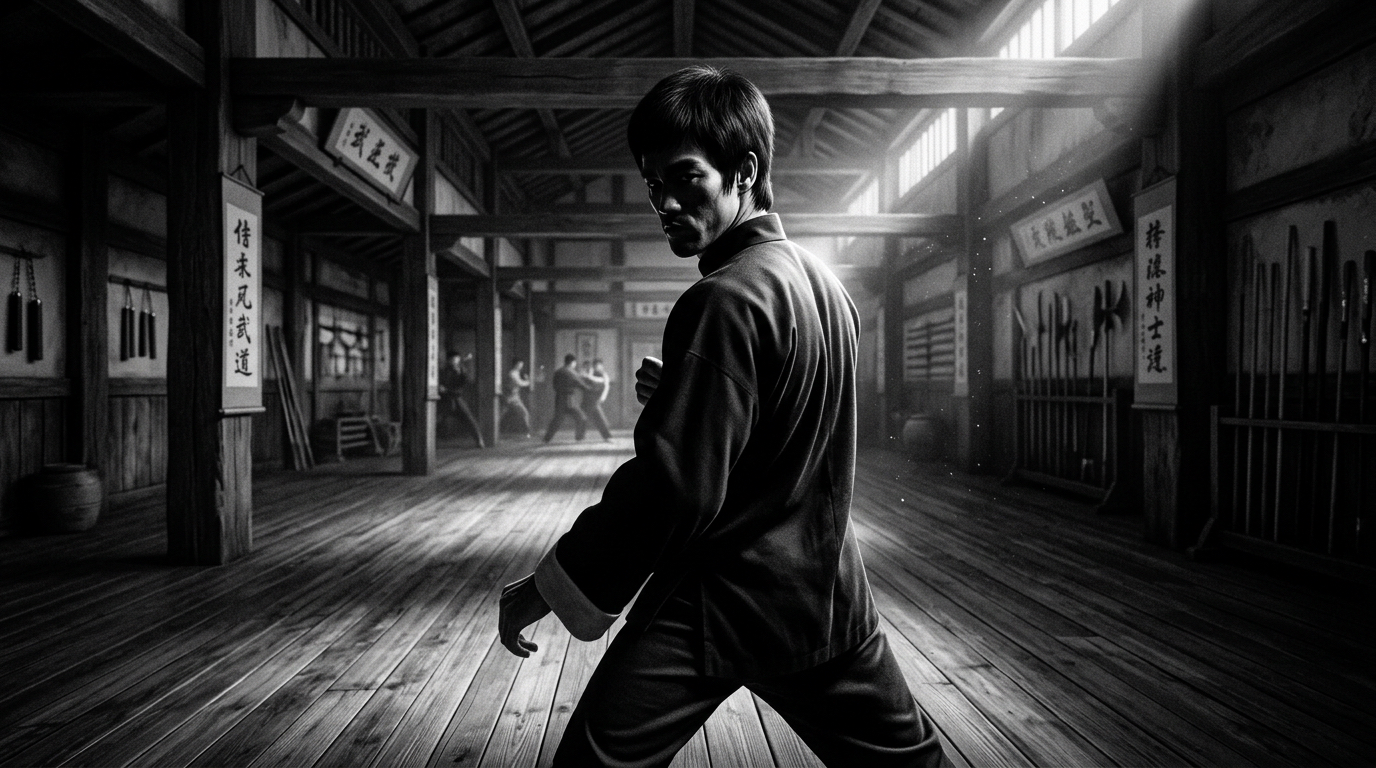
The image of Bruce Lee, frozen in a war cry, his body tense, became an icon present on every continent. But that image, however powerful, is only the surface. To understand the dragon, it is not enough to admire its flight: it is necessary to descend into the cave where it was born, explore the fires that tempered it, and follow the path that took it from the streets of Hong Kong to the top of the world, and beyond.
Chapter 2: November 27, 1940: The Dragon’s Child is Born in San Francisco
Lee Jun-fan was born on November 27, 1940 at the Chinese Hospital on Jackson Street in San Francisco’s Chinatown. His father, Lee Hoi-chuen, was a Cantonese opera singer of considerable renown in Hong Kong, who was touring the United States at the time of the birth. His mother, Grace Ho, came from a middle-class family in Hong Kong and had Eurasian ancestry, a European heritage that would shape her son’s life in ways no one could have anticipated that day. According to the Chinese lunar calendar, the child was born in the hour and year of the Dragon. It was a nurse at the hospital who gave him the English name the world would come to remember: Bruce. His parents named him Lee Jun-fan, a Cantonese expression meaning “to return again,” as if the name itself carried the prophecy of a man destined to cross oceans.
His birth on American soil was a twist of fate, a direct consequence of his father’s tour. But this geographical accident granted him American citizenship, which he would use decades later as a strategic lever when negotiating contracts and visas between two worlds that never quite decided whether he belonged to them. In April 1941, the family returned to Hong Kong and settled in an apartment at 218 Nathan Road, in the heart of the Kowloon district. Eight months later, in December of that same year, Japan launched its attack on the British colony. Hong Kong fell in less than eighteen days. Bruce Lee spent his early years in a militarily occupied territory.
Biographies that romanticized his childhood tended to omit this context. The Japanese occupation of Hong Kong lasted from December 1941 to August 1945. During that period, the city was subjected to severe rationing, forced labor, and the systematic humiliation of the local population. The population plummeted from 1,600,000 pre-war to fewer than 600,000 by the end of the occupation, a result of forced deportations, starvation, and executions. The Lee family, thanks to Lee Hoi-chuen’s connections in the local entertainment industry, avoided the worst. But Bruce grew up breathing the air of a fractured city: he saw foreign soldiers in the streets, food shortages as the norm, and the silent resignation of a subjugated population. His mother’s Eurasian heritage made them uncomfortable in an increasingly polarized society, where “different” rarely meant protected.
When the occupation ended in August 1945, Hong Kong began to rebuild. The uncertainty of those years left a generational mark. In Bruce’s case, that mark took the form that his teachers, friends, and eventually his doctors would notice throughout his life: an obsession with controlling every variable of his immediate reality. His body. His mind. His skill. The external chaos of those early years seemed to have become an existential project: the construction of an internal order that no one could take from him.
Hong Kong grew from 600,000 inhabitants at the end of the war to over 2,000,000 by the early 1950s, absorbing the massive influx of refugees fleeing the Chinese Civil War and, from 1949 onward, the People’s Republic of China under Mao Zedong. This exodus created a unique environment: a British colony on Chinese territory, teeming with exiles who carried with them different languages, incompatible political loyalties, and memories of a China that no longer existed. It was a place where identity was always provisional, always negotiated, always at risk of being challenged by the next arrival. Bruce Lee grew up in this environment, and this experience of identity as something to be defended—not something to be received—shaped his thinking in ways that emerge in every interview, every piece of writing, and every decision of his career.
From a very young age, Bruce was drawn into the world of entertainment. Lee Hoi-chuen was a well-known figure in Hong Kong’s Cantonese film circuit, and his son appeared in over twenty film productions as a child actor, beginning with a baby role in *Golden Gate Girl* (1941). Throughout his childhood and adolescence, he frequently played orphans, juvenile delinquents, and troubled children; among his most recognized works from this period is *The Kid* (1950). This early exposure to cameras instilled in him an intuitive understanding of framing, lighting, and acting that would prove fundamental decades later in building a career in action films.
Outside of the studios, life on the streets of Kowloon during the 1950s was harsh. The city was saturated with social tensions generated by overcrowding and competition between communities of different backgrounds. Young people organized themselves into gangs based on their neighborhood, their language, their social class. Bruce, energetic and quick-tempered, soon responded to this environment in the way that came most naturally to him: with his body. He led his own gang, the “Junction Street Eight Tigers,” and street fights became a constant feature of his adolescence. “I was a punk and I looked for fights,” he would admit years later. It wasn’t just a matter of survival; it was a way of asserting an identity in an environment where identity was always a contested issue.
It was this need to defend himself more effectively that led him, in 1954, to the doorstep of Yip Man, the Wing Chun master who would change the course of his life. Yip Man, then around sixty years old, was initially reluctant to accept him: the unwritten rules of traditional Chinese martial arts discouraged teaching someone of non-entirely Chinese descent, and Bruce’s mother was Eurasian. The young man’s persistence and the evidence of his talent convinced the master. What Bruce found in Wing Chun was not just a fighting system; he found a structured philosophy. The style’s emphasis on economy of movement, the body’s central line as the axis of attack and defense, the simultaneity of offensive and defensive gestures, and the principle of using the opponent’s force against them resonated with something Bruce was beginning to articulate in a still imprecise way: that effectiveness in combat does not depend on brute force but on understanding the principles that govern movement.
Ip Man would remark decades later that Bruce was his most dedicated student and, simultaneously, the least obedient. He practiced more than his peers, questioned more, and innovated where others memorized. He didn’t treat Wing Chun as a set of forms to be executed but as a set of principles to be understood so that later, when that understanding was sufficient, one could transcend it. The master allowed this unconventional approach, perhaps because he recognized something he had rarely seen: a student who didn’t want to appropriate another’s art, but rather find his own.
At the same time, Bruce’s inexhaustible energy found another unexpected channel of expression: dance. He became an accomplished cha-cha dancer and won the Hong Kong Championship in 1958. A skill that seems trivial compared to the rest of his career, but which provided him with something of concrete technical value: an exceptional sense of rhythm, dynamic balance in motion, and footwork that would later become one of the hallmarks of his fighting system. Great fighters don’t just know how to strike; They know how to move between punches. Bruce learned that on the dance floors of Hong Kong.
The street fights continued and grew increasingly serious. After a particularly vicious altercation in 1959 that resulted in a run-in with the local police, the family made a decision without much input from Bruce: just eighteen years old and with a hundred dollars in his pocket, he was sent back to his hometown of San Francisco. The stated goal was to remove him from bad influences and offer him a more stable future. What no one could have imagined was that this trip wasn’t a punishment, but rather a true beginning.
Chapter 3: 1959-1964: Seattle, Philosophy, and the Forging of a Unique Art
The journey across the Pacific was more than just a geographical displacement. Bruce Lee arrived in San Francisco, but his final destination was Seattle, Washington, where old friends of his father awaited him. Behind him lay the neon lights of Kowloon; ahead, the perpetually gray skies of the Pacific Northwest and the opportunity to reinvent himself without the burden of a reputation that preceded him. Anonymity was, for the first time in his life, an advantage.
The transition was difficult. He worked at the restaurant of Ruby Chow, a well-known figure in Seattle’s Cantonese community, in exchange for room and board. He went from being a renowned child star in Hong Kong and a feared street fighter in Kowloon to washing dishes and waiting tables in a provincial city in the American Northwest. He completed his secondary education at Edison Technical School in Seattle and in 1961 enrolled at the University of Washington, where he chose philosophy as his major. The choice was neither accidental nor improvised: Bruce wasn’t just looking to train his body; he was looking for a conceptual framework for what his body already knew how to do intuitively but what his mind hadn’t yet been able to articulate precisely.
He immersed himself in readings that most of his contemporaries in martial arts circles wouldn’t have considered relevant to a combat practitioner. Plato, Spinoza, and Descartes on the Western side; Laozi, the teachings of Chan Buddhism, and the writings of Krishnamurti on the Eastern side. He sought answers to questions that no martial art style he had encountered directly addressed: what is being, how does perception function in combat, what is the relationship between observer and observed, what remains when all layers of cultural conditioning are stripped away and one arrives at the direct experience of the moment. His notebooks from those years were filled with reflections, diagrams, and aphorisms where Western and Eastern philosophy mingled with technical observations on biomechanics, angles of attack, and movement theory.
Alongside his academic studies, Bruce began teaching. The first classes were informal: gatherings in parks, basements of shops in the Chinese community, and garages of private homes. He named his school the “Jun Fan Gung Fu Institute,” using his Chinese name as a personal brand. Unlike traditional masters who kept Gung Fu knowledge to initiates within the Chinese community, Bruce was willing to teach anyone who showed genuine interest, regardless of race or background. This openness drew immediate criticism from the more conservative segments of the Chinese martial arts community on the West Coast, who believed that the secrets of Gung Fu should not be shared with Westerners. Bruce ignored these criticisms and persevered.
Among his first students was Taky Kimura, a Japanese-American who would become his closest friend in Seattle and the one responsible for keeping the first school alive after Bruce left. Kimura recounted in later interviews that Bruce’s classes were simultaneously brutal and precise: he demonstrated techniques at real combat speed and expected the students to process what they had just seen. Many quit after one or two sessions because the level of demand exceeded their expectations. Those who persevered discovered a system radically different from anything available in the West at that time: not memorization of predetermined forms but an understanding of principles that each individual had to adapt to their own physical and psychological characteristics.
It was during this period that Bruce first articulated the principles that would eventually take the form of Jeet Kune Do, although the formal name wouldn’t appear until some years later. “There are no styles,” he would repeat to his students. “There are only principles.” This statement challenged the very structure of Western martial arts training, which assumed that a style like karate, judo, or kung fu was a closed and complete whole that had to be absorbed in its entirety. Bruce argued that this assumption was fundamentally flawed and practically wrong: the principles are universal; styles are merely different containers for the same principles, and the rigidity of the container is the primary enemy of effectiveness in the chaos of real combat.
In 1961, an event occurred that would change the course of his life. Bruce met Linda Emery, a sixteen-year-old student of Swedish and English descent who enrolled in one of his martial arts classes. In Seattle in 1961, a romantic relationship between a nineteen-year-old Chinese-American and a middle-class white girl was not socially acceptable. Linda’s mother objected. Friends discouraged her. But Linda and Bruce shared an intellectual connection that transcended those boundaries: she was intelligent, curious, and able to keep up with him in philosophical conversations that lasted until the early hours of the morning. She became his primary interlocutor, his keeper of ideas, the person who would transcribe and organize his notebooks. On August 2, 1964, they married in a ceremony that Linda’s mother did not attend. Their unwavering support during the years that followed, including the most economically challenging ones, was the anchor without which the rest of the story would not have been possible.
In 1964, Bruce opened a second Jun Fan Gung Fu Institute in Oakland, California, in collaboration with James Yimm Lee, a respected martial artist from the Bay Area. It was here that Bruce’s philosophy of open teaching faced its most direct challenge. The traditional San Francisco Gung Fu community, led by Wong Jack Man, a master of Xing Yi Quan and Northern Shaolin, decided to formally confront him. The accusation was twofold: he was teaching non-Chinese people and publicly questioning the usefulness of classical styles. The confrontation took the form of a closed-door sparring match. The various biographical sources present divergent versions of the details, but the central outcome is consistent in most: Bruce won convincingly, although the match was longer and more physically demanding than he had anticipated. That result was the final catalyst for a transformation that had been brewing for months: if classical forms did not guarantee a quick and efficient victory, then everything had to be dismantled and rebuilt from scratch. Efficiency became his central obsession.
That same year, Bruce was invited to the Long Beach International Karate Championship. His demonstration left a lasting impression. He performed push-ups balanced on two fingers of one hand and executed his “one-inch punch”: the technique that generated explosive force at minimal distance, sending a volunteer flying backward until they knocked over the chair positioned to cushion the impact. The demonstration was empirical evidence that strength depends not on the distance of the throw but on perfect coordination between muscle mass, weight transfer, and the precise moment of maximum contraction. Among the audience was Jay Sebring, Hollywood celebrity hairstylist, who was so impressed that he told television producer William Dozier about Bruce. Dozier obtained a recording of the demonstration and invited Bruce for an audition. The result would change the history of action cinema two years later.
Chapter 4: 1966-1971: Hollywood, the Closed Door, and the Invisible Formative Years
In 1966, Bruce Lee landed the role of Kato in the television series The Green Hornet. He was a supporting character: the silent assistant to the white protagonist. In the Hollywood hierarchy of that era, this was all that was offered to an ambitious Asian actor. Kato had no narrative arc of his own, no significant lines of dialogue; he existed to support the white star. Bruce knew this. He accepted it because it was the only door that opened, and because he understood that a small door, if you know how to use it, can be the beginning of a broader path.
What happened after the premiere in September 1966 was not what the producers had anticipated. Viewers realized that the real draw of the series wasn’t the Green Hornet, but Kato. Bruce’s economy of movement, his ability to communicate with his body what others communicate with words, and the authenticity of his fight sequences made the narrative accelerate whenever he entered the scene. The series’ cinematographers documented that they had to film the fight sequences at a higher frame rate than usual because, in standard projection, Bruce’s movements were imperceptible. The producers received an unusual volume of correspondence from viewers specifically asking about Kato.
In Hong Kong, where the series was distributed later, the effect was different and more profound. Viewers saw one of their own transformed into an American television icon: not as a servant, not as a villain, but as the character the public wanted to see. It was the first time many of them had seen that. They recognized him as a symbol of something that didn’t yet have a name.
The Green Hornet was canceled after a single season of twenty-six episodes. Hollywood, though formally impressed, still couldn’t find the right role for Bruce. The parts he was offered next were either supporting or stereotypical, and he consistently rejected them, with concrete financial consequences for his family. To make ends meet—his son Brandon was born in 1965, his daughter Shannon in 1969—he gave private Jeet Kune Do lessons to members of Hollywood’s elite. Steve McQueen, James Coburn, and screenwriter Stirling Silliphant paid fees that most instructors in the country couldn’t have imagined. Coburn would later declare that the lessons with Bruce were the most significant intellectual and physical experience of his career. The sessions with Silliphant were particularly productive: the screenwriter recognized Bruce as a first-rate thinker and facilitated connections that would help open doors.
During those years of apparent external stagnation, Bruce never stopped developing his art. He deconstructed and reconstructed everything he had learned since childhood. Jeet Kune Do absorbed the footwork of Western boxing, the high kicks of French savate, the distance principles of fencing, the fluidity of Wing Chun, and elements of wrestling and pencak silat. His library grew with books on biomechanics, the psychology of movement, exercise physiology, and film theory. His notebooks from that time would form the core of *Tao of Jeet Kune Do*, published posthumously in 1975, which revealed a thinker who combined the physics of movement with the Eastern philosophy of emptiness and non-action.
A brief appearance in the film *Marlowe* (1969), where his character methodically destroyed an office with a sequence of kicks and punches before leaving the set, was a glimpse of what cinema could do with him if given the chance. That chance didn’t come. Hollywood still hadn’t found a suitable role for an Asian protagonist who wasn’t merely decorative. The mounting frustration and the certainty that his potential was being wasted led Bruce to make the decision that would change the course of film history: to return to Hong Kong, where he hoped to finally have creative control to show the world what he had been building for years. The decision meant acknowledging that America wasn’t ready for him as a leading man, moving his family to a city his children barely knew, and betting on a film industry that operated under entirely different rules than Hollywood. It was a calculated gamble by a man who had learned to trust his own judgment.
Chapter 5: 1971: The Return to Hong Kong and the Record-Time Conquest of Asia
In 1971, Bruce Lee landed in Hong Kong with Linda and their two young children, Brandon and Shannon. It wasn’t a defeat; it was a strategic regrouping dictated by clarity of purpose. If America wasn’t ready for him as a leading man, he would create his own cinematic universe in Asia, where he would call the shots.
The Hong Kong film industry he encountered was a field in transformation. The Shaw brothers had dominated the market since the 1950s with a mass-production model: kung fu films manufactured on tight budgets and three-week shooting schedules. The model had been profitable for two decades, but audiences were showing signs of saturation. A competitor had recently emerged: Golden Harvest, founded by producer Raymond Chow after his departure from the Shaws. Chow immediately recognized in Bruce Lee the catalyst his studio needed. He offered her what Hollywood had denied her for years: a two-movie contract as the absolute star and the promise of greater creative control.
The first of these films was *The Big Boss* (1971), shot in rural Thailand on a modest budget and under difficult technical conditions. The plot was seemingly conventional: a Chinese migrant worker becomes entangled in organized crime at an ice factory and must confront a corrupt boss who runs a drug trafficking network. What was unconventional was the way Bruce Lee filled the screen. His movements were raw, direct, and brutally realistic compared to the stylized and ornate kung fu of Shaw Brothers films, where fights resembled carefully choreographed dances. Every punch, every scream, every combination of techniques conveyed an intensity unprecedented in that industry. The damage seemed real.
The premiere of *The Big Boss* in Hong Kong in October 1971 was a seismic event. Cinemas reported queues that snaked around blocks hours before each screening; police were called in several times to control the crowds. The film shattered all existing box office records in the history of the Hong Kong film industry. The man who had been an unknown supporting actor in America was now the undisputed king in his own land.
Golden Harvest accelerated production of the second film before the effects of the first release had even faded. Fist of Fury premiered in March 1972. The story placed Bruce Lee in the role of Chen Zhen, a martial arts student seeking revenge for his master’s death in early 20th-century Shanghai under Japanese occupation. The film struck a chord of national pride with a sensitivity its creators may not have fully anticipated. The sequence in which Bruce’s character smashes a sign prohibiting “dogs and Chinese” from entering a park leased to foreign colonizers became an image that circulated in the collective consciousness of the Chinese diaspora as a symbol of resistance and dignity. Newspapers in Hong Kong and Southeast Asia featured it on their front pages. The film incorporated the use of nunchucks as an emblematic weapon, which would become Bruce Lee’s iconic symbol in global popular memory. The box office result even surpassed that of *The Big Boss*. In less than a year, Bruce Lee had achieved in Asia what he couldn’t in a decade in the United States.
Chapter 6: 1972: The Colosseum in Rome, Total Control, and the Unfinished Project
With two historic hits under his belt, Bruce Lee founded his own production company, Concord Production Inc., in partnership with Raymond Chow. The artistic freedom he had been seeking throughout his career was now his on paper. His first project under this new structure was The Way of the Dragon (1972): he wrote it, directed it, choreographed every fight sequence, and starred in it. It was, in every material sense of the term, his filmed manifesto.
He moved the action from Hong Kong to Rome, placing his character—Tang Lung, a young martial artist sent from Hong Kong to protect a relative’s restaurant threatened by the Italian mafia—in the context of a fish out of water who nevertheless proves more competent than all those who underestimate him. The narrative choice was also autobiographical: the portrait of a man who arrives in a foreign territory where everyone assumes he does not belong, and who demonstrates through his actions that the territory and who occupies it are not the same as the competition.
For the final showdown, he needed a believable antagonist. He flew to Los Angeles and hired Chuck Norris, then a world karate champion with an impressive competitive record. The fight between the two was filmed in the Colosseum in Rome. The sequence lasted over ten minutes without any major cuts. Before the showdown, the two warriors warm up and stretch on opposite sides of the arena, displaying a mutual respect that the narrative would later transform into a fight to the death. The clash of styles—Norris’s angular, explosive karate versus Bruce’s fluid, unpredictable JKD—was filmed in such a way that the viewer could read each fighter’s tactical decisions. Action directors in the following decades would study that sequence as a reference text on how to film a fight that conveys more than just “this one wins and this one loses.” When *The Way of the Dragon* was released, it outperformed its two predecessors at the box office.
With his confidence at its peak, he began the most ambitious and philosophical project of his career: Game of Death. The premise was a direct allegory of JKD: his character had to ascend a five-story pagoda, facing a master of a different fighting system on each level. The narrative objective was to demonstrate through combat that rigid styles are traps and that adaptation is the only skill without limits.
For the project, he filmed over one hundred minutes of footage, including sequences against Eskrima master Dan Inosanto and basketball player Kareem Abdul-Jabbar, who stood 7 feet 2 inches tall and presented an unprecedented challenge in terms of body geometry. The sequences filmed against Abdul-Jabbar are, for scholars of his work, the clearest documentation of JKD in action: Bruce adapting his system in real time to an opponent whose physical characteristics rendered most of his usual techniques ineffective. He conceived of Game of Death as the definitive cinematic testament to his philosophy. Fate did not allow him to complete it: before the project progressed further, an offer arrived from Warner Bros. that he could not refuse. He decisively put Game of Death on hold and embarked on Enter the Dragon.
Chapter 7: 1973: Enter the Dragon — Dragon Island and the Flight to Worldwide Fame
In late 1972, Warner Bros. came up with an unprecedented proposal. The studio had observed Bruce Lee’s Asian box office figures and recognized what the market was telling them: there was a global demand for martial arts films that no Western studio had been able to capitalize on. The proposal was a co-production with Golden Harvest: Bruce Lee as the star of a substantial-budget film, directed by a Hollywood filmmaker, with guaranteed distribution in Western markets. It was the opportunity he had been waiting for since arriving in Seattle with one hundred dollars.
The chosen director was Robert Clouse. The budget was approximately $850,000, modest by Hollywood standards but enormous in the context of Hong Kong cinema. The plot was a variation on the spy genre: a martial artist recruited by intelligence services to infiltrate a tournament held on the island fortress of the villain Han, with the aim of dismantling a trafficking network. The premise was the vehicle; the real content was the opportunity to showcase Bruce Lee on the biggest stage of his career, surrounded by an international cast that included John Saxon and Jim Kelly.
The production was complicated from day one. Language barriers between the Chinese and American teams caused daily friction. The script was rewritten as filming progressed. Bruce, a perfectionist in everything that involved authentically portraying his art, frequently clashed with the director and screenwriters to ensure that the fight sequences didn’t become mere empty spectacle. He became the de facto choreographer of each fight, designing sequences of such complexity and visual precision that they left the American crew bewildered.
The film culminated in the hall of mirrors scene, an idea conceived by Bruce himself. The character must fight in a room where mirrors multiply the image of his opponent until it becomes impossible to distinguish what is real from what is a reflection. The instruction he receives before entering—”destroy the image and you will find the man”—is the most direct formulation of his philosophical thought: in combat, as in life, illusion is the main adversary.
On July 10, 1973, Bruce Lee completed his final shots of Enter the Dragon. Those present reported that he seemed satisfied, though exhausted. The most ambitious project of his career was finished. Final editing, sound work, and the worldwide release that would definitively change his place on the map of global cinema awaited him. Ten days later, he was dead.
Chapter 8: The Signals His Body Sent: The Months Leading Up to July 1973
To understand Bruce Lee’s death, it’s necessary to examine the months leading up to it, because those months reveal a series of factors that none of those around him—including himself—wanted to recognize for what they were.
In May 1973, during a dialogue dubbing session at a studio in Hong Kong, Bruce collapsed. He suffered seizures and lost consciousness. He was rushed to Hong Kong Baptist Hospital, where doctors diagnosed him with cerebral edema: an accumulation of fluid around the brain that created dangerous pressure on the neurological tissue. The diagnosis was serious, but he responded to treatment. After several days in the hospital and undergoing a battery of tests—including a specialized evaluation in Los Angeles—he was discharged with instructions for complete rest and a drastic reduction in his pace of life. According to accounts from close friends at the time, Bruce thanked them for the advice and continued exactly as before. “This isn’t how Bruce Lee would die,” he told a close friend in the weeks that followed.
The life Bruce had built over the preceding years was, from any reasonable medical perspective, unsustainable. His training regimen during that period could include, in a single day: one hour of intense cardiovascular work, one hour of strength training with weights, one hour of martial arts technique practice at combat speed, thirty minutes of specific speed and reaction time work, and an additional session of free sparring. It was a minimum, not a maximum.
Her diet was equally extreme in its austerity. She ate primarily lean protein, vegetables, and brown rice, deliberately avoiding all processed foods. She believed in intense hydration as a form of physical purification, drinking quantities of water that modern physicians would identify as potentially problematic. Subsequent studies of her case have suggested the possibility of chronic hyponatremia: a dangerous dilution of the sodium level in the blood caused by excessive water consumption without corresponding electrolyte replacement, which can lead to brain swelling. This hypothesis would explain both the May and July episodes, although it was not identified during her lifetime.
Toward the end of his life, his weight had dropped from his usual 63 kilograms to about 58, with such a low percentage of body fat that his ribs were visible. Those around him noticed something different about him, though they found it difficult to articulate: thinner than ever, more tense, with an urgency in his movements that wasn’t just energy but, to those who knew him well, something akin to fragility. Dan Inosanto, one of his closest disciples, commented in later interviews that in the last months of Bruce’s life, something had been troubling him, though he couldn’t quite put his finger on it. When he suggested Bruce rest, Bruce would reply that he was in the best shape of his life. And perhaps in some ways he was. But other parameters, those the doctors had pointed out in May, weren’t improving with training.
Chapter 9: July 20, 1973: The Dragon Did Not Awaken
The day of Bruce Lee’s death began as an extraordinarily busy one. He met with film producers to discuss future projects and visited Raymond Chow’s office to review details of Enter the Dragon and new developments in development. Sometime that afternoon, he went to the apartment of Betty Ting Pei, a Taiwanese actress and singer involved in the production of several Golden Harvest films. Available records confirm the basic facts of what transpired there. The contextual details of that afternoon remain, half a century later, partially opaque.
Around 7:00 p.m., Bruce complained of a severe headache. He lay down in the bedroom. Betty Ting Pei offered him a painkiller; According to the most documented medical reports, it was Equagesic, a combination of acetylsalicylic acid and meprobamate available without a prescription in Hong Kong at the time. Bruce took the drug and fell asleep.
Hours later, Betty was unable to wake him. She called a doctor friend. The doctor arrived, assessed the situation, and indicated that Bruce’s condition was critical, and called an ambulance. Paramedics arrived around 11:00 p.m. Bruce Lee was taken to Hong Kong Baptist Hospital, the same hospital where he had been treated in May. He was pronounced dead at 11:30 p.m. He was 32 years old.
The autopsy, performed the following day, determined that the cause of death was acute cerebral edema, the same diagnosis as the May episode, this time with irreversible consequences. The official verdict was “death by misfortune.” The hypothesis most supported by doctors at the time was a hypersensitive reaction to a component of the painkiller, possibly meprobamate, which in a person with a documented predisposition to cerebral edema could have triggered a second, this time fatal, episode. Other factors were not ruled out: the extreme stress accumulated during weeks of production without real rest, the chronic dehydration-rehydration that compromised the electrolyte balance, the physical exhaustion since the May episode.
The sudden and mysterious death of a man who seemed the very embodiment of physical vitality, at the peak of his career and on the cusp of global fame, gave rise to decades of public speculation: Hong Kong mafia plots, revenge by rival martial arts masters, versions of the “dragon’s curse.” The most extreme theories lack documentary support. The official explanation, while never entirely satisfactory to those who wanted a more dramatic narrative, is the most consistent with the available evidence: Bruce Lee died as a result of the interaction between a pre-existing and revealed neurological condition, a lifestyle that ignored medical warnings, and a single triggering factor that under other circumstances would not have been fatal.
On July 26, 1973, Bruce Lee was buried in Seattle’s Lake View Cemetery, the city where he had found his intellectual path and where he had met Linda. Joining the family were Steve McQueen, James Coburn, Chuck Norris, and other friends who had witnessed different moments in his life. Six weeks later, on August 25, 1973, Enter the Dragon premiered in US theaters. Bruce wasn’t there to see the public’s reaction to the film that, in his own estimation, would be the definitive turning point of his career.
Chapter 10: Jeet Kune Do: The Art of Having No Art
Jeet Kune Do is not a martial arts style. This seemingly paradoxical statement is the necessary starting point for understanding why Bruce Lee’s philosophy had such a profound impact on global martial arts in the following century.
Traditional martial arts, Bruce argued, had evolved into rituals divorced from their original purpose: effectiveness in real combat against an actively resisting opponent. A practitioner could spend years perfecting the execution of kata forms and remain completely defenseless against someone who attacked without adhering to the patterns of the style the practitioner knew. The styles had turned fighting into dance and called it martial art. Bruce didn’t reject the artistic dimension of movement, but he insisted that an art that didn’t work in the chaos of real combat had lost its raison d’être and needed to be honest about it.
Jeet Kune Do (JKD) addressed this problem with principles that Bruce Lee progressively articulated throughout his notebooks, classes, and interviews. The first was economy of movement: every movement must have a purpose, and any movement without one should be eliminated. The second was the absence of predetermined forms: the practitioner does not reproduce an external model but develops their own responses based on universal principles. The third was interception—the very name of the system: the most effective technique is not the one that blocks the opponent’s strike once it has begun, but the one that interrupts it at the moment the movement starts. The fourth was individual adaptation: JKD is not a closed system imposed on the student’s body, but a set of principles that each person must adapt to their own physical and psychological characteristics.
“Be like water, my friend” is the phrase the world remembers. Water has no inherent shape: it takes the shape of its container. It has no color: it reflects its surroundings. It has no power at rest: but when accumulated and directed, it can pierce rock. The Jeet Kune Do practitioner must possess this capacity: without a predetermined form, adaptable to any situation, able to flow around obstacles or strike with concentrated force as the moment demands.
Bruce absorbed techniques from more than twenty different disciplines: the footwork of Western boxing, the high kicks of French savate, the distance principles of fencing, the fluidity of Wing Chun, elements of American wrestling, Indonesian pencak silat, and Filipino Eskrima. He was loyal to no particular tradition; he was loyal to the principles of efficiency, economy, and personal authenticity. “Absorb what is useful, reject what is useless, add what is essentially yours”: the formulation that summarizes that methodology and that tens of millions of people who know nothing about martial arts have found useful for their own disciplines.
His writings, published posthumously in *Tao of Jeet Kune Do* (1975) and in several volumes of his personal notebooks edited by Linda Lee, revealed a thinker who combined the physics of movement with the psychology of combat, the biology of exercise, and Eastern philosophy. He quoted Confucius and Laozi, but also Western philosophers and modern scientists. His personal library, cataloged after his death, contained more than two thousand books in English and Chinese. He was a voracious reader who saw knowledge as a continuum without disciplinary boundaries and whose physical practice was inseparable from his intellectual pursuits.
The impact of Jeet Kune Do on global martial arts was profound and relatively gradual. In the 1970s and 80s, Bruce Lee’s direct disciples—Dan Inosanto, Taky Kimura, Ted Wong, among others—spread his principles. In the 1990s, the development of cage fighting and mixed martial arts as a professional sport formalized in regulated competition what Bruce had articulated as a philosophy: there is no single superior style, only principles that can be applied from multiple systems. Dana White, president of the UFC, publicly referred to Bruce Lee on several occasions as the conceptual father of MMA, a claim that elite coaches and athletes in the sport have consistently endorsed.
Conclusion: The Dragon’s Legacy: Cinema, Representation, and the Thought That Survives
On July 20, 1973, Bruce Lee was 32 years old. He had starred in four films, built his own fighting system that would challenge the structures of global martial arts for decades, and irreversibly changed the representation of Asian men in Western mass culture. All of this in just four years of an effective film career.
In cinema, the impact was immediate, both technical and political. Before Bruce Lee, action sequences in Hollywood films were slow, conventional choreographies designed for readability, not truth. Bruce Lee shattered that model with the evidence of his raw speed, so far beyond what film crews could capture that camera operators had to adjust their shooting speeds. He introduced a new grammar: the camera closer to the fight, faster cuts, an emphasis on the impact of each technique, and the musculature of movement visible and meaningful. And above all, he introduced the idea that a cinematic fight could say something about who the fighters are, not just which of the two is stronger.
Directors like Quentin Tarantino and the Wachowski siblings explicitly cited Bruce Lee as a fundamental reference. The “bullet time” of *The Matrix* was a cinematic response to the technical problem Bruce had posed decades earlier: how to depict on screen a speed that the human eye cannot follow in real time. Jackie Chan, Jet Li, Donnie Yen, and subsequent generations of Asian action stars built their international careers on the path Bruce forged. Without the precedent of *Enter the Dragon*, the Western reception of his films would have been very different.
The most important legacy, however, is not technical but political. Bruce Lee was the first Asian in the history of Hollywood cinema to occupy center stage not as a villain, not as a servant, not as a decorative exotic, but as the character the public wanted to see win. In a historical period when the civil rights movement in the United States was challenging systems of racial representation in mass culture, Bruce Lee made that challenge through the fait accompli: he was there, on screen, being the hero, and the public accepted him. After him, that possibility could no longer be denied.
The death of Brandon Lee in 1993 at the age of 28 on the set of *The Crow*, accidentally struck by a projectile lodged in the barrel of a prop gun, added a dimension of family tragedy to his legacy. Shannon Lee, Bruce’s daughter, dedicated years of her adult life to managing her father’s intellectual property and working against the distorted portrayals the entertainment industry continued to produce of him. In 2020, the unveiling of a Bruce Lee statue in Los Angeles was the formal recognition by a city that for years had ignored him as a potential star.
Bruce Lee’s figure also became a symbol of empowerment with a scope far broader than film or martial arts. His story resonates in communities very different from those he inhabited during his lifetime. His aphorisms circulate in contexts that have no relation to combat or film: in the philosophy of business leadership, in learning theory, in the psychology of athletic performance. Something in its formulation touches on a principle fundamental enough to survive the transfer to contexts radically different from the one that generated them.
What Bruce Lee left behind is not a technique or a style. Techniques become obsolete; styles ossify. He left behind a question that every human discipline must ask itself, and rarely does so honestly: what of what I do truly works, and what is inherited ritual that I mistake for knowledge? The answer to that question is uncomfortable in any field. Bruce Lee made it uncomfortable in his own, on screen, with his body, before the entire world. That is why the figure of the dragon remains ablaze more than fifty years after his death: not because it is unattainable, but because it points in the most unsettling direction. Inward.
Five Moments That Define the Legend
1964: The One-Inch Punch in Long Beach
At the Long Beach International Karate Championship in August 1964, Bruce Lee gave the demonstration that launched him into the spotlight of the American entertainment world. With his fist positioned one inch from a volunteer’s chest, he unleashed a burst of energy that sent the man reeling backward, knocking over the chair set up to cushion the impact. The demonstration was empirical evidence that strength depends not on the distance of the punch but on the perfect coordination between the musculature, the transfer of body weight, and the precise moment of maximum contraction—what in Chinese tradition is called fajin: the release of concentrated energy. It was the science behind the art in its most naked form. It was this moment that Jay Sebring described to producer William Dozier, triggering the chain of events that would bring Bruce to the American screen.
1971: The Ice Factory in The Big Boss
For most of The Big Boss, Bruce’s character holds back his fighting prowess because of a family promise. When that restraint breaks down and the promise is betrayed, the ice factory sequence produces something Hong Kong audiences in 1971 had never seen before: cinematic violence that feels physically real. Not the ornate, stylized kung fu of Shaw Brothers films, where fights resembled dances with dramatic lighting, but direct, raw movements with the weight and consequence of actual combat. Every punch seems to land; every fall seems to hurt. The impact of that sequence on the Hong Kong film industry was immediate and irreversible: it ushered in a new standard and set the tone for everything that would follow in Bruce Lee’s career.
1972: The duel in the Roman Colosseum in The Way of the Dragon
The final showdown between Bruce Wayne’s character and Chuck Norris’s character in the Roman Colosseum is arguably the most studied martial arts duel sequence in the history of action cinema. Ten minutes without major cuts, preceded by a setup in which the two contenders acknowledge each other as equals before the fight to the death begins. The clash of styles—Norris’s angular, linear-power karate versus Bruce Wayne’s fluid, interception-focused JKD—is filmed in such a way that the viewer can read each fighter’s tactical decisions in real time. Action directors in the following decades would study that sequence as a textbook example of how to construct a cinematic fight that is simultaneously believable and narratively significant.
1972-1973: The Original Footage of Game of Death
The original footage filmed for Game of Death before Bruce Lee paused the project to film Enter the Dragon is, for scholars of his work, the closest thing to a philosophical testament of his martial art. The sequences filmed against Dan Inosanto and Kareem Abdul-Jabbar show a martial artist adapting his system in real time to radically different adversaries: against Inosanto, the short weapons of Eskrima force him to maintain combat distances completely different from those of unarmed combat; against Abdul-Jabbar, the thirty-centimeter height difference invalidates most conventional angles of attack, forcing creative solutions derived from the principles of Jeet Kune Do. They are the practical demonstration of what Bruce preached in theory: that JKD is not a catalog of techniques but a methodology of continuous adaptation to the real conditions of combat.
1973: The Labyrinth of Mirrors in Enter the Dragon
The final sequence of Enter the Dragon, conceived by Bruce Lee himself, is the most direct cinematic synthesis of his thinking. The character must fight in a room where mirrors multiply the image of his adversary until it becomes impossible to distinguish which is real and which is a reflection. The instruction he receives before entering—”destroy the image and you will find the man”—is the most honest formulation of his philosophy: in combat, as in life, illusion is the main adversary. He who learns to distinguish between the projected image and concrete reality is the one who finds the opening. It was a metaphor for his entire life: the man who spent decades destroying images—the stereotype of the Asian actor without narrative agency, the rigidity of the inherited martial style—to find, beneath them all, something that could not be destroyed.
The Man Behind the Dragon: Linda, the Family, and the Contradictions of Genius
Biographies that focus solely on Bruce Lee’s public career miss the man. The man was more contradictory, more human, and more interesting than the legend.
Linda Lee Cadwell, who spent decades preserving and passing on Bruce’s legacy, described her husband in interviews over the years as someone who could be simultaneously devoted and distant, extraordinarily attentive and deeply absorbed in his obsessions. He was a present father when he was present: playing with Brandon and Shannon, incorporating them into his daily life, showing a genuine interest in their development. Brandon accompanied his father on visits to film sets from a very young age, and Bruce spoke in interviews with pride about his sons’ early signs of curiosity and character. But his career kept him physically away for months at a time in his later years, filming in Hong Kong while the family remained primarily in Los Angeles. The tensions of that separation, and the constant presence of other people from the entertainment world in her environment, generated frictions that Linda acknowledged bluntly in her memoirs.
According to those who knew him well, Bruce was deeply insecure about aspects of his life that his public persona didn’t reveal. The years of rejection from Hollywood had left their mark. The awareness that, even in success, racial barriers limited the types of roles available to an Asian actor in the West affected him deeply and surfaced in private conversations. Dan Inosanto recounted that Bruce could swing from euphoria to dejection in a single afternoon of training, that there was a streak of melancholy in him that physical discipline generally kept in check but that never completely disappeared.
He was also, according to the same accounts, absolutely convinced of his own exceptionality. This wasn’t an unfounded conviction—the empirical evidence of his physical ability and intelligence was irrefutable for those who observed him closely—but it generated friction and estrangement. Some martial arts masters who knew him in his early years in America described him as difficult to work with unless things were done his way. Those who chose to work with him achieved results that no other method could have produced. This tension between the genius that demands total control and the community that requires negotiation was a constant in his life.
Linda described in her writings that Bruce had a habit of reading aloud passages that impressed him, constantly asking questions, and expecting those around him to maintain the same level of intellectual intensity. It was stimulating for those who could keep up, and exhausting for those who couldn’t. He didn’t tolerate idle time well. Moments of genuine rest—no reading, no training, no discussion of ideas—were rare in his life. This inability to completely disconnect was, in retrospect, one of the forces that fueled both his extraordinary work and the exhaustion that contributed to his death.
In the final years of his life, as his success in Hong Kong made him Asia’s biggest star and negotiations with Hollywood began to take shape, Bruce faced a new kind of pressure: the pressure of massive fame. Witnesses from that time describe how in Hong Kong it was virtually impossible for him to go out in public without being recognized and approached. The crowds of admirers who gathered at his film premieres had gone from being an indication of his popularity to a phenomenon requiring police coordination. He responded to this attention with the same discipline he applied to everything else: with control over his public image, with an awareness of what each appearance communicated.
The question his closest friends asked themselves after his death was whether Bruce was, deep down, happy. The answer is probably more complex than a simple yes or no. He was someone who found in his work—in training, in studying, in filmmaking—a form of satisfaction that most people don’t experience with that intensity. But that same intensity came at a personal cost that he couldn’t or wouldn’t always pay except with more work. His philosophy of honest self-expression, which he applied with remarkable consistency to the physical and artistic realms, was less perfect in the realm of personal relationships. He was an extraordinary man who had the limitations of extraordinary men: the difficulty of being fully present in the life he is living when his mind is always in the life he is building.
The Cinematic Legacy: A New Grammar of Action
To fully understand Bruce Lee’s impact on cinema, it is necessary to place his work in the context of what came before him. Hollywood action films of the 1950s and 60s were a product of theater and Westerns: physical combat was choreographed to be legible from a distance, punches were telegraphic, falls were dramatic rather than physically convincing, and speed was deliberately sacrificed in favor of clarity. Audiences of that era had learned to read this conventional language and accepted it as a valid representation of real combat.
Bruce Lee arrived in that context with a speed and technical authenticity that conventional cinematic language was incapable of containing. The first camera operators who filmed him in *The Green Hornet* documented the problem: filmed at standard frame rate, Bruce’s movements were an imperceptible blur to the eye. The technical solution was to film at a higher frame rate, which, when projected at standard speed, produced a slight slow-motion effect that made the movements perceptible without losing the sense of speed. It was the first time that an action performer forced technical teams to adapt their methods to the actor’s capabilities, rather than the other way around.
In his Hong Kong films, Bruce also had control over the choreography and, in the case of *The Way of the Dragon*, over the complete direction. This allowed him to develop his own cinematic language for action: the camera moved closer to the fight, eliminating the safe distance of theater and creating the sensation that the viewer was in the same physical space as the fighters. The cuts were faster, following the rhythm of the exchanges rather than imposing an external narrative pace. The sound of the blows was emphasized to create visceral impact. And each fight sequence was constructed with an internal logic that reflected the principles of Jeet Kune Do: initiating the exchange, reading the opponent, adapting, and resolving the situation.
The impact of this language on filmmakers in the following decades was profound. John Woo, who developed the “bullet ballet” of Hong Kong action cinema in the 1980s, cited Bruce Lee as a key reference. The Wachowski siblings, in constructing the action sequences of *The Matrix*, combined Bruce’s language with Chinese martial arts and Japanese animation to create something new, but the starting point was recognizable. Quentin Tarantino, in *Kill Bill*, paid explicit and detailed homage to Bruce’s films, reframing the visual and narrative elements of *Game of Death* and *Fist of Fury* within a Western art-house cinema context.
The political impact of Bruce Lee’s work in film was equally lasting, though less visible in the short term. It took decades for the Hollywood industry to fully absorb the lesson that an Asian protagonist could carry a film to global success. In the 1980s and 1990s, Jackie Chan and Jet Li found paths to the Western market that acknowledged their debt to Bruce but also navigated more cautiously the same racial barriers he had directly confronted. In the 2000s and 2010s, actors like Donnie Yen, Tony Jaa, and Michelle Yeoh solidified an Asian presence in global action cinema that would have been impossible without Bruce’s earlier work. The process was slow, nonlinear, and frequently disappointing in its setbacks. But the direction was the one Bruce Lee had pointed out with his on-screen presence fifty years earlier.
The Obsession Without Limits: Body, Training, and the Price of Extreme Excellence
To truly understand Bruce Lee, it is essential to understand his relationship with his own body. Bruce didn’t simply train physically: he was obsessed with the total optimization of the human body as an instrument of expression and as a practical demonstration of a philosophy. This obsession led him to extraordinary physical developments and, ultimately, to crossing lines that his body could not withstand.
His exercise regimen was extraordinary even by modern standards for elite athletes. In the most intense years of his career, a typical training day included high-intensity cardiovascular work in the early morning, followed by a weight training session of up to an hour, followed by technical martial arts practice that combined individual forms with heavy bag work, partner work, and free sparring. In the afternoons, there was often a second session specifically dedicated to speed and reaction time work. Bruce measured and recorded his reaction times and the speed of his punches with an accuracy that would have been unusual in a competitive athlete, and which was virtually unprecedented in the martial arts world of the time.
He was one of the first martial artists to incorporate weight training into his regular practice, something traditional masters considered taboo because it supposedly made the practitioner slow and stiff. Bruce argued with empirical evidence that this assumption was wrong: muscular strength developed through resistance training, when properly integrated with technique and speed, multiplied the power of the strike without sacrificing the fluidity of movement. His training records from that time show an athlete who designed his physical program with the precision of an engineer: periodization, progression of loads, specific work for each muscle group, all documented and adjusted based on measurable results.
His diet was equally meticulous in its austerity. He ate primarily lean protein—chicken, fish—fresh vegetables, and brown rice, deliberately avoiding all processed foods, refined sugars, and anything he felt might compromise physical performance. He made his own protein shakes blended with fruits and vegetables whenever possible. This nutritional discipline was a deliberate component of his body optimization project: the physique he wanted to build required not only the right training stimulus but also the right fuel to respond to that stimulus.
The physical results of that regimen were visible and documented. In photographs taken throughout his life, the evolution of his physique shows a progressive transformation toward a muscular definition that his contemporaries in the martial arts world had no reference point for. It wasn’t the massive physique of bodybuilding, which Bruce rejected as incompatible with the speed and flexibility his system required. It was a physique in which every muscle group was visible, functional, and specifically trained for its role in combat movement. The doctors and physiologists who examined him during the evaluation in Los Angeles after his May 1973 collapse noted that he had the metabolic and musculoskeletal profile of an elite athlete in his prime.
But this very pursuit of total optimization had an aspect that, viewed from the outside, was clearly excessive. Bruce couldn’t accept the notion that there was a performance point beyond which further training produced not benefit but harm. For him, that point was always a psychological limit disguised as a physiological one, and psychological limits existed to be overcome. When doctors warned him in May 1973 that his lifestyle was dangerous for someone with the predisposition to cerebral edema that had just manifested, Bruce processed that warning as just another of the conventional limitations that his discipline could overcome.
His personal notes from the last years of his life reveal a man desperate to achieve something indefinable. “I am going to be the best version of myself I have ever been,” he wrote in an undated notebook that Linda Lee identified as being from that period. The phrase is revealing: not “the best possible version” but “the best version I have ever been,” implying a process of continuous self-improvement with no set endpoint. For someone who had already achieved what he had, this formulation points to a dynamic of internal striving that had no mechanism for satisfaction.
His philosophical writings also contained clues to this inner tension. He preached fluidity and adaptability, “being like water” that has no rigid form or useless resistance. But in his own life there was a fundamental rigidity: that of someone who could not accept that the human body, even the best trained, has physiological limits that are not psychological limits in disguise. The man who wrote about the importance of adapting to reality as it is found his limit in the most basic reality of all: biology.
The Death of a Son, the Weight of a Legacy, and the Enduring Memory
Bruce Lee’s story doesn’t end on July 20, 1973. It continues through the people who survived him, through the impact his work had on global culture, and through the tragedies and triumphs of his family in the decades that followed.
Linda Lee Cadwell, who was 27 when she was widowed, spent the years immediately following Bruce’s death organizing and preserving his intellectual and artistic legacy. She gathered, cataloged, and eventually published Bruce’s notebooks, technical diagrams, and philosophical writings, which might otherwise have been scattered or lost. The book Tao of Jeet Kune Do, published in 1975, was made possible by this preservation work. Linda also published her own memoir about life with Bruce, *Bruce Lee: The Man Only I Knew*, which offered a personal perspective that balanced the public mythologizing with the everyday reality of the man. She remarried in 1988 and continued to be involved in preserving Bruce’s legacy through the Bruce Lee Foundation.
Brandon Lee, the eldest son of Bruce and Linda, inevitably grew up in his father’s shadow. Comparisons were unavoidable, and Brandon had to navigate the weight of a legacy that was simultaneously a source of family pride and an identity burden. He followed in his father’s footsteps in the world of action films and developed his own career, which, despite often being viewed through the lens of the Lee name, displayed genuinely unique traits: a sense of humor his father lacked on screen, an inclination towards more psychologically complex roles, and a physique recognizably like his father’s but developed independently. His films Rapid Fire (1992) and The Crow (1993) showcased an actor finding his own voice.
Brandon’s death on March 31, 1993, at the age of 28, on the set of *The Crow* in Wilmington, North Carolina, was a tragedy that deeply impacted his family and the public. A projectile that had accidentally become lodged in the barrel of a prop gun was discharged during a filming sequence, striking Brandon in the abdomen. He died in the hospital hours later, without regaining consciousness. The film he was shooting at the time of his death was completed using stock footage and doubles, and was released in 1994—becoming a somber cinematic experience: the farewell film of an actor who would never see it released, a disturbing echo of his father’s story with *Enter the Dragon*. Linda Lee identified this parallel in later interviews as something she could not process without pain for years.
Shannon Lee, the youngest daughter of Bruce and Linda, was born in 1969 and was four years old when her father died. Her relationship to Bruce’s legacy was necessarily different from Brandon’s: more distant in terms of personal memory, but more deliberate in terms of intentional stewardship. In the 2000s, Shannon took control of the Bruce Lee Family Company and the Bruce Lee Foundation, actively working to ensure that her father’s portrayal in film, television, and popular culture was true to the complexity of the real man and not just the simplified legend. When Quentin Tarantino’s film *Once Upon a Time in Hollywood* (2019) depicted Bruce Lee in a way Shannon considered a disrespectful caricature, she voiced her disagreement publicly and articulately, pointing out the difference between homage and distortion. The ensuing controversy revealed how alive the debate remained about who has the right to tell Bruce Lee’s story and how.
Bruce Lee’s legacy in the five decades since his death has continued to expand in directions he could not have fully anticipated. His aphorisms and image are present on every continent, in radically different cultural contexts. In the 1990s, the development of mixed martial arts as a competitive sport formalized the philosophical principles he had articulated as theory into regulations. In the 2000s and 2010s, the growth of the Asian representation movement in Hollywood found in him a constant point of reference and argument. In the third decade of the 21st century, documentaries, books, and academic studies continue to revisit his life and work with new analytical tools, uncovering layers of meaning that earlier generations of biographers had not fully explored.
The dragon who flew farther in less than four years of active filmmaking than most artists fly in a lifetime remains, half a century later, a living reference point for disciplines and conversations he could never have imagined. Not because he is unattainable, but because he points in the most uncomfortable direction: inward, toward the question of what one truly does and what one does simply because one has always done it. That question has no expiration date.