Chapter 1: The Day Rock Found Its King
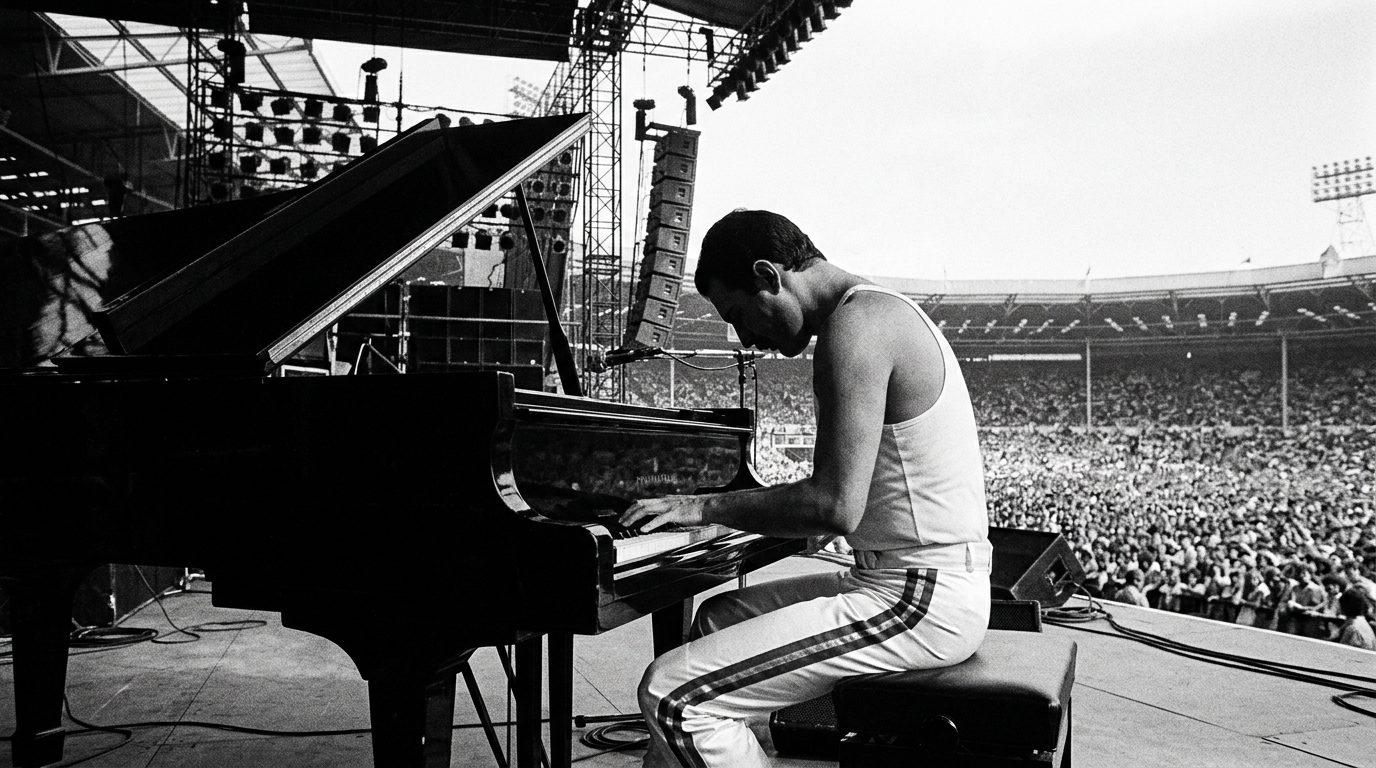
July 13, 1985. Wembley Stadium held seventy-two thousand people in a human wave of expectant faces. Nearly two billion more followed the event glued to their televisions in 130 countries, witnesses to something unprecedented: Live Aid. The air had been vibrating for hours with performances by legends, but the climax, the moment that would be seared into the collective memory of rock, was about to arrive. At 6:41 p.m. London time, a man with a mustache, dressed in simple white jeans and a tank top, trotted toward the stage. He wasn’t just a singer; he was a force of nature about to be unleashed. He was Freddie Mercury.
From the moment his fingers touched the piano to play a powerful, abridged version of “Bohemian Rhapsody,” it was clear this was no ordinary concert. It was a coronation. For 21 minutes, Freddie Mercury didn’t just sing: he commanded. He moved across the vast stage with a blend of feline grace and martial prowess, wielding the microphone and his foot like a scepter, like a conductor commanding one of the largest crowds rock had ever seen. The tension that had built up over hours was released in a unified roar when Freddie, with a simple gesture, transformed 72,000 strangers into a perfectly tuned choir. The “ay-oh” he unleashed wasn’t a question; it was a decree. And the stadium responded with thunderous devotion. That was, as it would later be known, “the note that was heard around the world.”
“Everyone realized that Queen was stealing the show,” recalled Paul Gambaccini, part of the BBC broadcast team. Even Elton John, a superstar in his own right, burst into Freddie’s dressing room after the performance to exclaim, “You bastards, you stole the show!”
In those twenty-one minutes, Freddie Mercury encapsulated his essence. He wasn’t just a rock vocalist with a vocal range that defied the laws of physics; he was a pioneer, a rebel with a cause, a showman who understood the stage as both a battlefield and a temple. He was a symbol of extravagance and excess in an era that celebrated them, but also a composer of exquisite sensitivity, capable of weaving heart-wrenching ballads and stadium anthems with equal mastery. His persona, both androgynous and virile, defied all conventions and paved the way for generations of artists who would dare to be different. He was a rock god who, paradoxically, felt more human and more vulnerable than anyone.
How did this man, born on a remote island off the east coast of Africa, become the undisputed monarch of rock? How did Farrokh Bulsara, a shy young Parsi self-conscious about his teeth, transform into the iconic Freddie Mercury, that whirlwind of charisma and pure talent? To understand the legend, to decipher the enigma behind the myth, we must return to the beginning: to a place and time far removed from the roar of Wembley.
Chapter 2: The Distant Echo of Zanzibar: Childhood, Exile, and the First Chords (1946–1969)
The story of Freddie Mercury doesn’t begin under the neon lights of London, but at the crossroads of cultures that was Stone Town, on the island of Zanzibar, on September 5, 1946. There, Farrokh Bulsara was born to Bomi and Jer Bulsara, members of the Parsi community, descendants of Persians who practiced Zoroastrianism and had settled in India. His father, a British government official, had moved the family to that exotic island off the east coast of Africa for his work at the High Court. In that vibrant environment, amidst the aroma of spices and the confluence of African, Arab, Indian, and European cultures, the early years of a seemingly quiet and reserved child unfolded. The family led a comfortable life, and young Farrokh, along with his younger sister Kashmira, born in 1952, grew up under the equatorial sun, unaware of the destiny that awaited him.
At the age of eight, his life took a dramatic turn. Following the tradition of the British colonial elite, his parents sent him to India for a prestigious education. He enrolled at St. Peter’s School, a British-style boarding school in Panchgani, near Bombay. It was a monumental change: from the warmth of family life in Zanzibar to the strict discipline of an institution thousands of miles away. However, it was there that the duality of his character began to take shape. Although he remained shy, he began to be known as “Freddie,” and his musical talent emerged with a naturalness that surprised everyone. By the age of seven, he was already taking piano lessons; at boarding school, he demonstrated an almost supernatural ability to reproduce on the keyboard what he heard on the radio.
“The only music he listened to and played was Western pop,” commented a former bandmate from his first group.
At twelve, he channeled that passion by forming his first band, The Hectics, a group of teenagers who covered their rock and roll idols. It was a school project, but for Freddie, it was his first taste of what it meant to be on stage. Alongside music, he developed a passion for philately, collecting stamps with a dedication that revealed his meticulous attention to detail, a trait he would later apply to his music. In 1963, after completing his early education, he returned to Zanzibar, but the reunion would be brief. A year later, in 1964, the Zanzibar Revolution erupted, a violent uprising that plunged the island into chaos. The Bulsara family, like many other residents of Indian origin, was forced to flee. They left everything behind and sought refuge in foggy, cold England.
The contrast couldn’t have been more stark. The family settled in a small house in Feltham, Middlesex, a suburb west of London. For a young man accustomed to the sunshine of Africa and India, the gray English landscape was a shock. Freddie, already 17, enrolled at Isleworth Polytechnic to study art. He was later accepted at Ealing Art College to study graphic design, an institution also attended by Pete Townshend of The Who and Ronnie Wood of The Rolling Stones. It was there that his artistic vision took shape, not only in music but also in aesthetics. Years later, he would design Queen’s iconic coat of arms, a complex heraldic piece combining the zodiac signs of the four band members. To make ends meet, Freddie took all sorts of jobs: selling secondhand clothes at Kensington Market alongside a young drummer named Roger Taylor, working as a baggage handler at Heathrow Airport. These were the days when Farrokh Bulsara was about to die so that Freddie Mercury could be born.
Chapter 3: The Rise of a Queen: The Birth of Glam and the Search for a Sound (1970-1973)
The end of the 1960s found Freddie Mercury a transformed man. The young Farrokh Bulsara graduated from Ealing Art College in 1969, but his true education had taken place in the streets, markets, and pubs of the British capital. He had absorbed the spirit of “Swinging London”: the fashion, the art, and above all, the music. His ambition, once a latent fire, now burned with a ferocious intensity. The opportunity came through his friendship with Tim Staffell, a fellow Ealing student and lead singer of a promising band called Smile. Freddie was captivated by the band’s sound, and particularly by the work of their guitarist, an astrophysics student named Brian May, whose instrument, the legendary “Red Special,” had been hand-built by him and his father, producing a unique, orchestral tone. Alongside the powerful drummer Roger Taylor, Smile had potential. According to Freddie, they lacked the direction and theatricality needed to succeed.
In 1970, Staffell, frustrated by the lack of success, decided to leave Smile to join another band. For May and Taylor, it seemed like the end of the road. For Freddie, it was the beginning. With a confidence bordering on arrogance, he offered himself not only as the new singer, but as the new visionary leader. “But you can’t sing,” Taylor retorted skeptically. Freddie’s response was to take charge and convince them that his voice, his charisma, and his ideas were exactly what they needed. He proposed a new name, one that broke with the modesty of “Smile”: Queen.
The choice was deliberately provocative and grandiose. “It’s very regal, obviously, and it sounds splendid,” Freddie would explain years later. “It’s a strong name, very universal and immediate. I was certainly aware of the gay connotations, but that was only one of its facets.” Along with the name, Freddie legally adopted the surname Mercury, in honor of the messenger of the gods in Roman mythology. Farrokh Bulsara had died; Freddie Mercury had been born.
The initial lineup was an unstable trio. They went through a succession of bass players for almost a year, unable to find someone who not only had the technical skill but also the right temperament to mesh with three such strong personalities. Finally, in February 1971, through a mutual friend, they met John Deacon. He was the polar opposite of Freddie: an electronics engineer from Leicester, quiet, reserved, and pragmatic. His hearing was unremarkable, but his solid technique and unflappable calm were the anchor the band needed. With Deacon on board, the classic Queen lineup was sealed.
The next two years were a period of intense development. By day, May, Taylor, and Deacon continued their studies and jobs, while Freddie sold secondhand clothes at Kensington Market alongside Roger Taylor. At night, they would lock themselves away to rehearse tirelessly, forging a sound that was an unprecedented amalgamation of hard rock, heavy metal, pop and glam, all seasoned with Freddie’s operatic sensibility.
“We were poor, but we didn’t care. We were convinced we were the best band in the world,” Brian May would recall of those early days.
Their big break came in an unconventional way. They gained access to the newly opened De Lane Lea Studios in Wembley to test the equipment in exchange for recording demos. It was there that producer Roy Thomas Baker and John Anthony of Trident Records first heard them. Impressed by their sound and Freddie’s voice, they offered them a management, recording, and publishing contract in 1972. The deal was predatory: Trident would provide them with equipment and studio time—generally at odd hours when other artists weren’t using it—but in return, the band would receive a minimum wage and a tiny fraction of the royalties. Desperate for an opportunity, they accepted.
The recording of their debut album, simply titled Queen, dragged on for almost a year under those precarious conditions. Finally, in July 1973, the album was released through a licensing agreement with EMI in the UK and Elektra Records in the US. From the roar of the Red Special on “Keep Yourself Alive” to the intricate vocal harmonies of “My Fairy King,” the record showcased a band with an already remarkably mature musical vision. Critics received it with interest, but commercial success eluded them. The single “Keep Yourself Alive” barely garnered any airplay on BBC Radio 1, a setback the band felt deeply. Nevertheless, the album laid the foundation for their sound and allowed them to embark on their first tour as support for Mott the Hoople, an experience that honed their stage presence and exposed their electrifying live performance to a wider audience.
Chapter 4: The Killer Queen’s Assault: Glam, Success, and the Conquest of the Charts (1974)
The year 1974 was a whirlwind for Queen: twelve months that saw them go from a promising rock band to becoming true superstars. Touring as support for Mott the Hoople in late 1973 had taught them a crucial lesson: to capture an audience, music alone wasn’t enough; you needed a show. Freddie absorbed this lesson like a sponge. He watched each night as Mott the Hoople’s charismatic Ian Hunter commanded the crowd, and his own stage presence began to evolve: bolder, more theatrical, more magnetic.
They returned to the studio in February 1974 to record their second album, Queen II, with a much clearer vision. The album was conceived as a concept album, divided into two thematic sides: the “White Side,” composed mainly by Brian May with more introspective and fantastical themes; and the “Black Side,” dominated by Freddie, which explored darker and more decadent territories. This duality reflected the creative dynamic at the heart of the band.
Technically, Queen II was a quantum leap. With producer Roy Thomas Baker, they pushed the recording technology of the time to its limits. Vocal harmonies became incredibly complex, with dozens of overdubbed tracks creating the effect of a massive choir—as can be heard on “March of the Black Queen.” May’s guitar was used to build multi-layered orchestral soundscapes that sounded like violins or trumpets. “The Fairy Feller’s Master-Stroke,” inspired by a painting by Victorian artist Richard Dadd, is a perfect example of this complexity: a tour de force of time signature changes, intricate arrangements, and dense, baroque lyrics. The single “Seven Seas of Rhye,” an energetic and catchy track that closed the album, became their first chart hit, reaching number 10 in the UK after the band performed it on the popular television show Top of the Pops.
Freddie’s image, dressed in a white satin suit designed by Zandra Rhodes and with his nails painted black, was a revelation to the British public and cemented their status as one of the leading bands of the glam rock scene. The success of Queen II led to their first headlining UK tour and, crucially, their first US tour as support for Mott the Hoople. However, fate had a test in store for them: midway through the tour, Brian May collapsed, diagnosed with hepatitis. The band had to cancel the remaining dates, a devastating blow just as they were about to conquer the world’s largest market.
During May’s convalescence, Freddie began working on a new song—a sophisticated and witty piece about a high-class prostitute. That song was “Killer Queen“. When May recovered, only to be diagnosed shortly afterward with a stomach ulcer, the band regrouped to record their third album, *Sheer Heart Attack*, in the summer of 1974. The forced downtime and accumulated frustration were channeled into the record, which turned out to be more direct, more accessible, and more diverse than its predecessors.
“Sheer Heart Attack was a bit different from our first two albums. We were starting to move away from the more epic material, which was rather self-indulgent,” Freddie admitted. “We wanted to return to a more rock and roll sound. It’s a much more immediate album.”
“Killer Queen” was the crown jewel of the album and the song that finally catapulted them to international stardom. Released as a single in October 1974, it reached number 2 in the UK and, more importantly, number 12 on the US Billboard Hot 100, finally giving them the success they so desperately craved across the Atlantic. The song is a masterclass in pop songwriting: an irresistible melody, clever lyrics full of double entendres, and a sophisticated arrangement that included a four-part guitar solo by May. The album also showcased the band’s incredible versatility: from the proto-thrash metal of “Stone Cold Crazy”—later covered by Metallica—to the piano ballad “Lily of the Valley” and the music-hall charm of “Bring Back That Leroy Brown.” Sheer Heart Attack reached number 2 in the UK and number 12 in the US, confirming that Queen was not just a glam rock band, but a musical force capable of dominating any genre they set their minds to.
Chapter 5: A Night at the Opera: The Making of a Masterpiece (1975)
In early 1975, Queen found themselves in a paradoxical position. They were rock stars with hits on both sides of the Atlantic and a growing reputation as one of the world’s greatest live bands. Yet, financially, they were broke. The onerous contract they had signed with Trident in 1972 meant that, despite having sold hundreds of thousands of records, they saw barely a penny of the profits. They lived on a salary of a mere $140 USD a week, an unsustainable situation that created enormous tension. With the help of lawyer Jim Beach, who would become their lifelong manager, they embarked on a bitter legal battle to free themselves from Trident. They decided to channel all their frustration and ambition into their next album. If it was going to be the last one, as they feared, it would be the biggest, the boldest, and the most spectacular they had ever created.
The result was A Night at the Opera, a title borrowed from the Marx Brothers film that perfectly reflected the album’s controlled chaos and anarchic genius. At the time, it was one of the most expensive rock albums ever produced. The band, along with producer Roy Thomas Baker, used six different recording studios over four months, employing an unprecedented amount of time and resources. Their aim was to create an album that sounded like a “rock orchestra,” pushing 24-track recording technology to its absolute limits. Each song was a world unto itself: from the heavy metal of “Death on Two Legs (Dedicated to…),” Freddie’s vitriolic tirade against his former Trident manager, to May’s acoustic ballad “’39,” a science fiction tale about space travelers returning to find that a hundred years have passed. John Deacon composed “You’re My Best Friend,” an ode to his wife that would become one of the band’s biggest hits, while Roger Taylor contributed the rocker “I’m in Love with My Car.”
But at the heart of the album was a Freddie composition that would defy all the conventions of popular music: “Bohemian Rhapsody”. Freddie had been working on the idea for years, scribbling notes and snippets of lyrics on scraps of paper and in the phone book. The song was a nearly six-minute suite, divided into six distinct sections: an a cappella introduction, a piano ballad, a guitar solo, an operatic section, a hard rock interlude, and a coda. The operatic section was a feat of studio engineering: Freddie, May, and Taylor spent three weeks recording their vocals over and over, building up more than a hundred vocal overdubs to achieve the effect of a massive choir. The words “Galileo,” “Scaramouche,” and “Bismillah” were woven together in a cascade of complex harmonies and counterpoint. No one, not even the band members themselves, fully understood the meaning of the lyrics, an enigmatic story about a young man who has killed another man and faces his fate. Freddie refused to explain it.
“It was one of those songs that has a fantasy aura. I think people should just listen to it, think about it, and then decide for themselves what it says to them,” Freddie declared.
When they presented the song to EMI Records, the reaction was one of disbelief. Executive Eric Hall bluntly told them it was too long to be a single and that no radio station would play it. The band refused to release it. In an act of calculated defiance, Freddie gave a copy to his friend, Capital Radio DJ Kenny Everett, asking for his opinion. Everett, as irreverent as Freddie, played the song fourteen times in a single weekend. The public response was instantaneous and overwhelming: radio switchboards and record stores were jammed with requests. EMI had no choice but to release the single in its entirety on October 31, 1975..
“Bohemian Rhapsody” shot to number one in the UK, where it remained for nine weeks, a record at the time. Its success was fueled by a groundbreaking promotional video directed by Bruce Gowers, considered one of the most influential music videos in rock history. The image of the four band members in darkness, their faces illuminated in an echo of the cover of Queen II, became one of the most iconic images of that era. A Night at the Opera was a resounding triumph, both commercially and critically. It not only saved the band from bankruptcy but also established them as the undisputed royalty of rock: a band that didn’t follow trends, but created them.
Chapter 6: The Global Coronation: Stadium Anthems and the Conquest of America (1976-1979)
The monumental success of A Night at the Opera and “Bohemian Rhapsody” transformed Queen from rock stars into a global phenomenon. The pressure to follow up such a groundbreaking album was immense, but the band, rather than trying to replicate the formula, decided to move forward by exploring new sonic territories. In the summer of 1976, they gave a free concert in Hyde Park, London, as a thank you to their British fans. Some 150,000 people attended, one of the largest crowds ever gathered in the city for a concert. The message was unequivocal: Queen was no longer a band for clubs or theaters; their music and their show demanded the biggest venues possible.
Their next album, A Day at the Races* (1976), was conceived as a companion piece to its predecessor, even sharing a Marx Brothers-esque title. The lead single, “Somebody to Love,” was Freddie’s answer to “Bohemian Rhapsody.” Inspired by his love of Aretha Franklin and gospel music, he composed a song of astonishing harmonic complexity. Through overdubbing, he, May, and Taylor created a choir of over one hundred voices that captured the essence of a congregation. The song reached number 2 in the UK and number 13 in the US, and was both a technical feat and a demonstration of the band’s studio mastery. The album also included May’s rocking “Tie Your Mother Down,” which would become a staple of his concerts, and the delicate Japanese ballad “Teo Torriatte (Let Us Cling Together),” a tribute to his devoted fanbase in that country.
It was during this period of stratospheric success that Freddie’s personal life underwent a fundamental change. His relationship with Mary Austin, his emotional anchor since the early 1970s, reached a turning point. In an emotionally charged conversation in late 1976, Freddie confided in her that he believed he was bisexual. Mary’s response was direct and perceptive: “No, Freddie, I don’t think you’re bisexual. I think you’re gay.” The revelation ended their romantic relationship, but far from driving them apart, it forged a new kind of bond, an unbreakable friendship that would last the rest of his life. Mary remained his closest confidante, his advisor, and, in his own words, his “common-law wife.”
“All my lovers asked me why they couldn’t replace Mary, but it’s simply impossible,” Freddie confessed. “The only friend I have is Mary, and I don’t want anyone else. For me, it was a marriage.”
While his personal life was being redefined, his public career reached new heights of ambition. In 1977, they released *News of the World*, an album that represented a deliberate change in sound. In response to the explosion of punk rock, which scorned the pomp of progressive rock that Queen had come to embody, the band stripped away some of its opulence to embrace a rawer, more direct sound. The result was two of the greatest and most enduring anthems in music history: “We Will Rock You” and “We Are the Champions.”
Brian May conceived “We Will Rock You” after a concert, inspired by the dream that the crowd, instead of applauding, would sing along. He created a simple, thunderous rhythm using only stomping and clapping, so that anyone in a stadium could join in. Freddie, for his part, wrote “We Are the Champions” as a response to their fans’ devotion, an anthem of victory and self-affirmation. Together, released as a double A-side single, they became the soundtrack to countless sporting events around the world. The album Jazz (1978), recorded in Montreux and Nice, saw them experiment even further, from the hard rock of “Fat Bottomed Girls” to the funk of “Fun It” and the exotic “Mustapha.” The singles “Bicycle Race” and “Don’t Stop Me Now” became classics. With the release of the live album Live Killers in 1979, Queen closed the decade as the biggest and most spectacular rock band on the planet, having conquered not only the charts, but also the hearts and voices of millions of fans in stadiums around the world.
Chapter 7: The Neon Game: Funk, Disco, and the Conquest of South America (1980-1983)
The arrival of the 1980s marked a stylistic and personal turning point for Queen and, in particular, for Freddie Mercury. The band that had defined the sound of 1970s rock with its opulence and complexity now faced a new musical landscape dominated by post-punk, new wave, and synth-pop. Far from resisting change, they embraced it, demonstrating once again their astonishing ability to adapt and reinvent themselves. This change was visibly reflected in Freddie himself. He left behind his glam image of long hair and tights and adopted a new look popular in the gay scene of the time: short hair, a mustache, and a more masculine aesthetic of leather and jeans. This visual transformation reflected his growing confidence in his identity and his immersion in the nightlife of cities like New York and Munich.
Musically, this change materialized on the album The Game (1980). For the first time, the band used a synthesizer on their own album, a taboo subject until then. The result was a cleaner, more polished, and more pop-oriented sound. The album was a massive commercial success, becoming their only number one album in the United States and selling over four million copies in that country alone. The first single was “Crazy Little Thing Called Love,” a rockabilly-style composition by Freddie that he claimed to have written in ten minutes while taking a bath at the Bayerischer Hof Hotel in Munich. The song, an homage to Elvis Presley, was a surprise hit, reaching number one in the United States. The second single was “Another One Bites the Dust”, a John Deacon song with an unmistakably funky bassline. The band was initially unconvinced of its potential as a single, but Michael Jackson, a huge Queen fan, urged them to release it after visiting their dressing room at a concert in Los Angeles. The song became their biggest hit in the United States, remaining at number one for three weeks and dominating both rock and R&B radio stations.
The success of The Game was followed by a foray into entirely new territory: film soundtracks. In 1980, producer Dino De Laurentiis commissioned them to compose the music for his film adaptation of the science fiction comic strip *Flash Gordon*. The band created a blend of rock, electronic music, and dialogue from the film, and although the production was a critical failure, the soundtrack proved a success, demonstrating their versatility once again.
However, Queen’s greatest achievement during this period didn’t take place in the studio, but rather in the stadiums of a continent rarely visited by major rock bands: South America. In February and March of 1981, they embarked on a record-breaking tour of Argentina and Brazil. They played in football stadiums before unprecedented crowds: five sold-out nights at Vélez Sarsfield Stadium in Buenos Aires, and two nights at Morumbi Stadium in São Paulo, where the crowds exceeded 100,000 people each night. The image of Freddie on stage, leading that human tide in a unified singing of “Love of My Life,” became a symbol of the universal power of music.
“There’s no one who can handle an audience like Freddie,” said the South American tour promoter, Harvey Goldsmith. “He had 150,000 people in the palm of his hand. It was his moment. He was Pavarotti in makeup.”
However, success also brought new tensions. The album Hot Space (1982) was an attempt to continue the exploration of funk and disco that had begun with *Another One Bites the Dust*. Recorded mainly in Munich, where Freddie had immersed himself in the club scene, the result was an album that alienated many of his more traditional rock fans. Despite containing the iconic duet with David Bowie, “Under Pressure”, the record was a commercial disappointment compared to previous work. Tensions within the band increased, with disagreements over the musical direction and Freddie’s increasingly hedonistic lifestyle. After the Hot Space tour, the band decided to take a break in 1983, their first in a decade. Each member embarked on solo projects, and for a time, Queen’s future seemed uncertain.
Chapter 8: The Resurrection of a Queen: The Return to the Top and the Challenge of South Africa (1984)
After a year of silence and individual projects, 1984 marked Queen’s grand return. The break had served to calm internal tensions and rekindle their creative appetite. They returned to the studio with renewed energy and a desire to fuse their classic rock sound with the new technologies that dominated the decade. The result was the album The Works, a record that represented a return to form and a perfect balance between stadium rock, synth-pop, and epic ballads. The recording process, which took place between Los Angeles and Munich, was more collaborative and democratic than that of Hot Space. The album was a resounding success, both commercially and critically, and returned Queen to the top of the charts worldwide, with the notable exception of the United States, where their popularity continued to decline.
The Works is a showcase of the four members’ formidable songwriting abilities. Roger Taylor composed “Radio Ga Ga,” a nostalgic ode to the golden age of radio that became a global anthem. Built on a foundation of synthesizers and drum machines but with the soul of a rock ballad, it reached number one in numerous countries. Its iconic music video, which incorporated footage from Fritz Lang’s 1927 science fiction film Metropolis and featured the band leading a crowd in rhythmic applause, became one of the most memorable images of the MTV era. John Deacon, meanwhile, wrote the romantic ballad “I Want to Break Free,” which ironically became an anthem of liberation and defiance. The music video, featuring the band members dressed as women in a parody of the popular British soap opera Coronation Street, was hailed as a showcase of the band’s irreverent humor in the UK and around the world, but was banned by MTV in the US, further damaging their image there. Brian May contributed the powerful rock ballad “Hammer to Fall,” about the Cold War and the nuclear threat, which became a concert favorite.
Freddie, for his part, composed the operatic and theatrical “It’s a Hard Life,” a song that in many ways was a spiritual sequel to “Bohemian Rhapsody,” with its complex structure and dramatic vocal performance. The extravagant music video, in which Freddie appeared in a feathered suit designed by Zandra Rhodes, showcased his love of excess and self-parody. The Works tour was a massive success, especially in Europe, where they reaffirmed their status as the biggest rock band in the world. However, it also included one of the most controversial decisions of their career: a series of concerts in Sun City, South Africa, in October 1984.
At the time, South Africa was under the apartheid regime, and the United Nations had called for an international cultural boycott. Queen’s decision to play at Sun City, a luxury casino complex in the bantustan of Bofutswana, was seen by many as a violation of that boycott and a tacit legitimization of the regime.
“We’re not a political band,” Freddie argued in an interview. “We’re going to play for the people, not for the government. Music is for everyone, and we shouldn’t punish the fans for the politics of their leaders.”
Despite their justifications, the decision drew enormous criticism. They were blacklisted by the United Nations and fined by the British Musicians’ Union. The controversy overshadowed the success of their comeback and put them on the defensive. Although the band argued that they had demanded to play for integrated audiences and that their music was a unifying force, the Sun City episode became a stain on their record. Despite the controversy, 1984 ended with Queen back at the top of the rock world. They had proven they could evolve without losing their essence, create era-defining anthems, and provoke both adoration and controversy. They were about to enter what would become, unbeknownst to them, the most legendary chapter of their history on stage.
Chapter 9: The Thunder of the Gods: The Performance That Defined a Generation at Live Aid (1985)
The year 1985 found Queen in a state of relative complacency. The The Works tour had been a success, but the Sun City controversy had left a bitter taste. The band, while still popular, had lost some of the innovative drive that had defined them. It was then that a call came that would change their destiny. Bob Geldof, the charismatic frontman of The Boomtown Rats, was organizing an unprecedented musical event: a dual benefit concert to be held simultaneously in London and Philadelphia to raise funds for famine relief in Ethiopia. The event would be called Live Aid. Geldof invited Queen to participate, but the band was initially reluctant. They felt pigeonholed as a “70s band” and were unsure of their place among the new generation of pop stars. Geldof’s persistence and the sheer scale of the event finally convinced them. They agreed, unaware that they were about to deliver a performance that would not only revitalize their career but also go down in history as the greatest live rock performance ever.
Once committed, Queen prepared for Live Aid with a professionalism and meticulousness that set them apart from many of their contemporaries. Unlike other bands who viewed the event as a mere appearance, Queen treated it as the most important competition of their lives. They locked themselves away in London’s Shaw Theatre for a week, rehearsing their 21-minute set over and over. They analyzed every second, every transition, every movement. They knew they wouldn’t have a soundcheck and that they would be playing in broad daylight—two things they detested—but they also knew it was a unique opportunity to prove to the world that they were still the biggest band on the planet. Freddie, in particular, was determined to steal the show. He understood, perhaps better than anyone, that Live Aid wasn’t an ordinary concert; it was a “global jukebox” where each band had barely twenty minutes to make their mark on nearly two billion people.
On July 13, 1985, Wembley Stadium was buzzing with anticipation. Legends like The Who, U2, and Elton John had already graced the stage. Shortly after 6:30 p.m., Queen took to the stage. What followed was a masterclass in stadium rock. From the moment Freddie sat down at the piano and played the opening chords of “Bohemian Rhapsody,” the energy in the stadium shifted. The abridged version of their magnum opus was followed by a sonic onslaught of “Radio Ga Ga.” It was then that one of the most iconic moments in music history occurred: 72,000 people, as one, raised their hands and clapped in unison, recreating the song’s video in a display of mass participation that left even the band members themselves speechless.
Freddie, with a triumphant smile, took over the stage. He ran from one side to the other, urging on the crowd, his body a whirlwind of energy. Then came the “ay-oh” moment, a vocal improvisation that became a dialogue between the rock god and his congregation. Every note Freddie threw was returned with thunderous ferocity. It was a moment of pure communion, a demonstration of Freddie’s unique power to connect with every single person in the stadium.
“Freddie was the greatest frontman of all time,” Dave Grohl of Foo Fighters would later say. “He could make a crowd in a stadium feel like they were in your living room. He had that power, that magic.”
The set continued with a powerful rendition of “Hammer to Fall,” followed by the rockabilly “Crazy Little Thing Called Love,” during which Freddie playfully interacted with a cameraman, creating a moment of intimacy amidst the vastness of the stadium. The climax arrived with “We Will Rock You” and “We Are the Champions.” The entire stadium became a resonating chamber, with 72,000 people stomping and singing along to every word. In just 21 minutes, Queen had reminded the world why they were rock royalty. Donations skyrocketed during their set, and the next day, all their albums re-entered the charts. Live Aid was a resurrection. It gave them a new surge of confidence and creativity, and above all, it cemented Freddie Mercury’s legacy: that afternoon at Wembley, he wasn’t just a singer; he was a phenomenon who orchestrated the greatest performance in rock history and crowned himself, once and for all, the undisputed king of the stage.
Chapter 10: The Final Magic: The Last Tour and the Solo Flight (1986-1988)
The triumph of Live Aid acted as a catalyst for Queen, injecting them with new life and a renewed sense of purpose. The band, which had been on the verge of breaking up just two years earlier, was now more united and popular than ever. They capitalized on this momentum with the album A Kind of Magic (1986), intrinsically linked to film. Director Russell Mulcahy asked them to compose the soundtrack for his fantasy film Highlander. Queen not only composed several songs, but also reworked them and included them on an album that became one of their biggest hits of the decade. Songs like “A Kind of Magic” and “Princes of the Universe” captured the film’s mythical atmosphere, while “One Vision,” a collaborative effort inspired by the Live Aid experience, was a powerful rock anthem about unity. Brian May’s ballad “Who Wants to Live Forever,” with its orchestral arrangement and Freddie’s emotive performance, became one of the most moving songs in their repertoire.
The album was a massive worldwide success, reaching number one in the UK and selling millions of copies. The accompanying tour, the 1986 “Magic Tour”, was the biggest and most spectacular of their career. They broke attendance records across Europe, culminating in two legendary nights at Wembley Stadium in July 1986, before more than 150,000 people. These concerts were filmed and released as the live album *Live at Wembley ’86*, considered one of the greatest live performances of all time. The tour ended on August 9, 1986, at Knebworth Park, where they played to an estimated crowd of 120,000. No one knew it at the time, not even the band members themselves: this would be Queen’s last concert with Freddie Mercury. The man who was born for the stage, who fed on the energy of the crowds, had given his last performance.
As Queen reached new heights, Freddie began to explore his interests outside the band more seriously. In 1985, he released his first solo album, Mr. Bad Guy, a collection of pop and disco songs that, while modestly successful, allowed him to experiment with a lighter, more personal sound. His most ambitious and surprising solo project came in 1987. Freddie was a great admirer of opera and, in particular, of the Spanish soprano Montserrat Caballé. In an interview on Spanish television, he declared his admiration for her, and to his surprise, Caballé contacted him. They met in Barcelona in 1987, and the chemistry was instant. Freddie presented her with a song he had written for her, “Barcelona”, and Caballé was so impressed that she proposed recording an album together. The result was the album Barcelona (1988), an unprecedented fusion of rock and opera. Freddie composed all the music, working closely with pianist and arranger Mike Moran. The title track became an anthem for Caballé’s hometown and was adopted as one of the signature songs of the 1992 Barcelona Olympic Games.
“It was as if classical music and rock joined hands for the first time,” Montserrat Caballé said of their collaboration. “It was an incredible experience. He had a sensitivity I haven’t found in any other rock singer.”
However, a dark shadow loomed over these triumphs. In the mid-1980s, Freddie Mercury was diagnosed with AIDS. At a time when the disease was shrouded in fear, ignorance, and brutal stigma, Freddie made the decision to keep his diagnosis strictly private. He shared it only with his inner circle: his partner, Jim Hutton, his former fiancée and best friend, Mary Austin, and his bandmates. He didn’t want to be the object of pity or have his illness overshadow his music. The decision to stop touring with Queen after 1986, which at the time was attributed to exhaustion, was actually a direct consequence of the diagnosis. The man who had defined stadium rock was forced to retire from the stage, the place where he felt most alive. As the outside world began to speculate about his increasingly thin appearance and his withdrawal from public life, Freddie retreated to the only place where he could still reign supreme: the recording studio. The final magic had begun, but now it was a race against time.
Chapter 11: The Miracle and the Hint: The Creative Struggle in the Shadows (1989)
After the whirlwind of the “Magic Tour” and their operatic foray with Montserrat Caballé, Queen took another brief respite. But the atmosphere of 1988 was very different from their previous hiatus in 1983. Freddie’s diagnosis, though kept in absolute secrecy from the outside world, had changed the band’s internal dynamics forever. The petty squabbles and artistic disputes that had once seemed so important were now overshadowed by a much darker reality. Aware that their lead singer’s time was limited, the four members of Queen reunited in early 1989 with a newfound sense of urgency and camaraderie. They decided to record a new album, and for the first time in their history agreed that all the songs would be credited to “Queen” as a whole, rather than to individual songwriters. It was a gesture of solidarity: a way to set aside egos and work as a true unit in a time of crisis.
The result of these sessions was the album The Miracle, released in May 1989. The record is a testament to the band’s resilience and creativity in the face of adversity. Musically, it is one of their most diverse and optimistic works, an explosion of polished, high-tech pop-rock that stands in stark contrast to the grim reality behind closed doors. The title track is an anthem to the wonders of the world, with lyrics that speak of “peace on earth and the end of war.” “I Want It All,” a powerful hard rock piece written by Brian May, became an anthem of rebellion, despite being written by a man in his forties. The song, with its raw energy and defiant chorus, proved that Queen hadn’t lost an ounce of their rock ‘n’ roll power. The album also contained moments of great tenderness, such as “My Baby Does Me”, and of almost progressive complexity, such as the epic and autobiographical reflection “Was It All Worth It”.
However, beneath the album’s bright and optimistic surface, hints of Freddie’s struggles can be found. The song “Scandal,” written by Brian May, was a direct response to the harassment by the British tabloid press, which had already begun to speculate relentlessly about Freddie’s health and increasingly frail appearance. But perhaps the most revealing song is the title track, a ballad. Although the lyrics seem to speak of great wonders, many have interpreted it as a more personal reflection on life and death. The album’s music video was also noteworthy: for the single “The Miracle,” the band hired four children to play the roles, a decision that has been interpreted as a way to avoid having Freddie appear on camera for extended periods.
“We decided to share all the songwriting credits, which was a very important decision for us,” explained Brian May. “We left our egos at the door and worked together as a real band. It was a way of supporting each other during a very difficult time.”
Despite the album’s success, which reached number one in the UK and several European countries, the band made a decision that baffled their fans: there would be no tour. The official excuse was that they wanted to break the “album-tour” cycle and try something different. But the real reason was that Freddie’s health no longer allowed him to endure the rigors of a world tour. This was the first public indication that something was wrong. Queen’s absence from the stage, the band that had defined stadium rock, further fueled press speculation. While the world wondered what was happening to Freddie Mercury, he was preparing for his final act: one last, defiant burst of creativity that would become his musical testament.
Chapter 12: Innuendo: The Swan Song and the Race Against Time (1990-1991)
Aware that his time was running out, Freddie Mercury embarked on one last, feverish race against death. The recording studio became both his sanctuary and his battleground, the only place where he could defy the disease ravaging his body. In 1990, he reunited Queen in Montreux, Switzerland, to record what would be his last album. The sessions for Innuendo were a testament to the extraordinary willpower of a man who refused to be a victim. Despite his growing weakness and constant pain, Freddie delivered one of the most powerful and emotional vocal performances of his career. The Swiss town on the shores of Lake Geneva offered him refuge from the increasingly intrusive British tabloid press. In Montreux he found a relative peace that allowed him to concentrate on the only thing that mattered to him: music.
The album Innuendo, released in February 1991, is a dark, complex, and deeply moving masterpiece. It is the sound of a band confronting mortality with brutal honesty and overflowing creativity. The title track is a six-and-a-half-minute epic reminiscent of the complexity of “Bohemian Rhapsody,” with its time signature changes, flamenco section performed by Yes guitarist Steve Howe, and cryptic lyrics about “just keep trying till the end.” But it is in the other songs that the true heart of the album lies.
“The Show Must Go On”, written primarily by Brian May as he watched Freddie struggle, became the ultimate anthem of his defiance. May had doubts about whether Freddie would have the strength to sing it; Mercury, after taking a swig of vodka, told her, “I’ll do it, darling,” and proceeded to record one of the most powerful vocal takes in rock history in a single take. The lyrics, with lines like “My soul is painted like butterfly wings / Yesterday’s fairy tales will grow but never die,” took on a poignant and prophetic meaning.
“These Are the Days of Our Lives,” a nostalgic ballad by Roger Taylor, is a bittersweet reflection on the passage of time. The song’s music video, filmed in May 1991, would be Freddie Mercury’s last appearance on camera. Shot in black and white to conceal his condition, the video is a heartbreaking farewell: Freddie, visibly thin and ill, looks directly into the camera at the end of the song and whispers the words “I still love you,” a final message to his fans. During this period, Freddie secluded himself in his home, Garden Lodge, in Kensington, a sanctuary of art and beauty he had painstakingly created over the years. Surrounded by his beloved cats, his artwork—Dalí, Goya—and the care of his closest circle—his partner Jim Hutton, Mary Austin, his personal assistant Peter Freestone, and his cook Joe Fanelli—he faced his final days with extraordinary dignity and courage.
“He kept working until the very end,” Brian May would recall. “He’d tell us, ‘Write me more stuff. I want to sing more stuff. Give me lyrics, and I’ll sing them.’ He didn’t want to waste a second. He had this incredible passion for creating music. It was his life.”
He continued recording until he literally couldn’t anymore. His last vocal recording was for the song “Mother Love,” in May 1991. He was so weak that he had to record his parts sitting down, leaning on a table. His voice, though fragile, hadn’t lost an ounce of its emotional power. He managed to record the first two verses, but felt too ill to finish the last. He told Brian May, “I’m not feeling very well, I think I’ll leave it for today. I’ll come back and finish it later.” He never got to. Brian May would sing the final verse when the song was completed for the posthumous album *Made in Heaven*.
As the end drew near, Freddie meticulously planned his legacy. He made decisions about how and when his illness would be announced, and he put his financial affairs in order, leaving the bulk of his fortune—including his Garden Lodge home and the royalties from his music—to Mary Austin. On November 22, 1991, he made the decision to stop taking his medication, except for painkillers. He was ready to go. The show, for him, was about to end. But his music, his defiance, and his indomitable spirit would resonate forever.
Chapter 13: A King’s Immortal Legacy: The Final Curtain and the Eternal Echo
On November 23, 1991, the world stood still. After years of cruel speculation and courageous silence, Freddie Mercury decided it was time to speak. From his deathbed at Garden Lodge, he dictated a press release that was delivered to the world by his manager, Jim Beach. The text was brief, direct, and devastating: “I wish to confirm that I have tested positive for HIV and have AIDS. I felt it was right to keep this information private until now to protect the privacy of those around me. However, the time has now come for my friends and fans all over the world to know the truth, and I hope that everyone will join with my doctors and all those around the world fighting this terrible disease.”
Less than 24 hours later, on the night of November 24, 1991, Freddie Mercury died at his home, at the age of 45. The official cause was bronchopneumonia resulting from AIDS. The show, for him, was over. The legend had only just begun.
The death of Freddie Mercury was not an end, but a transformation. The man disappeared, but the myth grew, cementing his status as one of the most iconic and influential figures of the 20th century. His courageous final announcement put a human and universally beloved face on the AIDS crisis. At a time when the disease was synonymous with marginalization and fear, the fact that a superstar of his stature shared his struggle helped break down barriers of prejudice and propelled the conversation about HIV globally. The Freddie Mercury Tribute Concert for AIDS Awareness, held at Wembley Stadium on April 20, 1992, was a testament to this. The event brought together a star-studded lineup — from Metallica and Guns N’ Roses to Elton John and Liza Minnelli — and was broadcast to more than a billion people, raising millions for research and giving rise to the Mercury Phoenix Trust, the charity created in his memory that continues to fight AIDS around the world.
The musical legacy of Freddie and Queen is immeasurable. They defied categorization, fusing genres with a boldness few had dared to attempt. Their music is a sonic tapestry spanning opera to heavy metal, gospel to disco, all bound together by unparalleled melodic sensibility and artistic ambition. “Bohemian Rhapsody” remains a marvel of production and songwriting, a testament to a band that refused to accept limitations. “We Are the Champions” and “We Will Rock You” have become the universal soundtrack of victory, echoing in sports stadiums around the world. Their influence can be traced across a vast array of artists: from Lady Gaga, who took her name from the song “Radio Ga Ga,” to Katy Perry, My Chemical Romance, and The Killers, all have cited Queen and Freddie as a fundamental influence on their music and stage presence.
“Freddie Mercury was and is my greatest inspiration. The confidence he exuded on stage and his androgynous style liberated me,” declared singer Adam Lambert, who has had the honor and monumental task of performing as Queen’s vocalist on their most recent tours.
Beyond the music, Freddie’s legacy lies in his embodiment of individuality. He was a Parsi immigrant in post-colonial Britain, a queer man in a predominantly heterosexual world, an artist who refused to be pigeonholed. His flamboyance and theatricality were not mere artifice; they were a celebration of self-expression, an invitation to embrace one’s identity unapologetically. His persona, with its light and shadow—his unbridled hedonism, his inner struggles, his overflowing generosity, and his fierce loyalty—makes him a complex and profoundly human character. He was no saint; he was a rock god with feet of clay, and it is precisely this duality that makes him so fascinating and enduring.
The posthumous release of the album Made in Heaven in 1995, featuring his final vocal recordings, was a poignant and fitting final gift. Decades after his death, Queen’s music continues to resonate with astonishing vitality, and the figure of Freddie Mercury, the ultimate showman, the undisputed king, continues to reign in the rock pantheon, immortal and eternal.
Appendix: Unforgettable Songs and Performances to Relive
To grasp the magnitude of Freddie Mercury’s genius, it’s not enough to read about his life; it’s essential to experience his art in its purest form. Here are seven musical moments that define his career and encapsulate his unparalleled talent.
1. “Bohemian Rhapsody” (1975)
You can’t talk about Freddie Mercury without starting with his magnum opus. This nearly six-minute suite is a feat of composition and production that broke all the rules of pop music. Its structure—ballad, operatic passage, and heavy rock—was an unprecedented audacity that demonstrated Freddie’s boundless ambition. Listening to it is to witness a creative mind at its peak, weaving genres and emotions into an epic narrative that continues to fascinate the world almost half a century later.
2. The Live Aid performance (1985)
Considered by many to be the greatest live performance in rock history. In just 21 minutes, Freddie Mercury demonstrated why he was the ultimate frontman. His stage presence, his instant connection with the 72,000 people at Wembley, and his flawless vocal delivery are legendary. Watching the video of this performance is essential to understanding his magnetic charisma and his ability to transform a concert into a historic event. The “ay-oh” moment is, quite simply, the definition of communion between an artist and their audience.
3. “Somebody to Love” (1976)
If “Bohemian Rhapsody” was his operatic masterpiece, “Somebody to Love” was his gospel cathedral. Inspired by Aretha Franklin, Freddie used overdubbing techniques to create a massive choir from just three voices: his own, Brian May’s, and Roger Taylor’s. The song is an amazing display of her vocal range and her ability to arrange complex harmonies, but also a window into her soul: a desperate lament for finding love that reveals her most vulnerable side.
4. “Don’t Stop Me Now” (1978)
This song perfectly encapsulates Freddie Mercury’s euphoria and hedonism. It’s an explosion of unbridled joy, driven by his energetic piano and lyrics that celebrate life lived to the fullest. Although it wasn’t one of their biggest hits at the time, it has since become one of Queen’s most beloved tracks, an anthem of freedom and optimism that captures the essence of his overwhelming personality.
5. “Under Pressure” (with David Bowie, 1981)
What happens when two of rock’s greatest icons lock themselves in a studio? The answer is one of the most recognizable bass lines in history and an unforgettable duet. Born from an improvisational session in Montreux, the song is a vocal tour de force showcasing two creative geniuses pushing each other to their limits. The interplay between Freddie’s passionate, operatic voice and Bowie’s cooler, more distant tone creates a dramatic tension that perfectly reflects the lyrics about the pressures of modern life.
6. “Barcelona” (with Montserrat Caballé, 1987)
This duet is definitive proof that Freddie Mercury knew no artistic boundaries. His dream of combining rock with opera materialized in this collaboration with the legendary soprano Montserrat Caballé. Far from being a mere foray, Freddie composed a piece that respected and challenged both worlds. His powerful and trained voice intertwines with Caballé’s in a climax of breathtaking beauty. “Barcelona” is a testament to his musical sophistication and his audacity in pursuing his deepest passions.
7. “The Show Must Go On” (1991)
Recorded when Freddie was already gravely ill, this song is his swan song, a final act of defiance and professionalism. The lyrics, written by Brian May, are a reflection on Freddie’s determination to keep working despite the pain. But it is Mercury’s performance that elevates it to legendary status. Knowing his time was running out, he mustered his last reserves of strength and delivered one of the most powerful and moving vocal performances of his life. It is the testament of an artist who lived and died for his music.