Chapter 1 — The Santiago Bernabéu Waves Handkerchiefs: The Night of April 10, 1988
On April 10, 1988, the Santiago Bernabéu stadium hosted Club Deportivo Logroñés for matchday 32 of the Spanish First Division. It was a cold afternoon in Madrid, and Real Madrid arrived at the match with the league title practically secured: Los Blancos had amassed a sufficient lead over their pursuers to make the day feel almost routine. What happened in that match would become one of the most replayed moments in the history of Spanish football.
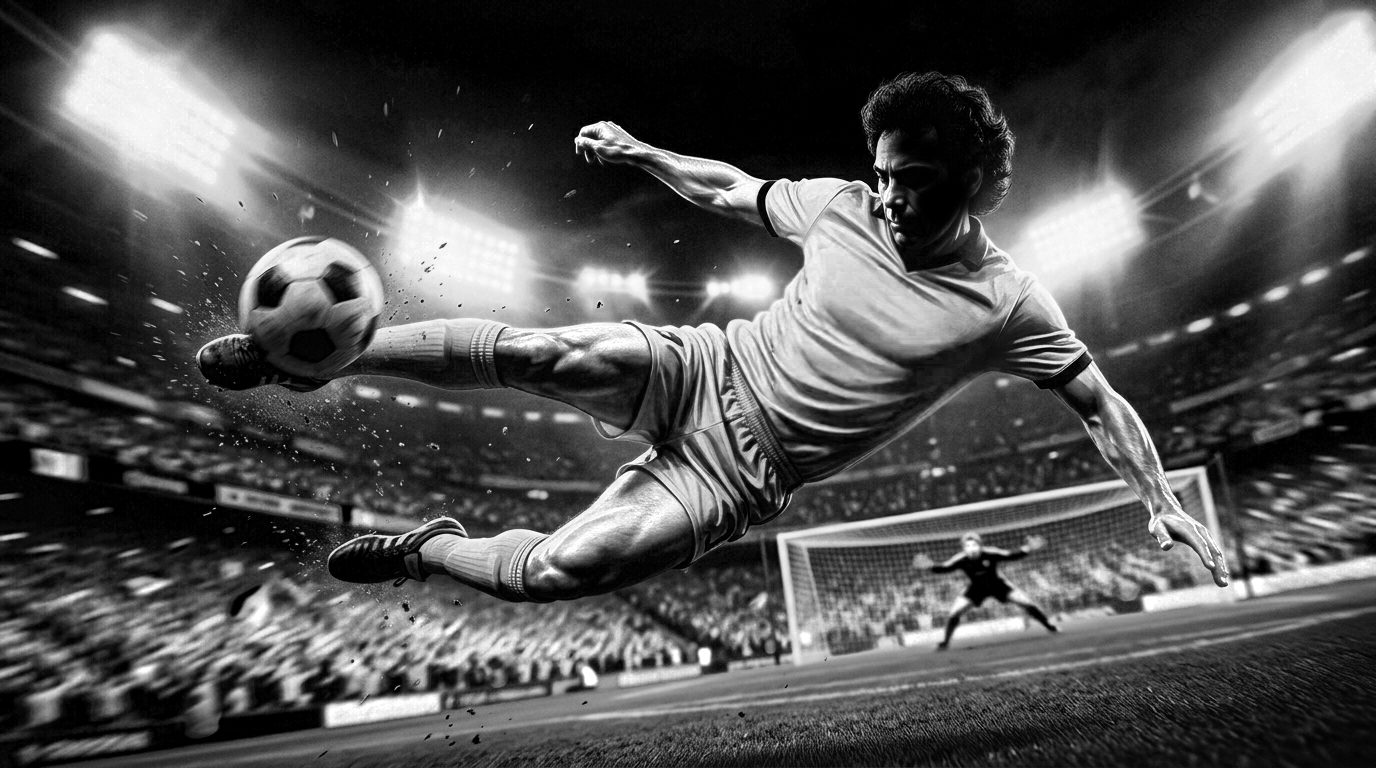
Thirty-eight minutes into the first half, a cross came into the Logroñés penalty area. Hugo Sánchez Márquez, 29, had his back to the opposing goal when the ball reached him. Without putting his feet to the ground, he twisted his body in mid-air and connected with his right instep in a flawlessly executed bicycle kick that contemporary chroniclers described as perfect in its mechanics. The ball nestled into the top left corner of the net before the goalkeeper could react. Before the referee could even confirm the goal, the 80,000 spectators packed into the Bernabéu began waving white handkerchiefs, a gesture in Spanish football culture reserved for exceptional performances. The following day’s Marca report described the scene as “a stadium that rose to its feet in unison, something the journalists present couldn’t recall ever having seen before in that venue.”
After scoring, Sánchez ran to the sideline, stopped, and executed a forward somersault. It was the same celebration he had repeated dozens of times since arriving in Spain in 1981: an acrobatic leap that his sister Herlinda, a high-performance gymnast, had taught him in the courtyards of the Jardín Balbuena neighborhood in Mexico City when they were both children. That night, in the most famous stadium in the world, a Mexican soccer player’s somersault stopped time for a few seconds.
That goal wasn’t Sánchez’s only one in the 1987-88 season. By the end of the championship, he had accumulated 29 goals and won his fourth Pichichi Trophy as the top scorer in the Spanish First Division, his third with Real Madrid, who were on their way to their fourth consecutive league title. But the goal against Logroñés transcended statistics: it was broadcast on news programs throughout Europe, discussed in sports talk shows, and became a technical reference for coaches trying to explain what a perfect bicycle kick was.
To understand why that moment had the impact it did, one must understand the context in which it occurred. In 1988, Hugo Sánchez was the only Latin American dominating the top competition in European football. In a league where foreign players had limited quotas and where Spanish clubs preferred to sign players from the continent, a Mexican had become the offensive leader of the most powerful team in Spain. The fact that he did it with bicycle kick goals that provoked standing ovations at the Bernabéu made him an unprecedented phenomenon.
The career of Hugo Sánchez Márquez is, in many ways, the story of a man who refused to accept the limitations imposed by his origins, his passport, and the expectations of his time. He was born in Mexico City in 1958 into a lower-middle-class family where sports were a core value but education was an obligation. He studied dentistry at the National Autonomous University of Mexico (UNAM) while playing for the Pumas youth team. He arrived in Spain at the age of 23, at a time when Mexican footballers were virtually unknown in the European football scene. And over the course of eleven years in the Spanish First Division, he scored 234 goals in 347 league matches, won five top-flight titles, and became the highest-scoring foreign player in La Liga history, a record he held for more than two decades until it was surpassed by Lionel Messi in 2014.
The question that runs through his entire career is not how he did it, but where he did it from. From what city, from what family, from what context did this footballer, who one day made the Bernabéu crowd wave their handkerchiefs, build his career? The answer begins in a neighborhood of Mexico City, during the years when the country was undergoing rapid transformation, and in a family where the father repaired cars and told his sons they would be the best in the world.
Chapter 2 — Mexico City, 1958-1976: The Boy from Balbuena and the Genes of Goals
Mexico City in 1958 was a rapidly expanding metropolis. With a population of around four million, the Mexican capital was experiencing the boom of the so-called “Mexican economic miracle”: a period of sustained growth that transformed outlying neighborhoods into middle-class districts, filled schools with children, and made soccer the quintessential mass sport. It was in this context that Hugo Sánchez Márquez was born on July 11, 1958, into a family for whom sports were the central focus of daily life.
His father, Héctor Sánchez, was an auto mechanic and amateur soccer player. He played in neighborhood leagues with enough skill that his contemporaries remembered him as a skillful striker, although he never made it to professional soccer. His mother, Isabel, played volleyball and was the one who instilled in the home the principle that Hugo would repeat decades later in interviews: that sports and studies were not mutually exclusive activities, but complementary ones.
The Sánchez Márquez family lived in the Jardín Balbuena neighborhood, in the Venustiano Carranza borough. It was a working-class neighborhood with wide streets, parks, and a nearby sports complex that drew local children. Hugo was the youngest of six siblings: Héctor, Horacio, Hilda, Herlinda, and Haideé. They all played some kind of sport. Héctor and Horacio played soccer; Hilda and Haideé played volleyball; Herlinda dedicated herself to artistic gymnastics, excelling enough to represent Mexico in international competitions. Years later, Herlinda would become the inspiration for the most recognizable celebration in the history of Mexican soccer.
His father’s influence was crucial in Hugo’s early sporting career. Héctor Sánchez worked as a mechanic for one of the doctors at Club Universidad Nacional, the Pumas of UNAM, and through this connection, he arranged for his older sons, Horacio and Héctor, to try out for the club’s youth academy. Both were accepted. For Hugo, who was about eight or nine years old at the time, seeing his brothers training at the university facilities was the first concrete glimpse he got of what his future might hold.
At age 11, in 1969, Hugo joined the youth academy of the Pumas UNAM. He was a thin, average-height boy who didn’t physically stand out from his teammates, but he displayed an ability to anticipate plays and a goal-scoring instinct that his coaches noticed from the very first training sessions. The Ciudad Deportiva (sports complex) and the university fields became his second home. He walked long distances to get to training, at a time when public transportation was unreliable and the children of Balbuena mainly got around on foot or by bicycle.
The training at Pumas in those years was demanding, both technically and academically. Club Universidad Nacional had an institutional identity tied to UNAM, and that identity was passed on to the youth academy: young players were encouraged to study, and the club looked favorably upon footballers who combined athletic performance with their studies. For Hugo, this philosophy aligned with what his mother had instilled in him at home. When the time came to choose between high school and football, he chose both: he studied at UNAM’s Preparatory School No. 7 while continuing his athletic development in the club’s youth system.
The international breakthrough came in 1975, when Hugo Sánchez, just turned 16, was called up to the Mexican Youth National Team. The team participated in the FIFA U-20 World Amateur Championship held in Cannes, France, and won the title. Sánchez’s performance was outstanding enough for sports journalist Ángel Fernández, one of the most recognized voices in Mexican sports journalism at the time, to give him the nickname that would accompany him throughout his career: “El Niño de Oro” (The Golden Boy). That same year, Mexico won the gold medal at the Pan American Games held in Mexico City.
The trip to Cannes had a transformative effect on the young striker’s mindset. For the first time, Hugo Sánchez witnessed firsthand the level of European football: the stadiums, the organization, the tactical intensity, the infrastructure. “I realized the level of football in Europe, what life was like there,” he recalled years later. “At 16, I decided I wanted to play there.” But the decision wasn’t impulsive. Sánchez established a clear sequence: first, he would finish his university studies, then he would succeed in Mexico, and only then would he make the leap to the Old Continent.
In 1976, at the age of 18, Hugo Sánchez participated in the Montreal Olympic Games as part of the Mexican national team. The Olympic experience solidified his belief that he had the skill to compete on the world’s most demanding stages. That same year, after returning from Montreal, he turned professional with the Pumas of the National Autonomous University of Mexico (UNAM). Sánchez has explained his decision to stay with the university club for two reasons: his brothers played there, and UNAM was where he was studying dentistry.
The sporting context in Mexico at that time was that of a country beginning to realize its footballing potential. The Mexican League was competitive regionally, but Mexican players rarely made the leap to Europe. Those who tried found doors closed: the perception in European football was that Spanish-speaking Latin American players came from Argentina or Uruguay, and that Mexicans didn’t have the level to compete in the leagues of the Old Continent. Hugo Sánchez, who at 16 had already decided he wanted to play in Europe, built his career in Mexico with that goal in mind. Every goal for Pumas was a step towards Atlético de Madrid. Every season in the Mexican League was an argument to convince Spanish executives that a Mexican could play in the First Division.
When Hugo finished his dentistry degree, his mother Isabel received the news with a satisfaction that went beyond maternal pride: it was confirmation that the principle she had instilled in her children—studies and sports, without hierarchy—was possible.
In August 1981, at 23 years old, with a university degree in hand, two league championships with the Pumas, and the certainty that he was ready for the next step, Hugo Sánchez Márquez boarded a plane to Madrid. He was leaving behind the Jardín Balbuena neighborhood, the university fields, the brothers who had taught him to play, and the sister who had taught him to celebrate. What he would find on the other side of the Atlantic would surpass even the expectations his father had expressed at that gathering of his friends, when Hugo was eight years old and the world of European football was just a black and white image on the family television.
Capítulo 3 — Madrid, 1981-1984: el extranjero que nadie esperaba
The Atlético de Madrid that welcomed Hugo Sánchez in the summer of 1981 was a club steeped in history and ambition, but also burdened by the frustration of having lived for years in Real Madrid’s shadow. The Vicente Calderón Stadium, inaugurated in 1966 on the banks of the Manzanares River, was home to a passionate fanbase that demanded results. The manager who had negotiated Sánchez’s signing, José Luis García Traid, saw in the Mexican a player capable of providing the goals the team needed. However, the start was not what either side had hoped for.
The first obstacle was García Traid himself: before Sánchez could demonstrate his ability, the manager was dismissed and replaced by Luis Sid Carriega. The new coach had not been involved in the transfer negotiations and did not share the same belief in the player. During the first three months of the 1981-82 season, Sánchez barely played. The situation was resolved when Carriega was also sacked and García Traid returned to the bench. With the coach who had hired him back, Sánchez began to have consistent playing time.
His official debut in the Spanish First Division came on September 19, 1981, in the match between Atlético de Madrid and Athletic Club, which ended 2-0 at the Vicente Calderón stadium. His first La Liga goal came on November 30, 1981, in a victory over Hércules de Alicante. From that moment on, Sánchez began to find his place in the team. Adapting to Spanish football wasn’t immediate: the pace of La Liga was different from that of the Mexican league, the physical intensity was greater, and Spanish defenders had a tradition of man-marking that tested forwards’ ability to move and create space.
What Sánchez possessed, and what Spanish defenders hadn’t seen before, was a combination of speed of execution, precision in finishing, and an acrobatic ability that allowed him to connect with balls in positions that other forwards considered impossible. His training in the Pumas’ youth academy had included intensive technical work, and his athletic condition—maintained with a discipline that his teammates at Atlético noticed from day one—allowed him to execute movements that required extraordinary neuromuscular coordination. The bicycle kick, the header in mid-air, the first-time shot: Sánchez practiced them in training with a repetition that his coaches described as obsessive.
The 1981-82, 1982-83, and 1983-84 seasons were years of consolidation. The numbers weren’t spectacular—Atlético was a team struggling to stay near the top of the table without ever winning the title—but Sánchez steadily accumulated goals and earned the respect of the Atlético fans. The Spanish press began to take notice: his bicycle kick goals made headlines, and his celebratory somersault was a visual element that photographers sought to capture. In an era without social media or video platforms, the image of Sánchez in mid-air—body outstretched, ball at his feet—circulated across the sports pages of newspapers and became a symbol of a style of play unlike anything La Liga had seen before.
Life in Madrid during those years also involved personal adjustments. Sánchez arrived in Spain with his first wife, Emma Portugal, with whom he had begun a relationship in Mexico. The couple settled in the Spanish capital and experienced the adaptation process that any immigrant goes through: the language wasn’t a problem—Spanish was his native tongue—but the customs, the schedules, the football culture, and the distance from his family were. Madrid’s winters, colder than anything Sánchez had experienced in Mexico City, and the constant pressure to perform in a league where every match was analyzed by a specialized and demanding press, created an environment that required psychological strength as well as technical skill.
The political and social context of Spain during those years was also relevant. The country was experiencing its democratic transition: just six years before Sánchez’s arrival, Francisco Franco had died, and Spain was building its democratic institutions in an atmosphere of simultaneous tension and hope. In that context, football was both an outlet and a reflection of regional and national identities. Atlético de Madrid represented a segment of Madrid’s fanbase that identified with the working class, in contrast to Real Madrid, historically associated with power and the elite. For Sánchez, who came from a working-class family in Mexico City, the atmosphere at the Vicente Calderón stadium resonated with emotions that extended far beyond the sporting aspect.
Alongside his career at Atlético, Sánchez continued to be called up to the Mexican national team. In 1983, Mexico participated in the CONCACAF Gold Cup, and Sánchez was a key player for the team. His presence on the national team was a source of pride for the Mexican community in Spain, who followed his performances closely. Restaurants and bars where the Mexican diaspora gathered in Madrid broadcast Atlético matches when Sánchez played, and the striker became a role model for Mexican immigrants in the country.
The 1983-84 season marked the beginning of Sánchez’s most productive period at Atlético. With greater consistency and confidence, the Mexican began to approach the statistics that would justify his signing. The team, then managed by César Luis Menotti—the Argentine coach who had led Argentina to the World Cup title in 1978—played a more sophisticated style of football than the one Sánchez had encountered upon his arrival. Menotti valued individual technical quality and gave his attackers the freedom to improvise within the collective schemes. For Sánchez, this philosophy was ideal: it allowed him to exploit his finishing ability from unconventional positions and his skill in creating the necessary space in an instant.
The following season would be the culmination of that stage and the springboard to the most important chapter of his career. But before reaching that point, Sánchez had demonstrated something that no one in European football had believed possible when he arrived from Mexico in 1981: that a Spanish-speaking Latin American footballer, who was neither Argentinian, Uruguayan, nor Brazilian, could not only survive in La Liga but become one of its leading figures.
Chapter 4 — The 1984-85 Season and the Pichichi Trophy That Opened the Doors to the Bernabéu
The 1984-85 Spanish First Division season was, for Hugo Sánchez, the turning point that divided his career into two distinct stages. Until then, he was a foreign striker who had shown enough quality to stay at Atlético de Madrid and contribute important goals. From that season onward, he became the top scorer in La Liga and the most sought-after transfer target in Spanish football.
The 1984-85 Atlético de Madrid team was a blend of experience and talent. Coach Luis Aragonés—who years later would lead Spain to its first European title at Euro 2008—had taken charge of the team and established a system that capitalized on Sánchez’s strengths: a center forward who was constantly on the move, who found space between the lines, and who could finish with both feet and his head with equal effectiveness. Aragonés understood that Sánchez needed freedom of movement and that his greatest asset was his ability to convert any ball that came into the box, regardless of the angle or height.
The result was a season in which Sánchez scored 19 goals in La Liga, enough to win the Pichichi Trophy as the top scorer in the Spanish First Division. It was the first time in the tournament’s history that a Mexican player had won the award. The Spanish press covered the achievement with headlines that emphasized the rarity of the event: a footballer from Mexico, a country that until then had not exported any players to Europe, was the top scorer in one of the most competitive leagues in the world.
But the 1984-85 season wasn’t just about the Pichichi. On June 30, 1985, Atlético de Madrid played Athletic Club de Bilbao in the Copa del Rey final at the Santiago Bernabéu Stadium. The match ended 2-0 for Atlético, with both goals scored by Hugo Sánchez. It was the first cup title for the Colchoneros in years, and Sánchez was the hero of the afternoon. Images of that match —Sánchez celebrating in the red and white jersey, the somersault on the Bernabéu pitch— circulated throughout the Spanish sports media and also reached Mexico, where the victory was followed with attention by a fanbase that was beginning to recognize him as their most outstanding representative in world football.
What happened after that final became one of the most talked-about episodes in the history of Spanish football. Real Madrid, who had been monitoring Sánchez’s performance for four seasons, decided they wanted the Mexican striker on their roster. The negotiation was complex: Atlético Madrid didn’t want to sell their top scorer to their biggest city rival, and the Atlético fans were horrified at the prospect of Sánchez crossing the Manzanares River to wear the white shirt. To avoid a direct conflict, Atlético’s board orchestrated a three-way deal: the transfer would be carried out through Pumas UNAM, the club where Sánchez had begun his career and which retained the rights to the player. In this way, Atlético could argue to their fans that they hadn’t sold Sánchez directly to Real Madrid.
On July 15, 1985, at the Estadio Olímpico Universitario in Mexico City, Hugo Sánchez signed his contract with Real Madrid. The club’s president, Ramón Mendoza, and the player’s agent, Guillermo Aguilar Álvarez Mazarrasa, finalized the agreement. The transfer fee was not officially disclosed, but estimates in the Spanish press at the time placed it between $1,200,000 and $1,800,000 USD, a considerable sum for Spanish football in the mid-1980s.
The reaction from Atlético Madrid fans was one of outrage. Sánchez had scored 82 goals in 152 matches for the club, winning a Pichichi Trophy (top scorer award) and a Copa del Rey (King’s Cup), and his departure to their city rivals was seen as a betrayal. Madrid’s sports newspapers dedicated entire pages to analyzing the transfer, with opinions divided between those who saw it as a legitimate professional decision and those who condemned it as a breach of loyalty. Sánchez explained his decision in sporting terms: Real Madrid was the biggest club in Spain, the one that offered him the possibility of competing at the highest European levels and continuing to grow as a footballer.
Decades later, in 2025, an article published by Spanish sports media pointed out that Atlético de Madrid had “erased” Hugo Sánchez from its institutional history, removing his name from the list of club legends. The episode illustrates the depth of the wound the transfer left in the memory of Atlético fans, but also the stature of the player Atlético lost that summer of 1985.
For Hugo Sánchez, signing for Real Madrid was the culmination of a process that had begun when, at 16 years old in Cannes, he decided he wanted to play in Europe. Four years at Atlético had been the apprenticeship. What would come next would be the masterpiece.
Chapter 5 — Real Madrid, 1985-1987: The Early Years at the Top
The Real Madrid that welcomed Hugo Sánchez in the summer of 1985 was a team in the process of building what would become one of the most successful periods in its history. President Ramón Mendoza had initiated an ambitious transfer policy, and the team boasted homegrown players who were beginning to establish themselves as stars: Emilio Butragueño, nicknamed “The Vulture,” Martín Vázquez, Míchel, Sanchís, and Martín. Hugo Sánchez was added to this group as the major foreign signing, the goalscorer who was meant to complement the creativity of the youth academy players with clinical finishing in the penalty area.
Sánchez’s official debut with Real Madrid in La Liga came on September 1, 1985, in the match played in Seville against Betis. The result was a 2-1 victory for Madrid, with Sánchez scoring the winning goal. However, the afternoon had a bittersweet taste: the Mexican was sent off for protesting a decision by referee Urizar Azplitarte. It was his first official match in the white shirt, and he had already demonstrated two of his most defining characteristics: his scoring ability and the competitive temperament that sometimes led him to clash with referees.
The 1985-86 season was one of consolidation. Under the management of Leo Beenhakker, Real Madrid built a team that combined the technical skill of the youth academy players with Sánchez’s effectiveness in the penalty area. The Mexican scored 22 goals in La Liga, enough to win his second Pichichi Trophy—his first with Real Madrid—and become the league’s top scorer for the second time in two consecutive years. The team ended up winning La Liga, the first of five consecutive titles that would mark an era.
But the 1985-86 season also featured a major European milestone. Real Madrid participated in the UEFA Cup, and Sánchez played a key role in the decisive moments. In the semifinals, the team faced Borussia Mönchengladbach. The first leg had been lost 3-1, a deficit that seemed insurmountable. In the return leg at the Bernabéu, Madrid staged a remarkable comeback with a collective performance in which Sánchez scored two goals: the final score was 5-1, enough to secure qualification for the final. Against FC Köln, Sánchez scored in the first leg—a 5-1 victory—and the result was sealed in the return leg on May 14, 1986. Real Madrid won their first UEFA Cup, and the Mexican had been instrumental in their path to that title.
The 1986-87 season confirmed that the previous year’s performance had been no fluke. Sánchez scored 34 goals in La Liga, the highest tally of his career up to that point, and won his third Pichichi Trophy. He was the first player in La Liga history to win the Pichichi in three consecutive seasons. Real Madrid were crowned league champions again, and the team was beginning to be recognized as one of the most powerful sides in Europe.
The team’s internal dynamics were complex. The homegrown players of the “Quinta del Buitre”—Butragueño, Míchel, Martín Vázquez, Sanchís, and Martín—formed a cohesive group that had grown up together in the club’s youth academy. Sánchez was the only foreigner in this core group, and his relationship with the youngsters was described by the press at the time as professional but not without its tensions. Butragueño was the idol of the Madrid fans, the player who embodied the club’s identity; Sánchez was the imported goalscorer, the one who put up the numbers but who would never be truly “one of the family.” This distinction—between the local idol and the effective foreigner—shaped the public perception of Sánchez throughout his time at Real Madrid.
What no one could deny were the goals. In those first two seasons with Madrid, Sánchez had scored 56 goals in La Liga, winning two consecutive Pichichi trophies, a league title, and a UEFA Cup. Sports journalist Julio César Iglesias, in a chronicle published in Marca in 1987, described Sánchez as “the most complete striker in La Liga, capable of scoring in any way and from any position.”
On a personal level, those years in Madrid were relatively stable. Sánchez and Emma Portugal continued their relationship, and the couple had become integrated into the Madrid football scene. Life in Madrid in the 1980s was that of a city undergoing rapid transformation: the Movida Madrileña filled the bars and art galleries with an energy that contrasted sharply with the seriousness of the Franco years. Sánchez, known for his discipline and strict training regimen, wasn’t part of that nightlife scene, but he lived in a city that breathed a newfound freedom and celebrated sporting success with an intensity he hadn’t experienced in Mexico.
The Mexican national team also demanded his attention. In 1986, Mexico hosted the World Cup, and Sánchez arrived at the tournament as the most recognized player on the national team. What happened at that World Cup would become one of the most painful chapters of his career.
Chapter 6 — The 1986 World Cup in Mexico: Other People’s Glory and the Penalty That Didn’t Go In
For Mexican fans, the 1986 World Cup in Mexico was an experience of collective euphoria that ended in a disappointment still remembered today. For Hugo Sánchez, it was something more complex: confirmation that football can be unfair to individuals even when teams triumph, and that the pressure of representing a country in its own tournament carries a weight that cannot be measured by club statistics.
Mexico arrived at the World Cup as hosts with a team that combined experience and talent. Coach Bora Milutinović had built an organized team, with a solid defense and a transitional ability that allowed them to compete with more established rivals. Sánchez was, in theory, the ultimate attacking weapon: the top scorer in the Spanish La Liga, at the peak of his career, playing on home soil. The expectation of the Mexican press and fans was that he would replicate at the World Cup what he did every week at the Bernabéu.
The reality was more complicated. International football operates on a different logic than club football: players know each other less, tactical schemes are less refined, and preparation time is limited. Sánchez, who at Real Madrid received the ball in specific positions thanks to a system of play tailored to his needs, depended on teammates with the national team who didn’t have the same understanding of his movements. The only goal he scored in the tournament came in the group stage match against Belgium, a header, in a 2-1 victory that qualified Mexico for the next round.
The most painful moment came in the quarterfinals against West Germany. The match, played at the Estadio Universitario in Monterrey on June 21, 1986, ended 0-0 after 90 minutes of regulation time and extra time. The match was decided by a penalty shootout. Sánchez—who had been one of the most reliable penalty takers in the Spanish First Division, converting all six of his penalties in his first season with Real Madrid—was designated to take one of Mexico’s shots. His shot was saved by German goalkeeper Harald Schumacher. Mexico lost the shootout 4-1 and was eliminated just shy of the semifinals.
The image of Sánchez missing that penalty was replayed on Mexican news programs for days. The country’s sports press was harsh on his performance in the tournament: more was expected from Spain’s top scorer, and his single goal in five matches fell short of expectations. Years later, Sánchez himself acknowledged that his performance in that World Cup was not what he had hoped for. “The performance we expected from Hugo Sánchez in the World Cup simply didn’t materialize,” the national team coach admitted in statements reported by Fox Sports Mexico.
The missed penalty in 1986 is one of the most analyzed moments in the history of Mexican soccer. Some analysts point out that the pressure of playing at home, in front of more than 100,000 spectators at Estadio Universitario, was a factor that affected his execution. Others suggest that Schumacher was a top-level goalkeeper who had studied Sánchez’s shooting patterns. What is certain is that that missed penalty became an image that accompanied Sánchez for years, a reminder that even the best can fail at the most important moment.
However, the 1986 World Cup also had a positive dimension for Sánchez: it was the stage where the football world saw the Mexican national team compete on equal terms with the European powerhouses for the first time. Milutinović’s team reached the quarterfinals, Mexico’s best performance in a World Cup up to that point, and Sánchez was part of that collective achievement. The fact that they were eliminated on penalties, and that one of the missed penalties was his, doesn’t erase the fact that Mexico was one step away from the World Cup semifinals for the first time in its history.
When Sánchez returned to Madrid in the summer of 1986, he did so with the determination that what he hadn’t been able to achieve with the national team he would make up for with Real Madrid. The 1986-87 season was his answer: 34 goals, a third consecutive Pichichi Trophy, and a second league title. Football, sometimes, has that ability to offer an immediate second chance.
Chapter 7 — Real Madrid, 1987-1990: The Top of the World and Five Consecutive Titles
The 1987-88, 1988-89, and 1989-90 seasons represented the pinnacle of Hugo Sánchez’s career as a professional footballer. In those three years, Real Madrid won three consecutive league titles—completing a run of five straight titles—and Sánchez established himself as the best striker in Europe in statistical terms. In the 1989-90 season, he scored 38 goals in La Liga, equaling the all-time record of Telmo Zarra, the Basque striker who had set that mark in the 1950-51 season.
The 1987-88 season was the one of the goal against Logroñés, the bicycle kick that brought the Bernabéu crowd to its feet. But that goal was just the most memorable of the 29 Sánchez scored in La Liga that year, enough to win his fourth Pichichi Trophy. The team, managed by Leo Beenhakker, played a direct, vertical style of football that capitalized on the speed of the attackers and Sánchez’s ability to finish from any position. The defense was solid, the midfield was creative, and the attack featured Sánchez and Butragueño as a duo that opposing defenders found impossible to neutralize simultaneously.
The 1988-89 season was different on a personal level. Sánchez’s relationship with Emma Portugal came to an end after eight years together. The separation had visible consequences for the footballer: after the announcement, Sánchez missed several training sessions, and his performance in the first few months of the season was inconsistent. However, the team continued winning. Real Madrid were crowned league champions for the fourth consecutive time, and Sánchez—although he didn’t win the Pichichi Trophy that year, which went to Baltazar of Atlético de Madrid—scored enough goals to be a key factor in securing the title.
The 1989-90 season was his absolute peak. With 38 goals in La Liga, Sánchez not only won his fifth and final Pichichi Trophy, but he also took home the Golden Boot as the top scorer across all European leagues. Real Madrid set a record of 107 goals in a season, a tally that reflected the attacking prowess of a team that combined Sánchez’s experience with the creativity of the youth academy players and the solidity of a defense that conceded few goals. The club won its fifth consecutive league title, a streak not seen in Spanish football since the 1950s.
Sánchez’s 38 goals that season deserve a technical analysis. A significant proportion were first-time finishes, with no time to control the ball. Sánchez had developed an anticipation technique that allowed him to calculate the ball’s trajectory before it arrived and position his body for the shot the instant it touched his foot. His shots were described by goalkeeping coaches as “impossible to read” because they changed direction at the last moment, the result of a wrist flick that Sánchez had practiced for years. Real Madrid’s fitness coach at the time, Ángel Vilda, noted in later interviews that Sánchez was the most disciplined player in finishing work he had ever seen: he arrived before anyone else at training and stayed after everyone else to practice shots from different angles.
The European Cup was the one thing that eluded them during that period. Real Madrid reached the quarterfinals in the 1989-90 season and faced Arrigo Sacchi’s AC Milan, one of the most powerful teams in Europe at the time. Milan won the tie, and Madrid was eliminated. On the way to those quarterfinals, Sánchez had scored four goals in the 9-1 thrashing of FC Swarovski Tirol in the round of 16, his highest-scoring performance in European competition for the club.
The atmosphere in the Real Madrid dressing room during those years was described by several players in later interviews as competitive and not always harmonious. Sánchez was a player who demanded the same level of commitment from his teammates that he demanded of himself, and that demand wasn’t always well received. His relationship with Butragueño was one of mutual respect but also of implicit competition: both wanted to be the offensive reference point of the team, and although their roles were different —Butragueño as organizer, Sánchez as finisher—, the dynamic between them generated tensions that the Spanish press detected and amplified.
On a personal level, those years were a time of rebuilding. After his separation from Emma Portugal, Sánchez began a new relationship with Isabel Martín, with whom he would build a stable life in the following years. This newfound emotional stability was reflected in his performance: the 1989-90 season, the one in which he scored 38 goals, was also the one that solidified this new personal phase.
For Mexico, Sánchez’s performances at Real Madrid had a dimension that went beyond the sport itself. In a country where football was the national passion and where the national team rarely reached the later stages of international tournaments, having the top scorer in Europe was a source of collective pride. Real Madrid matches were broadcast in Mexico with audiences that news programs of the time described as record-breaking for European football in the country. In that sense, Sánchez was Mexico’s first sporting ambassador in the world of elite football.
Chapter 8 — Real Madrid, 1990-1992: The Twilight of an Era and the Farewell to the Bernabéu
The 1990-91 season marked the beginning of the decline of Real Madrid’s golden era and, with it, the beginning of the end of Hugo Sánchez’s time at the club. The team that had won five consecutive league titles was beginning to show signs of fatigue: the Quinta del Buitre players were approaching 30, competition from other Spanish clubs—especially Johan Cruyff’s Barcelona, which was building its own dream team—was intensifying, and injuries were starting to affect the consistency of key players.
For Sánchez, the 1990-91 season was the first in which injuries significantly disrupted his rhythm. At 32, the body that had functioned like a precision machine for more than a decade was beginning to show signs of wear and tear. The muscle problems he had managed to avoid for years thanks to his disciplined training began to appear more frequently, and the number of games he played that season was noticeably lower than in previous years.
The sporting landscape had also changed. Johan Cruyff’s Barcelona, with Pep Guardiola in midfield and Hristo Stoichkov leading the attack, had built the so-called “Dream Team” that would dominate Spanish football in the early 1990s. Real Madrid, which had been the benchmark of Spanish football for five years, now found itself in a challenging position: it had to reinvent itself to compete with a Barcelona that played a different, more positional and sophisticated style of football. The club’s response was to sign new players and commit to a generational renewal that inevitably relegated the veterans to a more marginal role.
The 1991-92 season was Sánchez’s last at Real Madrid, though not by his own choice. Injuries kept him out of most matches: he only played eight league games all season. On March 21, 1992, in matchday 27 of La Liga, Sánchez played his last official match in a Real Madrid shirt: a 1-0 victory over Deportivo La Coruña at the Bernabéu, with him scoring the winning goal. Four days earlier, he had scored his last goal in European competition, in the UEFA Cup against Sigma Olomouc, also in a 1-0 victory.
His departure from Real Madrid at the end of that season was discreet, lacking the farewell that fans and even club officials acknowledged years later he deserved. Sánchez had scored 208 goals in 282 official matches for the club, becoming the fourth-highest scorer in the institution’s history, behind Alfredo Di Stéfano, Carlos Santillana, and Ferenc Puskás. He had won five league titles, one Copa del Rey, three Spanish Super Cups, and one UEFA Cup. His four Pichichi Trophies with the club were a record unmatched by any other player in the tournament’s history.
The Spanish press of the time was ambivalent in its assessment of Sánchez’s departure. Some columnists pointed out that the club had failed to manage the end of the career of their top scorer of the 1980s, that the send-off had been cold for someone who had given so much to Real Madrid. Others argued that Sánchez had been difficult to manage in recent years, that his contractual demands and personality had created friction with the board. What was beyond question was the statistical legacy: in seven seasons with Real Madrid, Hugo Sánchez had been the top scorer in La Liga in four of them.
When Sánchez left the Bernabéu in the summer of 1992, he was 33 years old and still wanted to play. What followed was a nomadic period, moving from club to club, reflecting both the difficulty of finding a new home after having been at the top and the resilience of a footballer unwilling to retire prematurely.
Chapter 9 — The Return to Mexico and the Final Years in Football: 1992–1997
The 1992–93 season saw Hugo Sánchez back in Mexico, wearing the Club América jersey. It was a return laden with symbolism: the striker who had conquered Spain was returning to the Mexican League at 33 years old with the reputation of being the best footballer the country had ever produced. Club América, one of the most popular and powerful teams in Mexico, was the perfect stage for that return.
His debut with América came on August 19, 1992 at the Marte R. Gómez Stadium, against Correcaminos UAT. Sánchez scored the winning goal, a way of introducing himself that the América fans received with enthusiasm. The season with América included a significant continental achievement: the club won the CONCACAF Champions Cup, defeating Alajuelense of Costa Rica in the final. Sánchez scored the winning goal in that final — his second title in that competition, the first having been with Pumas in 1980.
In 1993, the Mexican national team participated in the Copa América held in Ecuador. The team, coached by Miguel Mejía Barón, reached the final, where they lost to Argentina. Sánchez was part of that team and contributed his experience in the decisive moments. He scored a goal in the semifinal against Ecuador, and the tournament was recognized by the Latin American sports press as the Mexican national team’s best performance in years. The 1993 Copa América is, in many ways, the best argument for those who maintain that Sánchez was an extraordinary player for the national team as well, even though his performances in the World Cups did not reflect the level he displayed at the club level.
In 1993-94, Sánchez returned to Spain to play for Rayo Vallecano, a club on the outskirts of Madrid with a strong local identity and a loyal fanbase. The season was productive in individual terms—16 goals in 29 league matches—but the team was relegated to the Second Division at the end of the season. With that season, his total in La Liga reached 234 goals in 347 matches, a figure that made him the highest-scoring foreign player in the history of the league.
The 1994-95 season found him back in Mexico, this time with Atlante. His arrival at the club was accompanied by controversy that the Mexican press covered extensively: América’s manager at the time was Leo Beenhakker, the same coach who had managed Sánchez at Real Madrid and with whom he had had disagreements. Ironically, the match between Atlante —with Sánchez in their ranks— and América ended 4-1 for Atlante, with the then-leader of the tournament as the victim.
The years 1995 and 1996 were the most itinerant of Sánchez’s career. He played for FC Linz in Austria, where he scored seven goals in 19 matches, and then joined the Dallas Burn of Major League Soccer in the United States. His MLS debut came on May 19, 1996, with a goal in a Dallas Burn victory. In June of that year, he scored a bicycle kick that the American media described as “an otherworldly goal.” At 37, Hugo Sánchez was still scoring bicycle kick goals in stadiums across three continents.
His time with the Dallas Burn in 1996 deserves special mention in the context of the expansion of soccer in North America. Major League Soccer had begun operations that same year, partly as a direct result of the 1994 World Cup in the United States. The arrival of Hugo Sánchez—with five Pichichi trophies and more than 500 career goals—was a media event that MLS organizers used to raise the profile of the new league. The Los Angeles Times covered his debut with an article highlighting that Sánchez had scored in his first game with the Texas team. Years later, the official MLS website described his bicycle kick that June as “one of the most memorable goals in club history.” It was the same technique that had dazzled the Bernabéu in 1988, now executed before an audience that was just beginning to become familiar with soccer but recognized the beauty of the move.
His final stint as a player was with Atlético Celaya in the Mexican League, where he retired in 1997 at the age of 38. His retirement was discreet, lacking the ceremony his career deserved. Sánchez had scored 516 goals in 883 official matches throughout his career, becoming the Mexican footballer with the most goals in official matches in history. He was also the highest-scoring foreign player in the history of the Spanish La Liga, a record he would hold for another 17 years, until Lionel Messi surpassed it on March 23, 2014.
Sánchez’s retirement as a player did not mean his departure from football. From his early years in Spain, he had expressed his intention to become a coach, to apply the tactical and technical knowledge he had accumulated over two decades as an elite player to the sidelines. The next stage of his life would begin, as was only natural, at the club where it had all started.
Chapter 10 — The Coach: Pumas, the Back-to-Back Championship, and the National Team
On March 26, 2000, Hugo Sánchez made his debut as head coach of Club Universidad Nacional, the Pumas of UNAM. It was a return to his roots: the same club where he had joined the youth academy at age 11, where he had made his professional debut at 18, and where he had won his first titles. Returning as coach was, in his own words, “fulfilling a commitment to my home.”
His first years as Pumas’ coach were a learning experience. Mexican soccer had changed since Sánchez played in the Liga MX: the short tournament format—Apertura and Clausura—had replaced the long championship, and the dynamics of the teams were different. Sánchez arrived with clear ideas about the style of play he wanted to implement—an attacking style of soccer with high pressure and quick transitions—but adapting to the new format and the available players took time.
Sánchez’s greatest success as a coach came in 2004, when he led Pumas to back-to-back championships: two consecutive titles in the 2004 Apertura and Clausura tournaments. It was the first consecutive championship in the short-tournament format in Mexican soccer history, an achievement recognized by the country’s sports press as one of the most important in the league’s recent history. The rector of UNAM, Juan Ramón De la Fuente, had given Sánchez the institutional support he needed to build a solid project, and the coach responded with results.
The 2004 back-to-back championships also included an episode that illustrates the international stature Sánchez maintained even as a coach. In that year’s Santiago Bernabéu Trophy, Pumas UNAM faced Real Madrid in the stadium where Sánchez had scored 208 goals as a player. The Pumas won the game, and Sánchez celebrated the victory with a satisfaction that went beyond the sporting aspect: he was the coach who had defeated the club where he had been a legend, in his own stadium.
In 2006, Sánchez was appointed head coach of the Mexican national team, the most important position in Mexican football. The appointment generated enormous expectations: the best Mexican footballer in history was taking the helm of the national team. However, his experience as national team coach was difficult. His tenure was marked by inconsistent results and a tense relationship with some players and the sports media.
Sánchez arrived at the position with the moral authority of being the best Mexican footballer in history, but that authority did not automatically translate into the ability to manage a locker room of players who had grown up playing a different style of football than the one he had experienced. Criticism of his squad selections was constant. The Mexican sports media, which had enthusiastically celebrated his appointment, became his harshest critics when the results failed to materialize with the expected consistency.
Qualifying for the 2010 South Africa World Cup was the primary objective of his tenure. Mexico qualified, but the process was turbulent. Sánchez’s dismissal was announced by the Mexican Football Federation in March 2008, with the argument that the qualifying results were insufficient to guarantee qualification. Sánchez rejected this justification, arguing that the team was in a position to qualify. His successor, Javier Aguirre, led the team to the tournament, which some interpreted as confirmation that Sánchez’s work had laid a foundation that his successor built upon, and others as evidence that the coaching change had been necessary.
After his time with the national team, Sánchez continued his coaching career at various clubs, though without replicating the success of his back-to-back championships with Pumas. The coach’s stature never reached the same level as his playing career, something Sánchez himself honestly acknowledged on several occasions. Self-criticism was characteristic of a man who had built his career on high standards and honesty with himself.
Final Chapter — The Legacy of the Pentapichichi: Goals, Borders, and His Mark on World Football
In 2011, FIFA inducted Hugo Sánchez Márquez into its Football Hall of Fame. It was the official recognition by the governing body of world football of the career of a player who had scored 516 goals in 883 official matches, won five Spanish La Liga titles, been the league’s top scorer four times, and carried the name of Mexico to the most important stadiums in Europe. His induction into the Hall of Fame was, in a sense, confirmation of something football fans already knew: that Hugo Sánchez was the best footballer Mexico had produced in the 20th century.
The IFFHS—the International Federation of Football History & Statistics—had recognized him as the best Mexican footballer of the 20th century and the best in the CONCACAF region during the same period. In the same organization’s world ranking, Sánchez appeared in 26th place among the best footballers of the 20th century, a position that placed him among the greats in the history of the sport. In 2019, the British magazine FourFourTwo included him in its list of the 100 greatest footballers of all time, at number 82.
Sánchez’s legacy in Mexican football is multifaceted. First, he opened a door that had previously been closed: he demonstrated that a Mexican footballer could compete and excel in the Spanish First Division, at a time when that possibility was considered improbable by European executives. His success at Atlético de Madrid and later at Real Madrid changed the perception of Mexican football in Europe and paved the way for the players who came after him.
Secondly, the model Sánchez represented—the footballer who combines sporting excellence with academic training—had a cultural impact that extends far beyond football. In a country where sport and education are frequently presented as mutually exclusive options, the figure of a striker who scored 38 goals in a La Liga season and who also held a degree in dentistry was a powerful argument in favor of the compatibility of both. His mother, Isabel, who had insisted he finish his university degree before considering Europe, saw how that principle became an example for thousands of young Mexican athletes.
Sánchez’s technical impact on football also deserves analysis. His mastery of the bicycle kick was so consistent and spectacular that this type of shot became almost exclusively associated with him in the collective imagination of Mexican football. His bicycle kick goals weren’t accidental: they were the product of years of systematic practice, of a biomechanical understanding of the movement that his coaches described as unique. The ability to calculate the ball’s trajectory and position the body for the shot in mid-air, with the precision needed to direct the strike into the top corner of the goal, requires a level of neuromuscular coordination that few footballers have achieved at the level Sánchez developed.
The “dove somersault” celebration, performed after each of his 516 official goals, is another element of his legacy that transcends the sport. The tribute to his sister Herlinda—the gymnast who taught him the somersault in the courtyards of Jardín Balbuena—transformed each celebration into an act of familial affection recognized by fans worldwide. In an era when goal celebrations were more understated than they are today, Sánchez’s somersault was a visual signature that distinguished him from any other footballer in the world.
On February 4, 2003, the Hugo Sánchez Márquez Stadium was inaugurated in Cuautitlán Izcalli, State of Mexico, named in his honor. It is one of the few stadiums in Mexico named after a living footballer, and its existence is an indicator of the stature Sánchez achieved as a public figure in his country. It’s not just a stadium: it’s a monument to the idea that a kid from Jardín Balbuena can become the top scorer in the Spanish League.
Sánchez’s legacy also has its shadows. His time as national team coach was a relative failure that damaged his reputation as a manager. His conflicts with clubs, coaches, and federations over the years created an image of a difficult person that persists in certain sectors of sports journalism. And the wound with Atlético de Madrid—the club that developed him as a European footballer and which he left for their city rival—is a scar that time has not fully healed.
But the shadows do not erase the light. Hugo Sánchez Márquez is, in the history of Mexican football, a figure without equal. No other player from the country has scored more goals in official matches. No other has won more Pichichi trophies in the Spanish La Liga. No other has been recognized by the IFFHS as the best in his region in a century. And no other has made the Santiago Bernabéu crowd wave their handkerchiefs with a bicycle kick that chroniclers of the time described as perfect in its execution.
The story of Hugo Sánchez is, ultimately, the story of a man who set out to be the best and, in the most important moments of his career, he was. The fact that he was also human—that he missed a penalty in a World Cup, that he had conflicts with coaches and managers, that his time as a manager didn’t match his playing days—doesn’t make him any less great. It makes him more real. And that reality, with its contradictions and its triumphs, is what makes his story worth telling.
Appendix — Performances and Unforgettable Moments
1. The Bicycle Kick Against Logroñés — April 10, 1988
On April 10, 1988, matchday 32 of the 1987-88 Spanish La Liga season, Real Madrid hosted Club Deportivo Logroñés at the Santiago Bernabéu. In terms of the standings, the match was a formality: Madrid were comfortably in first place, while Logroñés were fighting to avoid relegation. What happened in the 38th minute of the first half turned that match into one of the most memorable in the history of Spanish football.
A cross from the right wing reached the Logroñés penalty area. Hugo Sánchez, with his back to the goal, calculated the ball’s trajectory in the air and twisted his body in a movement that biomechanical analysts would describe as a textbook bicycle kick: his body extended horizontally, his right instep connecting with the ball at the exact point in its trajectory, his hip rotating to direct the shot into the top left corner of the goal. The Logroñés goalkeeper couldn’t react. The ball went in, grazing the post.
What followed was one of the most documented reactions in the history of the Bernabéu stadium. The 80,000 spectators who filled the stands began waving white handkerchiefs simultaneously, a gesture that in Spanish football culture is reserved for performances that exceed ordinary expectations. The Marca newspaper’s report the next day described the scene as “a stadium that rose to its feet in unison, something that the journalists present couldn’t recall ever having seen before in that venue.” Sánchez executed his usual celebration—the forward somersault—and returned to the center circle with the composure of someone who has completed a move practiced thousands of times.
Technically, the goal required solving three simultaneous problems in less than a second: calculating the trajectory of the moving ball, positioning his body in the air for impact, and directing the shot with enough precision to beat the goalkeeper. That goal was broadcast on news programs throughout Europe and became the technical benchmark for what constitutes a perfect bicycle kick. Decades later, FIFA’s official website included it among the most technically demanding goals in football history.
2. The Cannes Youth World Cup — 1975
In the summer of 1975, the city of Cannes, on the French Riviera, hosted the FIFA U-20 Amateur World Cup. Mexico participated with a team that included Hugo Sánchez, who had just turned 16, as one of its forwards. The Mexican team won the tournament, and Sánchez’s performance was outstanding enough for sports journalist Ángel Fernández to give him the nickname that would accompany him throughout his career: “El Niño de Oro” (The Golden Boy).
The importance of that tournament in Sánchez’s career goes beyond the title. It was the first international stage where the young Pumas forward realized that his level was comparable to that of the best European youth players. “I realized the level of football that existed in Europe, what life was like there,” Sánchez recalled years later. “At 16, I decided I wanted to play there.” The decision wasn’t impulsive: she established a clear sequence: she would finish her university studies, succeed in Mexico, and only then make the leap to Europe. That plan was executed exactly as she had conceived it in Cannes.
That same year, Mexico won the gold medal at the Pan American Games held in Mexico City. The double experience of winning an international tournament in France and a gold medal in his hometown in the same year laid the foundation of confidence that would sustain his career for the next two decades. Journalist Ángel Fernández, who had closely followed Sánchez’s development with Pumas, wrote at the time that the young forward possessed “a technical maturity beyond his years.”
3. The First Title with the Pumas — 1976-77 Season
The 1976-77 Mexican League season was historic for Club Universidad Nacional. The Pumas of UNAM won their first league title, breaking years of frustration for a club that had a strong identity and a dedicated fanbase but had never been able to capture the national championship. Hugo Sánchez, who had made his professional debut in October 1976 at just 18 years old, was part of that historic team. His contribution wasn’t that of an undisputed starter—he was the youngest player on the roster and shared playing time with more experienced forwards—but his goals at key moments of the season were crucial on the road to the title.
The 1976-77 title held special significance for the university institution. The Pumas were the club of the National Autonomous University of Mexico (UNAM), and their fanbase was primarily composed of students and faculty who saw the team as an extension of the university’s identity. Winning the first championship transcended football: it was an affirmation that the UNAM sports project had enough solidity to compete with the most powerful clubs in the country.
The second title with Pumas came in the 1977-78 season, by which time Sánchez was an undisputed starter and the team’s top scorer. This pair of consecutive titles established Pumas as one of the dominant clubs in Mexican football in the late seventies, and Sánchez as the country’s most promising striker. It was this reputation that reached the ears of Atlético de Madrid’s management when they began searching for a Latin American striker to bolster their squad in 1981.
4. The UEFA Cup with Real Madrid — 1986
The 1985-86 UEFA Cup was Hugo Sánchez’s first European title with Real Madrid. In the semifinals, Real Madrid faced Borussia Mönchengladbach. The first leg, played in Germany, ended 3-1 for Borussia, a deficit that the Spanish press considered virtually insurmountable. To overturn the deficit, Madrid needed to win by at least three goals at the Bernabéu.
What happened in the second leg was one of the most memorable nights at the Bernabéu in the 1980s. Madrid won 5-1, with Sánchez scoring two of the five goals. The Mexican’s two goals—one a first-time shot from the edge of the area and the other a header at the far post—opened the tie and gave the team the confidence to complete the comeback. The Spanish press described that night as “one of Real Madrid’s best performances in Europe in the last decade.”
In the final against FC Cologne, Sánchez scored in the first leg, a 5-1 victory that made the result irreversible in the second leg on May 14, 1986. It was Sánchez’s first European title with Real Madrid and confirmation that the Mexican was capable of performing at the highest level in continental competitions as well.
5. The Third Consecutive Pichichi — 1986-87 Season
The 1986-87 season was the one in which Hugo Sánchez definitively established himself as the best striker in the Spanish La Liga. With 34 goals in the championship, he won his third consecutive Pichichi Trophy, becoming the first player in the tournament’s history to win that award three seasons in a row. The record reflected a consistency in performance that sports analysts of the time found exceptional: maintaining that level of goalscoring for three consecutive years, in a championship as competitive as the Spanish La Liga of the 1980s, required a combination of technical skill, physical condition, and mental stability that few strikers had demonstrated in the tournament’s history.
Journalist Julio César Iglesias, in a Marca article published at the end of the season, described Sánchez as “the most complete striker in La Liga, capable of scoring in any way and from any position.” Of the 34 goals, some were first-time finishes, others bicycle kicks, others headers, and still others were shots with the inside of his foot from angles that other strikers considered impossible. This variety was the product of years of systematic practice in which Sánchez had worked on each type of shot until he mastered it with equal effectiveness.
Real Madrid won the league that year, their second consecutive title, and the team was beginning to be recognized in Europe as one of the most powerful forces on the continent. The combination of Sánchez’s individual technique and the collective play of the Quinta del Buitre produced a style of football that the Spanish press of the time described as “the most attractive in La Liga for years.”
6. The Header Goal in the 1986 World Cup in Mexico — Mexico vs. Belgium
On June 3, 1986, the Azteca Stadium in Mexico City hosted the match between Mexico and Belgium, corresponding to the group stage of the 1986 World Cup in Mexico. The stadium, with a capacity of over 100,000 spectators, was packed with Mexican fans eager to see the top scorer in the Spanish La Liga score on home soil.
The goal came in the first half: a cross from the left wing, Sánchez anticipating the Belgian defender and connecting with his head in a shot that went into the top corner of the goal past Jean-Marie Pfaff, one of the most renowned goalkeepers in Europe at that time. The Azteca Stadium responded with an explosion of noise that commentators of the time described as “deafening.” Mexico won the match 2-1 and qualified for the next round.
The context of that goal made it especially significant. Sánchez had been playing in Spain for five years, leading La Liga in scoring, and representing Mexico in European football. Scoring in a World Cup played in his own country, in front of 100,000 compatriots, was the symbolic culmination of that representation. It was the only goal Sánchez scored in World Cups throughout his career, making that header at the Azteca Stadium a unique moment in his personal history and in the history of Mexican football.
7. The 1985 Copa del Rey — The Two Goals in the Final
On June 30, 1985, the Santiago Bernabéu Stadium hosted the Copa del Rey final between Atlético de Madrid and Athletic Club de Bilbao. The geographical irony was evident: Atlético was playing the most important final of its season in the stadium of its fiercest rival. For Hugo Sánchez, who would sign with Real Madrid weeks later, this match was his last in the red and white stripes.
Sánchez scored both goals in the 2-0 victory. The first, a first-time shot from the edge of the area that nestled into the bottom corner of the net; the second, a header from a cross. Both goals showcased his technical prowess: one a powerful and precise strike from outside the box, the other a perfectly timed and well-placed shot in the six-yard box. Atlético won its first Copa del Rey title in years, and Sánchez was the hero of the afternoon.
The irony of the match did not escape the chroniclers of the time: Sánchez had scored both goals in a Copa del Rey final at the stadium of the club he would join weeks later. When his transfer to Real Madrid was confirmed in July, Atlético fans recalled that final with a mixture of pride and bitterness that encapsulated the complex relationship between the player and the club. The 1985 Copa del Rey was the best farewell gift Sánchez could have given Atlético, and also the beginning of the end of a relationship that time has not been able to fully mend.
8. The 38 goals of the 1989-90 season and the European Golden Boot
The 1989-90 season was the statistical peak of Hugo Sánchez’s career. His 38 goals in La Liga equaled the all-time record of Telmo Zarra, the Basque striker who had set that mark in the 1950-51 season. It had taken 39 years for Zarra’s record to be equaled, and the fact that it was a Mexican who achieved it was something the Spanish press emphasized. Those 38 goals earned Sánchez the fifth and final Pichichi Trophy of his career and the Golden Boot as the top scorer across all European leagues.
Real Madrid’s fitness coach at the time, Ángel Vilda, later remarked in interviews that Sánchez was the most disciplined player he had ever seen in his finishing: he arrived at training before anyone else and stayed after everyone else to practice shots from different angles. This discipline was reflected in the variety of his goals: first-time finishes, inside-of-the-foot shots, bicycle kicks, headers. Each type of shot was the product of a systematic practice that Sánchez had maintained for over a decade.
Real Madrid set a record of 107 goals that season and won their fifth consecutive league title, completing a streak unseen in Spanish football since the 1950s. Sánchez, who had arrived at Real Madrid in 1985 as the foreign reinforcement intended to complement the homegrown players, finished the season as the top scorer in all European leagues.
9. The 1993 Copa América — The Runner-Up Finish with Mexico
The 1993 Copa América, held in Ecuador, was Hugo Sánchez’s best tournament with the Mexican national team. The team, coached by Miguel Mejía Barón, reached the final of the continental tournament, Mexico’s best performance in the competition up to that point. Sánchez, who was 34 years old and had returned to Mexico to play for Club América after his years in Spain, was called up as one of the team’s key players. His experience in European football and his ability to score in crucial moments made him an invaluable asset for coach Mejía Barón.
Sánchez’s goal in the semifinal against Ecuador was one of the most memorable moments of his career with the national team: a first-time shot from the edge of the penalty area, with the inside of his right foot, that nestled into the top corner of the Ecuadorian goal. Testimonies from his teammates on that team describe Sánchez as a player who conveyed confidence and high standards simultaneously: he knew what it was like to win in Europe and wanted the Mexican national team to compete with that same mentality.
The final against Argentina ended with a victory for the South Americans, and Mexico finished as runner-up. But the tournament was recognized by the Latin American sports press as the Mexican national team’s best performance in years, and Sánchez was singled out as one of the leaders who had made that result possible. The 1993 Copa América is, in many ways, the best argument for those who maintain that Sánchez was an extraordinary player for the national team as well.
10. The 9-1 thrashing of FC Swarovski Tirol — 1990-91 European Cup
In the round of 16 of the 1990-91 European Cup, Real Madrid faced FC Swarovski Tirol of Austria. The first leg, played at the Bernabéu, ended 9-1, Real Madrid’s biggest win in a continental competition up to that point. Hugo Sánchez scored four of the nine goals, his highest-scoring performance in European competition with the club: an overhead kick, a first-time shot, a header, and a finish with the inside of his foot from the edge of the penalty area.
Each of the four goals required a different technical solution, and Sánchez executed them with equal efficiency, reflecting the breadth of his attacking repertoire. The context was also significant: Sánchez was 32 years old and in the twilight of his Real Madrid career. Injuries began to affect his consistency the following season, and the thrashing of Swarovski Tirol was, in a sense, one of the last glimpses of his best form as a footballer.
Real Madrid reached the quarterfinals of that European Cup, where they were eliminated by Arrigo Sacchi’s AC Milan, the most powerful team in Europe at the time.
11. The Real Madrid Debut — September 1, 1985
On September 1, 1985, Hugo Sánchez made his official debut for Real Madrid in a La Liga match against Real Betis, played at the Benito Villamarín stadium in Seville. The result was 2-1 for Madrid, with Sánchez scoring the goal: a first-time shot from the edge of the penalty area, with the inside of his right foot, which nestled into the top corner of the Sevilla goal.
However, the afternoon had a bittersweet taste. Sánchez was sent off for protesting a decision by referee Urizar Azplitarte. It was his first official match in the white shirt, and he had already demonstrated two of his most defining characteristics: his scoring ability and the competitive temperament that sometimes led him to clash with referees. The following day’s As newspaper was headlined: “Sánchez: Goal and expulsion in his debut.”
The episode was representative of what Sánchez’s career at Real Madrid would be: technically brilliant, personally controversial. During seven seasons, the Mexican scored 208 goals in 282 official matches for the club, winning five league titles, one Copa del Rey, three Spanish Super Cups, and one UEFA Cup. His debut on September 1, 1985, was, in miniature, a summary of that entire period.
12. The Back-to-Back Championship with Pumas — Apertura and Clausura 2004
In 2004, Hugo Sánchez led Pumas UNAM to the first back-to-back championships in the history of Mexican soccer. The titles in the Apertura 2004 and Clausura 2004 tournaments were the greatest achievement of his coaching career and represented the culmination of a project Sánchez had begun building when he took over as manager of the club in 2000. The team that won those two titles combined players from the university’s youth academy with strategic reinforcements and played an attacking, direct style of soccer that reflected the philosophy Sánchez had developed as a player over two decades.
The back-to-back championships included an episode that the Mexican sports press covered with particular attention: in that year’s Santiago Bernabéu Trophy, Pumas UNAM faced Real Madrid in the stadium where Sánchez had scored 208 goals as a player. Pumas won the match, and Sánchez celebrated the victory with a satisfaction that transcended the purely sporting aspect.
“Returning to the Bernabéu as the coach of a Mexican team that beats Real Madrid in their own stadium is one of the most emotional moments of my life in football.”
— Hugo Sánchez, press conference, Santiago Bernabéu Trophy 2004
The 2004 back-to-back championships represent the pinnacle of Sánchez’s coaching career, and the moment when he came closest to replicating as a manager the level of excellence he had achieved as a player. The rector of UNAM, Juan Ramón De la Fuente, publicly acknowledged Sánchez’s contribution to the university’s sports project, and the club celebrated the two titles with a ceremony at the Olympic University Stadium that brought together thousands of fans. For Sánchez, who had begun his relationship with the Pumas at age 11, the 2004 back-to-back championships were the culmination of a journey that had taken more than three decades to complete.