Chapter 1: The Tiger in the Neon Cage
December 3, 1968, at the NBC studios in Burbank, California, a 33-year-old man dressed head to toe in black leather sat in a chair that resembled a makeshift throne—not of gold, but of wood and sweat—surrounded by his old bandmates, Scotty Moore and D.J. Fontana. That man was Elvis Aaron Presley, and he was about to play the most important game of his life.
It had been more than seven years since he had performed in front of a live audience, a self-imposed exile in the golden desert of Hollywood. Film after film, each one more bland than the last, had eroded his cultural relevance until he was a parody of himself. The King of Rock and Roll had become a predictable product: beach songs, flimsy plots, a shiny container emptied inside.
His manager, Colonel Tom Parker, had originally planned a harmless Christmas special: Elvis singing carols in a Santa Claus sweater. But the show’s producer, Steve Binder, saw something more. He saw the latent fire, the hunger of an artist drowning in mediocrity. Binder fought Parker, betting his career that if Elvis were given back a guitar instead of a reindeer hat, the world would remember why he was called the King. The decision to record an intimate, almost rehearsal-like segment was a stroke of genius.
Without the trappings of a grand stage, just his musicians and a handful of spectators a few feet away, Elvis had nowhere to hide. At first, his hands trembled visibly. The guitar seemed like a foreign object, an anchor to a past that felt a million years distant. But then he began to sing. And time stood still.
What emerged was not the Hollywood matinee idol but the stage animal who had terrified and seduced a generation. His voice, deeper and richer than in his youth, overflowed with a blend of blues, gospel, and rock and roll that sounded both primal and entirely new. Every song, from “Heartbreak Hotel” to “Lawdy Miss Clawdy,” was a resurrection. He moved in his chair like a caged tiger; the contained energy threatened to burst through the bars of the screen. He wasn’t performing: he was bearing witness.
“I want to tell you something. I’ve been away a long time. I’ve been making movies… which are weird. It’s strange. It’s like you start singing and then you stop for a scene. You have to start all over again. It’s hard to get any kind of feeling.”
—Elvis Presley, during the 1968 special.
That wasn’t just a concert; it was a statement of intent. His meteoric rise in the 1950s wasn’t merely a musical phenomenon: it was a seismic event that exposed the flaws in postwar America. His almost unreal beauty, his voice capable of being tender and wild in the same breath, and that pelvic thrust that adults deemed vulgar and dangerous, made him the perfect symbol of everything one generation feared and the next secretly desired. He was the first great idol of the television age, a figure whose image was as powerful as his music.
The special, known today as the Comeback Special, was watched by 42% of the television audience, reaffirming Elvis’s status not as a relic but as a vital and contemporary force. The program culminated with “If I Can Dream,” a passionate plea for peace in a year marked by the assassinations of Martin Luther King Jr. and Robert F. Kennedy. His face beaded with sweat and his eyes closed, dressed in white like a secular preacher, Elvis sang with a conviction that silenced the cynics. It was proof that his art could transcend mere entertainment and touch something deeper.
But to understand why a man who had everything felt the need to rise from his own ashes, it is necessary to go back to the beginning: a small two-room house in the heart of the Deep South of the United States.
Chapter 2: The Echo of Two Hearts in Tupelo
In the early hours of January 8, 1935, in a modest home her own father had built in Tupelo, Mississippi, Gladys Love Presley gave birth to twin boys. The first, Jesse Garon, was stillborn. Thirty-five minutes later, Elvis Aaron Presley arrived, his cry filling the silence left by his brother. This duality of birth and loss, of presence and absence, would be a recurring metaphor throughout his life. He grew up with the feeling that a part of him was always missing, a connection to the brother he never met but who, in his own words, he felt as a constant presence. This emotional burden fostered an extraordinarily intense bond with his mother, whose love became both her son’s anchor and, at times, his cage.
The Presleys’ life in Tupelo during the Great Depression was a constant struggle against scarcity. Vernon Presley, Elvis’s father, was a hardworking but unlucky man, drifting from one precarious job to another. Poverty wasn’t an abstraction: it manifested itself in food shortages and constant moves. In 1938, the situation worsened when Vernon was convicted of check fraud and sentenced to three years in the infamous Parchman Farm State Penitentiary, though he ultimately served only eight months. During that time, Gladys and a three-year-old Elvis relied on the charity of neighbors and relatives. The fear of poverty and the desire to provide for his mother would become two of the most powerful driving forces behind his ambition.
Music was a refuge in the midst of adversity. The family fervently attended the Assemblies of God church, where young Elvis was mesmerized by the cathartic power of gospel. The services were vibrant events, filled with passionate singing and an emotional surrender that transcended the liturgical. There he absorbed the harmonies, the rhythm, and, above all, music’s ability to connect with the deepest emotions. He didn’t learn to read music formally; he felt it. On the radio, he listened to the greats of country music, but he also secretly tuned in to stations that played what was then called “race music”: the rhythm and blues of African American artists emanating from the legendary Beale Street in Memphis. That blend of the sacred and the profane began to gestate within him a unique sound.
On October 3, 1945, at the age of ten, his teacher encouraged him to participate in a talent contest at the Mississippi-Alabama Fair. He timidly climbed onto a chair to reach the microphone and sang “Old Shep,” a country ballad about the death of a dog. He placed fifth, but experienced for the first time the feeling of captivating an audience. Shortly afterward, for his eleventh birthday, his parents bought him his first guitar from the Tupelo Hardware Company. He had asked for a bicycle, but Gladys, fearing for his safety, convinced him to choose the instrument instead. It was a decision that would change the history of popular music.
In November 1948, seeking better economic opportunities, the Presley family moved to Memphis, Tennessee. They settled in a public housing complex, and the transition was difficult for the 13-year-old. At L.C. Humes High School, he was an introverted boy, frequently teased for his closeness to his mother and his hillbilly style. He began to distinguish himself by growing sideburns and slicking his hair back with Vaseline—an act of quiet rebellion. His refuge remained music. He spent hours practicing guitar and absorbing the melting pot of Memphis sounds: the raw blues of Beale Street, the gospel music of the churches, the country of the Grand Ole Opry. He immersed himself in it all, developing an eclectic and open-minded taste.
He worked various jobs to help his family, including as an usher at a movie theater and, later, as a truck driver for the Crown Electric Company. But his dream was different. In the summer of 1953, at 18 years old, he mustered the courage and four dollars to enter a small recording studio called Memphis Recording Service, run by a man named Sam Phillips. The official excuse was to record an acetate disc as a gift for his mother. He sang two ballads: “My Happiness” and “That’s When Your Heartaches Begin.” Phillips’ assistant, Marion Keisker, asked him who he resembled. “I don’t look like anyone,” Elvis replied with a confidence that belied his shyness. Keisker noted on his file: “Good ballad singer. Remember.”
Sam Phillips had one obsession: to find a white singer who could sing with the feeling and soul of a Black artist. Unbeknownst to him, he had just found him. The echo of that lonely heart in Tupelo was about to become a roar that would shake the world.
Chapter 3: The Spark at Sun Records (1954-1955)
When Sam Phillips finally called Elvis in 1954, the young man was still driving trucks for Crown Electric. Phillips wanted him to record a country ballad, but the session was tense and awkward. However, during a break, Elvis began playing “That’s All Right,” a rhythm and blues song that Arthur “Big Boy” Crudup had originally recorded in 1946. It was an act of musical irreverence, a boundary-crossing that in 1954 was almost revolutionary. Scotty Moore, the guitarist who accompanied Elvis, joined in with his electric guitar, and Bill Black, the bassist, provided the pulse. From that exchange, something entirely new was born: an unprecedented fusion of country, blues, and rock and roll. Phillips, who had been searching for exactly that, shouted, “That’s it! That’s what I want! That’s what I’ve been looking for!” On July 5, 1954, at Sun Studio in Memphis, rockabilly was born.
On July 19, 1954, “That’s All Right / Blue Moon of Kentucky” was released by Sun Records. The reaction was immediate. The song entered the local Memphis charts and generated a buzz that radio stations didn’t know how to categorize: it wasn’t fully country, nor fully blues. It was both and neither. In October 1954, Elvis was invited to perform on the Louisiana Hayride, a live radio show in Shreveport, Louisiana. It was his first major professional gig, and although he was terrified, his performance was captivating. The audience responded enthusiastically, and suddenly Elvis Presley was no longer an unknown: he was a rising star, the future incarnate.
Throughout 1954 and 1955, Sun Records released five Elvis singles, each more successful than the last. “Good Rockin’ Tonight,” “Milkcow Blues Boogie,” “You’re a Heartbreaker,” and “Mystery Train” were all regional hits that cemented his reputation. “Mystery Train,” in particular, was a remarkable artistic achievement: a Junior Parker song that Elvis transformed into an exercise in tension and release, his voice navigating between anguish and hope. Each recording showcased an evolution in his vocal technique and his understanding of how to manipulate emotion through sound.
Elvis’s impact on Sun Records was profound, but Phillips recognized that he had something too big for his small label. In November 1955, he sold Elvis’s contract to RCA Victor for $35,000, an extraordinary sum at the time. The transition also included the services of Colonel Tom Parker, a shrewd and unscrupulous businessman who would become Elvis’s manager for the next 22 years. Parker was a marketing genius: he understood that Elvis was not just a singer, but a brand that could be packaged, promoted, and sold to the American public.
The Sun era had been one of promise; the RCA era would be one of conquest. Elvis, barely 20 years old, was about to change the world.
Chapter 4: The Crowned King (1956-1957)
Elvis Presley’s first single for RCA Victor was “Heartbreak Hotel,” released in January 1956. Written by Mae Boren Axton and Tommy Durden, the song was a dark meditation on loneliness and heartbreak, with an almost gothic atmosphere. Elvis transformed it into an anthem of youthful despair: his voice dropped to a whisper in the verses before exploding in the chorus. It reached number one on the Billboard Hot 100 and remained on the charts for 31 weeks. But it was only the beginning. In 1956 came “I Want You, I Need You, I Love You,” “Hound Dog,” “Don’t Be Cruel,” and “Love Me Tender,” all number one hits. By the end of the year, he had sold more than ten million records. In one week in December 1956, he had ten songs simultaneously on the Billboard Top 100, an unprecedented achievement.
But the music was only part of the story. The real revolution was visual. On September 9, 1956, Elvis appeared on The Ed Sullivan Show, watched by approximately 60 million viewers—about 82% of the nation’s television audience. The show’s producers, fearful for his reputation, ordered that the camera only film him from the waist up. Even so, his impact was seismic. Newspapers were outraged. Churches condemned his performance as an attack on morality. Parents across the country forbade their children from listening to his music. And teenagers, of course, loved him even more. Elvis had become the perfect symbol of youthful rebellion.
In November 1956, he made his film debut in Love Me Tender, a 20th Century Fox production. Despite mixed reviews for his performance, the film was a massive commercial success. By 1957, he had released Loving You and Jailhouse Rock, two hugely popular films with young audiences. Jailhouse Rock, in particular, featured one of cinema’s most iconic dance sequences: Elvis executing moves that were both precise and wild, controlled and chaotic.
The albums from this period cemented his position as the most important artist of the decade. *Elvis* (1956), *Loving You* (1957), and *Elvis’ Golden Records* (1958) all reached number one on the Billboard 200 and showcased his versatility: romantic ballads, high-energy rock and roll numbers, and gospel songs that demonstrated his deep connection to religious music. His vocal range was extraordinary; he could make a pop song sound like a hymn or transform a hymn into a pop song.
Elvis’s personal life during this period was equally tumultuous. He bought a large house in Memphis for his family to live with, a demonstration of his devotion to Gladys. But beneath the public image, Elvis was a deeply insecure man, constantly worried about maintaining his relevance and his position at the top. The King of Rock and Roll was beginning to bear the weight of his own crown.
Chapter 5: The Soldier and the Homecoming (1958-1960)
On March 24, 1958, Elvis Presley was drafted into the United States Army. The news was met with a mixture of surprise and admiration. Here was America’s most famous man, at the height of his career, going through the draft process like any other young American. He didn’t ask for a special assignment, he didn’t seek any loopholes. He was assigned to the 32nd Armored Regiment of the 3rd Armored Division, stationed at Fort Hood, Texas, for basic training. The image of Elvis with his buzz cut and wearing khaki uniform was widely circulated. It was a moment of humanization.
The military service was, in many ways, a public relations masterstroke by Colonel Parker. While other artists of his stature might have sought a position in the Special Services, Elvis served as a private, which made him relatable to middle-class America. Parker, initially concerned about the impact on his client’s career, soon transformed the service into a narrative of heroic sacrifice that only increased public admiration.
In October 1958, Elvis was sent to West Germany, where he was stationed at Ray Barracks in Friedberg, near Frankfurt. It was there that one of the most significant events of his personal life occurred: he met Priscilla Beaulieu, the 14-year-old stepdaughter of an Army officer, at a party. The 23-year-old Elvis was captivated. They began dating in a relationship that, although initially controversial, would become one of the most documented love stories of its era. Priscilla eventually moved to Graceland, Elvis’s Memphis mansion, and years later became his wife.
During his time in Germany, Elvis was promoted to Sergeant, a distinction that recognized his performance and leadership, and received the Good Conduct Medal. But the most important thing was the time away from the entertainment industry: it allowed him to reflect on his career and his life, and return as a different man.
When he was honorably discharged in March 1960, his return was triumphant. His first single after his service, “Stuck on You,” immediately reached number one. However, the direction of his career changed significantly under the guidance of Colonel Parker, who decided that Elvis would focus primarily on making Hollywood films. It was a decision that, while commercially successful in the short term, would have long-term consequences for his artistic relevance. During the following decade, he would star in more than thirty films, many of them criticized for their lack of substance. However, he would also record some of his most memorable albums during this period, including From Elvis in Memphis* (1969), which marked the beginning of his artistic resurgence.
Chapter 6: The Celluloid Exile (1960-1967)
The 1960s were, in many ways, the most controversial period of Elvis Presley‘s career. Under the management of Colonel Parker, he became a filmmaking machine: between 1960 and 1969, he starred in 31 films, an average of more than three per year. Some, like King Creole (1958) and Flaming Star (1960), were respectable dramatic efforts that demonstrated his potential as an actor. But most were trivial vehicles designed to capitalize on his name. Films like Blue Hawaii (1961) and Girls! Girls! Girls! (1962), Fun in Acapulco (1963) and Viva Las Vegas (1964) were, at best, light entertainment and, at worst, insults to the intelligence of the audience.
Parker had calculated that movies were more lucrative than live concerts. They provided a steady income through box office receipts, soundtrack sales, and distribution rights, without the complex logistics or security risks of touring. It was a rational decision from a business standpoint, but the artistic cost was high. Elvis, who had once pushed boundaries and experimented with new sounds, became a factory product: a name on a marquee that guaranteed predictable profits.
Even during this period of relative artistic stagnation, however, he continued to record quality music. Gospel music, in particular, allowed him to express himself with an authenticity that his film comedies rarely afforded him. In 1962, he released Pot Luck, an album that showcased his versatility, but these moments of excellence were overshadowed by the mountain of mediocre material produced during the decade.
Elvis’s personal life during this period was equally complex. His relationship with Priscilla Beaulieu deepened, and in 1967, after several years of dating, they married in a private ceremony in Las Vegas. Their daughter, Lisa Marie, was born in February 1968, anchoring him momentarily to domestic life. However, the marriage also faced increasing pressures: Elvis’s infidelities, his prolonged absences, and his growing reliance on prescription drugs began to erode the relationship from within.
That drug dependency was, in many ways, the most serious problem of the period. Initially, the drugs were prescribed to help him sleep and manage stress. Over time, their use became habitual: amphetamines, sedatives, painkillers. His personal physician, Dr. George Nichopoulos regularly prescribed a variety of substances, and Elvis, who tended toward extremes in everything, began consuming them in increasingly larger quantities. This was the beginning of a pattern that would eventually contribute to his death.
Despite these underlying problems, Elvis remained a relevant cultural figure. But among critics and serious fans, there was a growing feeling that something had been lost: that the artist who had once revolutionized popular music had become a parody of himself. The question on everyone’s mind was whether he could ever recapture the magic that had made him the King.
Chapter 7: The Resurrection (1968-1969)
On December 3, 1968, when Elvis sat in that chair at the NBC studios in Burbank, the moment of truth arrived. The television special Elvis, later known as the Comeback Special, was directed by Steve Binder, who saw it as an opportunity for redemption. Binder resisted Colonel Parker’s plans for a harmless Christmas special and opted for the intimate segment that would become the heart of the show: Elvis with his original musicians Scotty Moore and D.J. Fontana, with no set, no safety net. He had to rely on his artistry, his voice, his ability to connect emotionally with the audience. There was nowhere to hide, and he didn’t.
The special was a resounding success. It was watched by 42% of the television audience, making it the most-watched program of the season. The reviews were universally positive. Those who had written Elvis off as a has-been were forced to reconsider. At 33, in black leather and with a guitar in his hands, he had proven that the fire was still burning. The show culminated with “If I Can Dream,” written especially for the occasion: a passionate plea for peace in a year marked by political and social violence. His face glistening with sweat and his eyes closed, Elvis sang with almost religious conviction. It was proof that his art could transcend mere entertainment.
The impact of the Comeback Special was immediate and profound. His album sales skyrocketed. His single “If I Can Dream” reached number 12 on the Billboard Hot 100. More importantly, his cultural relevance was restored. The special also marked a change in the direction of his career: instead of continuing with trivial films, Elvis began to focus on live music and recording material with greater artistic depth.
In April 1969, he released “In the Ghetto,” written by Mac Davis, a social commentary on urban poverty that reached number 3 on the Billboard Hot 100. It was followed by “Suspicious Minds,” released in August 1969, which became his first number one hit in seven years. The song sold millions of copies and proved that Elvis could still connect with contemporary audiences, even in the era of progressive rock and psychedelic music.
The album From Elvis in Memphis, released in June 1969 and produced by Chips Moman at the legendary American Sound Studios, was an artistic turning point. It included “In the Ghetto,” “Suspicious Minds,” “Don’t Cry Daddy,” and other songs that demonstrated Elvis remained a top-tier artist. The album was critically acclaimed and reached number 13 on the Billboard 200. For many, From Elvis in Memphis was the definitive proof that the Comeback Special had not been an isolated event, but the beginning of a genuine resurgence.
In July 1969, Elvis returned to live touring after an almost eight-year absence. His first concert took place on July 26 at the International Hotel in Las Vegas, with celebrities from all over Hollywood in attendance to witness the King’s return. Nervous but determined, Elvis delivered a two-hour performance that received a standing ovation. The press was unanimous in its praise. The film exile was over.
Chapter 8: The King on His Throne (1970-1973)
The years 1970 to 1973 were the peak of Elvis Presley‘s career as a live performer. He established a residency at the International Hotel in Las Vegas, performing two-week engagements several times a year. Each night, thousands of people packed the auditorium, and tickets sold out weeks in advance. Elvis had become the biggest act in Las Vegas, a revenue generator who attracted tourists from all over the world.
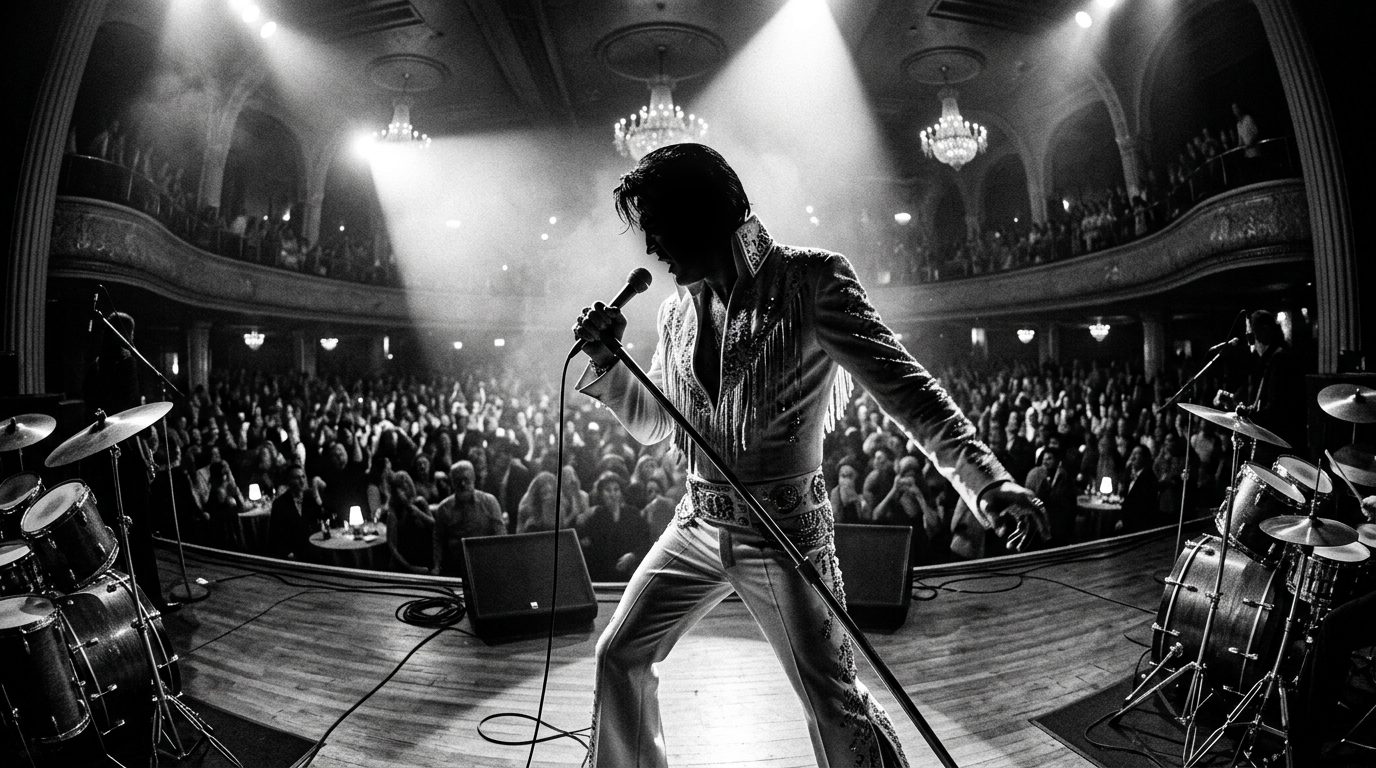
During this period, he also undertook extensive tours across the country. His concerts were major cultural events, with critics and celebrities in the audience. His voice, though no longer as pure as in his youth, had gained a profoundly moving depth and maturity. His stage presence, honed over decades, was masterful: controlled yet explosive, a testament to a lifetime dedicated to the art of performing.
In 1973, Elvis performed a concert in Honolulu, Hawaii, broadcast live via satellite. *Aloha from Hawaii* was a landmark event: the first concert by a solo artist to be broadcast globally, seen by approximately 1.5 billion people worldwide. The live album that resulted from that broadcast reached number 1 on the Billboard 200. For many, *Aloha from Hawaii* represented the definitive peak of his career as a performer. The previous year, the documentary *Elvis on Tour*, directed by Pierre Adidge and Robert Abel, had won the Golden Globe Award for Best Documentary Feature, capturing Elvis’s energy and magnetism on stage like no other audiovisual recording had done.
However, while his artistic and commercial success shone brighter than ever, Elvis’s personal life was quietly unraveling. His marriage to Priscilla deteriorated, and they separated in 1972. The divorce was finalized in 1973, with Priscilla gaining custody of Lisa Marie. Although devastated, Elvis channeled his grief into songs like “Burning Love” (1972) and “Separate Ways” (1973), in which his voice expressed a vulnerability rarely seen in his public performances.
His health problems were also worsening. His prescription drug use continued to increase. His weight fluctuated dramatically, reflecting a constant struggle with depression and anxiety. Dr. Nichopoulos continued prescribing, seemingly without questioning the pattern of use. Friends and family expressed concern, but Elvis, accustomed to having his wishes fulfilled, rejected any suggestion that he needed help. At the height of his stage power, the King was in a slow but inexorable downward spiral.
Chapter 9: The Twilight of the King (1974-1975)
As Elvis entered the latter half of the 1970s, the signs of his decline became increasingly apparent. Although he continued to fill venues in Las Vegas and on his tours, his physical and mental health deteriorated before the public eye. His weight increased significantly, from the 170 pounds of his youth to over 250 pounds at times. His once fluid and explosive stage movements became slower and more labored. Critics who saw him perform during this period noted that something fundamental had changed. He was no longer the dynamic performer who had captivated the world in 1968 and 1969: he was a man struggling, both physically and emotionally, to maintain his status as the King.
In 1974, he released *Promised Land*, whose title track reached number 14 on the Billboard Hot 100. The album was a commercial success, but critics felt Elvis was merely going through the motions, recording songs that didn’t challenge him artistically. In 1975, *Today* proved even less successful. Album sales began to decline, reflecting his diminishing cultural relevance. Popular music was evolving toward punk, disco, and progressive rock, and Elvis—once the symbol of youthful rebellion—was seen by many as a relic of another era.
Colonel Parker, now in his seventies, continued to pressure Elvis to perform more concerts, tour more, and record more. He was the engine that kept the machine running, regardless of the toll it took on the man who fueled it. Elvis complied, though with increasing reluctance.
His personal life remained turbulent. After his divorce from Priscilla, he had a series of relationships widely covered by the press. None of them provided the kind of emotional stability he needed. His reliance on prescription drugs continued to increase, and with it, the gradual distancing from the person he had once been.
Chapter 10: The Last Tour (1975-1976)
In 1975 and 1976, Elvis embarked on a series of tours that took him to the biggest stages in the country, including Madison Square Garden in New York and the Forum in Los Angeles. His concerts continued to sell out weeks in advance, a testament to his enduring power as a draw. However, those who saw him perform during this period noticed a disturbing change. It was no longer passion that drove his performances: it was obligation. It was as if he were playing the role of Elvis Presley rather than being him.
In 1976, he released From Elvis Presley Boulevard, Memphis, Tennessee, recorded at Graceland. The album included moments that demonstrated his talent was still intact, but overall it was seen as a lesser effort. Sales were disappointing compared to his earlier work. His Las Vegas residencies, although still selling out, had become predictable: the same repertoire night after night, with little or no change.
Elvis’s health continued to deteriorate. His weight fluctuated dramatically. He suffered from chronic constipation, aggravated by his poor diet and heavy medication use. He began experiencing heart problems: arrhythmias and high blood pressure. Dr. Nichopoulos continued prescribing medications for these issues without seeming to address the underlying causes. Elvis rejected any suggestion that he needed to make fundamental lifestyle changes.
His relationship with his family also became strained. His father, Vernon, was aging and becoming ill. His daughter, Lisa Marie, now a teenager, was growing up in the shadow of a fame that complicated everything. Members of his inner circle, known as the “Memphis Mafia,” expressed concern for his well-being. But Elvis, accustomed to invincibility, dismissed their warnings. He continued living as if his body could indefinitely endure the abuse he was inflicting upon it.
Chapter 11: The Shadow of Mortality (1977)
The first few months of 1977 foreshadowed what was to come. Elvis toured the southern United States in January and February. Critics who saw him noted that he was visibly ill: his voice was weak and inconsistent, his stage presence grim. He had to cancel several concerts due to health problems and was briefly hospitalized once for intestinal complications. It was clear to everyone around him that something was fundamentally wrong.
In June 1977, Elvis embarked on his final tour, which took him through the Midwest and the South. It was a difficult tour. At a performance in Indianapolis, his voice was so weak that it was almost inaudible in some passages. Reporters documented his gaunt appearance and lack of energy. After the tour, she returned to Graceland to rest before a new Las Vegas residency scheduled for August.
In late July 1977, Elvis remained at Graceland, surrounded by family and close friends. He continued to take massive amounts of medication prescribed by Dr. Nichopoulos. His diet remained extremely poor, and his weight had exceeded 250 pounds. He seemed to be in complete denial about the seriousness of his condition.
On the afternoon of August 16, 1977, Elvis retired to his private quarters at Graceland. It was the last time he was seen alive. The following morning, his girlfriend, Ginger Alden, found him unconscious in the bathroom. She called emergency services, but it was too late. Elvis Aaron Presley, the King of Rock and Roll, was dead. He was 42 years old. The official cause of death was cardiac arrest, although the autopsy revealed high levels of prescription drugs in his system. The man who had revolutionized popular music, who had been a transformative cultural force adored by millions, was no longer there.
Conclusions: The Enduring Influence
The death of Elvis Presley was a seismic event that shook the world. The news spread immediately across all television networks and newspapers. Thousands of people gathered outside Graceland to mourn the King. His funeral was one of the largest events in Memphis history, and his grave in the mansion’s garden became a place of pilgrimage. More than four decades after his death, Graceland remains one of the most visited tourist sites in the United States.
Elvis’s legacy is complex and multifaceted. As an artist, he revolutionized popular music. He was a pioneer of rockabilly, a genre that fused country, blues, and rock and roll in a completely new way. His influence is immeasurable: artists such as The Beatles, the Rolling Stones, David Bowie, and Bruce Springsteen have cited him as a fundamental influence. His ability to fuse disparate genres, his versatile voice, and his magnetic stage presence made him unique.
But Elvis was more than a musician. He was a cultural symbol of transformation and change. His rise to fame in the 1950s coincided with a period of profound racial tension in the United States, and his music—which fused the musical traditions of Black and white people—was a force for cultural integration. For parents of the time, Elvis was a threat. For young people, he was the promise of freedom, the possibility of breaking with social conventions and living more authentically.
“Elvis is the reason I have a music career. His influence on my life was profound. He showed that it was possible to be authentic, to be different, to be yourself, and still be loved by millions of people.”
— Bruce Springsteen
As an actor, Elvis achieved commercial success but limited artistic success. He starred in 31 films between 1956 and 1969, many of them box-office hits. However, with the exception of *King Creole* and *Flaming Star*, most were trivial vehicles. His film career exemplifies how commercial appeal can overshadow artistry. Even so, even in his lighter films, Elvis displayed an almost mesmerizing charismatic presence.
As a person, he was profoundly complex. Adored by millions, yet often alone. A genius artist capable of creating music that moved people, and at the same time, a man unable to navigate the complexities of his own existence. He was raised to believe he could have anything he wanted, and he discovered that money and fame couldn’t buy happiness or peace of mind. His reliance on drugs reflected his inability to cope with the emotional pain that accompanied his fame.
Elvis’s death also ignited a broader conversation about how the entertainment industry treats its stars. Dr. Nichopoulos was subsequently investigated for his role in prescribing drugs, and his medical license was suspended for a period. Elvis’s tragedy highlighted the dangers of prescription drug dependency, a problem that remains critical in contemporary society.
Today, Elvis Presley has been inducted into multiple halls of fame, including the Rock and Roll Hall of Fame, the Gospel Music Hall of Fame, and the Country Music Hall of Fame. In 2018, he was posthumously awarded the Presidential Medal of Freedom, America’s highest civilian honor. He was a man who was both a victim and a beneficiary of his own genius: a king who ruled over an empire of music and culture but was unable to govern his own life. His legacy is complex, contradictory, and profoundly human. It is the legacy of an artist who forever changed popular music and world culture.
Songs and Moments That Define Him
“That’s All Right” (1954)
Recorded on July 5, 1954 at Sun Records, it was Elvis’s first single and the beginning of it all. The song, originally recorded by Arthur “Big Boy” Crudup in 1946, was transformed by Elvis into something entirely new: faster, more energetic, charged with an emotion that made it sound as if it were being sung for the very first time. Scotty Moore’s guitar provided the catchy riff, Bill Black’s bass the rhythmic pulse, and Elvis’s voice navigated between tenderness and rawness. It captures the exact moment rockabilly was born and popular music changed forever.
“Heartbreak Hotel” (1956)
Released in January 1956, it was Elvis’s first number one hit on the Billboard Hot 100. Written by Mae Boren Axton and Tommy Durden, the song was a dark meditation on loneliness with an almost gothic atmosphere. Elvis’s voice dropped to a whisper in the verses before exploding in the chorus, creating a devastating sense of intimacy and immediacy. It sold millions of copies and remained on the charts for 31 weeks. It proved that Elvis was not just a rock and roll singer: he was an artist capable of expressing complex and profound emotions.
“Hound Dog” (1956)
Recorded in July 1956, it is one of the most iconic songs in his catalog. Originally recorded by Big Mama Thornton in 1953, Elvis’s version was faster, more energetic, and almost palpably powerful. It reached number one on the Billboard Hot 100. It was precisely this song that Elvis sang on The Ed Sullivan Show during the performance that producers censored, filming him only from the waist up. That gesture only fueled the legend.
“Jailhouse Rock” (1957)
Released in September 1957, written by Jerry Leiber and Mike Stoller, it reached number one on the Billboard Hot 100 and lent its name to a film that includes one of the most iconic dance sequences in cinematic history. Elvis executed moves that were both precise and wild, controlled and chaotic. The song captures the essence of what made him unique: the ability to combine technical precision with overflowing emotional passion.
“Can’t Help Falling in Love” (1961)
Released in November 1961 as part of the soundtrack for Blue Hawaii, this romantic ballad demonstrated Elvis’s versatility as an artist. Written by Hugo Peretti, Luigi Creatore, and George David Weiss, its gentle ukulele introduction gave it an intimate, almost tropical feel. Elvis’s voice expressed the vulnerability of love with a depth few performers could match. It reached number 2 on the Billboard Hot 100 and eventually became one of the most popular wedding songs in the world.
“Suspicious Minds” (1969)
Released in August 1969 and written by Mark James, it was Elvis’s first number one hit in seven years. Recorded during the From Elvis in Memphis sessions, the song proved that Elvis could still connect with contemporary audiences in the midst of the progressive rock era. Its arrangement, with an almost cinematic orchestral bridge, was a display of artistic ambition. It was the moment when Elvis proved, without a doubt, that he was still a vital force.
“If I Can Dream” (1968)
Written by W. Earl Brown specifically for the Comeback Special, it was a passionate plea for peace and understanding in a year devastated by the assassinations of Martin Luther King Jr. and Robert F. Kennedy. Elvis’s deeply emotive and almost religious voice gave it a dimension that transcended mere entertainment. It reached number 12 on the Billboard Hot 100 and remains one of the most powerful moments of his entire career.
“Burning Love” (1972)
Released in August 1972 and written by Dennis Linde, it was one of Elvis’s last major hit songs. It reached number 2 on the Billboard Hot 100 and proved that even as his personal life was falling apart, he was still capable of recording contemporary material that resonated with audiences. The steady rhythm guitar and vocal intensity make it a time capsule: the energy of a performer at his stage peak, recorded while the man singing it was fighting battles the stage couldn’t reveal.