Chapter 1: The Prince of Darkness on the Throne of Madness
The thick air backstage at the Iowa Memorial Union in Des Moines vibrated with an almost electric energy. It was January 20, 1982, a frigid night that would go down in rock and roll history for an act as infamous as it was iconic. On a threadbare sofa, covered by a towel bearing his own tour logo, lay John Michael Osbourne, known worldwide as Ozzy, the self-proclaimed Prince of Darkness. At 33, the former Black Sabbath vocalist was at the peak of his solo career, but also on the brink of his own downfall.
The tour for his second album, Diary of a Madman, was a spectacle of pure gothic theatricality. The stage replicated a medieval castle, the playground of an Ozzy who, night after night, indulged in a ritual of calculated excess: he threw chunks of raw meat into the audience, drank from a chalice like a dark monarch, and moved with the frenetic energy of a man possessed by the very demons he sought to summon. But that night in Des Moines, the line between spectacle and reality would blur in a grotesque and unforgettable way.
In the midst of the frenzy of “Crazy Train,” a young man in the audience threw what Ozzy, in the dim light of the moment, thought was a rubber bat onto the stage. Without hesitation, he picked it up and sank his teeth into it. The metallic taste and the unmistakable texture of flesh and bone revealed the terrible truth: the animal was real. The crowd roared, a mixture of horror and fascination, as Ozzy was carried offstage, his mouth bleeding, to receive a series of painful rabies shots.
This incident, which has become one of rock’s most enduring legends, perfectly encapsulates the archetype of Ozzy Osbourne: the ultimate rebel, the man who took heavy metal spectacle to its wildest limits. He wasn’t just a singer; he was a performer, a martyr of excess, a court jester in the chaos he himself had created. His career, both with Black Sabbath and as a solo artist, is a testament to a life lived on the edge of the abyss: a saga of self-destruction and redemption, of musical genius and unbridled madness.
To understand how John Michael Osbourne, a dyslexic, working-class boy from industrial Birmingham, transformed into the iconic Ozzy, the Godfather of Heavy Metal, one must go back to the bleak post-war days in England, where the roar of factories and the hopelessness of a generation forged the sound of a musical revolution that would change the world forever.ç
Chapter 2: The Hammer of the Gods Forged in Birmingham
To find the root of the thunder that would one day shake the foundations of the world, one must travel to Aston, an industrial suburb of Birmingham, in the years following the Second World War. In that landscape of brick and soot, where the rhythm of life was dictated by factory sirens and the air smelled of molten metal, John Michael Osbourne was born on December 3, 1948. He was the fourth of six children in a working-class family struggling, like so many others, to make ends meet in a nation still licking its wounds.
His father, John Thomas Osbourne, worked night shifts as a toolmaker at the General Electric Company, while his mother, Lilian, a devout Catholic with a secret passion for show business, worked during the day in an automotive parts factory. The Osbourne home at 14 Lodge Road was modest, not to say precarious. Scarcity was a constant companion, a reality that shaped young John’s character from his earliest years.
School quickly became a personal battleground. Diagnosed with dyslexia and other learning disabilities at a time when such conditions were poorly understood and often stigmatized, he felt like an outcast. Teachers called him slow; his classmates bullied him. This torment led him to develop a shell of humor and rebelliousness as a defense mechanism.
“I was always the class clown to keep them from hitting me. It was like, if I can make them laugh, they won’t beat me up.”
That need to perform, to capture attention in order to survive, was the first seed of the future stage star. Outside the classroom, life was no less challenging. The lack of opportunities and the monotonous routine pushed him toward juvenile delinquency. At 17, his criminal career came to an abrupt end when he was arrested for shoplifting and, unable to pay the fine—his own father refused, seeking to teach him a lesson—he was sentenced to six weeks in Winson Green Prison. That terrifying and humiliating experience was a turning point.
The true epiphany, however, didn’t come from within the walls of a building, but rather through the airwaves of a radio. The explosion of the “British Invasion,” and in particular the music of The Beatles, was a ray of light in his gloomy existence. Seeing four young men from Liverpool, from backgrounds not unlike his own, conquer the world with their music opened a door to a universe of possibilities he had never imagined. With a borrowed microphone and a small amplifier, he began his journey. After a series of monotonous jobs—apprentice plumber, car horn tuner—he decided to pursue his one true passion. He placed an ad in a local music shop: “Ozzy Zig Needs Gig – Has Own P.A.”
That modest poster caught the attention of two musicians from his old neighborhood, guitarist Tony Iommi and drummer Bill Ward, who were forming a new band. Although Iommi remembered Ozzy from school as an “idiot,” the need for a vocalist led them to give him a chance. Along with bassist and lyricist Geezer Butler, they first formed Polka Tulk Blues Band, and then Earth. Little did they know they were laying the foundations for one of the most influential bands in history. The hammer of the gods, forged on the anvil of industrial Birmingham, was about to strike.
Chapter 3: The Black Mass: The Birth of Black Sabbath
By the late 1960s, the band known as Earth had built a modest but solid reputation on the Birmingham pub and club circuit. Their repertoire, an energetic mix of blues-rock in the vein of Cream and Ten Years After, ensured a steady stream of gigs. However, fate was about to conspire to push them into completely uncharted musical territory. They discovered that another group already existed with the name Earth, forcing them to seek a new identity.
Inspiration came from a decidedly dark source. Outside their rehearsal space, they were projecting the 1963 Italian horror film I tre volti della paura, known in English as Black Sabbath. Geezer Butler, the band’s bassist and main lyricist, watched with fascination the long lines of people willing to pay to be scared. The idea seemed revolutionary to him: if people paid to be scared at the movies, why wouldn’t they pay to be scared by music? Butler, an avid reader of occult novels by authors like Dennis Wheatley, was already exploring dark themes in his lyrics. He suggested the name, and although there were initial doubts, the power of the name Black Sabbath ultimately prevailed.
“”I thought, if people pay to see horror movies, maybe they’ll like horror music. It was a very logical idea to me.” — Geezer Butler
The change was much more profound than a simple name. The key to the new sonic identity was an industrial accident that, paradoxically, became a blessing. At 17, Tony Iommi had lost the tips of the middle and ring fingers of his right hand in a metal press. Devastated and on the verge of giving up on the guitar, a friend introduced him to jazz guitarist Django Reinhardt, who also played with injured fingers. Inspired, Iommi created homemade prosthetics from melted plastic and leather. To be able to play, he had to tune his guitar lower, reducing the string tension. This adjustment not only made it easier to play: it created a heavier, denser, and more ominous sound. It was the birth of the heavy metal riff.
One of the first songs to emerge from this metamorphosis was, precisely, “Black Sabbath.” Built on a three-note riff based on the tritone—an interval known since the Middle Ages as the Diabolus in Musica for its dissonance—it was the perfect soundtrack for a horror film. The lyrics, inspired by an experience Butler claimed to have had with a dark figure at the foot of his bed, were performed by Ozzy with a voice that conveyed both dread and vulnerability. The combination was hypnotic.
The creative synergy of the quartet was the driving force behind this revolution. Iommi’s guitar, with its monolithic riffs, was the foundation. The rhythm section of Butler and Ward provided a powerful and fluid base, with the bass often acting as a second guitar and Ward’s drums adding a jazz-influenced complexity. And above all, there was Ozzy’s unmistakable voice: his high, plaintive timbre, his unique phrasing, and his natural charisma made him the perfect harbinger of the apocalypse. Together, they hadn’t just created a band; they had invoked a new genre. The black mass had begun.
Chapter 4: Paranoia and Paradise: The Conquest of the World
On Friday, February 13, 1970, Vertigo Records released Black Sabbath‘s self-titled debut album in the UK. The cover, with its spectral image of a woman dressed in black in front of a watermill, was a visual premonition of the sound within. Recorded in a mere twelve hours on a shoestring budget, the album was met with disdain by critics, who dismissed it as crude, noisy, and simplistic. Yet, for a youth disillusioned with the hippie optimism of the previous decade, that dark, heavy sound was an anthem. The record entered the top 10 of the British charts, a commercial success that defied critical consensus and demonstrated the existence of a massive audience hungry for this new and menacing sound.
With no time to savor their success, the band was pressured by their record company to quickly produce a new album. In September 1970, just seven months after their debut, they released *Paranoid*. The album was a quantum leap in production and songwriting. The title track, composed at the last minute in the studio, became an unexpected hit and the band’s most recognizable anthem. With its driving riff and lyrics about mental anguish, “Paranoid” catapulted Black Sabbath to international stardom. The album also included two of the genre’s most iconic pieces: “War Pigs,” a scathing critique of the Vietnam War, and “Iron Man,” a science fiction story about a man who travels through time and becomes a metallic avenger. *Paranoid* reached number one in the UK and sold millions of copies worldwide.
“We never set out to be controversial. We simply wrote about the things around us: war, death, madness. We were a reflection of our time.”
Success brought with it a lifestyle of excess that would become an integral part of the band’s legend. Tours became a whirlwind of concerts, travel, and endless parties. Drugs and alcohol became the fuel that kept the Black Sabbath machine running, but they also began to erode the relationships and health of its members. Ozzy, in particular, embraced the role of the mad frontman with self-destructive enthusiasm, cultivating a public image that was both fascinating and terrifying.
Despite the chaos, the band managed to maintain an impressive creative streak. In 1971, they released *Master of Reality*, an album even heavier and darker than its predecessors. With Iommi tuning his guitar three semitones lower, the sound became denser and muddier, laying the groundwork for what would later be known as stoner rock and doom metal. Songs like “Sweet Leaf,” an ode to marijuana, and “Children of the Grave,” a galloping pacifist anthem, demonstrated the band’s continued evolution. Black Sabbath had conquered the world, but the paradise they had found was riddled with paranoia and inner demons.
Chapter 5: The Dizzying Heights of Success and the Shadow of Disintegration
By 1972, the Black Sabbath machine was an unstoppable beast. Following the massive success of their first three albums, the band relocated to Los Angeles to record Vol. 4. The title was an ironic reference to peace and love, but the album credits thanked “the great L.A. COKE Company.” Cocaine flowed as freely as musical ideas, resulting in an album that was both expansive and unfocused. Songs like “Snowblind,” a not-so-subtle ode to their new favorite drug, coexisted with the piano ballad “Changes” and devastating riffs like “Supernaut.” Vol. 4 revealed the first cracks in their armor.
The following album, Sabbath Bloody Sabbath (1973), was a conscious attempt to regain creative control. The band retreated to a castle in Wales in search of inspiration. The result was one of their most acclaimed records: a complex and progressive work incorporating synthesizers, strings, and orchestral arrangements. They enlisted Rick Wakeman, the keyboardist from Yes, to play on the track “Sabbra Cadabra.” The album was a success, but the pressure to maintain creative and commercial momentum was beginning to take its toll. Internal tensions, exacerbated by substance abuse and touring fatigue, intensified.
“We were getting to the point where we couldn’t even look at each other. We were four guys who hated each other and had to go on stage together.”
Sabotage (1975) was the sound of a band at war: with itself and with its management. The title was a direct reference to the legal problems with their former manager. The music was aggressive, almost desperate. Songs like “Hole in the Sky” and “Symptom of the Universe”—the latter considered a precursor to thrash metal—displayed a renewed ferocity, but the recording process was a hell of constant fighting. Ozzy felt increasingly alienated, his voice relegated to the background by Iommi’s complex arrangements.
The breaking point came with *Technical Ecstasy* (1976). It was Iommi’s attempt to steer the band in a more commercial and melodic direction, a decision that clashed head-on with Ozzy’s rawer sensibilities. The song “It’s Alright,” sung by drummer Bill Ward, was the final straw. Ozzy felt like a stranger in his own band. In 1977, after a chaotic tour and with his marriage falling apart, he left Black Sabbath.
Although his departure was brief—he returned a few months later to record the mediocre *Never Say Die!* (1978)—the magic was gone. The album was a commercial failure, the sound of a band on autopilot. In 1979, while trying to start a new album, Tony Iommi, with the support of Butler and Ward, fired Ozzy Osbourne. The Prince of Darkness had been dethroned. It seemed like the end of the story; in reality, it was only the end of the first act.
Chapter 6: Blizzard of Ozz: The Phoenix Rises
Fired from the band he co-founded, Ozzy Osbourne spiraled into depression and self-destruction. He holed up in a Los Angeles hotel, drowning his sorrows in alcohol and drugs. The future seemed bleak. However, an unexpected figure emerged from the shadows to offer him not just a helping hand, but a battle plan: Sharon Arden, the daughter of Don Arden, Black Sabbath’s feared and powerful manager.
Sharon, who had worked in her father’s office and known Ozzy since adolescence, saw in him a wasted talent and undeniable charisma that Black Sabbath, in her opinion, had stifled. With unwavering faith in his potential, she became his manager, his confidante, and eventually, his wife. Their first task was to get him out of the hotel and out of his lethargy. The strategy was clear: form a new gang and show the world that the Prince of Darkness was a force to be reckoned with.
Through a series of auditions in Los Angeles and London, they assembled a band of exceptional talent. Bassist Bob Daisley, a veteran of Rainbow and Uriah Heep, provided a solid musical foundation and great songwriting ability. Drummer Lee Kerslake, also of Uriah Heep, supplied the rhythmic power. But the key piece, the secret weapon that would define Ozzy’s new sound, was a young and prodigious guitarist of just 23 years old: Randy Rhoads.
“When I heard Randy play, I was speechless. It was like God had sent me an angel. He was everything I wasn’t: disciplined, musically educated, and with an incredible work ethic. He saved me.”
Rhoads, until then known primarily in the Los Angeles scene as the guitarist for Quiet Riot, was a virtuoso who fused the ferocity of rock with the elegance of classical music. His playing style, precise yet explosive, was the perfect counterpoint to Ozzy’s voice and personality. The collaboration was instant and fruitful: Ozzy hummed melodies, and Rhoads transformed them into memorable riffs and solos, while Daisley handled most of the lyrics.
The result was *Blizzard of Ozz*, Ozzy Osbourne’s debut solo album, released in September 1980. Songs like “I Don’t Know,” “Crazy Train,” and “Mr. Crowley” were perfectly crafted heavy metal anthems, with unforgettable riffs, dazzling solos, and an energy that had been absent from Black Sabbath’s later work. “Crazy Train” became an instant rock radio classic. The phoenix had risen from the ashes, bigger and brighter than ever.
Chapter 7: Diary of a Madman and Randy’s Farewell
The success of Blizzard of Ozz confirmed that the creative partnership between Ozzy Osbourne and Randy Rhoads was a force of nature. The band quickly returned to the studio to capitalize on the momentum. The result was Diary of a Madman, released in November 1981. If Blizzard was the statement of intent, Diary was the masterpiece: darker, more complex, and more ambitious than its predecessor, with an astonishing level of musical maturity achieved in a short period of time.
The album opens with the ominous “Over the Mountain,” a whirlwind of riffs and rhythms that immediately establishes a tone of urgency and power. The title track is a six-minute-plus epic that showcases the incredible synergy between Daisley’s lyrical vision, Ozzy’s dramatic vocal performance, and, above all, Rhoads’ songwriting genius. The piece incorporates classically inspired acoustic sections, ghostly backing vocals, and one of the most memorable guitar solos of his career. The album was another resounding success, and the tour that followed became one of the most legendary and controversial in rock history.
“Randy was such an incredible musician. He could take a simple idea of mine and turn it into a symphony. He was my muse, my partner, my brother. Losing him was like losing a part of myself.”
It was during this tour, in Des Moines, Iowa, that the infamous bat incident occurred. But the real, devastating tragedy was just around the corner. On March 19, 1982, the band was en route to a festival in Orlando, Florida. The tour bus stopped in Leesburg for repairs. The driver, Andrew Aycock, who was a licensed pilot, invited Randy Rhoads and the band’s makeup artist, Rachel Youngblood, for a ride in a small Beechcraft Bonanza airplane that was in a nearby hangar. During the flight, Aycock—who later tested positive for cocaine—began making low passes over the bus in an attempt to wake those sleeping inside. On the third pass, the plane’s wing clipped the roof of the bus, causing the aircraft to spin out of control, crash into the garage of a nearby house, and burst into flames. All three occupants were killed instantly.
The death of Randy Rhoads at the age of 25 was a devastating blow to Ozzy and the music world. One of the brightest talents of his generation had been lost. The tour was canceled, and for a time it seemed that Ozzy’s career, which had resurfaced so spectacularly, might end along with the life of his young and brilliant guitarist.
Chapter 8: The Jake E. Lee Era
The silence left by Randy Rhoads’ guitar was deafening. Ozzy Osbourne faced an impossible dilemma: how to continue without the architect of his resurrection. Pressed by contractual obligations and by Sharon, who insisted that the best way to honor Randy was to move on, Ozzy embarked on the painful search for a new guitarist. After a stint with Bernie Tormé and then with Brad Gillis to complete the tour, the band needed a permanent replacement.
The choice fell on Jake E. Lee, a guitarist from San Diego with a flashy and technical style, influenced by both the blues and the virtuosity of the era. The pressure on him was immense: not only did he have to fill the shoes of a legend, but he had to do so in a band that was still in mourning. The result of this new lineup was *Bark at the Moon*, released in 1983. The album was a massive commercial success, propelled by the music video for the title track, which became a staple of the fledgling MTV. In it, Ozzy played a scientist who transforms into a werewolf, an image that was seared into the pop consciousness of the 1980s.
Musically, *Bark at the Moon* was more polished and straightforward than its predecessors, with a sound closer to the commercial metal that dominated the decade. While it lacked the neoclassical depth of the albums with Rhoads, Jake E. Lee’s talent was undeniable, and songs like the ballad “So Tired” and “Bark at the Moon” itself became classics in Ozzy’s repertoire. However, controversy overshadowed the release: Jake E. Lee and bassist Bob Daisley claimed they hadn’t received proper credit or royalties for their songwriting work, a pattern of financial disputes that would repeat itself throughout Ozzy’s career.
“After Randy, I was lost for a while. Every guitarist I tried, I compared to him. Jake was a great guitarist, but he was different. I had to learn to work in a new way.”
The following album, *The Ultimate Sin* (1986), took commercialization a step further. With even more polished production and a look that embraced the glam metal aesthetic, it was Ozzy’s most commercially successful album to date. The single “Shot in the Dark,” with its catchy chorus and heavily played video, became his biggest solo hit. Despite its commercial success, the album is viewed by many fans as a creative low point, and Ozzy himself has expressed disdain for it, feeling that he had strayed too far from his roots. Jake E. Lee was abruptly fired after the tour, and Ozzy’s relationship with his personal demons reached a new and dangerous peak.
Chapter 9: No More Tears: The Quest for Redemption
Following the commercial success but creative dissatisfaction of The Ultimate Sin, Ozzy Osbourne needed a new direction and a new guitarist. The search was exhaustive. Among the audition tapes received from all over the world, one in particular—sent by a young, unknown guitarist from New Jersey named Zakk Wylde—immediately caught Sharon and Ozzy’s attention. Wylde, with his Viking-like appearance, aggressive technique, and use of artificial harmonics, was the heavy, fresh air the band desperately needed.
The addition of Wylde marked the beginning of one of the longest-lasting collaborations of Ozzy’s career. The first album they recorded together, *No Rest for the Wicked* (1988), was a return to form. The sound was rawer, heavier, and darker than its predecessor. Songs like “Miracle Man,” a scathing jab at televangelist Jimmy Swaggart, and “Crazy Babies” showcased a renewed energy. The album also marked the return of Geezer Butler, the legendary bassist of Black Sabbath, who joined the band for the tour.
However, Ozzy’s personal demons continued to wreak havoc. His alcoholism reached a boiling point in 1989, during the Moscow Music Peace Festival in Moscow. In an alcoholic stupor, he attempted to strangle Sharon. He was arrested and, waking up in a cell with no memory of what had happened, he was confronted with the harsh reality of his addiction. Sharon gave him an ultimatum: either he sought help or he lost everything. Ozzy finally agreed to enter rehab.
“Hitting rock bottom was the best thing that could have happened to me. I realized I was going to die if I didn’t stop. Rehab saved my life. It wasn’t easy, and I’ve had relapses, but that was the first time I really wanted to change.”
The result of that newfound sobriety was *No More Tears*, released in 1991. The album is considered by many to be one of the high points of Ozzy’s solo career. With the help of outside producers and songwriters like Lemmy Kilmister of Motörhead, who co-wrote four of the songs, including the ballad “Mama, I’m Coming Home,” the album was a masterpiece of melodic heavy metal. The title track, with its iconic bassline and epic structure, is a tour de force. “Road to Nowhere” is a poignant reflection on his struggle with addiction. The album sold millions of copies and cemented Ozzy’s status as a living legend.
Feeling on top of the world, Ozzy announced that the tour accompanying the album, dubbed “No More Tours,” would be his farewell to the stage. He wanted to retire, spend more time with his family, and preserve his newfound sobriety. The Prince of Darkness, it seemed, was ready to abdicate. But the throne of rock and roll isn’t something one simply walks away from.
Chapter 10: The Television Era
Ozzy Osbourne’s supposed retirement lasted less than a Zakk Wylde guitar solo. The “No More Tours” tour culminated in November 1992 with two shows in Costa Mesa, California, where Black Sabbath, with Rob Halford of Judas Priest as guest vocalist, opened the show. The night ended with a surprise reunion of the original lineup on stage for the first time in over a decade. The energy was electric, a harbinger of things to come. “Retiring at 46 isn’t as great as it sounds,” Ozzy himself later joked. Boredom and restlessness quickly set in. The beast of the stage couldn’t be caged for long.
After a period of relative calm, Ozzy returned to the studio with a new team of musicians, including guitarist Steve Vai. Although this collaboration didn’t result in a full album, it did lay the groundwork for *Ozzmosis*, released in 1995, with Zakk Wylde back on guitar. The album featured a darker, more melancholic sound, influenced by the alternative rock that dominated the era. Songs like “Perry Mason” and the ballad “See You on the Other Side” proved that Ozzy was still capable of creating relevant and powerful music. The accompanying tour, ironically named “The Retirement Sucks Tour,” returned him to his natural habitat: the stage.
However, Ozzy’s greatest act of reinvention in the 1990s didn’t happen in a recording studio, but in the world of music business. In 1996, after being denied a spot at the Lollapalooza festival, Sharon Osbourne, with her characteristic instinct for turning setbacks into opportunities, decided to create her own festival. Thus, Ozzfest was born. Conceived as a traveling heavy metal festival, it became an institution: a launching pad for a new generation of bands and a haven for veterans of the genre. Ozzfest revitalized Ozzy’s career and redefined the metal landscape in a decade dominated by grunge.
“Ozzfest was Sharon’s idea. I was told I wasn’t ‘cool’ and that metal was dead. So we said, ‘Screw it, we’ll do our own festival.’ And it became the biggest thing we’d ever done.”
The success of Ozzfest paved the way for the most anticipated reunion. In 1997, the original Black Sabbath lineup—Ozzy Osbourne, Tony Iommi, Geezer Butler, and Bill Ward—reunited for a series of concerts culminating in two nights in their hometown of Birmingham. The concerts were recorded and released on the live album *Reunion* (1998), which included two new studio tracks: “Psycho Man” and “Selling My Soul.” The band won their first Grammy Award for their live performance of “Iron Man.” A full circle, a vindication for the four lads from Aston who had changed the world.
But Ozzy’s greatest transformation was yet to come. In 2002, the world was invited into the Osbourne household through the MTV reality show *The Osbournes*. The show, which followed the daily lives of Ozzy, Sharon, and their children Jack and Kelly, became an unprecedented cultural phenomenon. It presented a very different Ozzy from the Prince of Darkness: an awkward, confused, and endearing family man who struggled with the remote control and picked up after his countless dogs. The show turned him into a pop culture star, beloved by millions who had never even heard a Black Sabbath song. The Patriarch of Darkness had become, against all odds, America’s lovable, dysfunctional dad.
Chapter 11: The Twilight of a Titan
Ozzy Osbourne’s television fame in the early 21st century catapulted him to a level of celebrity that transcended music. He became a pop culture icon, a familiar face on talk shows and at award ceremonies. However, this newfound status didn’t halt his musical career. In 2001, he released Down to Earth, a solid album that, while not reaching the heights of his classic work, demonstrated that he still had the ability to produce quality heavy metal. But decades of excess were beginning to take an increasingly visible toll.
In 2003, a serious accident nearly cost him his life. While driving a quad bike on his property in England, he lost control, and the vehicle overturned on top of him, fracturing his collarbone, eight ribs, and a vertebra in his neck. The injury was so severe that he had to be placed in an induced coma. Recovery was slow and painful, and it marked the beginning of a series of health problems that would plague him in the years to come. Despite everything, he returned to the stage to headline Ozzfest 2004.
The following decade was a period of ups and downs. He released two more solo albums, *Black Rain* (2007) and *Scream* (2010), and continued to tour less frequently. The Black Sabbath reunion also had its own dramas. In 2011, the band announced they were working on a new album with producer Rick Rubin and planning a world tour. However, fans’ joy was dampened by Tony Iommi’s lymphoma diagnosis and a contract dispute that led to the exclusion of original drummer Bill Ward from the project. Despite these setbacks, and with Brad Wilk of Rage Against the Machine on drums, they released *13* in 2013, their first studio album with Ozzy in 35 years. The album debuted at number one on charts worldwide and won a Grammy Award.
The ensuing world tour, dubbed “The End,” was billed as the band’s final farewell. On February 4, 2017, in their hometown of Birmingham, Black Sabbath played their last concert. The circle, finally, had been completed.
“Knowing this is the last time is bittersweet. It’s the end of an incredible era in my life. But I’m not retiring. I’ll continue with my solo career. Music is my life; I don’t know how to do anything else.”
True to his word, Ozzy embarked on his own farewell tour, “No More Tours II.” However, fate had other plans. A severe staph infection in his hand and pneumonia forced him to postpone several dates. The hardest blow came in 2019 when a fall at home aggravated injuries from his 2003 accident, requiring major neck and back surgery. During his convalescence, in a January 2020 interview, Ozzy revealed to the world that he had been diagnosed with Parkinson’s disease. The news shocked his fans, but Ozzy, with his characteristic fighting spirit, refused to give up.
Chapter 12: An Ordinary Man Facing the Abyss
The 2020s began for Ozzy Osbourne under a leaden sky. In January, the world received the news many feared: Ozzy had been diagnosed with Parkinson’s disease, specifically the PRKN 2 variant. The diagnosis explained the tremors and rigidity that had begun to affect his mobility and his legendary energy on stage. It added to the aftereffects of his 2019 fall, which required neck surgery that left him with chronic pain. For a man who had made physical vitality a central part of his artistic identity, the blow was devastating.
Yet, in the midst of this storm of adversity, an unexpected source of creative redemption emerged. The collaboration with rapper Post Malone on the song “Take What You Want” in 2019 had reconnected him with producer Andrew Watt. That encounter became the catalyst for his twelfth studio album, Ordinary Man, released in February 2020. The album was recorded in a burst of creativity while Ozzy was recovering from surgery. Watt assembled a dream band: Duff McKagan of Guns N’ Roses on bass and Chad Smith of the Red Hot Chili Peppers on drums.
Ordinary Man is a deeply personal and reflective work. The title track, a duet with Elton John, is a monumental ballad where two rock icons reflect on their extraordinary lives and their impending mortality. “I don’t want to die like an ordinary man,” sings Ozzy, a statement that is both a plea and a challenge. In “Under the Graveyard,” he reminisces about his darkest days of addiction, while in “Holy for Tonight,” he contemplates final judgment. The album was critically acclaimed as his best work in decades, featuring collaborations with Slash and Tom Morello, and proved that even facing the abyss, the Godfather of Heavy Metal still had much to say.
“This album was a gift from my higher power. It helped me get out of bed after surgery. It’s proof that music is still the best medicine.” Although the planned tour to promote the album had to be canceled due to his health problems and the subsequent COVID-19 pandemic, the record served as a powerful reminder of his artistic relevance. The man who had built a career on an image of invincibility and madness now presented himself to the world as an “ordinary man” facing an extraordinarily difficult destiny, and in that honesty, he found a new kind of strength.
Chapter 13: Patient Number 9
If Ordinary Man was the sound of vulnerability, its successor was the roar of defiant perseverance. Patient Number 9, released in September 2022, was Ozzy Osbourne’s thirteenth and final studio album: a monumental work, not only for its musical quality, but for the sheer miracle of its existence. Created while Ozzy grappled with chronic pain, multiple surgeries, and the effects of Parkinson’s disease, the album is a testament to his indomitable will to create. Once again produced by Andrew Watt, the record was conceived as a celebration of guitar virtuosity, a pantheon of legends assembled to pay homage to the Prince of Darkness.
The album brought together a who’s who of the greatest guitarists in rock history. The late, legendary Jeff Beck lends his inimitable genius to the title track and “A Thousand Shades.” Former Black Sabbath bandmate Tony Iommi unleashes his seismic riffs on “No Escape from Now” and “Degradation Rules,” marking his first extensive collaboration on an Ozzy solo album. Zakk Wylde returns with his signature pinched harmonics, and Eric Clapton delivers a soulful, bluesy solo on “One of Those Days.” The list of collaborators is rounded out by Pearl Jam’s Mike McCready.
The album’s central theme—encapsulated in the title track and its Todd McFarlane animated video—is that of a patient trapped in a mental institution, a metaphor for Ozzy’s own struggle with his inner demons and physical ailments. The music is heavy, dark, and surprisingly energetic. “Patient Number 9” unfolds as a seven-plus-minute epic with cinematic tension, while “Degradation Rules” is a return to the muddy, heavy sound of early Sabbath. Ozzy’s voice, though marked by time, sounds remarkably strong and full of conviction.
“Having all these incredible musicians on my album is just mind-blowing. It’s like a gift from heaven. Each of them brought their own magic, and I’m so grateful.”
The recognition came quickly. At the 65th Grammy Awards, the album took home the award for Best Rock Album, while “Degradation Rules” won for Best Metal Performance. At 73, confined to his home and recovering from life-altering surgery, Ozzy Osbourne was, against all odds, on top of the music world once again.
Chapter 14: The Last Concert at Villa Park
The circle, which began in the gray industrial suburbs of Birmingham, had to close in the same place. Despite the diagnoses, surgeries, and constant pain, Ozzy Osbourne clung to one last, monumental goal: to say goodbye to his fans on his own terms, in his hometown. On July 5, 2025, that dream became a reality. Under the evocative name “Back to the Beginning,” Villa Park—the stadium of his beloved football team—was transformed into the epicenter of the metal world for a cathartic day of music.
The event was conceived as a celebration of his entire career. Thousands of fans of all generations, dressed in black, filled the stadium, aware that they were about to witness history. The day featured performances by bands representing the past, present, and future of metal, many of which owed their existence to the man they had come to honor.
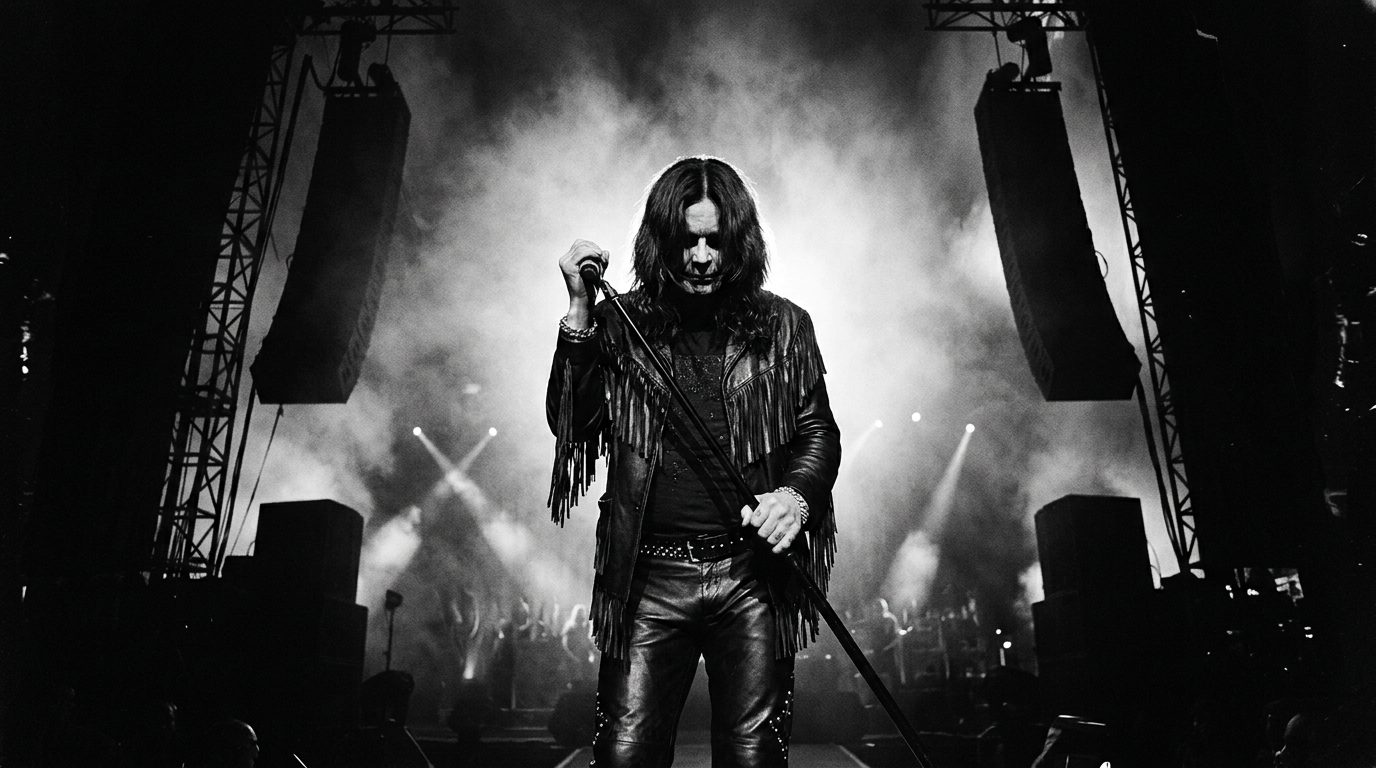
When Ozzy took the stage for his solo set, the ovation was deafening. Visibly frail, leaning on a microphone stand adorned with a cross, but with his usual defiant gaze, he began the ritual. His voice, though worn by time and battle, resonated with unmistakable passion. Classics like “Crazy Train,” “Mr. Crowley,” and “Mama, I’m Coming Home” were sung in unison by the crowd, each song a chapter in the soundtrack of their lives.
But the true apotheosis of the night was yet to come. After a brief intermission, the lights dimmed, and an air raid siren—the sound that had heralded Black Sabbath’s revolution more than five decades earlier—drove through the stadium. One by one, they emerged from the shadows: Geezer Butler, Bill Ward, and Tony Iommi. The original lineup was reunited on stage for the last time. The opening riff of “Black Sabbath” sliced through the air, and time seemed to stand still. They played a short but devastatingly powerful set: “War Pigs,” “Iron Man,” and finally, “Paranoid.”
“Thank you. I love you all.” — Ozzy’s last words on stage.
As the final chords of “Paranoid” faded, the four original members embraced center stage. Ozzy, tears in his eyes, simply thanked the crowd before the curtain fell for the last time. It wasn’t just the end of a concert; it was the end of an era. The ultimate survivor had completed his journey. The final act at Villa Park wasn’t a surrender to illness, but a final declaration of victory.
Chapter 15: The Prince’s Silence
The echo of the final chord of “Paranoid” at Villa Park was still ringing in the hearts of thousands of fans when the rock and roll world fell into an abrupt and desolate silence. Just seventeen days after his triumphant and emotional farewell in Birmingham, the curtain finally fell. On July 22, 2025, John Michael “Ozzy” Osbourne, the indomitable Prince of Darkness, passed away at the age of 76. The news, confirmed by his family, shocked the world, though it wasn’t entirely unexpected. Ozzy’s battle with Parkinson’s disease, along with the accumulated ailments of a life lived on the edge, had finally come to an end.
He died at home, surrounded by his family. The official cause was complications from his long illness. In the days following his final concert, those close to him described a man at peace, exhausted but content. He had fulfilled his last wish: to say goodbye on stage, in his hometown, with his band. It seemed as if, having completed that final mission, his body had finally allowed him to rest.
The reaction was a global outpouring of grief and tribute. Musicians from all genres flooded social media with messages of condolence and admiration. His Black Sabbath bandmates issued joint and separate statements, remembering their “brother” and the incredible journey they had shared. “The world is a much darker place without him,” wrote Tony Iommi. “There will never be another Ozzy.”
“Losing him feels like the sun has gone out. He was more than a singer; he was the energy, the chaos, and the heart of everything we did. Goodbye, my friend.” — Geezer Butler
Media outlets around the world, from British tabloids to prime-time news programs in the United States, devoted extensive coverage to his life and career. Obituaries in publications such as The Guardian, The New York Times, and Rolling Stone praised him not only as a pioneer of heavy metal but also as a cultural icon and one of the most unique and beloved personalities in music history. Rock radio stations across the globe abandoned their regular programming to broadcast marathons of his music. Fans spontaneously gathered at iconic locations, from the Rainbow Bar and Grill in Los Angeles to Birmingham, to leave flowers, candles, and mementos.
The silence of the Prince of Darkness was deafening, but his music roared louder than ever. His death was not the end of his story, but the consecration of his legend.
Chapter 16: The Immortal Legacy of the Father of Heavy Metal
To assess the legacy of Ozzy Osbourne is to trace the very history of heavy metal and, to a large extent, the evolution of the rock star archetype in the 20th and 21st centuries. His passing on July 22, 2025 did not silence his impact; on the contrary, it amplified it, solidifying his status as one of the most crucial and influential figures in popular music. His influence is measured not only in over 100 million albums sold, but in the creation of a genre, the definition of an aesthetic, and the embodiment of a survival saga that transcends music.
Musically, his contribution is a fundamental diptych. First, as the unmistakable voice of Black Sabbath, he was the herald of a sonic revolution. His high-pitched, plaintive voice, that wail that cut through Tony Iommi’s riffs, became the voice of a disillusioned generation. Entire genres—from doom and stoner to thrash and gothic metal—have their DNA directly anchored in Black Sabbath’s early albums. Secondly, his solo career demonstrated astonishing resilience. By teaming up with virtuoso guitarists like Randy Rhoads and Zakk Wylde, he not only remained relevant but helped define the sound of metal in the ’80s and ’90s, fusing heaviness with a melodic, neoclassical sensibility that inspired legions of musicians.
Beyond the music, Ozzy redefined the figure of the frontman. He understood, perhaps better than anyone, that rock and roll is as much theater as sound. The Prince of Darkness, the bat-biting madman, the jester of heavy metal… all were masks of a character cultivated with a mastery that blurred the line between man and myth. His ability to be both terrifying and endearing kept him at the center of popular culture for more than five decades. And when the world thought it had seen it all, he reinvented himself as the dysfunctional patriarch of The Osbournes, humanizing himself before a global audience.
“I’m not a great singer, and I’m not a great musician. I’m an entertainer. I go on stage and make people go crazy. That’s my job.”
His final albums, *Ordinary Man* and *Patient Number 9*, served as a poignant and powerful epilogue to his vast discography. Far from being the work of a fading artist, they were bursts of creativity born from adversity. In these works, Ozzy confronted his own mortality with brutal honesty and unexpected dignity, collaborating with a new generation of artists and legends of his own era. These albums earned him further Grammy Awards in the final stage of his life and reshaped his legacy, revealing the vulnerable man behind the “Madman” myth.
Ultimately, Ozzy Osbourne’s story is the definitive chronicle of survival in rock and roll. He survived poverty, prison, addictions that would have destroyed most, the loss of friends and bandmates, near-fatal accidents, and a debilitating illness. His last concert at Villa Park wasn’t a tragedy, but the final act of a man who lived and died on his own terms. Ozzy Osbourne’s legacy doesn’t reside solely in the grooves of his vinyl records or the MTV archives, but in the idea that a working-class kid from Birmingham could change the world with his voice, his attitude, and an unwavering refusal to be an ordinary man. The Prince of Darkness has fallen silent, but his sonic reign is eternal.
Appendix: Featured and Recommended Works
The discography of Ozzy Osbourne, both with Black Sabbath and as a solo artist, is a vast and often intimidating territory. For those seeking a guide through decades of sonic darkness, this selection represents the pillars upon which his legend was built. It is not an exhaustive list, but a curated starting point for understanding the evolution and impact of the Godfather of Heavy Metal.
With Black Sabbath
1. Paranoid (1970)
Why Listen: If you can only listen to one heavy metal album in your lifetime, it should be this one. Recorded in a burst of creativity, Paranoid is the gospel of the genre. It contains three of the most important anthems in rock history: “War Pigs,” a devastating critique of war; “Iron Man,” with its monolithic riff and science fiction storyline; and the title track, a two-and-a-half-minute onslaught of anxiety that became an unlikely hit. This album not only defined the sound of Black Sabbath but also provided the blueprint for all the metal that followed. The production is raw and visceral, capturing the band’s pure energy at its peak.
2. Master of Reality (1971)
Why listen: This is where the sound gets heavier, denser, and darker. Tony Iommi tuned his guitar three semitones lower, creating a muddy, crushing tone that would lay the foundation for stoner rock and doom metal. From the marijuana ode “Sweet Leaf” to the galloping pacifist anthem “Children of the Grave,” Master of Reality is the sound of a band at the peak of its creative power, pushing the boundaries of sonic heaviness.
3. Sabbath Bloody Sabbath (1973)
Why listen: This album marks the point where Black Sabbath attempted a synthesis between their heavy sound and the progressive ambitions that dominated early 1970s rock. With the addition of synthesizers and orchestral arrangements, the album is more complex and textured than its predecessors. The title track is a compositional masterpiece, with Ozzy demonstrating emotional depth in his vocal performance. “Sabbra Cadabra” incorporates elements of classical music, while “Killing Yourself to Live” is a pure rock anthem. The album was critically acclaimed and proved that Black Sabbath was capable of evolving and experimenting without losing their identity.
Solo
4. Blizzard of Ozz (1980)
Why listen: This is the resurrection album. Fired from Black Sabbath and written off, Ozzy returned with a new band and a revitalized sound that redefined heavy metal for the 1980s. The centerpiece is the discovery of prodigious guitarist Randy Rhoads, whose fusion of neoclassical technique and rock ferocity shines through on every track. “Crazy Train” is a timeless anthem, and “Mr. Crowley” is a masterpiece of gothic metal songwriting. Blizzard of Ozz is the ultimate proof that Ozzy was much more than just the vocalist for Black Sabbath; he was a star in his own right.
5. Diary of a Madman (1981)
Why listen: The tragic and brilliant follow-up to Blizzard. This album showcases the creative partnership of Ozzy and Randy Rhoads reaching astonishing maturity: darker, more complex, and more ambitious, with arrangements that incorporate classical elements and an atmosphere of gothic madness. The title track is an epic that demonstrates Rhoads’ genius and Ozzy’s knack for dramatic performance. It is the final testament of one of the most talented guitarists in history and a high point in Ozzy’s career.
6. Bark at the Moon (1983)
Why listen to it: Although often dismissed by metal purists, Bark at the Moon is an important album in Ozzy’s evolution. With Jake E. Lee on guitar, the sound is more direct and commercial, but no less effective. The music video for the title track, which shows Ozzy transforming into a werewolf, became an MTV icon. The album was a massive success, proving that Ozzy could compete in the mainstream metal market of the 1980s. Songs like “So Tired” and “Bark at the Moon” are enduring classics in his repertoire.
7. No More Tears (1991)
Why listen: After a decade of excess and creative ups and downs, Ozzy found sobriety and, with it, one of the best albums of his career. Featuring Zakk Wylde on guitar and a polished, powerful production, No More Tears is a collection of perfectly crafted heavy metal anthems. The title track is an epic tour de force, and the ballad “Mama, I’m Coming Home”—co-written with Lemmy Kilmister of Motörhead—became a massive hit. The album won a Grammy Award and cemented Ozzy’s status as a living legend.
8. Ordinary Man (2020)
Why listen: This album is important not for its groundbreaking sound, but for what it represents: Ozzy’s ability to continue creating meaningful music even in the face of illness and mortality. Recorded after his Parkinson’s diagnosis, the album is a meditation on human frailty and acceptance. The collaboration with Elton John on the title track is particularly poignant, with both artists reflecting on their legacies and their place in history. “Under the Graveyard” is a dark yet introspective journey. The album was a critical and commercial success, proving that Ozzy, even in his later years, remained relevant and indispensable.