Chapter 1: The Night That Changed America: The Assault on Liverpool
On the night of February 9, 1964, at the Ed Sullivan Theater in New York City, 700 lucky fans, mostly teenagers, packed the studio.
Outside, on the streets of Manhattan, thousands more crowded the streets, hoping to catch a glimpse of the new messiahs of rock and roll. The entire nation, with an estimated audience of 73 million people, was about to witness a moment that would divide the history of popular music into a before and after.
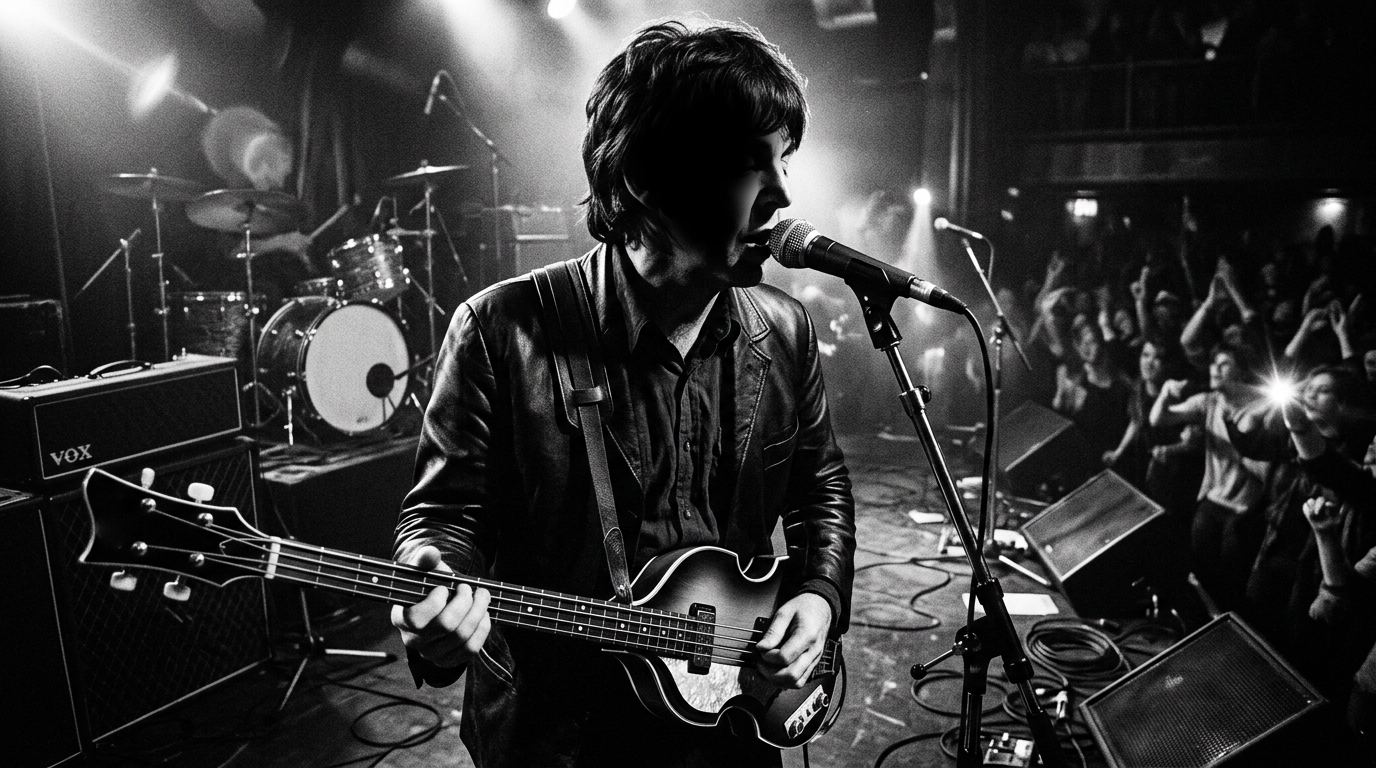
A 21-year-old, with a violin-shaped Höfner bass slung over his shoulder, was preparing to change the world. His name was James Paul McCartney.
Backstage, the atmosphere was eerily calm. John Lennon, the intellectual and acerbic leader of the group, chewed gum with nervous indifference. George Harrison, the youngest and most stoic, tuned his Gretsch guitar with meticulous concentration. Ringo Starr smiled with an almost Buddhist tranquility.
And then there was Paul. With his expressive eyes and a smile that could disarm an army, he embodied the group’s irresistible charm. But beneath that facade of youthful confidence throbbed a steely ambition and an innate understanding of what it took to conquer not just the ears, but also the hearts of a generation.
When Ed Sullivan announced, “Ladies and gentlemen, The Beatles!” the roar of the audience was so deafening it threatened to drown out the opening chords. The camera focused on Paul, who, with a nod of his head, began the count: “One, two, three, four!” Then the sound of “All My Loving” erupted into American homes. Paul’s clear, melodic voice cut through the din like a declaration of intent. The camera panned from face to face—John, captioned “SORRY GIRLS, HE’S MARRIED”; then George; Finally, Paul, whose mischievous grin sparked a new wave of cheers. It wasn’t just a performance. It was a televised coronation.
In those few minutes, Paul McCartney became more than just a musician: he became an archetype. The romantic, the craftsman of perfect melodies, the diplomat capable of mediating between the most abrasive personalities. While John was the rebellious soul and George the mystical spirit, Paul was the beating heart of The Beatles. His bass playing didn’t function as a simple rhythmic anchor; it was a second melody, a counterpoint that wove complexity into seemingly simple songs. And his ability to compose timeless ballads like “Michelle” and visceral rockers like “I’m Down” defied categorization.
That night, The Beatles didn’t just sell records: they ignited a cultural revolution. For a generation growing up under the shadow of the Cold War and the assassination of a president, their music was an antidote of optimism and vitality. They broke with the rigidity of their parents’ generation, offering a new way of seeing, feeling, and being. And Paul McCartney, the young man from Liverpool with the violin-shaped bass, guided that transformation from the center.
How did this young working-class man—who had lost his mother in his teens and learned to play guitar in front of a mirror—reach the top of the musical universe? To understand, we must go back to the streets of post-war Liverpool, where the echo of bombs still resonated and a young man dreamed of melodies that did not yet exist.
Chapter 2: The Liverpool Crucible: Forging a Dream Amidst Echoes of War
James Paul McCartney was born on June 18, 1942 at Walton General Hospital, Liverpool, into a world still bearing the scars of war. His father, Jim McCartney, was a man of remarkable character: a cotton merchant by day, a passionate jazz musician by night, and leader of Jim Mac’s Jazz Band in the 1920s. His mother, Mary Patricia Mohin, was a nurse and midwife of Irish descent, a warm and strong figure who became the pillar of the family. Paul and his younger brother, Michael, were baptized in their mother’s Catholic faith, although Jim—a former Protestant turned agnostic—held a more secular view of life. They grew up in a lower-middle-class home, first in Anfield and then in Allerton, at number 20 Forthlin Road, a house that the National Trust would preserve decades later as a sanctuary.
Post-war Liverpool was a city of contrasts: a bustling port where the austerity of reconstruction coexisted with the constant influx of new cultural influences brought by sailors carrying rhythm and blues and rock and roll records from the United States. For young Paul, music was in the air and in his blood. Jim never gave him formal lessons, but the family piano was the center of social gatherings, and he encouraged his sons to experiment and find joy in creating melodies. He taught Paul the fundamentals of harmony and how to “listen” to music, not just hear it. This informal education, based on intuition and feeling, would lay the foundation for McCartney’s compositional approach throughout his career.
Tragedy struck the family on October 31, 1956. Mary, the matriarch, died of a stroke following surgery to remove breast cancer. Paul was only 14 years old. The loss was a seismic event that would resonate throughout his life and work: the figure of “Mother Mary” would become a beacon of comfort in “Let It Be,” one of his most universal testaments. Mary’s death also forged a tacit bond with another young man from Liverpool who had lost his own mother at a similar age: John Lennon. That shared grief would become one of the cornerstones of their complex and fruitful relationship.
It was during this period of mourning that music became Paul’s refuge. Shortly after losing his mother, his father bought him his first guitar, a Zenith Model 17. Being left-handed, he had to reverse the strings to play it—an act of ingenuity that demonstrated a determination that would always stay with him. He spent hours in front of a mirror, learning to imitate his heroes: Little Richard, Elvis Presley, Eddie Cochran. The raw energy of American rock and roll offered him an outlet for his pain and a vision of the future beyond the factories and docks of Liverpool.
It was in this context that on July 6, 1957, a mutual friend, Ivan Vaughan, took him to the St. Peter’s Church festival in Woolton. There, on a makeshift stage, a skiffle group called The Quarrymen was playing, led by a charismatic and rebellious 16-year-old: John Lennon. After the performance, Paul played a flawless version of Eddie Cochran’s “Twenty Flight Rock”—remarkable not only for his technical skill but also because he knew all the lyrics by heart. Lennon, impressed, saw him as an equal. A few weeks later, Paul McCartney was invited to join The Quarrymen.
That meeting in a church garden was the true Big Bang of pop music. The union of McCartney’s melodic sensibility with Lennon’s lyrical sharpness and rock ‘n’ roll spirit created an unprecedented synergy. The dream had begun to take shape.
Chapter 3: Hamburg: The Baptism of Fire and the Birth of an Identity
In August 1960, The Beatles—then a quintet consisting of John Lennon, Paul McCartney, George Harrison, bassist Stuart Sutcliffe, and drummer Pete Best—embarked on an odyssey that would transform them from a group of enthusiastic teenagers into a formidable rock and roll machine. Their destination was Hamburg, Germany, a port city with a red-light district as seedy as it was vibrant. Allan Williams, their first manager, had secured them a residency at the Indra Club, a strip club converted into a music venue. What awaited them was not glamour, but a baptism of fire.
The conditions were brutal. They lived in precarious conditions, often in the back of a movie theater, and their workdays were grueling: up to eight hours a night, seven days a week. To stay awake and energetic, they resorted to amphetamines (Preludin) supplied by the bartenders and club patrons. This exhausting existence, fueled by stimulants and the constant pressure of entertaining a raucous audience, forced them to push themselves. They had to expand their repertoire, experiment with sound, and, above all, learn to command the stage. Paul flourished in this environment: his natural charisma and desire to connect with the audience made him the group’s showman.
Musically, Hamburg was their crucible. The need to fill hours upon hours with music forced them to play louder, faster, and with more energy. Their sound became rawer, more powerful. Paul, who had reluctantly taken up the bass when Stuart Sutcliffe—a talented painter but rudimentary bassist—decided to stay in Hamburg to pursue his art career and his relationship with photographer Astrid Kirchherr, discovered his true calling there. Inspired by musicians like Motown’s James Jamerson, he began to develop a melodic and contrapuntal style that would become one of the hallmarks of The Beatles’ sound: his bass didn’t simply keep the beat, but sang its own melody.
It was also in Hamburg that they cultivated their iconic image. Astrid Kirchherr photographed them in black and white with an existentialist aesthetic, capturing a vulnerability and intensity that contrasted sharply with the promotional images of the time. She was the one who suggested the “mop-top” hairstyle, a style that defied the conventions of masculinity at the time and would become their most recognizable visual trademark.
After several stays in Hamburg between 1960 and 1962, The Beatles returned to Liverpool as a completely transformed band. However, one piece still needed to be put in place. In August 1962, they made the difficult decision to fire Pete Best: his drumming style didn’t fit the musical direction the band was taking, and his introverted personality clashed with the humor and camaraderie of the rest of the group. His replacement was Ringo Starr (Richard Starkey), the drummer for Rory Storm and the Hurricanes, whom they knew and admired from their time in Hamburg. With Ringo, the definitive lineup of The Beatles was complete. The quartet that would conquer the world was ready.
Chapter 4: The British Invasion and the Conquest of the World (1963-1965)
With their final lineup solidified, The Beatles, under the tutelage of producer George Martin at EMI’s Abbey Road Studios, were ready to unleash their potential. The classically trained Martin immediately recognized the band’s raw talent and, especially, Lennon and McCartney’s songwriting prowess. He became the fifth Beatle in the studio: a mentor capable of translating their ideas into sophisticated arrangements without stifling their energy.
Their first single, “Love Me Do,” released in October 1962, was a modest success, reaching number 17 on the British charts. But it was their second single, “Please Please Me,” released in January 1963, that truly ignited their success. With its infectious energy and flawless vocal harmonies, the song shot to number one on several UK charts, and Beatlemania began to take shape. The self-titled debut album, recorded in a marathon one-day session to capture the energy of their live performances, topped the charts for 30 weeks.
The year 1963 was an unprecedented whirlwind in their homeland. Constant touring, television appearances, and a fanatical adoration bordering on hysteria became their new reality. Paul, with his photogenic charm and melodic flair, became the most visible face. His relationship with actress Jane Asher introduced him to the effervescent cultural world of Swinging London, exposing him to avant-garde theater, art, and classical music—influences that would begin to subtly seep into his work.
While the UK succumbed to Beatlemania, the United States remained untouched. Capitol Records, EMI’s American subsidiary, had refused to release their first singles. It wasn’t until late 1963, with “I Want to Hold Your Hand”—a perfectly balanced collaboration between Lennon’s energy and McCartney’s pop sensibility—that the dam broke. The performance on The Ed Sullivan Show on February 9, 1964, was not just a concert: it was a cultural event that captivated a nation and marked the official start of the British Invasion. The Beatles didn’t just conquer America; they revitalized it, injecting optimism and exuberance into a youth still mourning the loss of John F. Kennedy.
The next two years were a relentless cycle of world tours, recordings, and films. *A Hard Day’s Night* (1964) and *Help!* (1965) captured the band’s wit and charisma, solidifying their public personas. Musically, this period saw a remarkable evolution in Lennon and McCartney’s songwriting: their individual styles began to take shape. Paul emerged as the master of the ballad, creating gems like “And I Love Her” and, most notably, “Yesterday.” Composed from a melody that came to him in a dream and recorded solo with a string quartet, “Yesterday” was a watershed moment, proving that a pop song could possess the emotional depth of a classical piece. It would go on to become one of the most covered songs in history.
Chapter 5: The Sonic Laboratory: The Revolver and Sgt. Pepper’s Revolution (1966-1967)
By 1966, Beatlemania had become a gilded cage. The constant roar of screaming fans made it impossible for the band to hear themselves on stage, and the grueling routine of touring had stifled their creativity. After a final, chaotic concert at Candlestick Park in San Francisco on August 29, 1966, The Beatles made a radical decision: they would stop touring for good.
That decision freed them to focus entirely on the recording studio, transforming it from a place to record performances into a sonic laboratory for experimentation and innovation. Paul McCartney, increasingly influenced by the avant-garde London scene and composers like Karlheinz Stockhausen, became the main catalyst for this new phase.
The first fruit was *Revolver*, released in August 1966. The album explored new territories: from the psychedelic rock of Lennon’s “She Said She Said” to the baroque melancholy of McCartney’s “For No One.” Paul demonstrated astonishing compositional maturity. In “Eleanor Rigby,” a string octet created a cinematic drama about loneliness and alienation—a theme unheard of in pop music at the time. His bass line in “Taxman” was aggressive and prominent; in “Got to Get You into My Life,” he celebrated his love for the Motown sound with a vibrant horn section. The studio became their instrument: looped tapes, reversed recordings, speed manipulation, unprecedented soundscapes.
Freed from the constraints of live performance, The Beatles embarked on their most ambitious project: *Sgt. Pepper’s Lonely Hearts Club Band*. It was Paul who conceived the central concept: The Beatles would adopt an alter ego—a fictional band that would allow them to break free from their own image and explore any musical style. This unifying framework resulted in an album that redefined the possibilities of popular music. Recorded over several months at Abbey Road, Sgt. Pepper’s was a sonic tapestry of astonishing variety, from the music hall of “When I’m Sixty-Four” to the mysticism of “Within You Without You” and the surreal psychedelia of “Lucy in the Sky with Diamonds.”
Paul’s contribution to the album was monumental. Besides being the driving force behind the concept, he composed some of its most memorable songs, including the majestic “A Day in the Life”—in collaboration with Lennon—and the poignant “She’s Leaving Home.” His bass playing, once again, was a revelation: melodic lines as integral to the songs as the vocals themselves. Released in June 1967, at the height of the “Summer of Love,” Sgt. Pepper’s Lonely Hearts Club Band was not just an album: it was a global cultural event and an artistic manifesto that elevated pop music to the level of art. The era of stadium rock was over; the era of rock as art had begun, and Paul McCartney was one of its principal architects.
Chapter 6: The Twilight of the Dream: The White Album and the Breakup (1968-1970)
The triumph of Sgt. Pepper’s was the zenith of The Beatles’ creative unity, but it also marked the beginning of their slow and painful disintegration. The first blow came in August 1967 with the tragic death of their manager, Brian Epstein, from an accidental overdose. Epstein had been the band’s anchor—the man who guided them from Liverpool clubs to worldwide fame. His absence left a leadership vacuum that Paul, with his energy and organizational instincts, tried to fill. However, his efforts to keep the band focused and productive were often perceived by John and George as authoritarian, sowing the first seeds of resentment.
Seeking a new spiritual direction, the band traveled to Rishikesh, India, in early 1968 to study transcendental meditation with Maharishi Mahesh Yogi. The retreat proved to be a period of prolific songwriting—generating most of the material for their next album—but it also exposed growing internal rifts. Ringo left early. Paul remained skeptical. And John’s disillusionment with the Maharishi marked the end of that collective search for a guru. They returned to England with a wealth of songs, but as increasingly estranged individuals.
The result was the double album *The Beatles*, known as the “White Album.” Released in November 1968, it was an expansive and eclectic masterpiece, but also the sound of a band falling apart. Tensions in the studio were palpable: John, by then inseparable from Yoko Ono, whose constant presence disrupted the band’s intimate sanctuary, explored avant-garde and raw confession. George, increasingly frustrated by the difficulty of having his songs taken seriously, flourished as a songwriter despite the disdain. At one point of particular tension, Ringo left the band for two weeks, and Paul had to play drums on tracks such as “Back in the U.S.S.R.” and “Dear Prudence.”
Despite the chaos, Paul’s contribution to the “White Album” was extraordinary in its diversity: from the visceral rock and roll of “Back in the U.S.S.R.” From the delicate acoustic ballad “Blackbird,” to the ska pastiche “Ob-La-Di, Ob-La-Da,” to the proto-heavy metal of “Helter Skelter.” This last song demonstrated his incredible vocal range and his willingness to push rock to its noisiest and most chaotic limits.
In a final attempt to revitalize the band’s spirit, Paul launched the “Get Back” project in January 1969: to rehearse and record a new album culminating in a live performance. The process was filmed for a documentary. The rehearsals, held in the cold, cavernous Twickenham Studios, were a disaster. Old wounds and new resentments resurfaced; George temporarily left the band. The dream of a live performance was reduced to an impromptu concert on the rooftop of Apple Corps’ offices on Savile Row on January 30, 1969. That performance—the last public appearance of the four together—was a bittersweet moment of musical brilliance amidst the dissolution.
The tapes for the “Get Back” project were shelved. Instead, the band decided to reunite with George Martin to record one last album. The result was Abbey Road. Released in September 1969, it was a fitting and masterful finale. Despite the tensions, they managed to put aside their differences and collaborate on a cohesive work. The B-side medley—largely Paul’s creation—wove together fragments of songs into an epic suite that concluded with the poignant line: “And in the end, the love you take is equal to the love you make.”
While Abbey Road was being acclaimed by critics and the public alike, the final breakup was imminent. Business disputes, centered on the choice of a new manager (Paul favored his father-in-law, Lee Eastman, while the other three preferred the controversial Allen Klein), were the final straw. On April 10, 1970, a week before the release of his first solo album, Paul issued a statement in the form of a self-interview in which he announced that he did not foresee a future working with The Beatles. The Beatles, the greatest band in history, had come to an end.
Chapter 7: Rise from the Ashes: Solo Flight and the Creation of Wings (1970-1973)
The Beatles’ breakup in 1970 wasn’t just the end of a band: it was the end of an era. For Paul McCartney, the man who had often been the driving force and glue that held the group together, the split was a devastating blow that plunged him into a deep depression. Holed up on his farm in Scotland with his new wife, Linda Eastman, and her family, he felt lost and betrayed. The dream that had fueled his life since adolescence had been shattered, and the bitterness of the split—magnified by legal battles and public attacks from his former bandmates—left him adrift. For months, alcohol was his solace. It was Linda who became his anchor, the unwavering support that helped him slowly emerge from the darkness.
In that self-imposed exile, with only a Studer four-track recorder as his equipment, Paul began recording again, in a rudimentary and experimental way. Playing all the instruments himself, with Linda contributing vocal harmonies, he created a set of intimate, homespun, and deliberately unpolished songs. The result was his first solo album, McCartney, released in April 1970: a declaration of independence, a deliberate rejection of the grandeur of Abbey Road. Songs like “Every Night” and “Junk” were melancholic reflections on his state of mind. However, it was “Maybe I’m Amazed” that stood out: a powerful rock ballad dedicated to Linda, a glimpse of McCartney’s melodic genius that promised the creative fire had not been extinguished.
His next album, Ram (1971), credited to Paul and Linda McCartney, was a more ambitious undertaking. Recorded in New York with session musicians, it contained veiled criticism of John Lennon and Yoko Ono in “Too Many People,” prompting a bitter response from Lennon with “How Do You Sleep?” on his album Imagine. The war of words between the two former collaborators reached its peak. Despite the controversy, Ram produced “Uncle Albert/Admiral Halsey,” Paul’s first US number one hit after The Beatles, and has since been reevaluated as one of his most creative and beloved solo works.
Tired of working alone and longing for the camaraderie of a band, Paul formed a new group from scratch: Wings. He insisted that Linda, despite her lack of musical experience, be a member—he wanted his family to be with him on the road, without repeating the isolation of Beatles tours. They were joined by former Moody Blues guitarist Denny Laine and drummer Denny Seiwell. The debut album, Wild Life (1971), recorded in just over a week, was a critical and commercial failure. But Paul was determined to prove that Wings was a real band. In 1972, they embarked on a university tour of the UK, showing up unannounced on campuses and playing for anyone who would listen—a return to basics, far removed from the hysteria of Beatlemania.
After a period of consolidation that included the single “Live and Let Die”—the theme song for the James Bond film of the same name—and the album *Red Rose Speedway* (1973), which reached number one in the United States, Wings found their sound with *Band on the Run* (1973). Recorded in Lagos, Nigeria, under difficult conditions—Denny Seiwell and guitarist Henry McCullough had left the band just before the trip, leaving the trio of Paul, Linda, and Denny Laine—the album was critically acclaimed as Paul’s best work since the breakup of The Beatles. With it, Paul McCartney had not only risen from the ashes: he had proven he could soar to such heights on his own. Wings cemented their status as one of the biggest bands of the 1970s.
Chapter 8: The Flight of the Phoenix: The Heyday of Wings and the Return to Earth (1974-1981)
The monumental success of Band on the Run cemented Wings as one of the dominant forces in 1970s music. Freed from the shadow of The Beatles, Paul embraced his role as the frontman of a new, globally-oriented band. With a stabilized lineup that included the charismatic guitarist Jimmy McCulloch and drummer Geoff Britton (later replaced by Joe English), Wings became a hit-making machine.
The album *Venus and Mars* (1975), recorded in New Orleans, was the prelude to Paul’s biggest tour to date: *Wings Over the World*. Spanning from 1975 to 1976, it was a full-fledged rock spectacle—ten countries, more than two million spectators. For Paul, it was a chance to reclaim the stage in a way he never could with The Beatles, whose concerts were often drowned out by screaming fans. Wings delivered flawless performances that combined their own hits with a carefully curated selection of Beatles classics: “Yesterday,” “Lady Madonna,” “The Long and Winding Road.” Playing that repertoire was an acknowledgment of their legacy and a way to reconnect with an audience that craved those anthems. The tour culminated in the triple live album *Wings over America* (1976), one of the best-selling live albums of all time.
The band’s next studio album, Wings at the Speed of Sound (1976), produced two of their biggest hits: the piano ballad “Silly Love Songs”—Paul’s defiant response to critics who accused him of writing only trivial love songs—and the rocker “Let ‘Em In.” Both reached number one in the United States. However, tensions were beginning to surface again within the band.
After a brief hiatus, Wings returned in 1978 with *London Town*, a softer, folk-influenced album, partly recorded on a yacht in the Virgin Islands. Internal problems persisted: Jimmy McCulloch and Joe English left the band during the sessions, reducing Wings once again to the core trio of Paul, Linda, and Denny Laine. Even so, the album produced another massive hit with “Mull of Kintyre,” an ode to the Scottish peninsula where Paul had his farm. With its bagpipe chorus and folk melody, it became the first single to sell over two million copies in the UK—the best-selling single in British history up to that point, surpassing even any Beatles single.
The final incarnation of Wings, featuring guitarist Laurence Juber and drummer Steve Holley, released *Back to the Egg* in 1979, an attempt to return to a rawer, new-wave-tinged rock sound. The final blow came in January 1980: during a tour of Japan, Paul was arrested at Tokyo airport for marijuana possession and spent nine days in jail before being deported. The incident was an international humiliation and led to the tour’s cancellation. Wings, already fragile, did not survive the blow. There was never an official announcement of their disbandment; the band simply called it quits in 1981.
Retired to his farm, Paul returned to solo recording. The result was McCartney II (1980): like its 1970 predecessor, it was largely recorded by himself, but this time Paul immersed himself in the world of synthesizers and electronic music. Experimental, quirky, and often avant-garde—featuring the synth-pop hit “Coming Up” and the minimalist “Temporary Secretary”—the album baffled critics and fans alike, but once again demonstrated his tireless musical curiosity and his refusal to rest on his laurels.
Chapter 9: The Midas Touch and the Shadow of Mourning (1982-1989)
The 1980s began with a tragedy that shook the world. On December 8, 1980, John Lennon was shot and killed outside his apartment in New York City. For Paul, it was an incomprehensible personal loss. Despite the public bitterness of their split, the bond between Lennon and McCartney remained deep, forged in their teenage years and through a creative collaboration that had changed the world. John’s death not only robbed him of the chance for a full reconciliation but also extinguished forever any hope, however remote, of a Beatles reunion. Paul’s initial response to reporters—”It’s a drag, isn’t it?”—was widely misinterpreted as insensitive, when it was the reaction of a man in shock, unable to process the enormity of the loss.
In this context of grief, Paul reunited with George Martin to record *Tug of War* (1982), a return to form hailed by critics as his best work since *Band on the Run*. Remarkably mature and emotionally profound, the album explored themes of conflict, love, and loss. The song “Here Today” was a direct and moving tribute to John Lennon, an imagined conversation in which Paul expressed the love he often couldn’t articulate during Lennon’s lifetime. The album also featured collaborations with Stevie Wonder on the optimistic, anti-racist ballad “Ebony and Ivory,” which became a worldwide number one hit, and with rock and roll pioneer Carl Perkins.
The success of their collaborations continued with *Pipes of Peace* (1983). Their work with Michael Jackson dominated the airwaves: they recorded “The Girl Is Mine”—the first single from Jackson’s groundbreaking album *Thriller*—and “Say Say Say,” a number one hit for Paul. However, the friendship soured in 1985 when Jackson, following Paul’s advice about the benefits of owning song publishing rights, bought the ATV Music catalog, which included the rights to most of the Lennon-McCartney compositions. For Paul, it was a personal and professional betrayal from which the friendship never recovered.
The rest of the decade was a rollercoaster. The film *Give My Regards to Broad Street* (1984), which Paul wrote and starred in, was a critical and box-office flop. Albums like Press to Play (1986) received a lukewarm reception. But Paul continued to explore new avenues: in 1988 he released Back in the USSR, an album of rock and roll classic covers released exclusively in the Soviet Union as a peace gesture, before its international release.
The decade concluded with a triumphant return with Flowers in the Dirt (1989). For this album, Paul collaborated with Elvis Costello—a sharp and often cynical lyricist whose partnership reminded many of his dynamic with John Lennon. Together they wrote, among other songs, the hit “My Brave Face.” The album was a critical and commercial success, marking the beginning of an artistic renaissance. Fueled by this success, Paul embarked on his first major world tour in over a decade, “The Paul McCartney World Tour,” which ran into 1990 and proved that the world’s appetite for his music was as insatiable as ever.
Chapter 10: Keeper of the Flame: Classics, Anthologies, and a Painful Farewell (1990–1999)
The 1990s found a revitalized Paul McCartney, embracing his status as a living icon while exploring new artistic territories. In 1991, he surprised the music world by premiering his first full-scale classical work, the Liverpool Oratorio. Commissioned by the Royal Liverpool Philharmonic Orchestra to mark its 150th anniversary, the oratorio was a 90-minute semi-autobiographical work for orchestra, chorus, and soloists, composed in collaboration with conductor Carl Davis. Although some classical music critics were skeptical, it was a commercial success that showcased McCartney’s versatility as a composer. It would not be an isolated experiment: throughout the decade he would continue to explore that territory with Standing Stone (1997) and Working Classical (1999).
The project that would define the decade was undoubtedly The Beatles Anthology. In the early 1990s, Paul, George, and Ringo, along with Yoko Ono representing John, reunited to oversee the creation of a definitive documentary and a series of albums that would tell the story of The Beatles in their own words. The result was an eight-part television series and three double albums that offered an unprecedented insight into the band’s creative process and camaraderie.
The most extraordinary part of the project was the decision to create new Beatles music. Using two home demos John Lennon had recorded in the late 1970s, “Free as a Bird” and “Real Love,” the three surviving Beatles, with the help of producer Jeff Lynne, reunited in the studio to complete the songs. Paul described the experience as if John had “left some tape and gone off to have a cup of tea.” The release of “Free as a Bird” in 1995 was a worldwide event: for the first time in 25 years, there was a new Beatles song.
Amid these retrospective projects, Paul continued his solo career with the acclaimed *Flaming Pie* (1997), a return to his classic, melodic sound with a simple and straightforward production. On March 11, 1997, in recognition of his immeasurable services to music, Paul McCartney was knighted by Queen Elizabeth II at Buckingham Palace. The young man from Liverpool who had dreamed of melodies had become Sir Paul McCartney.
However, the decade that brought him so much acclaim ended in profound personal tragedy. In 1995, his beloved wife, Linda, was diagnosed with breast cancer. For the next three years, Paul devoted himself to her care, drastically reducing his professional commitments. Linda McCartney died on April 17, 1998, at the family ranch in Tucson, Arizona, after 29 years of marriage. The loss was a devastating blow. In 1999, he channeled his grief into music with Run Devil Run, a collection of rock and roll covers from his youth — an act of catharsis, a tribute to the foundations of his musical life and one more step in a journey marked by both triumph and tragedy.
Chapter 11: Navigating the New Millennium: Personal Turmoil and Artistic Resilience (2000-2010)
Paul McCartney entered the new millennium as a figure in mourning, but also as a symbol of resilience. His creative spirit, though wounded, refused to be silenced. The first decade of the 21st century would be a period of remarkable artistic productivity, though often overshadowed by a turbulent personal life.
Musically, the decade began with Driving Rain (2001), an album that reflected a renewed sense of optimism, recorded with a new band of young musicians. The album included the poignant “Freedom,” written in response to the September 11 attacks in New York. Paul performed the song at the Concert for New York, a benefit concert he organized, which served as a powerful reminder of the healing power of music.
In June 2002, he married former model and activist Heather Mills in a ceremony in Ireland. The relationship had been the subject of intense media scrutiny from the start. The couple had a daughter, Beatrice, in 2003. However, the marriage was tumultuous: they separated in 2006, and the bitter and highly publicized divorce dragged on for almost two years. The legal proceedings were a painful and humiliating period for McCartney, who saw his private life dissected in the tabloid press. The final settlement in 2008 freed him from a relationship that had become toxic.
Despite the personal turmoil, his musical output was remarkably strong. In 2005, he released *Chaos and Creation in the Backyard*, an introspective album produced by Nigel Godrich (known for his work with Radiohead). Godrich challenged McCartney to play most of the instruments himself and to delve deeper into his songwriting. The result was an album of melancholic beauty and musical sophistication that was compared to his best work, earning several Grammy nominations.
In 2007, he surprised the music industry by leaving his longtime label, EMI/Capitol, to sign with Hear Music, Starbucks’ record label. His first release under that agreement, *Memory Almost Full* (2007), was an energetic and reflective album that explored themes of mortality and memory, exposing his music to a new generation of listeners. That same year, he also released the choral oratorio *Ecce Cor Meum* (2006), commissioned by Magdalen College, Oxford, which had been eight years in the making and was partly a tribute to Linda.
The decade concluded with a new chapter in his personal life. In 2007, he began a relationship with New York businesswoman Nancy Shevell—discreet, stable, the complete opposite of the drama of his previous marriage. With her, Paul seemed to have found peace again. At the end of a decade of extremes, his ability to transform pain into art had sustained him once more.
Chapter 12: The Eternal Legacy: An Icon in the 21st Century (2011–Present)
Entering his eighth decade, Paul McCartney showed no signs of slowing down. Far from becoming a museum piece, he has remained one of the most industrious and relevant figures in popular music, a beacon of creativity and vitality who continues to inspire artists and audiences of all ages.
On October 9, 2011, Paul married Nancy Shevell in an intimate ceremony at the same Marylebone registry office where he had married Linda years earlier. Marriage brought him a stability and personal happiness that was reflected in his work. In 2012, he released Kisses on the Bottom, a delightful album of covers of jazz standards from his father’s era—a personal project that demonstrated his love for the craft of classic songwriting. The following year he returned with New (2013), a vibrant and contemporary pop-rock album in collaboration with producers such as Mark Ronson and Paul Epworth, praised for its youthful energy and inexhaustible gift for melody.
The creative streak continued with *Egypt Station* (2018), a concept album that debuted at number one on the US Billboard 200 chart, his first time topping the US charts in 36 years—a testament to his enduring relevance. In 2020, in the midst of the COVID-19 pandemic lockdowns, he released *McCartney III*, completing a trilogy of self-titled solo albums spanning 50 years. Like its predecessors, it was an intimate and experimental work, a musical diary of an artist in isolation who found solace and purpose in his home studio. It was hailed as one of his finest works in decades.
Beyond his own recordings, McCartney has remained a constant presence on the world stage. His tours—from “On the Run” to the recent “Got Back”—are global events that draw multigenerational crowds. His concerts are marathons of nearly three hours in which he performs a repertoire spanning his entire career, with an energy and passion that would put musicians half his age to shame. He has also participated in surprising collaborations, such as his work with Kanye West and Rihanna on “FourFiveSeconds” (2015), which introduced him to a new audience of hip-hop and R&B.
Paul McCartney’s legacy is immeasurable. He has written or co-written more than 32 number-one singles in the UK and US, and “Yesterday” remains the most covered song of all time. As a bassist, he revolutionized the instrument’s role in rock music. As a performer, his charisma and ability to connect with audiences are legendary. But perhaps his greatest legacy is his tireless love of music and his unwavering optimism in the face of adversity.
Today, Sir Paul McCartney is not just a musician: he is a cultural institution, a guardian of the flame of a golden age of popular music, and at the same time, a vital and contemporary artist. His story—from the streets of Liverpool to the pantheon of immortals—is one of the great narratives of the 20th century. As long as there’s a melody in his head and a bass guitar in his hands, Paul McCartney will continue doing what he’s always done: writing the soundtrack to our lives, one song at a time.
Chapter 13: The Voice of the Bass: Technical Innovation and Musical Legacy
Although Paul McCartney is widely recognized as a genius songwriter and charismatic singer, his most revolutionary contribution to popular music was his transformation of the electric bass: from a supporting instrument to a melodic and contrapuntal voice of equal importance. When he joined The Beatles in 1961, the bass was typically a background instrument, primarily responsible for keeping the beat. Paul fundamentally changed this.
Inspired by Motown bassists like James Jamerson—who played on hits by The Supremes, The Temptations, and Marvin Gaye—Paul began experimenting with bass lines that not only kept time but also told their own melodic story. His instrument of choice was the Höfner Violin Bass 500/1, a German violin-shaped bass that produced a warm, resonant sound, played with flat-wound strings. This instrument became his visual and sonic signature.
Examples of his bass genius abound in The Beatles’ catalog. In George Harrison’s “Something,” Paul’s bass weaves a melodic line almost as memorable as the main melody. In John Lennon’s “Come Together,” the bass is the song’s most recognizable element, a hypnotic riff that defines the piece’s character. In “Dear Prudence,” the bass provides a harmonic progression as important as the guitar. What distinguishes Paul’s approach is his understanding of how the bass could create tension, movement, and emotion within a song. This innovation had a profound impact: later bassists, from John Entwistle of The Who to Geddy Lee of Rush, were directly influenced by his approach.
Paul’s voice is another crucial aspect of his legacy. His vocal range is remarkable—effortlessly shifting from a high falsetto to a deep bass—influenced by the great rock and roll vocalists of his youth, especially Little Richard. His harmonies with John Lennon on songs like “If I Fell” and “Because” are masterclasses in vocal counterpoint. His ability to sing in styles as distinct as the raw rock and roll of “Back in the U.S.S.R.” and the gentle ballad of “The Long and Winding Road” demonstrates a versatility few singers can match. As a producer, he also pioneered experimentation with multitrack recording and sound effects to create complex vocal textures, a technical innovation that, combined with his musical sensibility, produced some of the most beautiful recordings in music history.
Chapter 14: The Enduring Influence: Paul McCartney in Contemporary Popular Culture
Paul McCartney’s influence on contemporary popular music is so pervasive that it often goes unnoticed. His impact is not limited to rock or pop; it has permeated virtually every musical genre. Artists as diverse as Kanye West, Rihanna, Coldplay, The Black Keys, and Billie Eilish have cited Paul as a crucial influence on their artistic development. His ability to write melodies that are simultaneously simple and sophisticated, accessible yet profound, has served as a model for generations of songwriters.
In the digital age, Paul McCartney’s music has found new audiences. His songs are used in films, television series, commercials, and video games. “Yesterday” has been covered more than 3,000 times—a record that will likely never be broken. His songs regularly appear on “greatest songs of all time” lists compiled by music and culture publications. In 2015, Rolling Stone magazine ranked him as the second-best songwriter of all time, second only to John Lennon. Before The Beatles and Paul McCartney, pop music was often considered trivial, a form of entertainment for teenagers. Paul helped elevate it to the level of art, demonstrating that it could be as sophisticated, emotional, and meaningful as any other form of artistic expression.
Paul’s personal life has also left an indelible mark on popular culture. His 29-year marriage to Linda became a symbol of the modern artistic couple. His vegetarianism, adopted in the 1970s for ethical and health reasons, made him an advocate for animal rights and environmental sustainability, influencing millions to reconsider their own dietary choices. His ability to constantly reinvent himself—from the rock and roll of The Beatles to the pop of Wings, and from classical music to electronica—has made him a role model of artistic evolution and adaptability. For young musicians today, Paul McCartney is more than a legend: he is a living inspiration, proof that creativity, passion, and dedication can sustain a lifetime of work.
Final Reflection: The Man Behind the Legend
When reflecting on the life and career of Paul McCartney, it’s easy to get lost in the numbers: 32 number-one singles, over 100 million records sold, tours that have generated billions of dollars, countless awards and accolades. But numbers, impressive as they are, don’t capture the true essence of who Paul McCartney is and why his music has touched the hearts of so many.
Paul McCartney is, at his core, an optimist. Despite losing his mother at the age of 14, despite the traumatic breakup of the band that made him famous, despite bitter divorces and the deaths of loved ones, his music has consistently been a celebration of life, love, and beauty. This doesn’t mean it’s naive or superficial. Far from it, his best songs contain an emotional depth and sophistication that defies analysis. But even in its darkest moments, there is a thread of hope, a belief that things can get better, that love can triumph, that music can heal.
His dedication to the craft of songwriting is legendary. Paul is a perfectionist capable of spending hours, days, or even weeks working on a single song, fine-tuning a melody, refining lyrics, searching for the perfect harmony. He is not a composer who relies on inspiration or luck; he is a craftsman who understands that great music requires work, discipline, and a deep understanding of musical principles. And yet, he maintains a sense of wonder and awe at the creative process. He remains able to surprise himself, to discover new possibilities, to experiment with new sounds and forms. This combination of discipline and curiosity, of mastery and humility, is what has kept his music fresh and relevant for more than six decades.
In his later years, Paul McCartney has become a guardian of memory, a custodian of the legacy of The Beatles and the era he helped define. But at the same time, he has refused to be trapped in the past. He continues to write new songs, record new albums, and explore new sounds. His story—from the streets of Liverpool to the pantheon of immortals—is one of the great narratives of the 20th century, and it is not over. As long as there is a melody in his head and a bass guitar in his hands, Paul McCartney will continue doing what he has always done: writing the soundtrack to our lives, one song at a time.
Appendix: Unforgettable Songs to Relive
1. “Yesterday” (1965)
Few songs in the history of popular music have achieved the mythical status of “Yesterday”. Its origin is legendary: the complete melody came to Paul McCartney in a dream one night in 1964 at the home of his then-girlfriend, Jane Asher. It seemed so perfect and polished to him that, upon waking, he rushed to the piano to transcribe it, convinced it must be a classical melody he had unconsciously plagiarized. For weeks, he played it for friends and music industry experts, asking if they recognized it. No one did. It was his.
The lyrics—a melancholic reflection on lost love—were written later, replacing the initial filler words (“Scrambled eggs, oh my baby how I love your legs…”). As for the recording, it was a watershed moment: for the first time, a Beatle recorded entirely solo. Produced by George Martin, the instrumentation was reduced to Paul’s voice and acoustic guitar, complemented by an elegant string quartet. This decision, though initially resisted by Paul for fear it would sound too sentimental, elevated the song from a simple pop ballad to a timeless work of art. “Yesterday” holds the Guinness World Record for the most covered song in history, with thousands of versions. It is the purest distillation of McCartney’s melodic genius: an unforgettable melody, sophisticated harmony, and universal emotion, all in just over two minutes of pop perfection.
2. “Sgt. Pepper’s Lonely Hearts Club Band” (1967)
More than a song, “Sgt. Pepper’s Lonely Hearts Club Band” is a concept, a statement of intent that opened the door to one of the most influential albums of all time. The idea, conceived by Paul on a flight back to England, was for The Beatles to adopt an alter ego—a fictional Edwardian band that would free them from the pressures of being “The Beatles” and give them unprecedented creative freedom.
The opening track of the self-titled album acts as a master of ceremonies, introducing this imaginary band to the audience. It begins with the sound of an orchestra tuning up and the murmur of a crowd, creating an atmosphere of theatrical anticipation. Then a hard-rocking guitar riff bursts in, followed by Paul’s vocals taking on the role of Billy Shears. The song blends stadium rock and music hall with a horn section that adds pomp and circumstance. Its brilliance lies in how it sets the tone for the entire album—it functions as an overture that is repeated in a faster version near the end, creating a conceptual framework that unifies the eclectic collection of songs. “Sgt. Pepper’s” transformed the way the world viewed pop music, demonstrating that an album could be a coherent work of art, not just a collection of singles.
3. “Hey Jude” (1968)
“Hey Jude” is an anthem of comfort and hope that transcends its personal origins to become a universal song of encouragement. Paul wrote the song in the summer of 1968, during a trip to visit Cynthia Lennon and their son, Julian, shortly after John separated from Cynthia for Yoko Ono. Feeling empathy for young Julian, Paul began singing to himself, “Hey Jules, don’t make it bad…” He later changed “Jules” to “Jude” because of its sound.
The song is a piano ballad that gradually builds into an epic and cathartic coda. At over seven minutes long, it was unusually long for a single at the time. The first half is intimate, with Paul offering words of comfort and encouragement. The second half elevates it to anthem status: a four-minute chant—an endless repetition of the “Na-na-na na” mantra—in which a 36-piece orchestra and a choir of fans join in, creating a sense of community and collective euphoria. “Hey Jude” spent nine weeks at number one in the United States and remains one of the most beloved songs in The Beatles’ catalog.
4. “Band on the Run” (1973)
In 1973, Paul McCartney needed a hit. His post-Beatles career with Wings had been inconsistent, and critics often treated him with disdain. The song “Band on the Run” was his triumphant answer: a compositional masterpiece, a three-part suite that encapsulates the sense of escape and liberation that defined the album.
The recording in Lagos, Nigeria, was chaotic: the band was robbed at knifepoint, losing the demos of the songs, and two members of Wings had quit just before the trip, leaving Paul, Linda, and Denny Laine to record the album as a trio. The song begins with a soft, melancholic ballad, reflecting a feeling of confinement. It then abruptly shifts into a funk-tinged rock section before exploding into a third movement of jubilant, acoustic celebration of freedom. This three-act structure became a worldwide success, and the album is considered the high point of Wings’ career and one of the best albums of the decade.
5. “Maybe I’m Amazed” (1970)
Amid the bitterness and depression that followed the breakup of The Beatles, “Maybe I’m Amazed” was a beacon of light—one of the most powerful and heartfelt love songs of Paul McCartney’s career. Written in 1969, as the band was falling apart, it’s a tribute to Linda for helping him through one of the darkest periods of his life. Unlike many of his more polished ballads, this song is raw, passionate, and visceral.
Recorded for his first solo album, Paul plays all the instruments: piano, guitar, bass, and drums. His unadorned voice cracks with emotion as he expresses his gratitude and awe at Linda’s love. The song builds from a gentle piano intro to a passionate rock climax, with a screaming guitar solo that rivals the vocals. Although never released as a single in its studio version, it became a staple of rock radio. A live version from the Wings over America tour reached the Top 10 in 1977. “Maybe I’m Amazed” is more than a love song: it’s a testament to human resilience and the power of love to heal the deepest wounds.
6. “Let It Be” (1970)
“Let It Be” is perhaps The Beatles’ most universal song, a comforting anthem performed on countless occasions, from funerals to world peace celebrations. Written by Paul McCartney in early 1969, it has a deeply personal origin: according to Paul, his mother, Mary, who had died 13 years earlier, appeared to him in a dream. In that dream, his mother spoke to him with reassuring words: “everything will be all right.” When he awoke, he went to the piano and composed the song. Although credited to Lennon-McCartney, John Lennon was always clear that Paul was the sole songwriter.
Recorded during the chaotic “Get Back” sessions in January 1969, the most famous version was later re-recorded with Phil Spector as producer. Spector added a lush orchestra and a gospel choir, transforming the intimate ballad into a large-scale production—a controversial decision even among the Beatles themselves. Nevertheless, the song, with its message of acceptance and peace, resonated deeply. It became the last single released by the Beatles during their existence as a band, and its video, which featured the four of them playing together, was a bittersweet farewell to an era. More than 50 years after its release, it remains one of the most frequently played songs on the radio.
7. “Eleanor Rigby” (1966)
“Eleanor Rigby” is a tour de force of songwriting and production that demonstrates Paul McCartney’s ability to create cinematic drama within the confines of a pop song. Written by Paul (though credited to Lennon-McCartney due to the band’s agreement), the song tells the story of a lonely woman living a life of isolation and quiet despair. Its brilliance lies in its lyrical economy: with only a few repeated verses, Paul paints a vivid portrait of urban alienation.
The instrumentation is equally audacious. Instead of the usual rock instruments, the song is orchestrated entirely with strings: two violins, two violas, and a cello. This decision, revolutionary in 1966 pop music, creates an atmosphere of classical melancholy that is all the more powerful for its contrast with the band’s typical energy. Paul’s raw, unadorned voice narrates the life of Eleanor Rigby—a woman who “picks rice at the church where she was married” and dies alone, with no one attending her funeral. The song is a commentary on human loneliness and the invisibility of the marginalized in society, a bold statement for a pop band and proof that popular music could be as literary and socially conscious as any other art form.