Chapter 1: The Stage Before the Storm
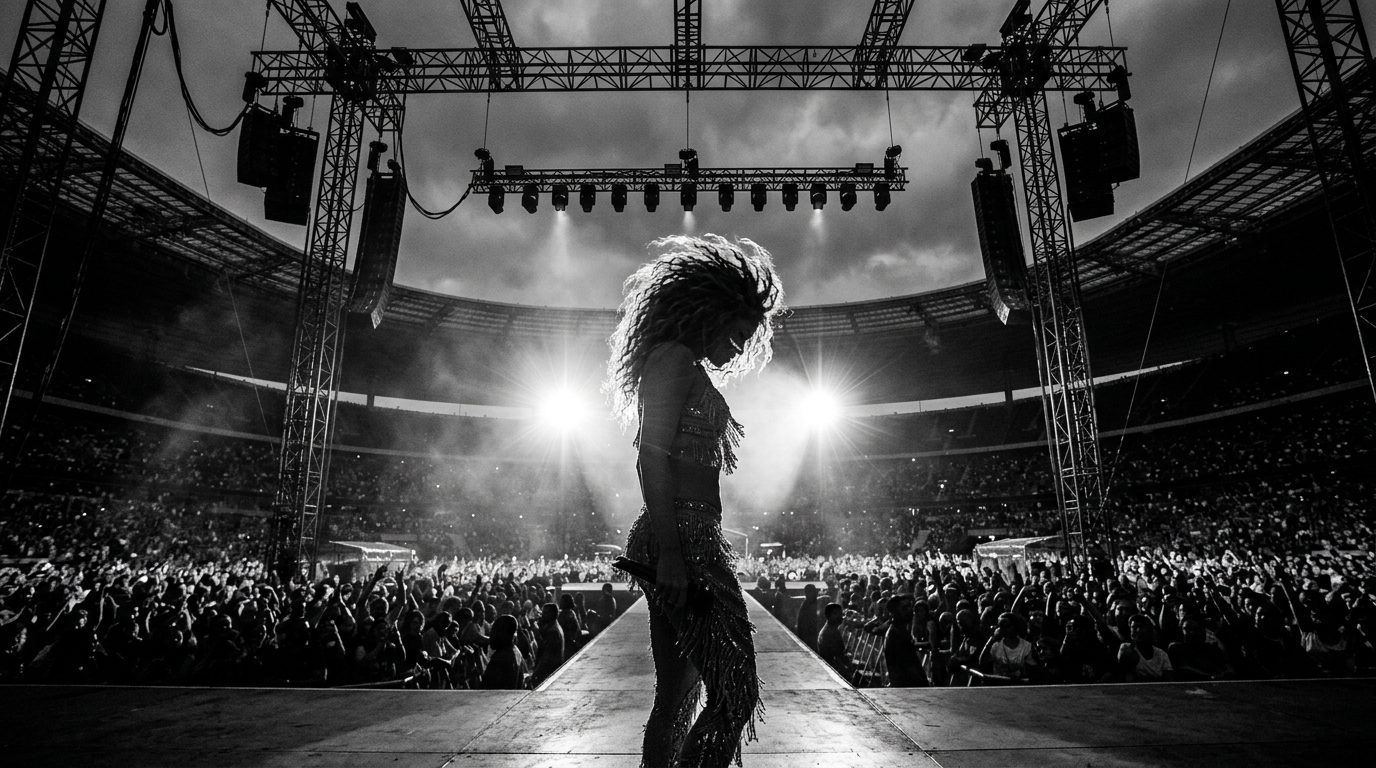
The air in Miami’s Hard Rock Stadium vibrates in a way that’s hard to explain. It’s not just from the 65,000 fans roaring in the stands; it’s a denser, almost physical electricity that’s concentrated in the labyrinth of corridors and dressing rooms beneath the grand stage. It’s February 2, 2020, the day of Super Bowl LIV, and at the heart of this whirlwind, just minutes away from one of the most anticipated performances in the event’s history, is Shakira Isabel Mebarak Ripoll. It’s not just her 43rd birthday; it’s the culmination of a career that has defied all expectations and redefined what it means to be a Latin star on the global stage.
Backstage, the chaos is a perfectly orchestrated choreography. Dancers in red sequined costumes stretch their muscles, sound technicians adjust microphones with surgical precision, and the echo of the crowd filters through like distant thunder. In the midst of it all, Shakira is an oasis of concentrated calm. She wears a vibrant red ensemble, an armor of Swarovski crystals that seems to radiate its own light. Her dark, intense eyes mentally rehearse every step, every note, every transition of a performance barely six minutes long that condenses three decades of musical history. There is no room for error. More than 100 million people in the United States alone will be watching.
“Hello Miami. Hello world,” she’ll say in a few moments. But in this preceding silence, her mind wanders. She thinks of the little girl from Barranquilla who danced on the table of an Arab restaurant, the teenager rejected from the school choir for having a vibrato “too strong,” the young woman who experienced failure with her first two albums. She thinks of the weight and the pride of representing not only Colombia, but an entire Latin culture on the biggest stage in the English-speaking world.
This is not just a concert. It’s a statement. It’s the culmination of a journey that began in the Colombian Caribbean, was forged in the recording studios of Bogotá and Los Angeles, and exploded on stages across five continents. Shakira, the woman whose hips became a symbol of liberation and whose name is synonymous with cultural fusion, is about to demonstrate why she is the undisputed queen of Latin pop. The she-wolf, the dreamer, the philanthropist, and the mother merge into a single force of nature. To understand the magnitude of that moment, we have to go back to the beginning.
Chapter 2: Roots Between Two Worlds. Barranquilla, Arab Heritage, and the Birth of an Artist
Barranquilla, the “Golden Gate of Colombia,” is a city where the Magdalena River meets the Caribbean Sea, a melting pot of cultures where African, Indigenous, and European rhythms intertwine in the hot, humid air. Against this vibrant backdrop, on February 2, 1977, Shakira Isabel Mebarak Ripoll was born. Her very name is a foreshadowing: “Shakira” (شاكرة), meaning “grateful” in Arabic, and “Ripoll,” a Catalan surname that reveals the complexity of her lineage.
Her father, William Mebarak Chadid, a man of Lebanese descent born in the United States, was a writer and businessman who filled the house with books and the sound of his typewriter. Her mother, Nidia del Carmen Ripoll Torrado, from Barranquilla with Catalan roots, brought the warmth and joy of the Caribbean to her life. Shakira grew up as the only child of this marriage, but surrounded by the energy of her nine older half-siblings. This family environment—her father’s literary introspection, her mother’s exuberance—was the initial stage of her development.
Her artistic revelation came early and unexpectedly. At the age of four, during a visit to a Middle Eastern restaurant, she heard the sound of the derbake, the traditional Arabic drum, for the first time. Her body’s reaction was instantaneous and instinctive: before anyone could stop her, she climbed onto a table and began to belly dance, an ancestral echo resonating in her Lebanese blood. The applause of the diners was her first ovation.
“That’s when I knew I wanted to be an artist. The stage felt like the most natural place in the world for me.”
Her writing also blossomed at a young age. Inspired by her father, she wrote her first poem, “The Crystal Rose,” at four. At eight, she composed her first song, “Your Dark Glasses,” a poignant ballad dedicated to the man who wore dark glasses to hide the pain of losing a son in a motorcycle accident. That family tragedy, which occurred when Shakira was only two years old, marked her childhood and taught her about the fragility of life, themes that she would later explore in her music.
However, the path wasn’t without its challenges. In her Catholic school choir, her voice, with its distinctive and powerful vibrato, was considered a problem. The music teacher told her she sounded “like a goat,” a criticism that, far from discouraging her, spurred her on to find her own unique and unmistakable voice. At school, she earned the nickname “the belly dancing girl,” and every Friday she presented a new routine, honing her craft before her first audience.
Resilience became a life lesson at the age of eight, when her father’s business went bankrupt and the family lost almost everything. To give her a broader perspective, her father took her to a park where orphaned children lived on the streets. That image deeply impacted her and planted the seed of philanthropy within her. “One day I’m going to help these children, when I become a famous artist,” she promised herself. It was a promise that, decades later, she would more than fulfill.
Chapter 3: The Education of a Dreamer: Between UCLA and the Stage
Shakira’s ambition was never confined to the stage. From a young age, she demonstrated a voracious intellectual curiosity, a desire to understand the world beyond the borders of Barranquilla. This duality—the passionate artist and the dedicated student—would define her approach to global conquest. Talent alone wasn’t enough; she needed the tools to communicate with the world on its own terms.
At the peak of her career, in an unusual move for a pop star, Shakira decided to take a break and enrolled at the University of California, Los Angeles (UCLA). Undercover, using her middle name, Isabel, she attended classes in the History of Western Civilization. She wanted to immerse herself in knowledge, to understand the roots of the cultures that so fascinated her and that were already beginning to influence her music. It wasn’t a whim; it was a declaration of principles. To be a global artist, she had to be a citizen of the world.
His thirst for knowledge extended to languages. Aware that English was the lingua franca of pop music, he dedicated himself to mastering it with the same discipline he applied to his choreography. But he didn’t stop there: he learned Portuguese, French, Italian, and Catalan, in addition to having a working knowledge of Arabic. This multilingual ability wasn’t just a marketing tool; it was a genuine bridge to connect with his audiences worldwide, allowing him to compose, give interviews, and think within different cultural frameworks, enriching his artistic vision.
“Learning a language is like opening a new window to see the world. Each language has its own personality, its own music. For me, it’s a way to connect with people, to understand their soul.”
Before achieving international fame, his talent had already been recognized in Colombia. Between 1988 and 1990, she won the “Searching for a Child Artist” television contest on the regional network Telecaribe for three consecutive years. These early victories gave her the confidence and visibility needed to take the next step. It was during this period that she met theater producer Mónica Ariza, who, convinced of the young woman from Barranquilla’s potential, became her first manager and helped her secure an audition with an executive from Sony Music Colombia.
The decision to prioritize music over a traditional university degree was a risky but calculated gamble. Shakira knew her window of opportunity in the music industry was limited, and that her true education lay in recording studios, on stages, and in interacting with other musicians. Her multicultural background, acquired both in the classrooms of UCLA and during her travels around the world, became her greatest asset and the foundation upon which she would build an unprecedented musical empire.
Chapter 4: The Failures That Forged a Legend. Magia and Peligro (1991-1993)
The road to stardom is rarely a straight line, and Shakira’s was no exception. Before the world sang her anthems, she experienced the bitter taste of failure; a painful experience that, in her case, proved fundamental in shaping the character and determination of the artist she would become.
At just fourteen years old, after signing her first contract with Sony Music Colombia, Shakira released her debut album, Magia (1991). The album, a collection of pop ballads and dance songs written by her during her pre-teen years, was a true reflection of her dreams and influences at the time. However, the market wasn’t ready for her music. The album was a resounding commercial failure, selling barely a thousand copies. For a teenager who had bet everything on music, the blow was devastating.
Two years later came the second attempt: Peligro (1993). Having just turned sixteen, Shakira released an album with a more rock-oriented sound, though equally personal. Despite being a more mature work, history repeated itself. Peligro also failed to connect with the public, and sales were, once again, disappointing. The music industry, with its usual cruelty, seemed to have turned its back on her. Two consecutive failures are a death sentence for most budding careers.
“I remember feeling enormous frustration. I had poured my whole heart into those records, and no one seemed to understand. For a moment, I thought maybe I wasn’t made for this, that my dream was just that, a dream.”
In the midst of that crisis of confidence, a ray of hope appeared on the horizon. In 1993, she was selected to represent Colombia at the prestigious Viña del Mar International Song Festival in Chile. With “Eres,” a powerful ballad, she faced the formidable “monster” of the Quinta Vergara. Although she didn’t win first place, her performance was a revelation: she demonstrated that, beyond sales figures, she possessed undeniable talent and a magnetic stage presence. Viña del Mar was a turning point, the artistic validation she desperately needed.
After her experience in Chile and the disappointment of her first two albums, Shakira made one of the smartest decisions of her career: to take a break. She decided to finish high school and distance herself from the industry. This period of reflection was crucial: it allowed her to mature, discover new influences, and, above all, find her true artistic voice, far from commercial pressures and imposed formulas. She realized that to succeed she couldn’t be an imitation of anyone; she had to be, authentically, Shakira. These early failures, far from destroying her, taught her the most valuable lessons about authenticity, perseverance, and the need to reinvent herself.
Chapter 5: The Latin American Dawn. Barefoot and the Birth of a Queen (1995-1997)
After a period of reflection and learning from her failures, Shakira returned to the studio with a completely new perspective. She was no longer the teenager seeking industry approval; she was a young artist who had found her voice and was ready to defend it. The result of that transformation was Barefoot (1995), the album that would not only save her from obscurity but also catapult her to stardom throughout Latin America and lay the foundation for her future global empire.
The starting point was a song: “¿Dónde estás corazón?” (Where Are You, My Heart?). Originally composed for a compilation album of Colombian artists called Nuestro Rock, the song became an unexpected hit on Colombian radio. Her freshness, her blend of pop-rock with honest and direct lyrics, captured the attention of the public and the record label itself, which saw in her a potential it had previously failed to recognize. Sony gave her the green light to record a full album under this new musical direction.
For this crucial project, Shakira teamed up with producer Luis Fernando Ochoa. The synergy between them was instantaneous. Ochoa understood Shakira’s vision: her desire to fuse Spanish rock with catchy pop melodies and introspective lyrics. Together they created a unique sound that broke with the conventions of Latin pop at the time. The result was a raw, poetic, and deeply personal album.
“With ‘Pies Descalzos,’ I felt that for the first time I was making the music I truly wanted to make. Each song was a piece of my diary, my thoughts, my frustrations. It was an act of liberation.”
The success wasn’t immediate, but it was overwhelming. The first official single, “Estoy Aquí,” became a generational anthem: its infectious energy and declaration of independence resonated with millions of young people across the continent. Other hits followed, such as “Un poco de amor,” the poetic “Antología”—an ode to first love that became a classic—and the socially critical “Se quiere, se mata.” The album sold over four million copies, an astronomical figure for a Colombian artist at that time.
The Pies Descalzos phenomenon transcended music. Shakira, with her jet-black hair, leather pants, and carefree attitude, became an icon of Latin youth. She represented a new femininity, more real, more intelligent, and less prefabricated. The tour that accompanied the album, the Pies Descalzos Tour, took her throughout Latin America, where she experienced the fervor of massive concerts for the first time. She was no longer a promise; she was a reality. The Latin American dawn had arrived, and at its center, a new queen was being crowned.
Chapter 6: Regional Consolidation. ¿Dónde están los ladrones? and MTV Unplugged (1998-1999)
After the overwhelming success of Pies descalzos, the pressure on Shakira was immense. Would she be able to replicate the phenomenon, or was she destined to be a one-hit wonder? The answer came in 1998 with ¿Dónde están los ladrones?, an album that not only solidified her superstar status in the Spanish-speaking world but also demonstrated an artistic maturity and ambition that foreshadowed her imminent global breakthrough.
The story behind the title is already legendary. At the end of a tour, the suitcase containing all the lyrics to her new songs was stolen at the Bogotá airport. Faced with the desolation of having lost months of work, Shakira channeled her frustration and rewrote the entire album in a burst of inspiration. The result was a more polished, rockier, and more sophisticated album than its predecessor, with a production cost of nearly $3,000,000 USD by Emilio Estefan Jr., who became a key mentor during this stage.
The first single, “Ciega, Sordomuda,” was an explosion of energy that fused pop-rock with mariachi trumpets, a bold combination that became an instant hit. The song dominated the charts throughout Latin America and Spain, and its surreal video showcased a more confident and theatrical Shakira. Iconic ballads like “Tú” and “Inevitable” followed, demonstrating her incredible vocal range and her ability to write lyrics of heartbreaking vulnerability.
And then there was “Ojos Así,” an homage to her Lebanese roots that fused Arabic music with pop and would become one of her most emblematic songs, with its hypnotic belly dance choreography.
“¿Dónde Están los Ladrones? was born out of an accident, a loss. But it taught me that sometimes, from the worst situations, the most honest art can be born. I had to dig deep inside myself again, and I think I found things I didn’t know were there.”
The album sold over seven million copies, and its massive success caught the attention of MTV in the United States. In 1999, the network invited her to record an MTV Unplugged, an acoustic format reserved for the most respected artists. Shakira’s performance was historic: it was the first Spanish-language Unplugged broadcast in the United States, and in it, stripped of studio production, she demonstrated the strength of her compositions and the power of her voice. The acoustic version of “Ojos Así” and the intensity of “Inevitable” became iconic moments. The live album, released in 2000, sold over five million copies and earned her her first Grammy Award.
With the Anfibio Tour in 2000, Shakira toured Latin America and the United States, performing in large venues and building an increasingly large and diverse fan base. She was no longer just a Latin pop star; she was a critically acclaimed artist, a respected songwriter, and a magnetic performer. The Hispanic market had become too small for her. The Anglo-Saxon world, with its promise of global glory, was the next inevitable step.
Chapter 7: The Leap into the Global. Laundry Service and the Anglo-Saxon Conquest (2001-2003)
At the beginning of the new millennium, Shakira faced the biggest challenge of her career: the crossover. The Anglo-Saxon market, historically elusive for Latin artists, was the last bastion to conquer. With the support of Emilio and Gloria Estefan, she embarked on the monumental task of creating a bilingual album that could seduce a global audience without betraying her roots. The result was Laundry Service (2001), an album that not only made her a global superstar but also forever changed the rules of the game for Latin music.
The process was arduous. Shakira moved to Miami and immersed herself in the studio, working intensely to perfect her English and learn to compose in a new language. Under the tutelage of Gloria Estefan, she translated and adapted her ideas, seeking a balance between her Latin poetic sensibility and the structures of Anglo-Saxon pop. The album title, whose Spanish version was Laundry Service, was a metaphor for her process of purification and artistic rebirth.
The first single, “Whenever, Wherever”—and its Spanish version, “Suerte”—was the perfect launching pad. The song was an irresistible fusion of pop-rock with Andean charangos and Arabic rhythms, a celebration of her multicultural identity. The iconic video, featuring Shakira dancing amidst exotic landscapes, became a global phenomenon. The song reached number one on the charts in more than 20 countries and charted in the top 10 of the Billboard Hot 100 in the United States. The whole world was mesmerized.
“Singing in English was one of the biggest challenges of my career. I was afraid I wouldn’t be able to express myself with the same honesty as in Spanish. But I realized that feelings are universal. Love and pain sound the same in any language.”
The album was an unprecedented commercial success, selling more than 13 million copies worldwide. Songs like the rock ballad “Underneath Your Clothes” and the energetic “Objection (Tango)” solidified her presence on English-language radio. Shakira had become the face of the Latin boom, but unlike other artists, her music wasn’t simply an adaptation to American pop. It was a proud display of her roots, a fusion that educated a global audience about the sounds of Latin America and the Middle East.
The tour that followed, the Tour de la Mongoose (2002–2003), was her first major world tour and grossed over $72 million USD. The name, Shakira explained, was a metaphor for the fight against hate and negativity in the post-9/11 world. On stage, she was a force of nature, combining her rock energy with her sensual hip movements. She had achieved the impossible: conquering the world’s most competitive market while remaining true to herself. The girl from Barranquilla was now a citizen of the world, and the queen of Latin pop had reclaimed her global throne.
Chapter 8: Artistic Maturity. Oral Fixation and Absolute Mastery (2005-2008)
After her global conquest with Laundry Service, Shakira could have settled comfortably on her throne. Her artistic restlessness, however, led her to embark on her most ambitious project to date: a double album, one in Spanish and the other in English, released just a few months apart. Oral Fixation Vol. 1 and Oral Fixation Vol. 2 (2005) not only demonstrated her incredible versatility and work ethic, but also cemented her status as one of the most important and respected artists on the planet.
The first release, Oral Fixation Vol. 1, was a triumphant return to her native language. Far from being an album for the mainstream market, it was a work of experimental pop that explored genres ranging from nascent reggaeton to bossa nova and alternative rock. The first single, “La Tortura,” a collaboration with Spanish singer Alejandro Sanz, was a masterstroke. The song, with its reggaeton-pop rhythm and lyrics about infidelity, became a cultural phenomenon: it remained at number one on Billboard’s Hot Latin Tracks chart for 25 consecutive weeks, a historic record that proved a Spanish-language song could dominate global charts.
A few months later came *Oral Fixation Vol. 2*, her English-language album. Although it had a slower start, everything changed with the release of its second single, “Hips Don’t Lie,” featuring Haitian rapper Wyclef Jean. The song, built on a sample of the salsa hit “Amores como el nuestro,” was an explosion of Caribbean joy, an ode to the power of dance. It became Shakira’s first and only number one on the US Billboard Hot 100 and a massive worldwide hit, cementing its place as one of the most iconic songs of the 21st century.
“The ‘Fijación Oral’ project was like my thesis. I wanted to prove that I could make complex and commercial music at the same time, in both Spanish and English. It was a period of overflowing creativity, but also of enormous pressure.”
The tour that united both projects, the Fijación Oral Tour (2006-2007), was a monumental production that took her to stadiums around the world. With a gross of over $156 million USD, it became the first tour by a Latin female artist to surpass the one hundred million dollar mark, a milestone that demonstrated her global appeal. On stage, she alternated between rock, pop, ballads, and Latin rhythms with astonishing ease.
During this period of absolute dominance, her personal life was stable with her then-partner, Antonio de la Rúa. Billboard magazine named her the top female Latin artist of the decade, a recognition of her impact and consistency. Shakira had reached the pinnacle, not only in terms of commercial success but also in terms of artistic respect. She had proven to be much more than a crossover artist; she was a complete artist, a brilliant songwriter, and an unparalleled performer who had built a bridge between cultures, uniting the world to the rhythm of her hips and the honesty of her heart.
Chapter 9: Continuous Reinvention. She Wolf, Sale el Sol, and the Digital Age (2009-2011)
In a constantly changing music world, with the rise of the digital age and social media, staying on top is an even greater challenge than conquering it. Shakira, always attuned to cultural trends, once again demonstrated her astonishing capacity for reinvention with her subsequent projects. She Wolf (2009) and Sale el Sol (2010) were two sides of the same coin: two albums that showcased her artistic duality—that of the global pop star and that of the singer-songwriter with Latin roots—as she navigated the transition to a new paradigm in the industry.
She Wolf was a bold foray into electropop and dance, a more synthesized and European sound that departed from her previous work. The lead single, with its pulsating rhythm and lyrics about liberating feminine instincts, was a declaration of independence. The video, in which Shakira displayed astonishing flexibility inside a golden cage, became a viral phenomenon, showcasing her mastery of visual language in the YouTube era. Although the album didn’t reach the stratospheric sales of its predecessors, it was a commercial success and demonstrated her willingness to experiment without becoming stuck in any formula.
“Loba represents the modern woman. That woman who knows what she wants and isn’t afraid to ask for it. It’s a celebration of freedom and our deepest desires.”
If *Loba* was a look toward the future, *Sale el sol* was a warm homecoming. The album combined the Spanish rock of her early days with merengue and tropical rhythms, a more organic and luminous sound. The record included the global anthem “Waka Waka (This Time for Africa),” the official song of the 2010 FIFA World Cup, which became one of the best-selling singles of all time and whose video surpassed one billion views on YouTube, a milestone in the digital age.
It was during the filming of that video that she met the Spanish footballer Gerard Piqué, beginning a relationship that would mark her personal life for the next decade. The album also contained hits such as “Loca” and the ballad “Sale el sol,” which spoke of hope after adversity.
The Sale el Sol World Tour (2010-2011) was a vibrant celebration that grossed nearly $100 million USD. Shakira also cemented her status as one of the first artists to understand and master the power of social media, connecting directly with her millions of followers on Twitter and Facebook. She became the first person to surpass 100 millions of dollars “likes” on Facebook, demonstrating that her influence extended far beyond music. In an industry undergoing profound transformation, she not only survived but thrived, reinventing herself once again and proving that her reign was far from over.
Chapter 10: Back to Her Roots. Shakira (2014) and El Dorado (2017)
The next stage in Shakira’s career was marked by a profound personal transformation: motherhood. The arrival of her two sons, Milan and Sasha, led her to a period of introspection and a return to her roots that was directly reflected in her music. Her albums Shakira (2014) and El Dorado (2017) are more intimate works, exploring love, family, and her identity as a woman and artist in a new phase of her life, without abandoning her characteristic knack for global hits.
The self-titled album, Shakira (2014), was an eclectic work that blended rock, reggae, and country, featuring collaborations with artists such as Rihanna (“Can’t Remember to Forget You”) and Blake Shelton. It was an album that reflected her life at that time, divided between a global career and her new role as a mother. Although it didn’t achieve the commercial success of her previous releases, it contained gems like the ballad “Empire” and the emotional “23,” dedicated to Gerard Piqué. During this period, she also joined the judging panel of the popular American show The Voice, where her charisma made her a fan favorite and introduced her to a new generation of viewers.
It was with *El Dorado* (2017) that Shakira once again dominated the charts with overwhelming force. The album, whose title refers to the mythical Colombian city of gold, was a metaphor for her artistic rediscovery. Returning to a predominantly Spanish-language sound, she immersed herself in the urban rhythms that dominated the scene—reggaeton and trap—always adding her personal touch. The collaboration with Colombian artist Maluma on “Chantaje” became a monumental hit. Other songs like “Me Enamoré” and “La Bicicleta,” with Carlos Vives, became instant anthems.
“El Dorado was like finding a treasure after a long search. Motherhood changed my perspective, made me more vulnerable but also stronger. This album is a reflection of that journey, of rediscovering inspiration in my own life.”
The album’s success was overshadowed by two major challenges. The first was a hemorrhage in her vocal cords that forced her to postpone her world tour, the El Dorado World Tour, plunging her into deep uncertainty about her future as a singer. The second was the beginning of her problems with the Spanish tax authorities, who accused her of tax fraud in a legal battle that would drag on for years at a huge personal and media cost.
True to her resilient spirit, Shakira bounced back. The tour, finally held in 2018, was a resounding success, grossing $96 million USD and proving that her connection with her audience was stronger than ever. She had overcome adversity once again, rising from the ashes with her usual determination.
Chapter 11: The Global Phenomenon. Super Bowl, BZRP, and the Resurgence (2020–2023)
Just when it seemed Shakira had already achieved everything, the start of the new decade saw her star in one of the most spectacular comebacks in pop history. A combination of professional milestones, a painful personal breakup, and a series of songs that became empowering anthems catapulted her to a new level of cultural relevance, demonstrating that her ability to connect with the spirit of the times was more powerful than ever.
The starting gun was her historic performance at the Super Bowl LIV halftime show in 2020, alongside Jennifer Lopez. In a show that celebrated Latin culture in grand style, Shakira dazzled with a medley of her greatest hits, her infectious energy, and a nod to her Colombian roots with the champeta dance. The performance was critically acclaimed and became one of the most-watched of all time, a powerful reminder of her status as a global icon.
Behind the scenes, however, her personal life was falling apart. In 2022, her separation from Gerard Piqué was announced after more than a decade together, a breakup that became a media frenzy. Far from hiding, Shakira channeled her pain and anger into music, in a series of songs that became a global phenomenon. Tracks like “Te Felicito” and “Monotonía” were the prelude to the storm that was about to break.
On January 11, 2023, the world stopped to listen to BZRP Music Sessions, Vol. 53, her collaboration with the Argentinian producer Bizarrap. The song was a direct hit, a musical catharsis full of powerful lines—”Women don’t cry anymore, women make money”—that became slogans of female empowerment around the world. She broke all records: it was the biggest debut for a Spanish-language song in the history of Spotify and YouTube, and it made her the first woman to reach the top 10 of the Billboard Hot 100 with a Spanish-language song. Shakira wasn’t just telling her own story; she was telling the story of millions of women.
“I never thought that what for me was a catharsis and a release would go straight to number one in the world at 45 years old and in Spanish. But I feel that this isn’t just about me, it’s about so many women who have felt represented by my story.”
The resurgence was recognized by the industry. Billboard named her the first “Latin Woman of the Year” in 2023. At the MTV Video Music Awards, she received the prestigious Michael Jackson Video Vanguard Award, becoming the first South American artist to do so, on a night when she delivered a memorable performance of more than ten minutes. The Grammy Museum inaugurated the exhibition “Shakira: The Grammy Museum Experience,” solidifying her place in the pantheon of music. She had transformed her pain into art, and art into a cultural movement.
Chapter 12: The Ultimate Triumph Tour. Las Mujeres Ya No Lloran (2024-2026)
The monumental success of her post-breakup singles culminated in the release of her twelfth studio album, Las mujeres ya no lloran (2024). The title, taken from her iconic session with Bizarrap, was more than a slogan; it was the manifesto of a new era. The album, a collection of songs that chronicle the journey from desolation to resilience and empowerment, was critically acclaimed and debuted at the top of the charts worldwide.
The true triumph, however, came with the announcement of the Las Mujeres Ya No Lloran World Tour. Conceived as her biggest and most ambitious tour to date, the tour became a global phenomenon even before it began. Ticket demand was unprecedented, breaking sales records in stadiums across North America, Latin America, and Europe. The tour wasn’t just a concert; it was a pilgrimage for its fans, a collective celebration.
The show, which kicked off in 2025, was a dazzling production, a journey through her more than three decades-long career, but with a focus on her new message of strength. From heartbreak anthems to dance classics, each song took on new meaning within the context of her recent history. On stage, Shakira gave her all each night, creating an intimate connection with tens of thousands of people.
“This tour is a party. It’s a celebration of life, of resilience, of female friendship. Every night, when I see so many people singing these songs that were born from pain, I feel that it has all been worth it. I’m not the one crying anymore; we cry tears of joy together.”
Financially, the tour shattered all previous records. With a box office gross exceeding $300 million USD, it became the highest-grossing tour in history for a Latina artist, a milestone that redefined the standards of success in the industry. But beyond the numbers, its cultural impact was immeasurable: the concerts became a space where women could shout, dance, and heal together, a symbol of female power and the ability to transform suffering into strength.
With Women Don’t Cry Anymore, Shakira not only solidified her legacy as the most successful Latin female artist of all time, but also established herself as a thought leader and a voice of female empowerment in the post-#MeToo era. The tour of ultimate triumph wasn’t just about her personal victory; it was about the victory of all the women who had decided to stop crying and start earning money.
Chapter 13: The Legacy That Transcends. Eternal Queen of Latin Pop
To assess Shakira’s legacy is to try to measure an earthquake. Her impact on music, culture, and philanthropy is so profound and multifaceted that it transcends numbers, even though these are, in themselves, astonishing: more than 125 million records sold, more than 400 awards—including 4 Grammys and 15 Latin Grammys—and 21 Guinness World Records. Her true influence lies in having been a pioneer, an architect of cultural bridges who forever changed the perception of Latin music in the world.
Shakira spearheaded the second great “Latin explosion” in the early 21st century, but unlike her contemporaries, her crossover didn’t involve diluting her identity to fit the Anglo-Saxon mold. On the contrary, her strategy was one of bold fusion: she introduced Andean charangos, the Arabic rhythms of the derbake, and the sensuality of cumbia into the DNA of global pop. She educated the world on the richness and diversity of Latin sounds, opening the door for a whole generation of artists—from J Balvin and Maluma to Karol G and Rosalía—to achieve international success singing in Spanish.
Her legacy as a songwriter is equally fundamental. From the beginning, Shakira has written or co-written the vast majority of her songs, something unusual in the world of mainstream pop. Her lyrics, often poetic and always honest, have explored love, heartbreak, social commentary, and empowerment with an authentic voice that has resonated with millions. She is a storyteller, a chronicler of human emotions who has proven that one can be both profound and commercially successful.
Beyond her music, her philanthropic work is an inseparable part of her identity. The Barefoot Foundation, which she created at just 18 years old, has built schools and provided education and nutrition to thousands of children displaced by violence in Colombia. Her work as a UNICEF Goodwill Ambassador has led her to advocate for children’s rights in global forums. Shakira has used her platform not only to entertain, but to generate real and tangible change, fulfilling the promise she made to herself as a child in a park in Barranquilla.
“My biggest dream is for music to serve a purpose beyond making people dance. I want it to be a tool for change, for education, for giving a voice to the voiceless. That, for me, is true success.”
Today, her place in history is secure. The Rock and Roll Hall of Fame includes her on its list of the 200 Definitive Artists. Billboard magazine considers her one of the greatest pop stars of the 21st century. But perhaps her greatest legacy is the most intangible: having demonstrated that a woman from Barranquilla, Colombia, could conquer the world without renouncing her essence, her language, or her culture. The girl who was rejected from the school choir for having a voice “too loud” became the defining voice of a generation, the symbol of Latin music, and the eternal queen of Latin pop. Her story is proof that magic is possible, that dreams come true, and that, sometimes, hips don’t lie.
Bonus Section: Featured and Recommended Works. Shakira’s Three Essential Albums and Why You Should Listen to Them
Exploring Shakira’s discography is embarking on a journey of constant evolution and reinvention. However, three albums stand out as fundamental pillars that not only defined key stages of her career but also left an indelible mark on music history. These are the essential works for understanding the magnitude of her artistic genius.
1. Pies Descalzos (1995): The Cry of Independence
Why listen to it? Because it’s the Big Bang of “Shakiramania.” After two commercial failures, this album represented an act of rebellion and authenticity. It’s the raw, unfiltered sound of an 18-year-old who found her voice by blending pop-rock with introspective and socially conscious lyrics. Songs like “Estoy Aquí” and “Antología” became anthems for a generation of young Latin Americans who felt represented for the first time. Listening to Pies descalzos is to witness the birth of a legend, the exact moment when Spanish pop changed forever.
2. Laundry Service (2001): The Conquest of the World
Why listen to it? Because it’s the instruction manual for how to do a perfect crossover without selling your soul in the process. This bilingual album not only catapulted Shakira to global stardom, but it also redefined what global pop music could be. The fusion of Andean, Arabic, and rock rhythms in “Whenever, Wherever” was a revelation that opened the doors of the Anglo market to world sounds. It’s a bold, ambitious, and spectacularly successful album that demonstrates Shakira’s global vision and her ability to create a universal musical language. Simply put, one of the most important albums of the 21st century.
3. Women Don’t Cry Anymore (2024): The Resurrection of the She-Wolf
Why listen to it? Because it’s a testament to one of the most epic comebacks in pop history. Born from the pain of a public breakup, this album is a masterclass in transforming suffering into art, and art into a cultural movement. From the catharsis of the session with Bizarrap to the vulnerability of its ballads, the album is an emotional journey that connects with the universal experience of heartbreak and resilience. It’s Shakira’s most mature and conceptual work, a record that not only returned her to the top of the charts but also cemented her status as a fundamental voice of female empowerment in the 21st century. Listening to it is understanding why, after more than three decades, Shakira remains the queen.