Chapter 1: Heaven Touched by Hands
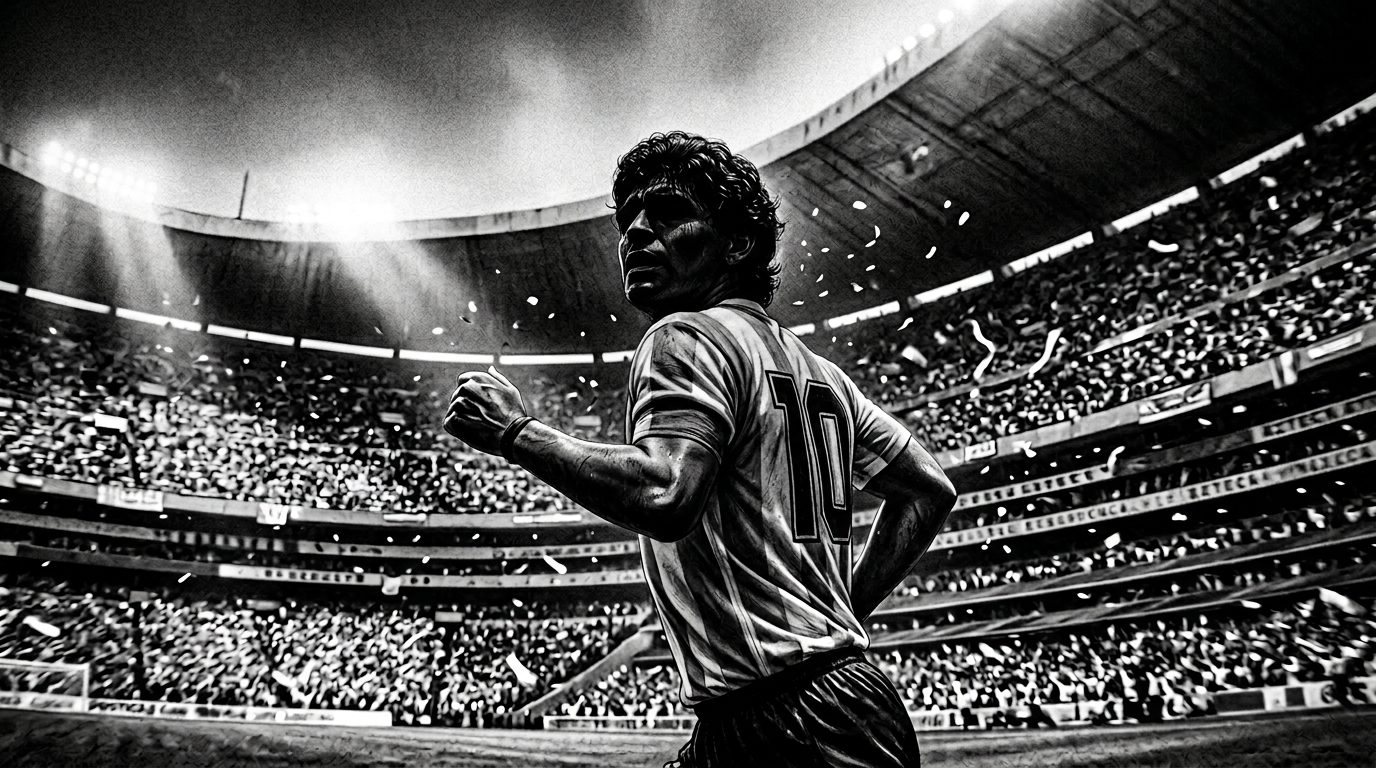
The air in Mexico City’s Azteca Stadium was a thick soup of heat, anticipation, and something more intangible: a mixture of wounded pride and the promise of a redemption that only football can offer. It was June 22, 1986, and 114,580 souls gathered to witness not just a World Cup quarter-final match, but a contest laden with symbolism that transcended the sport. Four years earlier, Argentina and England had fought a war over the Falkland Islands, a brief but bloody conflict that had left a deep scar on the Argentine psyche. On the hallowed turf of the Azteca, the opportunity arose for a different kind of revenge, one that would be fought with feet and heart.
At the center of that whirlwind of emotions stood a man of short stature but imposing presence: Diego Armando Maradona. At 25, he was already a world-renowned figure, a generational talent who had dazzled at Argentinos Juniors, Boca Juniors, and Barcelona. With the number 10 on his back and the captain’s armband on his arm, Maradona was more than a footballer: he was a general, an artist, and a messiah, all rolled into one, carrying on his shoulders the hopes of an entire nation.
The match against England was a microcosm of Maradona’s life and career: a symphony of genius, controversy, and audacity that bordered on the divine. For fifty minutes, the encounter was a tactical battle, a high-speed chess match played under the blazing sun. Then, in the 51st minute, came the moment that would define him forever. After a failed one-two with Jorge Valdano, the ball rose into the air thanks to an unintentional back pass from English midfielder Steve Hodge. Maradona, always cunning, always one step ahead, raced toward the penalty area, where the imposing goalkeeper Peter Shilton—twenty centimeters taller than him—was preparing to clear. In an instant that defied logic and the rules, Diego leaped, not with his head, but with his outstretched left fist, and deflected the ball into the net. The stadium erupted in a mixture of jubilation and confusion. The incredulous English players surrounded the Tunisian referee, Ali Bin Nasser, but their protests were in vain. The goal stood.
“I did it with Maradona’s head but with the hand of God,” he would later declare, a phrase that would become his epitaph and the justification for a mischievous act that, for millions of Argentinians, was sweet revenge.
But the story of that day didn’t end there. If the first goal was an act of profane cunning, the second was a pure work of art. Just four minutes after the “Hand of God,” Maradona received the ball in his own half and began a run that would be etched in the annals of sport. With the ball glued to his left foot as if it were an extension of his body, he glided through the English players like a bullfighter dodging charges. One, two, three, four, five opponents were left behind, outpaced by a combination of speed, control, and audacity that defied imagination. As Shilton came out to challenge him, he evaded him with astonishing ease and tapped the ball into the back of the net.
In the broadcast booth, Uruguayan commentator Víctor Hugo Morales, his voice breaking with emotion, tried to find the words for what he had just witnessed:
“Cosmic kite! What planet did you come from to leave so many Englishmen in your wake? To make the whole country a clenched fist shouting for Argentina! Thank you, God, for football, for Maradona, for these tears…”
In the span of four minutes, Maradona encapsulated the duality of his genius. He was the trickster and the magician, the sinner and the savior. He was the embodiment of the street kid, the boy from Villa Fiorito who had learned to survive and triumph with a mixture of sublime talent and street smarts forged in adversity. His performance against England was not just a sporting victory: it was a declaration of identity, an act of rebellion against the powerful, the vindication of a people who had been humiliated on the battlefield.
Maradona was the archetype of the flawed genius, a man who reached the pinnacle of glory but also battled inner demons that threatened to consume him. His life was a rollercoaster of dazzling successes and precipitous falls, of adoration and scorn, of love and self-destruction. An idol with feet of clay, an earthly god whose flaws somehow made him even more human and fascinating. Within him coexisted the sublime artist, capable of creating beauty on the pitch, and the tormented man, a victim of his own addictions and an environment that often exploited and betrayed him.
That duality, that constant tension between light and darkness, is key to understanding not only his career but also the cultural impact he had in Argentina and the world. Maradona was not just an athlete: he was a social phenomenon, a symbol of the class struggle, an icon of rebellion against the established power. His complex and contradictory figure continues to be a subject of debate and fascination, a mirror in which the passions, dreams and frustrations of millions of people are reflected.
To understand the man who reached the pinnacle of success at the Azteca Stadium, it’s necessary to travel back to his origins, to the dusty streets of Villa Fiorito, where a boy with extraordinary talent began to dream of glory. It is there that the story of Diego Armando Maradona begins, the cosmic kite who taught us that, sometimes, the wildest dreams can come true.
Chapter 2: Villa Fiorito and the Cebollitas (1960-1976)
The legend of Diego Armando Maradona wasn’t born in a monumental stadium or under the glare of fame, but on the unpaved streets of Villa Fiorito, a shantytown on the outskirts of Buenos Aires that in the 1960s was synonymous with poverty and marginalization. It was in this environment of deprivation—where opportunities were scarce and dreams often drowned in the mud—that the indomitable character of a boy destined to become a football god was forged. Born on October 30, 1960, Diego was the fifth of eight children of Diego Maradona Sr., a laborer of Guarani descent who worked in a bone crushing factory, and Dalma Salvadora Franco, “Doña Tota”, a woman of Galician and Italian origin who devoted herself to her children, often skipping meals so that they could eat.
The Maradona family home was a humble dwelling, with unplastered brick walls and a corrugated iron roof that rattled with every rain. There was no running water or electricity, and the space was so cramped that privacy was a nonexistent luxury. Even so, amidst their hardship, the family found strength in love and unity to overcome their difficulties. For young Diego, there was a refuge, a sanctuary where he could escape the harshness of reality: the vacant lot. “Las Siete Canchitas,” a vacant lot near his house, became his first stage, the place where, with a ball made of rags or any round object he could find, he began to develop a symbiotic relationship with the ball that seemed to defy the laws of physics.
His father, Don Diego, a man of few words but with an iron will, instilled in his children the value of hard work and sacrifice. Doña Tota, with her unconditional love and unwavering faith, was Diego’s emotional refuge, the person who always believed in his talent and protected him from adversity. In that environment of deprivation, football became the universal language, the currency, the only way to dream of a different future.
“I grew up in a gated community… gated from electricity, water, and telephone service,” Maradona would later quip, in a phrase that humorously and bitterly encapsulated the reality of his childhood.
It was on that vacant lot where a friend, Goyo Carrizo, first saw Diego’s extraordinary talent and took him to a tryout for the Argentinos Juniors youth divisions. The man who would change his life forever was Francisco Cornejo, a youth coach who, upon seeing the eight-year-old boy juggling the ball with astonishing skill, was speechless. “It seemed like the ball never left his foot. He had a control that wasn’t normal for a boy his age,” Cornejo would later recall. The first impression was so striking that the coach even doubted Diego’s age, asking for his ID to confirm it. With infinite patience and a keen eye for talent, Cornejo became a father figure, the man who polished that rough diamond and guided him in his first steps in football.
Thus was born the legend of the Cebollitas, the 1960 age group team from Argentinos Juniors that, under the tutelage of Cornejo and with Maradona as its undisputed star, became a winning machine. With Diego as the conductor, this team of humble boys achieved a streak of 136 undefeated matches, a record that still seems incredible today. They dominated local tournaments and also traveled to Peru and Uruguay, leaving a trail of astonishment in their wake. The fame of the “golden boy” began to grow, and on September 28, 1971, the newspaper Clarín published the first article about him, although with a misspelling of his last name: “Caradona.” Even then, his talent was so evident that during halftime of Argentinos Juniors’ first division matches he entertained the public by juggling the ball, a spectacle that became an attraction in itself.
While Maradona dazzled on the pitch, Argentina was plunging into one of the darkest periods in its history. In 1976, a coup d’état overthrew the government of Isabel Perón and established a civic-military dictatorship that sowed terror and repression. Football, however, became an escape, a passion that united a divided and fearful people. In this context of political and social upheaval, Maradona’s rise was a ray of hope, a symbol that, even in the darkest times, talent and determination could prevail.
The move from the Cebollitas (Little Onions) to the top divisions was a natural transition for Diego. At 14, he was already a recognized figure in youth football, and his first-division debut was only a matter of time. Life in Villa Fiorito, however, remained a daily struggle. Despite his growing fame, the Maradona family continued to live in poverty, and Diego never forgot his roots. This connection to his humble origins would be a constant throughout his life, the source of his identity and his deep empathy for the underprivileged.
Maradona’s childhood wasn’t just about football. It was also about experiencing poverty, the strength of his family, street smarts, and the formation of a rebellious and defiant character. In Villa Fiorito, he learned to distrust authority, to fight for what was his, and to never give up. These lessons, learned in the mud of the dirt field and the harshness of daily life, would be as important as his innate talent in forging the man the world would come to venerate. The boy who dreamed of playing in a World Cup and lifting his family out of poverty was about to take the first step toward that dream, a path that would lead him to the top of the world, though also fraught with dangers and temptations.
Chapter 3: The Professional Debut and Consolidation at Argentinos Juniors (1976-1981)
On October 20, 1976, just ten days shy of his 16th birthday, the name Diego Armando Maradona was forever etched in the annals of Argentine professional football. The setting was the modest stadium of Argentinos Juniors, in the La Paternal neighborhood, and the opponent was Talleres de Córdoba, one of the strongest teams of the time. Juan Carlos Montes, the Argentinos coach, aware of the raw talent he had on the bench, approached the young Maradona at halftime and gave him an instruction that revealed both his confidence in his talent and the essence of Argentine football: “Go on, kid, play like you know how, and if you can, nutmeg someone.” Wearing number 16 on his back, Diego stepped onto the field and, with his first touch, carried out the order with almost insulting ease, slipping the ball between Juan Domingo Cabrera’s legs. The murmur from the stands erupted into a roar of approval. They had witnessed the birth of a star.
“That day I touched the sky with my hands,” Maradona would confess years later, a phrase that reflected the profound emotion of a boy who had fulfilled his lifelong dream, the dream of his family, and the dream of an entire neighborhood.
The debut was just the prelude to a meteoric rise. In 1977, Maradona took ownership of the number 10 jersey and became the undisputed leader of a team that, thanks to his genius, began to compete on equal terms with the giants of Argentine football. He played 49 matches and scored 19 goals, but beyond the numbers, it was his ability to unbalance defenses and create impossible plays that captivated the fans. During a match against Huracán, he is said to have scored one of the most extraordinary goals of his career, a dazzling run past opponents from his own half that, unfortunately, wasn’t captured by television cameras and became an oral legend, passed down from generation to generation.
His talent was so dazzling that major clubs in Europe and South America began inquiring about him. Diego, advised by his first agent, Jorge Cyterszpiler, decided to stay at Argentinos Juniors, a club that offered him the peace of mind he needed to continue developing without the pressure of the giants. That decision spoke volumes about the maturity of a young man who already understood when he was ready to take the next step.
The year 1978 brought the first major disappointment of his career. With the World Cup about to be held in Argentina, Maradona was one of the standout players in the domestic league, and his inclusion in the national team seemed assured. César Luis Menotti, the Argentine coach, had called him up for several friendlies. But when it came down to it, when the final list of 22 players was announced, Maradona’s name was missing. Menotti, in a decision that would spark endless debate, opted for more experienced players, considering that Diego, at only 17 years old, was “too young” to handle the pressure of a World Cup on home soil. “I’d rather have him crying on my shoulder now than have the whole country crying later,” he declared, in a phrase that has gone down in history.
The news was a devastating blow. “That day, the saddest of my career, I swore I would get my revenge,” he wrote in his autobiography. The exclusion not only hurt him personally, but also struck him as an injustice. Two days after meeting her, in a match against Chacarita, Maradona played with a simmering fury, scoring two goals and drawing a penalty, as if he wanted to show the world the mistake they had made. The wound of 1978 would never fully heal and would become the driving force behind his boundless ambition, the fuel that would feed his desire to prove, time and again, that he was the best.
Far from crushing him, the World Cup disappointment strengthened Maradona. In the following years, he became a goal-scoring machine and a record-breaker, becoming the top scorer in the Argentine league for five consecutive seasons, an unprecedented achievement. In 1979, he led the Argentine youth team to victory in the Under-20 World Cup in Japan, a tournament in which he dazzled the world with his talent and charisma. As his professional career took off, his personal life also began to take shape. He moved with his family to a more comfortable house in La Paternal and began a relationship with Claudia Villafañe, who would become his wife and a central figure throughout his tumultuous life.
By 1981, Argentinos Juniors had become too small a club to accommodate the magnitude of his talent. Argentina’s biggest clubs vied for his signature, but it was Boca Juniors, the club he loved, that ultimately secured his services. The transfer was a national event, and his presentation at La Bombonera, on a day of torrential rain, became an iconic scene. Wearing the blue and gold jersey, Maradona fulfilled another of his childhood dreams. His time at Argentinos Juniors had come to an end, but he left an indelible legacy: that of a child prodigy who had become king of his own home, now embarking on a quest to conquer the world.
Chapter 4: The Brief Time at Boca and the First World Record (1981-1984)
Diego Maradona’s transfer to Boca Juniors in 1981 was much more than a simple sporting transaction: it was the culmination of a long-anticipated romance between Argentina’s most talented footballer and the country’s most popular club. La Bombonera was decked out to welcome its new idol, and Maradona’s arrival generated collective euphoria that translated into a massive increase in club members and unprecedented media attention. Despite the enormous pressure that came with wearing the blue and gold jersey, Diego did not disappoint. In his first Superclásico against River Plate, he scored an unforgettable goal, a work of art of speed, skill, and finishing that remains etched in the memory of the fans.
Led by Maradona, and accompanied by players of the caliber of Miguel Ángel Brindisi and Hugo Gatti, Boca Juniors won the 1981 Metropolitano Tournament, the only title Diego would win in his home country. It was a brief but intense period, lasting barely a year, filled with moments that forever cemented his love affair with the Boca fans. The economic crisis gripping the country and the club made his continued presence untenable, and the offer from FC Barcelona became an inevitable departure.
With the Argentine championship title under his belt, Maradona arrived at the 1982 World Cup in Spain as the great hope of a team defending the title won in 1978. The World Cup, however, would turn into a bitter disappointment. Argentina, again managed by Menotti, failed to find the collective rhythm of the previous tournament, and Diego, subjected to suffocating man-marking, was unable to shine in all his glory. The opening defeat against Belgium foreshadowed what was to come. Although he scored two goals in the victory against Hungary, his participation was marked by frustration and impotence. Elimination in the second round, after losses to Italy and Brazil, was sealed with the image that encapsulated his powerlessness: his expulsion in the match against Brazil for a reckless kick to Batista.
“I went to Spain to become world champion, and I returned with a failure on my shoulders. It was one of the greatest sorrows of my career,” Maradona would admit, reflecting the profound impact of that elimination on his competitive spirit.
Despite the World Cup setback, Maradona’s prestige remained undiminished in Europe. FC Barcelona paid a record $7,300,000 USD for his transfer, making him the most expensive footballer in history at that time. His arrival in Barcelona generated enormous excitement, but his time at Barça would be marked by misfortune and conflict. A few months after arriving, he was diagnosed with hepatitis, which kept him off the pitch for several months. When he finally seemed to be finding his best form, leading the team to victory in the Copa del Rey and the Copa de la Liga in 1983, he suffered one of the most serious injuries of his career.
On September 24, 1983, in a league match against Athletic Bilbao, defender Andoni Goikoetxea, nicknamed “the Butcher of Bilbao,” delivered a vicious tackle from behind that fractured Maradona’s left ankle. The image of Maradona writhing in pain on the Camp Nou pitch went viral and sparked outrage around the world. The recovery was long and painful, and although he managed to return to play that same season, the injury left physical and psychological scars that would haunt him for the rest of his career. His relationship with the Barcelona board, chaired by Josep Lluís Núñez, was already broken. Diego felt unprotected and openly criticized the lack of a firm hand against violence in Spanish football.
The point of no return came in the 1984 Copa del Rey final, precisely against Athletic Bilbao. The match, played in an atmosphere of extreme tension, ended in a brawl in which Maradona was one of the main protagonists, responding to the provocations of the Basque players with a series of blows. The Barcelona board, tired of the scandals and nightlife of their star player, decided to put him on the market.
It was then that a modest club from southern Italy, Napoli, appeared on the scene, willing to do anything to sign the best player in the world. In a record-breaking operation, the Neapolitan club paid $13,000,000 USD for his transfer. Maradona’s time in Barcelona came to an abrupt and contentious end. Despite the titles won, the feeling was bittersweet. The city that had welcomed him like a king was now showing him the door. For Maradona, the move to Naples wasn’t a step backward, but an opportunity for resurrection, the beginning of a new adventure in a city that, like him, lived and breathed football with an overflowing passion and that would embrace him as its prodigal son, its savior, its god.
Chapter 5: The God of Naples: The Golden Years (1984-1987)
If Maradona’s arrival in Barcelona had been an event, his presentation in Naples on July 5, 1984 was an event of biblical proportions. More than 75,000 souls packed the Stadio San Paolo, not to watch a match, but to witness the arrival of a messiah. Napoli, a club historically overshadowed by the industrial giants of northern Italy—Juventus, AC Milan, Inter Milan—had made the boldest gamble in its history to sign the Argentine genius. For the city, a vibrant metropolis plagued by poverty, unemployment, endemic corruption, and the omnipresent power of the Camorra, Maradona’s arrival was much more than a signing: it was an act of defiance, a cry of pride from the neglected south against the opulent north that despised it. Diego was not just a footballer; he was the embodiment of hope, a redeemer who had come to avenge years of sporting and social humiliations.
The impact was immediate and visceral. The city was covered in murals of his face, newborns were baptized with his name, and an almost religious fervor filled the streets. Maradona, with his humble origins and rebellious nature, connected instantly with the soul of the city. Unlike distant, bourgeois Barcelona, Naples was chaotic, passionate, and anarchic—a mirror of his own personality. “I want to become the idol of the poor kids of Naples, because they are like I was in Buenos Aires,” he declared at his presentation, sealing a pact of eternal love with the city.
The road to glory was not easy. The Italian Serie A of the 1980s was the toughest and most tactical league in the world, a minefield for creative players. In his first two seasons, despite glimpses of his immense talent, Maradona and Napoli failed to climb above mid-table. The pressure was immense, and the criticism was swift. Diego, forged in adversity, did not give up. He adapted to the rigor of “catenaccio,” learned to cope with relentless man-marking, and, little by little, transformed a team of modest players into a competitive machine. The club, under the presidency of Corrado Ferlaino, built a team to his specifications, surrounding him with stars like the Brazilian Careca and the Italian Bruno Giordano.
“In Naples, I felt at home from the first day. They gave me the love I needed to play football the way I know how. That’s why I gave them everything I had,” Maradona would explain, summarizing the perfect symbiosis that developed between him and the city.
The 1986-87 season was the culmination of that process. With Maradona in peak form after winning the World Cup in Mexico, Napoli embarked on a quest for the Scudetto. It was an epic campaign, a battle fought every Sunday against the powerful northern teams, especially against Michel Platini’s Juventus, Maradona’s great rival in the fight for the throne of world football. On May 10, 1987, in a San Paolo stadium that was a volcano about to erupt, a 1-1 draw against Fiorentina was enough to secure the first league title in the club’s history.
The city erupted in a celebration that lasted for weeks, a carnival of unbridled joy that released decades of pent-up frustration. Symbolic funerals were held for the northern teams, cemeteries were filled with graffiti that read “They don’t know what they missed!”, and Maradona’s image was elevated to the status of a deity. San Gennaro, the city’s patron saint, had a new competitor.
But the life of a god on earth comes at a price. The Neapolitans’ adoration became a gilded cage. Maradona couldn’t walk down the street, couldn’t go to a restaurant, couldn’t lead a normal life. His privacy vanished completely. Seeking protection and an escape from this suffocating pressure, he fell into the clutches of the Camorra, the powerful Neapolitan mafia. The Giuliano clan, which controlled the Forcella neighborhood, became his shadow, providing him with security, access to exclusive parties, and, most dangerous of all, cocaine. The drug, which he had tried sporadically in Barcelona, became an addiction, a dark refuge where he tried to soothe the anxiety and the weight of fame.
His personal life was also shaken. While his relationship with Claudia Villafañe was solidifying with the birth of their daughters Dalma and Gianinna, his nightlife was a whirlwind of excess. In the midst of this chaos, Diego Sinagra was born, the result of an extramarital affair with a young Neapolitan woman, a son he would refuse to acknowledge for decades, adding a layer of complexity and contradiction to his already turbulent life.
The 1987 Scudetto marked the pinnacle of Maradona’s era in Naples. He had fulfilled his promise, leading the underdogs to the pinnacle of Italian football. But while Naples celebrated its hero, the seeds of self-destruction had already been sown. The god of Naples was a profoundly human man, vulnerable and tormented, and his descent into hell, though still far off, had already begun.
Chapter 6: The Hand of God and World Consecration (1986)
The 1986 World Cup in Mexico was not simply a football tournament for Argentina: it was a journey of national redemption, and Diego Armando Maradona was its prophet and guide. After the military humiliation of the Falklands War in 1982 and the disappointing performance at the World Cup in Spain that same year, the country desperately needed a reason to believe again. Carlos Salvador Bilardo, a methodical and pragmatic coach, often labeled “anti-football” for his emphasis on results over entertainment, had built a solid and hardworking team, but it lacked the spark of genius needed to aspire to glory. That spark was Maradona. In an act of faith and cunning, Bilardo handed him the captain’s armband and designed a tactical system —an innovative 3-5-2— with the sole purpose of freeing his number 10 and allowing him to unleash his full creative potential.
Argentina’s campaign was a crescendo of emotions. After a solid group stage, the team began to show its true potential in the knockout rounds. But it was in the quarterfinals, against England, where football history was forever changed. The match, charged with a tension that transcended the sport itself, became the canvas on which Maradona painted his masterpiece: a blend of cunning and genius that encapsulated his essence. The first goal, the “Hand of God,” was an act of street smarts, a transgression of the rules that, for many Argentinians, was sweet revenge for the affront of the Falklands War. The second, the “Goal of the Century,” was a symphony of skill, speed, and courage, a 60-meter run in which he left half the English team in his wake before finishing with astonishing composure.
“At that moment, I felt like I was alone against the world, that nobody was going to help me. But when I saw the ball go in, I felt a liberation, a joy that I can’t describe. It was like stealing the English’s wallet without them noticing,” Maradona would confess about his first goal.
After the feat against England, the path to the final seemed clear. In the semifinals, Argentina faced a talented but inferior Belgium, and once again Maradona made the difference. With two more spectacular goals in the second half—one of them an almost exact replica of the “Goal of the Century”—he sealed their passage to the final. Bilardo’s team, often criticized for their physical style of play, had found in Maradona the key to unlocking any defense. The “Maradona dependence” was total, but nobody seemed to care. His performance in that World Cup was one of the most dominant ever seen: he was involved in 10 of Argentina’s 14 goals, scoring 5 and assisting on another 5.
The final, played on June 29th in a packed Azteca Stadium, was against the powerful West Germany, managed by Franz Beckenbauer. The match was an epic battle between Argentine creativity and German solidity. Argentina took a 2-0 lead with goals from José Luis Brown and Jorge Valdano and seemed to have the game under control. The Germans, true to their indomitable spirit, managed to equalize with two set pieces, silencing the thousands of Argentine fans in the stadium. With less than ten minutes remaining, the specter of extra time began to loom over the Azteca.
It was then, in the moment of greatest uncertainty, that Maradona emerged once again. Surrounded by a tangle of German players, he managed to thread a pinpoint pass, with astonishing clarity, to Jorge Burruchaga, who, after a memorable run, beat goalkeeper Harald Schumacher to score the decisive 3-2 goal. It wasn’t a Maradona goal, but it was “the” Maradona goal. His ability to see the pass where no one else did, his generosity at the crucial moment, demonstrated that he was not only an individual genius, but also a leader capable of making his teammates better.
The final whistle unleashed pandemonium. Argentina were world champions for the second time in their history. The image of Diego kissing the World Cup became iconic, the symbol of a victory that transcended the sporting realm. It was a team’s triumph, but above all, the triumph of a man who had fulfilled his promise, who had led his country to the pinnacle. The victory in Mexico ’86 not only gave Argentina a world title: it restored pride and joy to a nation that desperately needed them. And it cemented Diego Armando Maradona, the kid from Villa Fiorito, as the best footballer on the planet.
Chapter 7: The Neapolitan Rise and Fall (1987-1992)
After winning their first Scudetto in 1987, Naples lived in a state of perpetual euphoria, and Diego Maradona was its undisputed king. Every Sunday, the Stadio San Paolo was a temple where the number 10 was worshipped, the genius who had defied the northern powerhouses and put the south on the map of Italian football. In 1989, Maradona led Napoli to victory in the UEFA Cup, the only international title in the club’s history, cementing his legendary status. A year later, in 1990, he repeated the league feat, winning their second Scudetto in a hard-fought and controversial season. Maradona was on top of the world, the most famous and highest-paid footballer on the planet.
But success has a dark side. The pressure of being the idol of an entire city was immense, and fame, a gilded cage that deprived him of any semblance of normalcy. To escape this pressure, Maradona took refuge in a life of excess. Parties, alcohol, and above all, cocaine became his constant companions. The Camorra, which had initially offered him protection, now had him trapped in a web of favors and silence. They provided him with the drugs and guaranteed him impunity, but in return, Diego became a prisoner of his own fame, a hostage in the hands of a criminal organization that exploited his image and his vulnerability.
“In Naples, drugs were everywhere. They were practically handed to me on a silver platter. And me, being a fool, I took them. It was the biggest mistake of my life,” he would confess years later, with the starkness of someone who had stared into the abyss and survived to tell the tale.
The 1990 World Cup in Italy was a turning point in his relationship with the country that had idolized him. Argentina, the reigning world champions, arrived at the tournament with a team decimated by injuries and far from its best form. With Maradona, who, despite not being at his physical peak, was still capable of tipping the scales with a single play, the team managed to advance to the semifinals. Fate decreed that their opponent would be the host nation, Italy, and that the match would be played precisely in Naples, at the Stadio San Paolo. In the days leading up to the match, Maradona appealed to the feelings of marginalization in the south: “For 364 days a year you are considered foreigners in your own country; today, you are asked to support the Italians. I, on the other hand, am Neapolitan 365 days a year.”
The call had no effect. The San Paolo, his temple, was draped in blue and welcomed him with a mixture of love and betrayal. The banners reflected the city’s division: “Diego in our hearts, Italy in our songs.” Argentina eliminated Italy in the penalty shootout, with Maradona, his ankle swollen like a balloon, calmly converting his shot. But the victory had a bitter taste. From that day on, he went from being a god to a villain. The Italian press, which until then had idolized him, turned on him relentlessly, and fans of rival teams made him the target of their insults.
The final against Germany was a death foretold. Argentina, physically and mentally exhausted, lost 1-0 with a controversial penalty in the final minutes. The image of Maradona weeping inconsolably as the Germans lifted the trophy was the sad epilogue to a World Cup that had squeezed him dry.
His return to Naples marked the beginning of the end. The atmosphere had turned hostile, and the protection he had enjoyed for years began to fade. In March 1991, after a match against Bari, he tested positive for cocaine in a doping control. The news was a bombshell, although for many in the football world it was an open secret. The Italian Football Federation had no choice but to act and imposed a 15-month suspension, one of the longest in football history for a doping case. The Italian justice system, which for years had turned a blind eye to his excesses, also opened an investigation for possession and distribution of narcotics, based on wiretaps that linked him to the Camorra.
Cornered, humiliated, and abandoned by those who had once flattered him, Maradona fled Naples in April 1991, in the early hours of the morning and without saying goodbye, like a fugitive. The most intense and passionate love story in modern football had ended in the worst possible way. The king was leaving his kingdom, leaving behind a trail of glory, excess, and broken hearts. Naples would never be the same again. And neither would Maradona.
Chapter 8: European Exile and the Return Home (1992-1995)
After his traumatic departure from Naples and the humiliating fifteen-month doping ban, Diego Maradona became an outcast in the world of football. The genius who had dazzled in Italy and led Argentina to global glory was now an uncomfortable figure, a talent tainted by addiction and scandal. His magic, however, remained intact, and several European clubs were willing to gamble on his resurrection. It was Sevilla, a Spanish league team with aspirations of greatness, that finally secured his services in 1992. The reunion with Carlos Bilardo, the coach who had led him to the top at Mexico ’86, seemed the ideal scenario for his redemption. The anticipation in the Andalusian city was enormous, and the club welcomed him with open arms, eager to relive the glory days of Naples.
Maradona’s time at Sevilla was a reflection of the emotional rollercoaster that was his life. There were flashes of his genius, impossible passes, and goals reminiscent of the best Diego, but also conflicts, indiscipline, and a clear lack of fitness. His relationship with Bilardo, which had always been a mixture of paternal love and hate, deteriorated rapidly. Maradona, accustomed to being the center of attention, couldn’t accept the coach’s iron discipline, and clashes became constant. The breaking point came in a match where Bilardo decided to substitute him; Maradona’s reaction, a string of insults and a public outburst, shattered the relationship. At the end of the season, after only 26 matches and 5 goals, Sevilla decided not to renew his contract. His European exile had been a failure. The prodigal son needed to return home.
“I need the affection of my people, the smell of my land. In Europe, no matter how much they love me, I will always be a foreigner,” Maradona would say, summarizing his feeling of being uprooted and his longing to return to Argentina.
His return to Argentina in 1993 was a national event. Newell’s Old Boys, a club from the city of Rosario, achieved what seemed impossible: convincing Maradona to return to play in Argentine football. His presentation at the Parque de la Independencia stadium drew massive crowds, a demonstration that, despite his setbacks, the Argentine people’s love for their idol remained undiminished. His time at Newell’s was brief, lasting only five matches, but it left an indelible mark. His presence revolutionized the city and the club, and his influence was fundamental to the career of a young man then taking his first steps in the youth divisions: Lionel Messi. The old demons, however, continued to haunt him, and his lack of consistency prevented him from finding the desired regularity.
Maradona’s personal life in the 1990s was a whirlwind of crises. His drug addiction, far from disappearing, had worsened. Scandals followed one after another, from clashes with the press—including the infamous incident in which he fired an air rifle at a group of journalists waiting outside his country house—to legal problems and the forced recognition of children born out of wedlock, such as Diego Sinagra, whom he refused to acknowledge for years despite DNA evidence. His marriage to Claudia Villafañe, who had been his anchor for years, crumbled under the weight of infidelity and excess.
In an attempt to stay connected to football, Maradona briefly ventured into coaching. In 1994, alongside his friend and former teammate Carlos Fren, he took over as manager of Deportivo Mandiyú, a modest club in the province of Corrientes. The experience was a resounding failure, with very poor results and a contentious departure. A year later, he tried his luck at Racing Club, one of the “Big Five” of Argentine football, with similar results. Maradona, the genius on the pitch, demonstrated a lack of the patience, discipline, and management skills necessary to succeed from the sidelines. His creative anarchy and difficulty in delegating clashed with the structure and planning required by the role of manager. These early experiences seemed to confirm that his place in football was still on the field, not on the bench.
Chapter 9: The Return to Boca and Retirement (1995-1997)
In 1995, Argentine football witnessed the last great return of its prodigal son. After his failed European exile and brief, disappointing stints as a coach, Diego Maradona needed a place where he felt loved, a refuge where he could be himself. And that place could be none other than Boca Juniors, the club he carried tattooed on his heart. His return to La Bombonera was an event that captivated the nation. Sporting an extravagant look—his hair dyed with a yellow stripe—Maradona once again donned his football kit, stepping onto the pitch that had seen him crowned champion in 1981. The Boca fans welcomed him with unconditional devotion, ready to forgive all his sins and accompany him on his final adventure.
“I came back to Boca because it’s my home. Here I feel happy, I feel alive. The Boca fans give me a love that money can’t buy,” Maradona declared, his voice breaking with emotion, at his presentation.
This second stint at Boca was more an act of love and nostalgia than a sporting triumph. At 35, Maradona was no longer the explosive, game-changing player of his youth. His body, ravaged by years of excess and battles on the pitch, was taking its toll. Nevertheless, his magic, his vision, and his leadership remained undiminished. Every pass, every touch of the ball, was a football lesson, a reminder of the genius he once was. He led a team that featured emerging young talents like Juan Román Riquelme and Claudio Caniggia, with whom he forged a memorable friendship and partnership, celebrating his goals with a passionate kiss on the lips that scandalized the puritanical Argentine society.
Maradona’s toughest battle wasn’t fought on the pitch, but within himself. His drug addiction continued to be a shadow that haunted him. Despite his attempts at rehabilitation, his trips to detox clinics in Switzerland and Cuba, cocaine continued to have a devastating hold on him. The ups and downs were constant: periods of apparent recovery were followed by dramatic relapses. In 1997, another positive doping test in Argentine football seemed to put an end to his career. A counter-test and a series of legal arguments, however, allowed him to continue playing for a few more months.
The end was near. On October 25, 1997, in a Superclásico against River Plate at the Monumental Stadium, Maradona played his last match as a professional. It was an epilogue laden with symbolism. At halftime, he was substituted by a promising young player named Juan Román Riquelme, in a sort of passing of the torch between two of the greatest idols in Boca’s history. Five days later, on his 37th birthday, he announced his definitive retirement. “With all the pain in my heart, the moment has come to announce my retirement. The football player is finished. No one is sadder than I am,” he declared at a press conference that moved the football world.
Maradona’s retirement left a void impossible to fill. The footballer was gone, but the legend was born. In his later years, he devoted himself to playing exhibition matches, participated in television programs —including his own show, “La Noche del 10,” which was a ratings success— and continued his personal struggle with addiction.
In 2001, four years after his retirement, a testimonial match was organized at La Bombonera, bringing together the greatest stars of world football, from Pelé to Éric Cantona, including Hristo Stoichkov and Carlos Valderrama. At the end of the match, with the stadium chanting his name, a visibly emotional Maradona took the microphone and delivered a speech that would become one of the most iconic moments of his life. With a trembling voice, he acknowledged his mistakes and weaknesses, but vehemently defended the purity of the game he loved so much. “Football is the most beautiful and healthiest sport in the world. Let no one doubt that. Just because someone makes a mistake, football shouldn’t have to pay the price. I made a mistake and I paid the price, but the ball remains untainted,” he declared, in a statement that became both his confession and his absolution.
Chapter 10: From the Bench to Legend: The Coaching Career (2008-2020)
After the end of his playing career, Diego Maradona‘s magnetism and unparalleled understanding of the game inevitably kept him tied to the world of football. After brief and unsuccessful stints on the benches of Deportivo Mandiyú and Racing Club in the 1990s, it seemed his destiny lay not as a strategist, but as an icon and commentator. In 2008, in a decision that shook the football world, the Argentine Football Association (AFA) appointed him national team coach. The gamble was risky: entrusting the reins of the country’s most important team to a man with no solid coaching experience, whose personal life was a whirlwind of controversy. But the AFA, chaired by Julio Grondona, bet on Maradona’s mystical power, on his ability to motivate the players and to unite a country behind his figure.
Maradona’s time in charge of the national team was, like his entire life, an emotional rollercoaster. The qualifying phase for the 2010 South Africa World Cup was an ordeal, with humiliating defeats like a 6-1 loss to Bolivia in La Paz and a historic defeat against Brazil in Rosario. Criticism mounted, and many called for his dismissal. Diego, true to form, dug in, blamed the press, and, in a fit of rage after securing a dramatic qualification with a last-minute goal by Martín Palermo against Peru in a torrential downpour, uttered his famous phrase: “They can all suck it.”
“I apologize to the mothers of my players. I know it’s hard to see your sons running like this, but it’s the only way to win. I ask you to support me, to support these lads who are risking their lives for the shirt,” he declared during the World Cup.
In South Africa, the team, led on the field by a young Lionel Messi, showed a different side. With Maradona experiencing the matches from the sidelines with overflowing passion, embracing his players and urging them on like any other fan, Argentina topped the group stage with a perfect record and thrashed Mexico in the round of 16. The dream of a third World Cup seemed within reach. But in the quarterfinals, the young German team handed them a historic thrashing: a 4-0 defeat that exposed all the team’s tactical shortcomings. The image of a devastated Messi and Maradona trying to console him was the sad end to an adventure that had filled an entire nation with hope. After the World Cup, the Argentine Football Association (AFA) decided not to renew his contract.
Far from giving up, Maradona sought new horizons. In 2011, he accepted an offer to manage Al-Wasl, a club in the United Arab Emirates. It was a period marked more by anecdotes and controversies than by sporting successes: he won only seven of his twenty-two matches, a statistic that reflected his inability to adapt to a different footballing context and a corporate culture that didn’t understand his anarchic nature. What Maradona was looking for wasn’t easy money; he needed to feel alive, to be needed, to have the opportunity to leave his mark on a team and a city.
In September 2018, he surprised the world by taking over as manager of Dorados de Sinaloa, a team in Mexico’s second division. Many saw this decision as a desperate move. Critics questioned his sanity: how could a man of his age and with his health problems manage in one of Mexico’s most challenging regions? Maradona, with his characteristic intuition, saw something others didn’t. At his presentation, he declared with disarming sincerity: “This is my rebirth. Here, I’m going to give everything I have. I’ve come to help these people, this city.”
When he arrived in Culiacán, Dorados were at the bottom of the table, a team without hope, without direction, without faith. His arrival transformed everything. The Argentine’s charisma, his contagious passion, and his footballing wisdom revitalized a squad that seemed doomed to failure. His training sessions were intense, sometimes chaotic, but always full of purpose. He would run among the players, shouting instructions to them, opening his heart to them. “I don’t want you to play like machines. I want you to play with your soul,” he used to say.
The results were spectacular. In a matter of months, Dorados went from a team in crisis to serious contenders for promotion. Maradona led them to two consecutive Liguilla finals, the second division’s playoff tournament. Although they didn’t achieve promotion to the first division, the progress was undeniable. The Netflix documentary series *Maradona in Mexico*, released in November 2019 and directed by Alejandro Hartmann, masterfully captured this period of redemption. In one of the most moving scenes, Maradona visits a poor neighborhood in Culiacán and is overcome with emotion upon seeing children playing soccer barefoot, recalling his own childhood in Villa Fiorito. “These kids are just like I was,” he says, with tears in his eyes, in a moment of pure authenticity that transcends the sport.
The Dorados era also revealed Maradona’s limitations as a coach. His lack of tactical discipline, his inability to maintain consistency, and his ongoing personal problems limited the team’s potential. Furthermore, his health continued to deteriorate. Images of Maradona in Culiacán show a visibly aged man, struggling to walk, dependent on medication and constant care. His passion for football still burned within him, but his body could no longer keep pace with his spirit.
In September 2019, the call of his homeland was stronger than ever. Gimnasia y Esgrima La Plata, a historic club going through a deep sporting crisis and close to relegation to the second division, bet on him as a savior. His arrival in La Plata was a revolution, not only on the field but also emotionally. Every match became a national event, a celebration of Diego’s life and career. The stadiums were filled not only with club fans but also with admirers from all over the region who wanted to say goodbye to their idol.
Maradona, visibly deteriorating in health, with mobility problems that forced him to manage seated on a custom-made throne on the bench, enjoyed this final outpouring of support with a mixture of gratitude and melancholy. Gimnasia managed to avoid relegation, an objective that seemed impossible when he arrived. His public appearances were becoming increasingly sporadic and worrisome. In October 2020, on his 60th birthday, the image of Maradona at the Gimnasia stadium was the last the world would see of him on a pitch. The man who had defied death on several occasions seemed to finally be losing that battle, although his spirit and his love for people remained intact until the very end.
Chapter 11: The Fall of the Idol: The Final Years and Death (2020)
The end of Diego Maradona was not a sudden event, but a slow and painful decline, a public agony witnessed by the world with a mixture of morbid fascination and genuine sadness. The man who had defied gravity on the field and death on numerous occasions finally encountered an opponent he could not outmaneuver. His final years were an ordeal: a succession of health problems, emergency hospitalizations, and a constant struggle with alcoholism, which had replaced cocaine as his primary demon. Osteoarthritis in his knees had left him almost unable to walk, and his enlarged and weakened heart beat at an increasingly erratic rhythm.
On October 30, 2020, his 60th birthday, the world saw Maradona on a football pitch for the last time. It was at the Gimnasia y Esgrima La Plata stadium, in a tribute match that was intended to be a celebration but turned into a harbinger of tragedy. The image was heartbreaking: a bloated Maradona, struggling to speak and stand, could barely manage a smile before being helped off the field by his entourage. Three days later, he was admitted to a clinic in La Plata suffering from anemia and dehydration. Tests revealed a much more serious problem: a subdural hematoma in his brain, a blood clot that required emergency surgery.
The operation, performed at a clinic in Olivos, was a success. The country held its breath for hours and celebrated the positive medical report as if it were a goal in a World Cup final. A multitude of fans gathered at the clinic’s entrance to express their support. After eight days in the hospital, Maradona was discharged to continue his recovery at a rented residence in a gated community in Tigre. The decision, made by his family and medical team, aimed to remove him from negative influences and ensure close monitoring of his health. But the house in Tigre, as would later be revealed, was not a sanctuary for recovery, but a prison lacking proper care, the scene of criminal negligence.
“Diego is alone. They’ve kidnapped him. They won’t let him see his family. They’re going to kill him,” his ex-wife, Verónica Ojeda, desperately pleaded in the days leading up to his death—words that would resonate with tragic force after the fatal outcome.
On November 25, 2020, Diego Armando Maradona’s heart gave out. He died alone in his room from acute pulmonary edema secondary to a recurrence of chronic heart failure. The autopsy later revealed that he had not consumed alcohol or illegal drugs in the days before his death, but he had taken a large quantity of psychotropic medications. His heart, which weighed twice its normal weight, and his severely deteriorated kidneys and lungs could no longer withstand the strain.
The news hit like a bombshell in Argentina and around the world. The country was paralyzed. The initial disbelief gave way to collective weeping, to a national mourning that transcended social classes, political ideologies, and football rivalries. The kid from Fiorito, the cosmic kite, the god of football, had become mortal.
The Argentine government decreed three days of national mourning, and the Casa Rosada became the site of a public wake that exceeded all expectations. Hundreds of thousands of people filed past his coffin, draped with an Argentine flag and a Boca Juniors jersey, to bid him a final farewell. The day ended with serious clashes between the police and fans who, desperate as the doors were about to close, tried to force their way into the government headquarters. The streets of Buenos Aires became a popular shrine, an open-air altar where tears, songs, jerseys from every team, and impromptu offerings mingled.
The entire world echoed the news. From Naples, where the city declared official mourning, to the most remote corners of the planet, Maradona’s legacy was honored. Footballers, artists, political leaders: all paid tribute to the genius who had captivated the world with his immortal left foot.
After the initial grief and shock came anger and a search for those responsible. The autopsy revealed that Maradona had not received adequate treatment for his heart condition and that his agony had lasted several hours. The courts opened an investigation for manslaughter, and seven members of his medical team, including his neurosurgeon, Leopoldo Luque, and his psychiatrist, Agustina Cosachov, were charged. The leaked audio recordings and messages revealed a shocking picture of abandonment and negligence. The medical board that analyzed the case concluded that the actions of the medical team were “inadequate, deficient, and reckless,” and that Maradona “would have had a better chance of survival” had he been treated in a suitable medical institution. The battle over his inheritance and the conflicts among his children, former partners, and entourage added a layer of sordidness to the tragedy.
Maradona’s death, in the midst of the COVID-19 pandemic, magnified the contradictions of society. The massive wake, with its outpouring of passion and lack of social distancing, reflected that need for collective catharsis, that irrepressible impulse to bid farewell to the last great folk hero. The idol’s fall was as precipitous as his rise to glory. But amidst the mire of legal disputes and human frailties, his figure—that of the kid who rose from a dirt field to conquer the world—grew larger, becoming an eternal myth, a legend that, like the ball, will never be tarnished
Chapter 12: The Eternal Legacy: Maradona in Contemporary Culture and Sport
Assessing the legacy of Diego Armando Maradona is as complex a task as trying to describe his football in words. His impact transcends statistics, titles, and records. Maradona was not only a brilliant footballer; he was a cultural phenomenon, a symbol of rebellion, a catalyst for collective emotions, and a mirror reflecting the contradictions of an era. His death only magnified his stature, transforming him into an eternal myth whose influence endures in sport and popular culture in a way that few athletes have achieved.
In the world of football, his legacy is immense. Maradona redefined the “number 10” position, making it the epicenter of the game and the starting point for all attacking creativity. His ability to control the ball in tight spaces, his peripheral vision to find impossible passes, and his skill to unbalance defenses with a dazzling dribble inspired generations of footballers. Players like Zinedine Zidane, Ronaldinho, and, of course, Lionel Messi, have openly acknowledged Maradona’s influence on their understanding of the game. But beyond technique, Maradona conveyed a way of experiencing football—an overflowing passion, a sense of belonging, and a commitment to the shirt—that deeply resonated with fans around the world.
“For me, Maradona is the greatest of all time. Not only for what he did on the pitch, but for what he conveyed, for how he felt about football. He played with his heart on his sleeve,” said Lionel Messi.
Off the field, Maradona’s legacy is even more complex and fascinating. In Argentina, he transcends the realm of sports to become an icon of national identity. His humble origins, his rise to glory, his clashes with the powerful, and his rebellious nature transformed him into the voice of the dispossessed, a symbol of popular resistance. The Maradona Church, a syncretic religion created by his admirers in 1998, is the most extreme manifestation of this devotion. With its own commandments, prayers, and rituals, this “church” celebrates the life and miracles of the “God” of football, in a blend of humor, devotion, and critique of traditional institutions. It is a phenomenon that reveals the profound need to believe in folk heroes, in figures capable of generating a sense of belonging and collective pride.
His figure has become an object of academic study, with university conferences dedicated to analyzing his impact on society, politics, and art. He is the mirror in which Argentina sees itself, a country that recognizes itself in its contradictions, its overflowing passion, its genius, and its capacity to rise from the ashes.
In Naples, his legacy is, if possible, even more palpable. Maradona not only gave Napoli the only two Scudettos in its history; he restored dignity to a stigmatized and marginalized city. He became the symbol of the south’s revenge against the north, the hero who defied the established power and won. The renaming of the Stadio San Paolo as the Stadio Diego Armando Maradona after his death was an act of poetic justice, the confirmation that his name will forever be linked to the city’s history. The murals with his face that adorn every corner of Naples are proof of a love that time has not managed to erase.
Maradona’s legacy is certainly not without its shadows. His addiction problems, personal scandals, and ideological contradictions are inseparable parts of his persona. He was a man who flirted with left-wing political leaders like Fidel Castro and Hugo Chávez while living a life of luxury and excess. A popular idol who, at times, scorned the press and his critics. A genius on the field and a self-destructive man off it. But it is precisely in this duality, in this mixture of light and shadow, that the fascination of his character lies. Maradona was not a saint; he was an imperfect god, a hero with feet of clay, and that is why his story continues to move people and generate debate decades later.
Unlike Lionel Messi, a footballer of comparable genius but with a low profile and an impeccable career, Maradona represents the archetype of the tragic hero, a fascinatingly complex figure who evokes a much deeper emotional connection. Messi is admired; Maradona is loved and hated with equal intensity. The question of whether he was the greatest footballer of all time will continue to be debated. Pelé, Messi, Cristiano Ronaldo—all have arguments to claim that throne. But what is undeniable is that none of them had the cultural and social impact of Maradona. His life was an opera, a drama with moments of sublime glory and heartbreaking tragedy. He was the kid from Fiorito who conquered the world, the cosmic kite who made us believe that anything is possible, the man who taught us that, sometimes, even gods bleed. And that is why his legacy, like the ball he loved so much, will never be tarnished.
h2>Bonus Section: Historic Matches and Moments to Relive
The career of Diego Armando Maradona is filled with moments that defied logic and redefined what was possible on a football pitch. Reliving these matches is not just an exercise in nostalgia, but an opportunity to understand the magnitude of his genius and the impact of his persona. Below is a selection of some of those timeless moments, with commentary.
1. The Debut (Argentinos Juniors vs. Talleres, October 20, 1976)
At just 15 years old, Maradona made his first appearance in the first division. With his first touch of the ball, he fulfilled his coach’s order to “nutmeg an opponent.” That audacious gesture was the calling card of a generational talent that didn’t ask permission to shine. Watching the few recordings of that day is like glimpsing the Big Bang of a new era in football.
2. The First Title (Boca Juniors vs. River Plate, 1981 Metropolitano Tournament)
The Superclásico in which Maradona sealed his eternal love for Boca. Under a torrential downpour, he scored an unforgettable goal, calmly and skillfully eluding goalkeeper Fillol and defender Tarantini. That match and that championship confirmed that Maradona was not only a genius, but also a winner.
3. The Hand of God and the Goal of the Century (Argentina vs. England, 1986 Mexico World Cup)
The most iconic match in World Cup history and Maradona’s crowning achievement. In four minutes, he encapsulated the duality of his persona: the street smarts of the first goal and sublime genius in the second. It’s a sequence that must be watched again and again to appreciate every detail, every dribble, every decision of a footballer in a state of grace. Victor Hugo Morales’ narration of the second goal is an indispensable piece that elevates the moment to the category of art.
4. The World Cup Final (Argentina vs. West Germany, Mexico World Cup 1986)
Although he didn’t score, his performance in the final was that of a true leader. With the game tied 2-2 and the team on the verge of collapse, he pulled off a pinpoint pass for Jorge Burruchaga to score the winning goal. That pass demonstrates that his greatness lay not only in his individual ability but also in his vision for making his teammates better in the most crucial moment.
5. The First Scudetto (Napoli vs. Fiorentina, May 10, 1987)
The day David beat Goliath. The draw that gave Napoli their first league title sparked a celebration that lasted for weeks. Seeing the images from that day, with an emotional Maradona in the center of a San Paolo stadium that was a volcano, is to understand the social and cultural impact of his figure, a man who restored dignity to an entire city.
6. The Conquest of Europe (UEFA Cup Final, Napoli vs. VfB Stuttgart, 1989)
Napoli’s only international title. Maradona’s performance throughout the tournament, and especially in the two-legged final, was masterful. The warm-up before the semi-final against Bayern Munich, where he dances and juggles the ball to the rhythm of “Live is Life,” is a video that captures the essence of his playful and joyful relationship with football.
7. The Betrayal of Naples (Argentina vs. Italy, 1990 World Cup)
A psychological drama on a football pitch. Maradona, the idol of Naples, facing Italy in their own stadium. Argentina’s victory on penalties was an act of resilience from a decimated team, led by a Maradona who played the entire tournament with a shattered ankle. It’s a match to understand the complexities of identity, loyalty, and passion in football.
8. The Last Dance (Boca Juniors vs. River Plate, October 25, 1997)
His last match as a professional. At halftime, he was substituted by a young Juan Román Riquelme, in a symbolic passing of the “number 10” throne at Boca. Although his physique was no longer what it once was, every touch of the ball that day was a lesson from a master bidding farewell to his art.