Chapter 1: August 25, 1970 – The Night That Conquered America
The night of August 25, 1970, at The Troubadour in West Hollywood, California, was a mixture of skepticism and curiosity. The assembled audience—influential figures in the industry, journalists, and musicians of the caliber of Neil Diamond, David Crosby, Stephen Stills, and Graham Nash—had come to witness the American debut of a virtually unknown British pianist and singer named Elton John. His self-titled debut album had received favorable reviews, but sales were modest. For Reginald Kenneth Dwight, the man behind the stage name, this performance was more than just a concert; It was the turning point in a career that until then had developed in the relative obscurity of English pubs and recording studios, where he worked as a composer for hire.
The pressure was immense, and someone in that venue seemed to have sensed it. When Doug Weston, the club owner, took to the stage to introduce the artist, his seriousness contrasted sharply with the relaxed atmosphere of the place. With almost prophetic determination, he declared: “Ladies and gentlemen, I am a man who takes pride in introducing you to new talent. Remember this night, because you are about to witness the birth of a star.”
When John appeared, his appearance gave no hint of the explosion that was about to unfold. Dressed in electric blue overalls adorned with stars and a long-sleeved T-shirt, he was the picture of a somewhat shy young man: his brown hair falling over his forehead, the glasses that were already part of his identity, though still far from the extravagance of later years. He sat down at the piano, flanked by his only two musicians: bassist Dee Murray and drummer Nigel Olsson. Without preamble, the trio launched into “Your Song.” The ballad, delicate and orchestrated in its studio version, took on a new dimension of intimacy and urgency live. John’s voice—with its distinctive Americanized inflection and gospel roots—filled the silence of the venue, and the complexity of his piano playing, which fused pop sensibility with the power of rock and roll and the technique of his classical training at the Royal Academy of Music, immediately captivated the audience.
The connection was instant and palpable. Robert Hilburn, the Los Angeles Times music critic who witnessed the performance that night, would later describe the experience as a moment of revelation, declaring John the first great rock star of the seventies.
As the set progressed, the initial shyness gave way to a display of pure spectacle. “Sixty Years On” and “I Need You to Turn To” showcased his talent for complex melodic composition; “Border Song” and “Take Me to the Pilot” unleashed a torrent of energy. The climax came with “Burn Down the Mission.” In a burst of theatricality, John kicked himself off the stool and began pounding the keys with a ferocity reminiscent of Jerry Lee Lewis: he knelt, threw himself to the floor, landing on his knees, and, in one of the gestures that would become his most recognizable trademark, lifted his legs above the keyboard without missing a beat. The audience, which had begun the evening seated and expectant, was now on its feet, completely captivated.
The performance at The Troubadour wasn’t just a success; it was a catalytic event that transformed Elton John from a promising songwriter into an international phenomenon in a matter of days. His self-titled album began climbing the US charts, and radio stations put “Your Song” into heavy rotation. The concert became legendary: the precise moment when talent, preparation, and opportunity converged to launch one of the longest and most successful careers in the history of popular music. That event defined the artist in all his complexity: a classically trained musician with the soul of a rocker, a composer of introspective ballads with the instincts of an flamboyant showman. The question that arose from that night was inevitable: where did this force come from, the force capable of fusing Bach with Little Richard and captivating even the most cynical audience in Hollywood? To understand the artist, it was necessary to explore the origins of Reginald Dwight, Pinner’s child prodigy.
Chapter 2: 1947-1962 – The Origins of a Prodigy in Pinner
Reginald Kenneth Dwight was born on March 25, 1947 in Pinner, a lower-middle-class suburb in Middlesex, northwest of London. His childhood was spent in a tense and emotionally restrictive family environment, a factor that would profoundly shape his personality and later artistic expression. His father, Stanley Dwight, was an officer in the Royal Air Force, an authoritarian figure who was frequently absent due to his military duties. Although Stanley played the trumpet as an amateur in the Bob Millar Band—a semi-professional orchestra that performed at military dances—he actively disapproved of his son’s musical aspirations and tried to steer him toward a more conventional career, such as banking. The relationship between father and son was marked by emotional distance and a lack of approval, a wound John would later explore in his music and which, in his own words, was one of the driving forces behind his flamboyant stage persona: a way to break free from the rigidity of his childhood.
In contrast, his mother, Sheila Eileen, though also strict, possessed a freer spirit and was the one who initially fostered her son’s musical talent. The Dwight home, however, was the scene of frequent and noisy arguments between his parents, and this atmosphere generated constant anxiety in young Reginald.
His vocation came early and was almost instinctive. Raised primarily by his mother and maternal grandmother, he found refuge and a means of expression in his grandmother’s piano. At just three years old, his family discovered him playing Émile Waldteufel’s “The Skaters’ Waltz” by ear. This natural talent was evident to everyone, and at seven he began receiving formal piano lessons. His aptitude was extraordinary: at school, he not only demonstrated an innate ability to compose melodies but also astonished his classmates with energetic performances in the style of Jerry Lee Lewis.
This gift culminated at age eleven when he won a Junior Exhibitor scholarship to London’s prestigious Royal Academy of Music. One of his instructors recounted in amazement how, after hearing a four-page piece by Handel for the first time, young Reginald reproduced it note for note, as if it were a gramophone record. For the next five years, he attended classes on Saturdays, where he studied music theory and immersed himself in the works of Chopin and Bach. Despite being considered a model student by some teachers, John would later confess to feeling a certain resentment toward formal discipline: he often managed to pass without diligent practice and occasionally skipped classes to ride the London Underground. This duality between classical discipline and a rebellious, intuitive spirit would become a central characteristic of his style.
The context of post-war Britain also played a role in his development. He grew up in a time of austerity, but also of an impending cultural explosion. The Dwights were avid record buyers, and young Reginald grew up listening to everything from Frank Sinatra to Bill Haley & His Comets. American rock and roll, with its raw energy and defiant attitude, had a seismic impact on him. Artists like Elvis Presley and Little Richard showed him a world of boundless expression, in stark contrast to the emotional restraint of his own home.
At fifteen, with the support of his mother and stepfather, Fred Farebrother—whom Sheila married after divorcing Stanley when Reginald was fourteen—he landed his first professional job. Known simply as “Reggie,” he played piano from Thursday to Sunday at the Northwood Hills Hotel, a nearby pub. His repertoire was a pragmatic mix of popular standards, songs by Ray Charles and Jim Reeves, and his own fledgling compositions. It was in this environment that he learned to read the audience and develop the stamina needed for long nights of performing. He also formed his first serious band, The Corvettes, and began wearing thick-rimmed glasses not out of visual necessity, but to emulate his idol, Buddy Holly.
These early years—marked by family tension, an elite musical education, and immersion in the rock and roll of London pubs—forged the tools and ambition that would lead him to seek a way out of Pinner and make the irrevocable decision to dedicate his life to music. The next step would be to find the lyrical voice that complemented his melodic genius, a quest that would lead him to the most important collaboration of his life.
Chapter 3: 1967-1970 – Taupin’s Alchemy and the Dawn of a Style
In 1967, the British music scene was buzzing with psychedelia and the twilight of Swinging London. For Reginald Dwight, the future Elton John, it was a pivotal year of transition. Tired of the routine of playing as a session musician in Bluesology, the backing band for blues singer Long John Baldry, and yearning for a career as a lead artist, he answered an advertisement placed in the New Musical Express magazine. It had been placed by Ray Williams, then A&R Director at Liberty Records, who was searching for new talent. In that same office, having responded to the same ad, was a young lyricist from Lincolnshire named Bernie Taupin.
Williams, with an intuition that would change the history of pop music, perceived that Dwight’s talent lay in composing melodies, not lyrics. He handed him an envelope containing Taupin’s poems. That purely chance encounter was the catalyst for one of the most prolific and enduring songwriting partnerships of the 20th century. Dwight composed music for Taupin’s lyrics and mailed it to him, initiating a long-distance collaboration that would soon become face-to-face. The first song they wrote together was “Scarecrow,” a track that already displayed the seeds of their future synergy: Taupin’s ability to create cinematic and evocative imagery, and John’s innate capacity to translate it into complex melodic and harmonic structures.
It was during this period that Reginald Dwight completely reinvented himself. He adopted the stage name Elton John, a fusion paying homage to two of his Bluesology bandmates: saxophonist Elton Dean and the charismatic bandleader, Long John Baldry. The name change symbolized a break with the past and a commitment to a new artistic identity.
In 1968, the John/Taupin duo signed a contract with DJM Records, the company of renowned music publisher Dick James, who had managed The Beatles’ catalog. Their initial role was that of songwriters for hire, producing material for other artists on the label. For nearly two years they wrote light pop songs for artists such as Roger Cook and Lulu—including “I Can’t Go On (Living Without You),” which competed to represent the UK in the 1969 Eurovision Song Contest, finishing sixth in the internal selection. Although this work was commercial, it allowed them to refine their own method: Taupin would write a batch of lyrics in under an hour and hand them to John, who would compose the music with astonishing speed, often in as little as half an hour. If a melody didn’t come immediately, he would discard the lyrics and move on to the next one, a process that prioritized spontaneous inspiration over laborious effort.
The turning point came thanks to the support of Steve Brown, a music editor at DJM who recognized the potential of their more ambitious compositions and encouraged them to record their own material. In 1969, John released his debut album, Empty Sky. Recorded with musician friends such as guitarist Caleb Quaye, drummer Roger Pope, and bassist Tony Murray, the album was a transitional work that blended the psychedelic pop of the era with elements of folk and rock. It didn’t have a significant commercial impact, but it was a crucial step: it proved that the John-Taupin formula had a life of its own.
For their next project, the self-titled album Elton John in 1970, the team became more professional. Producer Gus Dudgeon, known for his work with David Bowie on *Space Oddity*, and arranger Paul Buckmaster joined the project. Dudgeon brought polished, expansive production; Buckmaster enveloped the songs in cinematic string arrangements that would become a signature of Elton John’s early sound. The album, released in April 1970, established the formula that would define his career: a blend of soulful ballads with gospel-inspired chord progressions and high-energy rockers. The first single, “Border Song,” was a modest success in the United States, but it was the second, “Your Song,” that catapulted him to fame. The ballad —with its disarmingly honest lyrics and unforgettable melody— became a transatlantic hit, entering the top 10 in both the UK and the US and establishing Elton John as a powerful new voice on the international music scene.
Chapter 4: 1971-1973 – Seven Gold Albums and the Rise of Glam Rock
Following the success of his US debut and the establishment of Your Song as a global standard, Elton John entered a period of unprecedented creativity and productivity. The established formula—the lyrical collaboration of Bernie Taupin, the production of Gus Dudgeon, and the arrangements of Paul Buckmaster—became a hit-making machine. In October 1970, just six months after his previous LP, he released Tumbleweed Connection, a concept album inspired by American country and folk-rock, with a theme evoking the Old West. Despite its distinctly Americanized sound, it was a resounding success, reaching number 2 in the UK and number 5 in the US.
Demand was so high that, a month later, the live album *17-11-70*—titled *11-17-70* in the United States—was released, a recording of a radio broadcast from the A&R studios in New York that captured the raw energy of the trio with Dee Murray and Nigel Olsson. 1971 continued with astonishing productivity: he composed the soundtrack for the film *Friends* and released *Madman Across the Water*, which contained two of his most enduring songs: the epic *Levon* and the quintessential Californian ballad, Tiny Dancer.
The year 1972 marked a decisive turning point with the addition of guitarist Davey Johnstone, whose work on electric and acoustic guitar and mandolin added a new texture and rock edge to the group’s sound. The first album with this four-piece lineup, Honky Château, released in May 1972, was a monumental success: it became the first of a run of seven consecutive albums to reach number 1 on the US Billboard 200, where it remained at the top for five weeks. The album spawned two iconic singles: “Honky Cat,” a New Orleans-flavored rock anthem, and “Rocket Man (I Think It’s Going to Be a Long, Long Time).” This last song, a melancholic ballad about an astronaut’s loneliness, became a worldwide hit and one of his most iconic tracks, showcasing the maturity of the John-Taupin collaboration in exploring alienation and the pressures of modern life through evocative metaphors. The success of *Honky Château* also gave him the freedom to experiment with his image: concerts became increasingly theatrical, with elaborate costumes, outlandish glasses, and a stage presence that set him apart from the more introspective singer-songwriters of the time.
The peak of this golden period came in 1973, a year in which Elton John dominated the charts in a way few artists have achieved. At the beginning of the year, *Don’t Shoot Me I’m Only the Piano Player* reached number 1 in the UK, the US, and Australia. The album produced two of his biggest commercial hits: Daniel, a poignant ballad about a war veteran, and Crocodile Rock, a nostalgic homage to 1950s rock and roll that became his first number 1 single on the Billboard Hot 100.
But the masterpiece of this period, and possibly of his entire career, arrived in October 1973 with the double album *Goodbye Yellow Brick Road*. This ambitious seventeen-song project was a demonstration of stylistic versatility rarely seen: from the hard rock of *Saturday Night’s Alright (for Fighting)* to the elegiac ballad *Candle in the Wind*—originally written about *Marilyn Monroe*—to the Caribbean texture of *Jamaica Jerk-Off* and the progressive epic of *Funeral for a Friend/Love Lies Bleeding*. The album was an instant commercial and critical success, topping the charts on both sides of the Atlantic and cementing John’s status as a central figure in glam rock, alongside artists such as *David Bowie* and *T. Rex*. With Goodbye Yellow Brick Road, he had not only conquered the music industry; he had created a timeless work that would define the sound and ambition of seventies pop-rock.
Chapter 5: 1974-1976 – On Top of the World and Owner of His Own Label
In 1974, Elton John wasn’t just a pop star; he was a global cultural phenomenon. His dominance of the charts was absolute, and his public image—an explosion of feathers, sequins, and platform shoes—had made him an icon of glam rock excess and theatricality. That status afforded him unprecedented creative and commercial autonomy. In a bold move to take full control of his career, he founded his own record label, The Rocket Record Company. Although he would continue to release his own albums on MCA Records in the US and DJM in the UK, Rocket became the home for his side projects and for signing other artists, such as singer Kiki Dee and, later, Neil Sedaka. This transition from musician to record executive revealed his growing business acumen and his desire to build an empire that extended beyond his own recordings.
His first album in this new era of autonomy was *Caribou*, recorded at Caribou Ranch Studios in Colorado. Despite being recorded in record time and John himself considering it a rushed effort, the album continued his string of successes, reaching number 1 in both the US and the UK. It spawned two massive singles: the energetic and satirical *The Bitch Is Back* and the majestic ballad *Don’t Let the Sun Go Down on Me*, which would become a staple of his live repertoire.
The year 1975 marked the culmination of his rise to fame. In May, he released *Captain Fantastic and the Brown Dirt Cowboy*, an autobiographical and conceptual album chronicling his early years of struggle alongside Bernie Taupin in London. Acclaimed for its thematic cohesion, its commercial success was historic: it became the first album ever to debut at number 1 on the *Billboard 200*. The cover, a surreal and detailed work by artist Alan Aldridge, was as iconic as the music it contained. Just five months later, in October 1975, he repeated the feat with *Rock of the Westies*, which also debuted at the top. This more rock-oriented album, recorded with a new lineup, produced the number 1 single “Island Girl.” Having two consecutive albums debut at number one on the Billboard charts in the same year was a feat that underscored his absolute dominance of the music market.
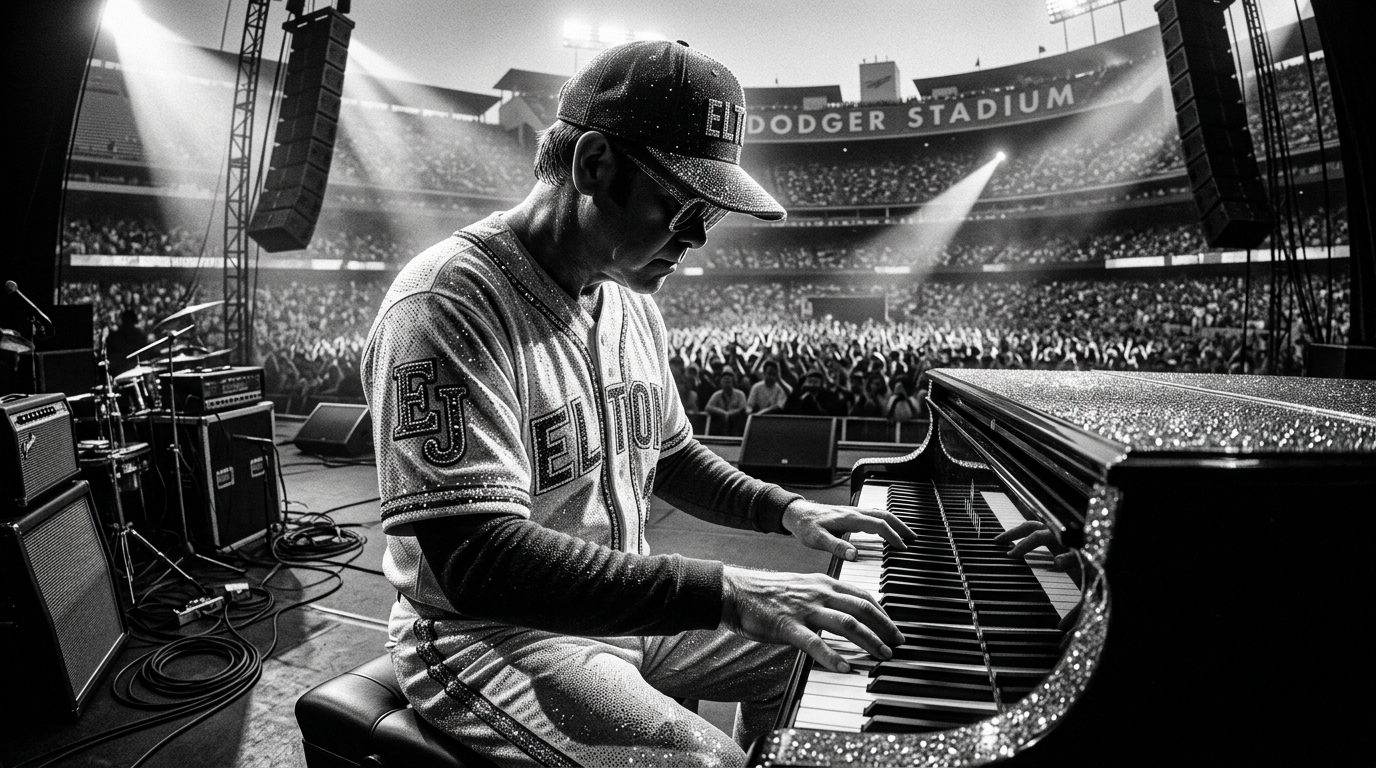
His fame reached stratospheric levels during that period. In October 1975, he performed two sold-out concerts at Dodger Stadium in Los Angeles, before more than 100,000 people. Dressed in a sequined Dodgers baseball uniform, those performances became iconic moments in rock history, capturing the massive scale of his stardom.
However, the overwhelming success began to take its toll. The relentless pace of recording and touring, combined with the pressures of extreme fame, led John to a state of physical and emotional exhaustion. In a 1976 interview with Rolling Stone magazine, he made a statement that caused a considerable stir: he came out as bisexual. For a male superstar of his magnitude in the 1970s, it was a risky act of honesty that could have seriously damaged his career. That same year, he released the double album Blue Moves, a darker and more introspective work that reflected his fatigued state of mind. Although it reached the top 5 and produced the hit single “Sorry Seems to Be the Hardest Word,” it marked the end of his long-running collaboration with Taupin and the end of his run of seven consecutive number 1 albums in the United States. At a concert in Wembley in 1977, he announced his retirement from live performances: “I’ve been at the top for a long time, and it’s time to come down.” Although that retirement would prove temporary, it was a clear indication that the frenzy of the first half of the decade had reached its breaking point.
Chapter 6: 1977-1979 – An Incomplete Retirement and the Iron Curtain
Elton John’s announced retirement from touring in 1977 was less an ending than a forced reconfiguration. The whirlwind of fame, the relentless output of music, and life under the public microscope had left him in a state of profound fatigue. Far from being a period of calm, these were turbulent years of transition, marked by the search for a new artistic and personal direction. The first and most significant manifestation of that change was the pause in his collaboration with Bernie Taupin. After Blue Moves, their paths diverged temporarily, a mutual decision driven by exhaustion and a desire to explore other projects.
For John, this meant taking on, for the first time, the burden of finding a new lyrical voice. The result was the album *A Single Man* (1978), for which he collaborated primarily with lyricist Gary Osborne. The album represented a notable sonic shift: the grandiose orchestral arrangements gave way to a cleaner, more contemporary sound. Despite producing the melancholic hit “Song for Guy”—an instrumental tribute to a young Rocket Records messenger who died in a motorcycle accident—the album lacked the narrative magic and thematic consistency of his work with Taupin. It received lukewarm reviews from critics and, while performing respectably, did not reach the heights of its predecessors.
Despite his intention to step away from touring, stillness was not a natural state for Elton John. His “retirement” was short-lived. In 1978, he returned to the stage in a more intimate format, often accompanied by percussionist Ray Cooper. These stripped-down performances highlighted his virtuosity as a pianist and his power as a performer, without the visual extravagance of previous years.
However, the most significant event of this period did not take place in Western stadiums, but in territory then considered impenetrable to most rock artists. In May 1979, Elton John and Ray Cooper embarked on a historic tour of the Soviet Union, becoming one of the first major Western rock artists to perform behind the Iron Curtain. The tour included eight concerts in Leningrad and Moscow and was a major cultural and diplomatic event. For the Soviet public, with very limited access to Western music, the concerts were a revelation. For John, it was a surreal and profoundly moving experience: performing before audiences who, although initially hesitant due to the authorities’ surveillance, were hungry for his music, he delivered some of the most emotional performances of his career. The final concert in Moscow, where he performed The Beatles’ “Back in the U.S.S.R.” as an encore, was a moment of collective catharsis that transcended Cold War politics. The tour was documented in the film “To Russia with Elton.”
This period in the late seventies was also marked by increasing personal struggle. Far from being a time of rest and recuperation, the absence of the structure of massive tours left a void that John filled with an increasingly hedonistic lifestyle. His dependence on cocaine and alcohol, which had begun during his peak years of fame, intensified, affecting his health, judgment, and work. Musically, the 1979 album, *Victim of Love*, was a failed experiment: a disco-oriented record recorded with producer Pete Bellotte—known for his work with Donna Summer—on which John played no instruments and wrote none of the songs. The project was a critical and commercial disaster and represents the lowest point of his recording output. Even so, his status as a global icon remained intact. The Soviet tour had proven its relevance beyond the charts, and the end of the decade, despite its ups and downs, closed a chapter of unparalleled success while opening one of uncertainty and challenges.
Chapter 7: 1980-1984 – Taupin’s Return and Reinvention in the MTV Era
The 1980s began for Elton John with a pressing need to rediscover his musical direction. After the artistic turmoil of the late seventies, the album 21 at 33 (1980) was a step toward reclaiming his identity. The title referred to it being his twenty-first recorded album, released at the age of thirty-three. The album marked the partial return of Bernie Taupin, who contributed lyrics to three songs, while others were written with Gary Osborne and new collaborators Tom Robinson and Judie Tzuke. The album produced the hit Little Jeannie, a soft ballad that reached the top 5 in the United States, demonstrating that his instinct for pop melody remained intact.
It was in 1983, however, that the true reinvention occurred. The album *Too Low for Zero* marked his full-time reunion with Bernie Taupin and the classic lineup of his 1970s band, including Dee Murray, Nigel Olsson, and Davey Johnstone. That reunion resulted in his strongest and most commercially successful album in years. The timing was perfect: the arrival of MTV in 1981 had radically changed the music industry, placing an unprecedented emphasis on image and video. Elton John, with his history of visual extravagance and theatricality, was perfectly positioned to thrive in this new era.
Too Low for Zero produced two of the decade’s most iconic videos and singles. The first was “I’m Still Standing,” a defiant anthem of survival and resilience. The video, filmed in Cannes and Nice and directed by Russell Mulcahy, was a burst of color and energy that introduced a vibrant and renewed Elton John to a new generation of MTV viewers. The second major hit was the ballad “I Guess That’s Why They Call It the Blues,” with its soulful melody, wistful lyrics by Taupin, and a memorable harmonica solo by Stevie Wonder. The album as a whole was a return to form, and it put Elton John back on the cusp of pop stardom. The following album, Breaking Hearts (1984), continued the streak with songs like Sad Songs (Say So Much), cementing his relevance in the changing landscape of the 1980s.
Amid this professional resurgence, John’s personal life took an unexpected turn. On February 14, 1984, Valentine’s Day, he married Renate Blauel, a German sound engineer he had met the previous year during the recording of Too Low for Zero. The wedding took place in Sydney, Australia, and was a media event. To the public, the marriage seemed to directly contradict John’s 1976 declaration of bisexuality. In retrospect, John himself has described the decision as a desperate attempt to find happiness and normalcy, and to deny a fundamental part of his identity. In his autobiography, *Me*, he explains that he genuinely loved Renate, but that he wasn’t honest with himself about his sexuality. The relationship lasted four years, a period in which John continued to produce music and tour, but also in which his personal struggles with addiction and his identity intensified in private.
Chapter 8: 1985-1989 – The Battle in the Mirror and the Redemption of the Past
The second half of the 1980s was one of the most challenging periods in Elton John’s life. Despite his continued chart success, his private life was crumbling under the weight of addiction, a failing marriage, and health problems. In 1985, he participated in one of the biggest musical events in history, Live Aid at Wembley Stadium. His performance was a reminder of his power as a performer, but behind the scenes, his dependence on cocaine and alcohol was at its peak. This duality between public success and private torment would define these years.
Musically, albums like *Ice on Fire* (1985) and *Leather Jackets* (1986) received mixed reviews. *Leather Jackets*, in particular, stands out as one of his biggest commercial and critical failures, reflecting a lack of creative direction. The strain on his voice, a side effect of his lifestyle, became increasingly apparent. In early *1987*, after a series of concerts in Australia, he was forced to cancel the remainder of the tour: the exertion had caused a hemorrhage in his vocal cords.
The throat surgery he underwent in Sydney in January 1987 was a moment of existential crisis. There was a real risk that he might never sing again. The operation was a success, but it permanently altered his voice, eliminating his famous falsetto and giving it a deeper, more resonant tone. This physical change forced a period of introspection. During his recovery, in 1988, his marriage to Renate Blauel ended. The divorce was amicable, but for John, it meant the final acknowledgment that he could no longer live a lie. In a subsequent interview, he publicly came out as gay, finally accepting his true identity.
This period was also marked by a series of highly publicized legal battles against the British tabloid *The Sun*, which had published false allegations about his private life. Although he ultimately won the cases, the process was exhausting and amplified the public scrutiny of his life. The turning point came with the death of Ryan White in 1990, an American teenager who had become a symbol of the fight against AIDS. John’s friendship with White and his family deeply affected him and motivated him to seek help for his own addictions.
Musically, the end of the decade brought a surprising redemption. In 1989, he released *Sleeping with the Past*, conceived as a tribute to the 1960s R&B and soul that had inspired him in his youth. Recorded in Denmark, the album had a cohesive sound and a warmth that had been absent from his earlier work that decade. The single “Sacrifice” became a massive hit, especially in Europe, and in the UK it was re-released as a double A-side with “Healing Hands,” becoming his first solo number 1 single in his home country. The success of *Sleeping with the Past* was a vindication: it proved that, despite personal turmoil and changes in his voice, his talent for songwriting and performing remained as powerful as ever. It was proof that, even after hitting rock bottom, Elton John was still able to create music that connected deeply with the public, using his own past not as a burden, but as a source of inspiration.
Chapter 9: 1990-1997 – Rebirth, The Lion King, and the Candle That Lighted the World
The 1990s began for Elton John not with a new album, but with the most important decision of his life. On July 29, 1990, after years of spiraling into addiction and deeply affected by the death of his young friend Ryan White, a victim of AIDS, he checked himself into a Chicago hospital to begin rehabilitation treatment. Sobriety gave him a clarity and emotional stability he hadn’t experienced since his rise to fame, and this personal rebirth translated directly into an artistic one.
His first post-rehab album, The One (1992), was a critical and commercial success. With a polished, contemporary sound, he produced hit singles such as the title track and the ballad “The Last Song,” a poignant piece about a father reconciling with his gay son dying of AIDS. The video’s proceeds were donated to the newly established Elton John AIDS Foundation, signaling his newfound commitment to activism, a cause that would become one of his life’s central passions.
In 1994, Elton John achieved a level of cultural recognition that transcended the world of pop music. Disney invited him, along with lyricist Tim Rice, to write the songs for their upcoming animated film, The Lion King. The collaboration was a monumental triumph: the soundtrack became a massive bestseller, and the songs—including Circle of Life, I Just Can’t Wait to Be King, and, most notably, the ballad Can You Feel the Love Tonight—became instant classics. Can You Feel the Love Tonight earned him his first Academy Award for Best Original Song, as well as a Grammy. That same year, he was inducted into the Rock and Roll Hall of Fame, a recognition of his impact over the previous two decades. Sober, creatively revitalized, and more successful than ever, Elton John had achieved a rare second peak in his career.
The climax of the decade, however, came through a tragedy that shocked the world. On August 31, 1997, his close friend, Diana, Princess of Wales, died in a car accident in Paris. The news devastated John. Amid the global mourning, he received a call from Buckingham Palace requesting that he sing at the funeral in Westminster Abbey. Aware that performing the original version of “Candle in the Wind”—written about Marilyn Monroe—would be inappropriate, he contacted Bernie Taupin. Within hours, Taupin rewrote the lyrics, transforming the song into a poignant tribute to Diana’s life. The new version, titled Candle in the Wind 1997, began with the words “Goodbye England’s Rose.”
John’s solo piano performance at the funeral was a moment of raw, overwhelming emotion, watched by billions of people worldwide. The recording of the single, released shortly afterward, became an unprecedented phenomenon: it shot to number one globally and became the best-selling single of all time, with over 33 million copies sold. All proceeds were donated to the Diana, Princess of Wales Memorial Fund. For Elton John, it was the ultimate confirmation of his place in the public’s heart: not just as an entertainer, but as a figure capable of giving voice to the deepest emotions of a generation.
Chapter 10: 1998-2009 – Knight of the Empire, Las Vegas, and the Theatrical Legacy
Following the emotional intensity and unprecedented success of Candle in the Wind 1997, Elton John entered the new millennium with the firmly established status of a global icon and British national treasure. In 1998, Queen Elizabeth II knighted him for his services to music and charity, an honor that recognized both his immense contribution to popular culture and his tireless philanthropic work. Now Sir Elton John, he continued to explore new artistic avenues with a particular focus on musical theater.
Following the cinematic success of The Lion King, the stage adaptation debuted on Broadway in 1997 and became a phenomenon in its own right. Capitalizing on that momentum, he teamed up again with Tim Rice to create Aida, a rock musical loosely based on Verdi’s opera. The show, which premiered on Broadway in 2000, was a box-office hit and earned John a Tony Award for Best Original Score, cementing his reputation as a top-tier theatrical composer.
Musically, his studio albums from this period reflected a growing maturity. *Songs from the West Coast* (2001) was critically acclaimed as a return to his 1970s singer-songwriter roots: with an organic, piano-centric sound, it produced the hit single “I Want Love,” whose video, starring a then-sober Robert Downey Jr., garnered considerable attention. He continued in this vein with *Peachtree Road* (2004), a soul- and country-influenced album recorded in Atlanta. While these albums didn’t achieve the massive sales of his earlier peaks, they demonstrated that his ability to create relevant music hadn’t diminished.
The center of his professional activity, however, shifted to a new and lucrative stage: Las Vegas. In 2003, he began his first residency at Caesars Palace, titled *The Red Piano*. Far from a typical greatest hits show, it was a conceptually ambitious multimedia production, featuring stunning visuals designed by photographer and director David LaChapelle. The residency was a resounding success, revitalizing the Las Vegas residency concept and attracting a new generation of performers to the city. For nearly six years and over 240 shows, it proved to be an ingenious way to continue performing for large audiences without the grueling rigors of a world tour.
In 2005, he composed the music for *Billy Elliot the Musical*, an adaptation of the acclaimed British film, with lyrics by screenwriter Lee Hall. Premiering in London’s West End, the musical received unanimous praise and won the Olivier Award for Best New Musical. Its subsequent transfer to Broadway in 2008 was equally successful, garnering ten Tony Awards, including Best Musical. John’s score, lauded for its authenticity and its ability to capture the mixture of despair and hope of the North of England miners’ community during the 1984 strike, is considered by many to be his greatest achievement in musical theatre. Also in 2005, he and his long-time partner, Canadian filmmaker David Furnish, formalized their relationship through a civil partnership, one of the first high-profile partnerships in the UK following the passage of the relevant legislation. By the end of the decade, Sir Elton John had transformed from a pop star into a cultural institution: a multifaceted artist whose work spanned rock, pop, film and theater, and a philanthropist whose impact was felt around the world.
Chapter 11: 2010-2024 – Fatherhood, the Long Goodbye, and the Full Circle of the EGOT
The sixth decade of Elton John’s career was defined by the realization of long-cherished personal dreams and the planning of a monumental final act as a touring artist. In 2010, his personal life changed forever with the birth of his first son, Zachary Jackson Levon Furnish-John, via surrogate. Three years later, in 2013, the family grew with the arrival of his second son, Elijah Joseph Daniel Furnish-John. Fatherhood, at sixty-three, had a profound impact on John, giving him a new perspective and a sense of purpose that transcended music.
This new chapter was formalized on December 21, 2014, when he and David Furnish legally married in England—exactly nine years after their civil partnership—following the legalization of same-sex marriage. Musically, the period was one of collaboration and reflection. In 2010, he released *The Union*, an acclaimed duet album with his idol Leon Russell, praised for its return to rock and gospel roots. In 2011, he returned to Las Vegas for a second residency, *The Million Dollar Piano*, which ran until 2018. He continued releasing studio albums such as *The Diving Board* (2013) and *Wonderful Crazy Night* (2016), which demonstrated his continued vitality as a songwriter.
In 2018, at the age of seventy, he made an announcement that resonated around the world: he would embark on one last, extensive world tour, titled *Farewell Yellow Brick Road*. Conceived as a three-year farewell to the stage, it was designed as a celebration of his more than half-century-long career and an opportunity to thank his fans in every corner of the globe. The tour began to universal acclaim, but in 2020, like the rest of the world, it was forced to a halt abruptly due to the COVID-19 pandemic.
During that unexpected hiatus, John recorded *The Lockdown Sessions* (2021), an eclectic collection of collaborations with artists as diverse as Dua Lipa, Stevie Wonder, Eddie Vedder, and Nicki Minaj. The lead single, *Cold Heart (PNAU Remix)*—an ingenious remix of his classics *Sacrifice* and *Rocket Man* featuring vocals by Dua Lipa—became a massive global hit and reached number 1 in the UK, making him the first artist to have a UK top 10 single in six different decades. The song introduced him to a new generation of Gen Z listeners, demonstrating his remarkable ability to remain relevant.
The Farewell Yellow Brick Road tour resumed in 2022 and finally concluded in July 2023 in Stockholm, after more than 300 concerts worldwide, becoming the highest-grossing tour of all time at that point. The end of the tour did not signify the end of his career, but rather a transition to a new phase. The circle seemed to be completed in January 2024, when his Disney+ concert special, Elton John Live: Farewell from Dodger Stadium, won an Emmy Award for Outstanding Variety Special (Live). With that win, Sir Elton John joined the most exclusive club in show business: the EGOT winners—artists who have won an Emmy, a Grammy, an Oscar, and a Tony. Upon concluding his career as a touring artist, he did not retreat into obscurity, but instead established himself as a living legend, a family man, a tireless philanthropist, and an artist whose influence and music would continue to resonate indefinitely.
Final Chapter: Conclusions and Legacy – The Man Who Painted Music in Colors
To assess the legacy of Sir Elton John is to trace the evolution of popular music over more than half a century. His impact transcends staggering figures—more than 300 million records sold, over fifty top 40 hits, a streak of seven consecutive number one albums—to delve into the very fabric of global culture. John was an architect of the pop-rock sound of the 1970s, an alchemist who fused the grandiosity of stadium rock, the intimacy of the singer-songwriter, the energy of R&B, and the discipline of classical music into a style unmistakably his own. His collaboration with Bernie Taupin redefined songwriting, demonstrating that pop music could be both commercially irresistible and lyrically sophisticated, capable of telling complex stories and creating evocative worlds.
His influence is palpable in generations of artists ranging from George Michael and Freddie Mercury to Lady Gaga and Ed Sheeran, who have inherited his sense of melody, his stage presence, and his belief in the power of spectacle. He was one of the first to demonstrate that the piano could be a leading instrument in rock and roll, as powerful and visually dynamic as the electric guitar.
Beyond his music, his legacy is intrinsically linked to his role as a cultural pioneer. In an era when homosexuality was taboo in the entertainment industry, his outspokenness and, ultimately, his unapologetic and open lifestyle helped break down barriers and normalize the presence of LGBTQ+ artists in the mainstream. His flamboyance—the sequined outfits, the outlandish glasses, the theatricality—was not mere embellishment; it was a statement of individuality, a celebration of difference in a world that often demanded conformity. He proved that an artist could be vulnerable and flamboyant, sensitive and powerful, all at the same time.
His public persona, with its highs and lows, his battles with addiction, eating disorders, and depression, humanized the superstar, revealing the cracks behind the facade of success. His subsequent sobriety and honesty about those struggles made him an unexpected model of resilience and redemption.
Any assessment of his legacy would be incomplete without acknowledging his philanthropic impact. The creation of the Elton John AIDS Foundation in 1992, at the height of the AIDS crisis, was an act of leadership and compassion. Using his fame as a platform for action, he has raised hundreds of millions of dollars and funded prevention and treatment programs worldwide, saving countless lives and helping to change the global conversation about the disease.
Ultimately, Elton John is a complex and contradictory figure: the shy Reginald Dwight who became the flamboyant showman; the classically trained musician who loved raw rock and roll; the global superstar who longed for the normalcy of family life. His music is the soundtrack to the lives of millions, a constant through decades of social and cultural change. His legacy lies not only in immortal melodies or record sales, but in the audacity of his individuality, the resilience of his spirit, and the profound humanity that has always beat at the heart of his work. Elton John didn’t just write songs; he painted music with colors, and in doing so, he made the world a slightly brighter and a whole lot more interesting place.
Appendix: Songs and Unforgettable Moments
1. Your Song (1970)
The song that introduced him to the world is a study in disarming simplicity and honesty. Musically, it is built upon a piano progression that, while seemingly simple, is full of subtle harmonic complexities that reveal his classical training. The vocal melody is conversational, almost shy, perfectly reflecting Taupin’s lyrics about a young man struggling to express his feelings. Gus Dudgeon‘s production and Paul Buckmaster‘s string arrangements envelop the song in a warmth that never overwhelms the intimacy of the performance. It is the quintessential Elton John ballad and the model upon which many of his future compositions would be built.
2. Tiny Dancer (1971)
This ode to the women of early 1970s California is a slow-burning piece that culminates in a cathartic chorus. It begins with a delicate piano arpeggio, gradually joined by bass, drums, and subtle steel guitar. The song’s structure is unconventional, delaying the arrival of the chorus and creating a narrative tension that resolves in the final explosion of “Hold me closer, tiny dancer.” Taupin’s lyrics, partly inspired by his first wife, Maxine, capture a snapshot of an era, but John’s melody lends it a universal and timeless quality.
3. Rocket Man (1972)
Inspired by the literary universe of Ray Bradbury and the growing interest in space exploration, this song is a melancholic meditation on loneliness and alienation. Musically, it stands out for its use of slide guitar, which creates an ethereal, spacey atmosphere, and for an ascending chorus that evokes the sensation of floating in the void. John’s vocal performance is restrained and reflective, conveying the weight of distance and the routine of an astronaut’s work. It is a perfect example of how the John-Taupin collaboration could take a science fiction concept and turn it into a profound statement about the human condition.
4. Crocodile Rock (1972)
A deliberate and joyful pastiche of late fifties and early sixties rock and roll. The song is an exercise in nostalgia, driven by a pounding piano rhythm in the style of Jerry Lee Lewis and a Farfisa organ reminiscent of artists like Del Shannon. Taupin’s lyrics tell the story of a young man reminiscing about the days of dancing a fictional dance called the “Crocodile Rock.” Although often categorized as a lighthearted piece, its infectious energy and impeccable pop construction gave John his first number one hit in the United States and demonstrated his mastery of crafting irresistible hits.
5. Goodbye Yellow Brick Road (1973)
The centerpiece of the self-titled album is a majestic ballad about disillusionment with fame and the longing for a simpler life. The song begins with a soft, dreamlike piano introduction before exploding into a powerful, almost operatic chorus. John’s vocal performance is among the finest of his career, showcasing his dynamic range and ability to convey profound emotion. Taupin’s lyrics use the metaphor of The Wizard of Oz to explore the perils of fame, a recurring theme in his work. It is a masterpiece of songwriting and production, and one of the most beloved songs in his catalog.
6. Funeral for a Friend/Love Lies Bleeding (1973)
This eleven-minute opening track from Goodbye Yellow Brick Road is Elton John’s most ambitious statement of progressive rock. The first part, Funeral for a Friend, is an instrumental piece that begins with the sound of church bells and an ARP synthesizer, creating a somber, cinematic atmosphere before giving way to a classical piano section. The transition to Love Lies Bleeding is an explosion of stadium rock, featuring a driving guitar riff from Davey Johnstone and a powerful rhythm section. The track demonstrates the band’s ability to fuse the complexity of progressive rock with the energy of hard rock.
7. Bennie and the Jets (1973)
One of the strangest and most original songs in his repertoire. Despite John’s own doubts about its commercial potential, it was released as a single and became a number one hit in the United States, especially popular on R&B stations. The song is a parody of glam rock, with a syncopated, staccato piano rhythm and sound effects of a live audience to create the illusion of a concert by a fictional band. John’s vocal performance is stylized, with an affected falsetto that adds to the satirical nature of the piece.
8. Don’t Let the Sun Go Down on Me (1974)
A powerful ballad with grandiose production and a memorable horn arrangement. The song is a desperate plea for salvation in a moment of loss and abandonment. John’s vocal performance is passionate and reaches an emotional climax in the final chorus, which features backing vocals from members of The Beach Boys. The song became a standard and gained a second life in 1991 as a live duet with George Michael, a version that reached number 1 worldwide.
9. Someone Saved My Life Tonight (1975)
One of the most personal and autobiographical songs in John and Taupin’s catalog. The lyrics recount a critical moment in John’s life around 1968, before his fame, when he felt trapped in an unwanted engagement. The “Sugar Bear” figure mentioned in the song is Long John Baldry, who convinced him to break off the engagement and focus on his music career. The six-minute track features a complex structure and dense production that captures the anguish and eventual liberation of that moment.
10. I’m Still Standing (1983)
Elton John’s anthem of resilience. Released at the height of the MTV era, the song is a defiance of critics and adversity. Musically, it’s an energetic and upbeat rock and roll number, driven by piano and a powerful horn section. Taupin’s lyrics, though written from his own perspective, became a personal statement for John, who was battling addiction and the pressures of fame. The iconic music video, filmed on the French Riviera, solidified his image as a survivor and an artist capable of reinventing himself.
11. Sacrifice (1989)
A melancholic ballad that marked a commercial resurgence for John in the late eighties. Taupin’s lyrics explore the difficulty of monogamy and fidelity in a relationship. John’s melody is understated and elegant, and the production, dominated by electronic keyboards, is characteristic of the era. The song became his first solo number one in the UK, a significant achievement that reaffirmed his relevance at the start of a new decade.