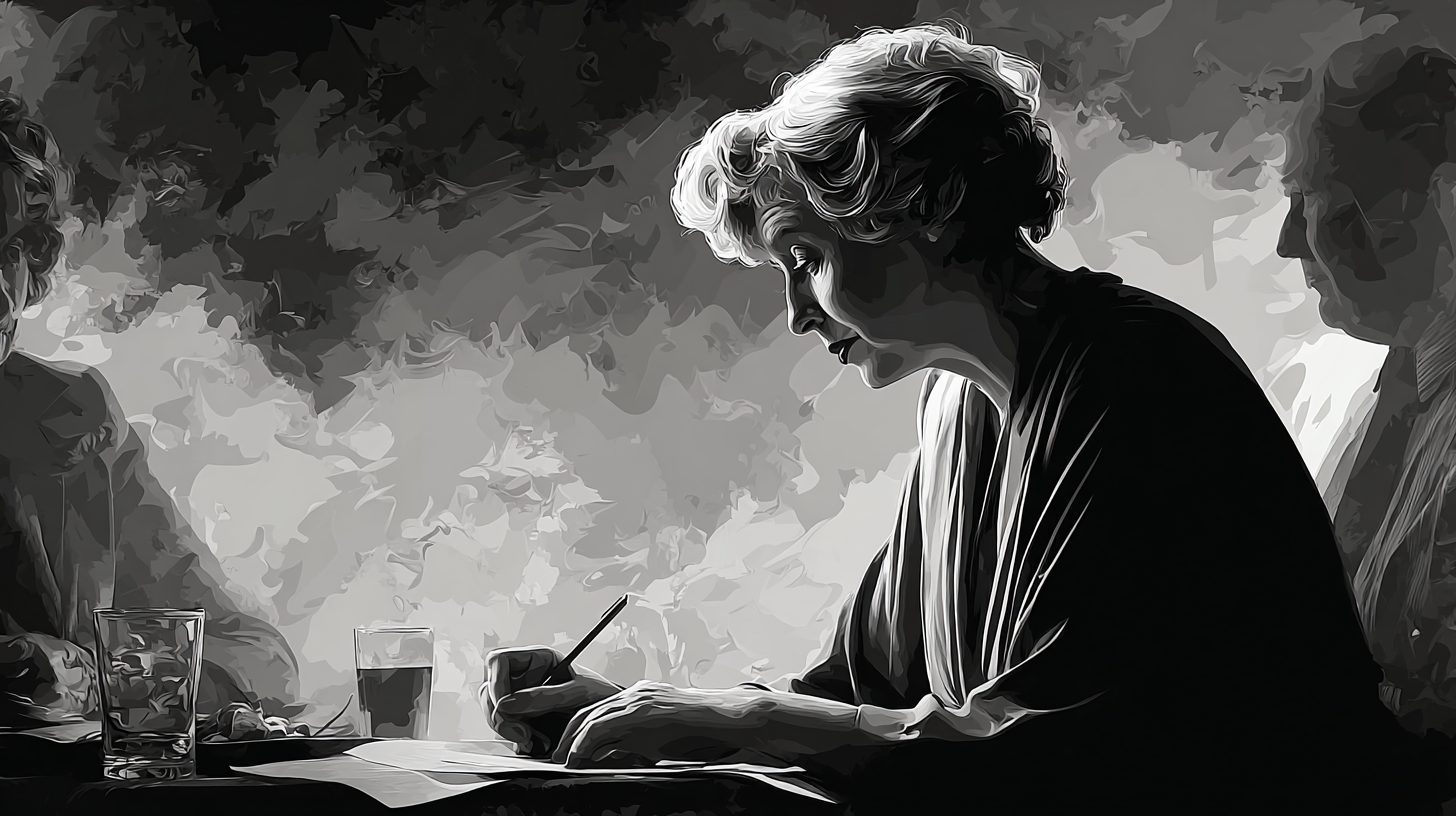
Agatha Mary Clarissa Christie is a name that resonates in every corner of the world. With over two billion copies sold, translated into more than 100 languages, and the creator of immortal characters like Hercule Poirot and Miss Marple, her legacy transcends literature to become a global cultural phenomenon. Her novels have been adapted into countless films, television series, and plays, including “The Mousetrap,” the longest-running theatrical production in the history of the world, which has been playing continuously in London since 1952.
But behind the “Queen of Crime” lies the story of an extraordinary woman whose life was marked by love, loss, adventure, and an incomparable talent for unraveling the mysteries of the human heart. She was a woman who taught herself to read at the age of five, who worked as a nurse and a dispenser during the First World War, who became one of the first British women to surf standing up, who lived archaeological adventures in the Middle East, and who, amidst a devastating personal crisis, was the protagonist of one of the most intriguing real-life mysteries of the 20th century: her own eleven-day disappearance in 1926.
This is the story of Agatha Christie: a biography that is, in itself, as fascinating as any of her novels.
Chapter 1: The Night Agatha Christie Disappeared
The cold of the night of December 3, 1926, enveloped the Berkshire countryside. Inside the “Styles” residence in Sunningdale, the atmosphere was even colder. Agatha Christie, the brilliant mind behind the mystery plots that were beginning to captivate England, found herself in the middle of her own drama—one without a clear script or an ingenious detective to solve it.
That night, following a heated argument with her husband, Colonel Archibald Christie, who had confessed his love for another woman, Nancy Neele, and demanded a divorce, Agatha made a decision that would make her the protagonist of an enigma as baffling as any of her novels. She got into her Morris Cowley, a small car her husband had given her, and drove into the darkness.
The next morning, the vehicle was found abandoned near an unsettlingly beautiful lake known as Silent Pool, in Surrey. Inside, a fur coat, a suitcase with clothes, and an expired driving license. Of Agatha, there was no trace. The news spread like wildfire: the Queen of Crime had disappeared.
The search that ensued was one of the largest in English history. Over a thousand police officers, hundreds of volunteers, and even airplanes combed the area. The press, hungry for a good mystery, delighted in the event. Theories multiplied: a kidnapping? a murder perpetrated by her unfaithful husband? an elaborate publicity stunt to promote her latest novel, “The Murder of Roger Ackroyd”? Or, the most disturbing of all, suicide?
For eleven days, the country held its breath. The woman who had created Hercule Poirot, the detective of the “little grey cells,” had vanished, leaving behind a seemingly unsolvable puzzle. This episode, fraught with anguish and speculation, was not a carefully constructed fiction but a painful interlude in the life of a woman who, behind her facade of a successful writer, was grappling with betrayal and a profound personal crisis.
This is the archetype of Agatha Christie: a woman of fascinating complexity, whose life was as full of unexpected twists as her own stories. She was a pioneer, an adventurer, and a keen observer of human nature, capable of transforming pain into art and mystery into an immortal legacy. To understand how she came to be the best-selling novelist of all time, we must go back in time, long before that December night, to the origins of the girl who dreamed up stories on the English coast.
Chapter 2: A Girl on the English Coast
In sunny Torquay, a popular seaside resort on the south coast of Devon, Agatha Mary Clarissa Miller was born on September 15, 1890. Her arrival was a “much-loved afterthought” for her parents, Frederick and Clara Miller, ten and eleven years after her siblings, Monty and Madge. The family lived in Ashfield, a spacious Victorian-style house with a large garden that would become the first setting for little Agatha’s imaginary worlds.
Her father, a wealthy American, and her mother, of Irish descent, provided her with an idyllic and unconventional childhood. Unlike other children of her era and social class, Agatha did not go to school. Her mother, a woman of great imagination and an excellent storyteller, believed that children should not learn to read until they were eight years old to protect their eyesight and creativity. However, Agatha’s curiosity was insatiable, and at the age of five, bored of being the only child at home, she taught herself to read.
The atmosphere at Ashfield was a breeding ground for creativity. Agatha spent hours in the garden, inventing imaginary friends and playing with her pets. Her sister Madge, eleven years her senior, often entertained her with chilling scenarios, creating terrifying characters who, unknowingly, were sowing the seeds of Agatha’s future mystery plots. A recurring nightmare about a “Gunman” who was not who he seemed would become a recurring theme in her later stories.
Literature also played a fundamental role in her development. She devoured the works of Edith Nesbit, such as “The Story of the Treasure Seekers,” and of Louisa M. Alcott, author of “Little Women,” as well as thrillers and poetry that came from America. This mix of literary influences, combined with the rich inner life she cultivated in her solitary childhood, laid the foundation for her extraordinary talent for storytelling.
Life at Ashfield, however, was not without difficulties. When Agatha was five, the family’s investments in the United States took a severe hit, forcing them to rent out their beloved house and spend a season in France to economize. Far from being a traumatic experience, these trips through the Pyrenees, Paris, and Brittany awakened in Agatha a love for travel that would stay with her throughout her life. “The two winters and a summer I spent in Paris were some of the happiest days I have ever known,” she would later write in her autobiography.
But tragedy struck the Miller family when Agatha was only eleven. Her father’s sudden death plunged her mother into a deep sadness, and Agatha, despite her young age, became her closest companion. Financial worries increased, and the possibility of selling Ashfield loomed over them. Nevertheless, mother and daughter found a way to move forward, united by grief and determination.
This childhood, marked by creative freedom, family love, and early experiences with loss, forged the character of the future writer. In the gardens of Ashfield, among the books in her library and in the stories her mother told her, Agatha learned that life was a mix of light and shadow, joy and sadness—a duality she would masterfully explore in her novels.
Chapter 3: Paris, Books, and the Awakening of a Writer
Agatha Christie’s formal education was as unconventional as her childhood. After a brief and unsuccessful stint at a finishing school in her native Torquay, her mother, Clara, decided that the rigid atmosphere of British education was not suitable for her daughter. Instead, she took her to Paris, the city that had already captivated Agatha during the family trips of her childhood.
In the French capital, Agatha attended a series of boarding schools, where she received lessons in piano and singing. She showed considerable talent for music and, for a time, entertained the idea of becoming a professional pianist. However, her extreme, almost paralyzing shyness prevented her from performing in public, an insurmountable obstacle for a stage career. Although the dream of being a concert pianist faded, her time in Paris immersed her in a vibrant artistic culture that undoubtedly enriched her inner world.
It was also during this period, around the age of eighteen, that she began to write short stories more seriously. While confined to bed with the flu, her mother suggested she write to combat boredom. What began as a pastime soon turned into a passion. A family friend, the author Eden Philpotts, read some of her early works and offered her a piece of advice that Agatha would always remember: “The artist is only the glass through which we see nature, and the clearer and absolutely purer that glass, the more perfect the image we can see through it. Never meddle.”
These early stories, though still immature, already showed a glimmer of her genius for plot and characterization. Some of them would later be reworked and included in her short story collections. Writing became her way of processing the world, of bringing order to chaos, and of exploring the complexities of the human psyche from the safety of her desk.
Financial necessity also played a role in her budding career. In 1910, Clara’s delicate health and the need to economize led mother and daughter to Cairo for a three-month debutante season at the Gezirah Palace Hotel. While other young women sought husbands among the handsome British officers, Agatha was more attracted to observing the varied characters around her. Although she received several marriage proposals, she rejected almost all of them, finally accepting, albeit with reservations, one from a family friend, Reginald Lucy, on the condition of waiting two years. Fate, however, had an encounter in store for her that would change the course of her life and career forever.
These formative years, between Paris and Cairo, between music and writing, were crucial to Agatha’s development as an artist. She learned to observe, to listen, and to grasp the nuances of human behavior. Every conversation, every encounter, every trip became material for her future stories. The shy young woman who could not play the piano in front of an audience was learning to express herself in another way: through words.
Chapter 4: Love in a Time of War
The engagement to Reginald Lucy, a practical and sensible man, seemed a safe and predictable path. But Agatha Christie’s destiny was not written in straight lines. In 1912, during a party at Ugbrooke House, an imposing manor near Exeter, her life took a plot twist worthy of her future novels. There, she met Archibald Christie, a handsome and charismatic subaltern and qualified aviator who had just applied to join the Royal Flying Corps, the precursor to the Royal Air Force.
The attraction was instantaneous and overwhelming. Archie, with his air of adventure and audacity, represented everything the quiet Reggie was not. Their courtship was a whirlwind, a passionate romance between two young people desperate to marry but without a penny to their names. In her autobiography, Agatha would describe the fascination she felt for him as “the excitement of the stranger,” an irresistible magnetism that led her to break her previous engagement and launch herself into the unknown.
The imminence of the First World War accelerated their plans. Archie was sent to France, and the couple married hastily on Christmas Eve 1914, during a brief leave. Their wedding night was spent at the Grand Hotel in Torquay, a fleeting moment of happiness before Archie had to return to the front. Over the next few years, their meetings were scarce and infrequent, marked by the uncertainty and atrocities of the war.
While Archie fought in France, Agatha joined the war effort on the home front. She enlisted as a nurse in the Voluntary Aid Detachment at a Red Cross hospital in Torquay. It was exhausting and often heartbreaking work, but it provided her with a unique perspective on life, death, and human nature. It wasn’t until 1915 that she joined the hospital’s dispensary, a decision that, unknowingly, would change her career forever.
Under the tutelage of an experienced pharmacist, Agatha immersed herself in the world of chemicals and precise doses. She learned about poisons, their effects, and their antidotes. Curare, strychnine, and cyanide ceased to be exotic names and became tools for her future literary craft. In 1917, she successfully completed the examination of the Worshipful Society of Apothecaries, gaining technical knowledge that would lend chilling verisimilitude to the crimes in her novels. The war, with its chaos and tragedy, not only robbed her of the normalcy of her early years of marriage but also unexpectedly gave her the deadliest weapon in her arsenal as a writer: **poison**.
This period of forced separation, hard work, and anxious waiting profoundly shaped Agatha. She saw firsthand human suffering, the fragility of life, and people’s capacity to endure the unbearable. These experiences would filter into her novels, giving them an emotional depth that went beyond simple entertainment. The war taught her that behind every crime is a human story, a personal tragedy that deserves to be told.
Chapter 5: A Belgian Detective Is Born
The monotony of dispensary work, despite its fascinating connection to poisons, began to weigh on Agatha’s restless imagination. It was then that her sister Madge, during a conversation, posed a challenge that would become a crucial moment in the history of literature: she bet Agatha that she couldn’t write a good detective story. For Agatha, who had grown up admiring Arthur Conan Doyle’s Sherlock Holmes adventures, the challenge was irresistible.
She accepted the bet and set to work. The first question was: who would her detective be? She didn’t want to create an imitation of Holmes. She needed a unique character, with his own methods and mannerisms. The inspiration came in the most unexpected way—by observing the Belgian refugees who had arrived in Torquay fleeing the German invasion. Among them, she imagined a former police officer, a meticulous man, obsessively tidy, with an impeccable mustache and an unwavering belief in the power of his “little grey cells.”
Thus was born Hercule Poirot, the Belgian detective who would become one of the most iconic characters in crime fiction. For the plot, Agatha drew on her newly acquired knowledge from the pharmacy. Poison, of course, would be the murder weapon. With the detective and the method decided, she began to weave the story of “The Mysterious Affair at Styles.”
Writing the novel was not a simple process. To polish the manuscript, she took a two-week holiday at the Moorland Hotel in Dartmoor, where, during long walks on the moor, she acted out the chapters and spoke the dialogue aloud as if she were her own characters. Once finished, she sent the manuscript to several publishers, but the response was a series of discouraging rejections.
Finally, in 1919, a momentous year in her life, her luck changed. With the end of the war, Archie found work in the City of London, and the couple was finally able to settle into a small apartment. On August 5 of that year, Agatha gave birth to her only daughter, Rosalind. And, as if fate wanted to align all the stars, the publishing house John Lane of The Bodley Head—the seventh to receive the manuscript—agreed to publish “The Mysterious Affair at Styles.”
The publisher offered her a contract for five more books and, although they insisted on changing the original ending (a climax in a courtroom) to the now-familiar library denouement, the book finally saw the light in 1920. The publication was a modest success, but more importantly, Hercule Poirot had been introduced to the world. The bet with her sister had not only been won, but it had launched one of the most extraordinary literary careers of the 20th century.
Poirot, with his vanity, his eccentricity, and his brilliance, would be Agatha’s companion for over fifty years. Through him, she would explore the darkest corners of human nature, unravel the most complex mysteries, and demonstrate that logic and careful observation can triumph over chaos. The little Belgian detective, born from a bet between sisters, would become a legend.
What made Poirot unique was not just his method, but his personality. He was vain to the point of comicality, obsessed with symmetry and order, and deeply proud of his physical appearance, especially his mustache. But behind this comical facade was a brilliant mind and a deep understanding of human psychology. Poirot didn’t just collect physical clues; he studied people—their motivations, their fears, and their desires. His famous “little grey cells” method was, in essence, an exercise in empathy and human understanding.
Agatha would have a complex relationship with her creation. Although Poirot brought her fame and fortune, he also became a burden. In her later years, she confessed that she was tired of him, finding him “insufferable” and “a pompous egoist.” However, the public adored him, and she couldn’t simply get rid of him. This tension between the creator and her creation adds another layer of fascination to the story of Agatha Christie, reminding us that even the most beloved characters can become prisons for their authors.
Chapter 6: Success, Surfing, and the Grand Tour
With the debut of Hercule Poirot and a five-book contract in hand, Agatha Christie’s career began to take off. After the war, she didn’t just repeat the formula of her first success. She experimented with different genres, creating the espionage thriller “The Secret Adversary,” where she introduced another memorable detective duo: the young and adventurous Tommy Beresford and Prudence “Tuppence” Cowley. This diversification demonstrated her versatility and her ambition not to be pigeonholed as a simple detective novelist.
In 1922, Agatha and Archie’s life took an exotic turn. Leaving their young daughter Rosalind in the care of her mother and sister, the couple embarked on the “Grand Tour,” a ten-month mission around the British Empire to promote the 1924 British Empire Exhibition. The trip took them to South Africa, Australia, New Zealand, Hawaii, and Canada.
It was an experience that broadened Agatha’s horizons and provided her with invaluable material for future novels. In South Africa, during a stop in Cape Town, the Christies discovered a new passion: surfing. Although the boards of the time were heavy and difficult to handle, Agatha threw herself into the waves with enthusiasm. In Hawaii, she perfected her technique, becoming, in her own words, one of the first British women to learn to surf standing up. This adventurous and sporty side contrasts sharply with the later image of an English lady that people have of her, revealing a modern and audacious woman.
The trip also directly inspired one of her novels. Archie’s employer, Major Ernest Belcher, who led the mission, served as the inspiration for the character of Sir Eustace Pedlar in “The Man in the Brown Suit,” a thriller and adventure novel set in South Africa.
Upon their return from the Grand Tour, the family reunited and moved to a house in Sunningdale, which they named “Styles” after her first novel. Agatha enjoyed a comfortable life, playing golf and writing. in 1923, she published her second Poirot novel, “The Murder on the Links.” However, not everything was idyllic. Agatha began to feel dissatisfied with the terms of her contract with The Bodley Head and, seeking a better deal, hired the literary agent Edmund Cork, of Hughes Massie. This professional move was key: Cork secured her a new, more lucrative contract with the publisher William Collins and Sons (now HarperCollins), which would become her publishing home for the rest of her life. With her career on the rise and her financial situation secure, Agatha Christie was preparing to enter the most successful phase of her career, without suspecting the deep personal crisis that lay ahead.
These early twenties were, in many ways, the calm before the storm. Agatha had found her voice as a writer, traveled the world, experienced motherhood, and built a seemingly perfect life. But, as she knew better than anyone, appearances can be deceiving, and the darkest mysteries often hide behind the most respectable facades.
Chapter 7: The Murder of Roger Ackroyd and Personal Tragedy
The year 1926 should have been Agatha Christie’s definitive consecration. With her new publisher, Collins, she published what would become one of the most famous and influential mystery novels of all time: “The Murder of Roger Ackroyd.” The book, with its surprising and audacious final twist that broke all genre conventions, was a resounding bestseller and cemented Agatha as one of the most important authors of her time. The novel that defined her career, however, arrived at the darkest moment of her personal life.
Tragedy struck in April of that year with the death of her beloved mother, Clara, at Ashfield. Agatha, who had always been very close to her, was devastated. The task of emptying the family home, a place full of memories of her happy childhood, fell on her shoulders, an emotional burden she had to bear largely alone. Archie, her husband, was distant and unsupportive, unable to comfort her in her grief.
The emotional distance between the couple became an insurmountable chasm. While Agatha struggled to cope with the pain and a writer’s block that prevented her from creating, Archie found solace in the arms of another woman: Nancy Neele, a young golfer and family friend. Her husband’s extramarital affair was a devastating blow to Agatha, a betrayal added to the deep pain of losing her mother.
Professional success brutally contrasted with the failure of her personal life. The woman who wove perfect plots and controlled the destiny of her characters found herself powerless before the collapse of her own marriage. The tension reached its climax in December 1926, when Archie confessed his love for Nancy and asked for a divorce. The news, though not entirely unexpected, was the final straw.
The year that had raised her to the top of the literary world had also dragged her to the depths of despair. The combination of grief, betrayal, and physical and mental exhaustion pushed her to the limit. On the night of December 3, overwhelmed by anguish, Agatha Christie would star in the most mysterious chapter of her own life, an enigma she herself would never fully reveal.
“The Murder of Roger Ackroyd” not only revolutionized the mystery genre with its unreliable narrator but also reflected, perhaps unconsciously, the emotional state of its author. The novel is about secrets, betrayals, and the mask people wear to hide their true nature. In many ways, it was a mirror of Agatha’s own life at the time—a life that, viewed from the outside, seemed perfect, but was crumbling within.
Chapter 8: Eleven Days Lost in Harrogate
Agatha Christie’s disappearance on December 3, 1926, sparked an unprecedented media frenzy. The discovery of her car abandoned at Silent Pool, with her belongings inside, was the perfect start to a real-life mystery. The sensationalist press quickly wove all kinds of theories, each more outlandish than the last. Had she been murdered by her husband so he could marry his mistress? Was it an ingenious publicity stunt? Or had she decided to take her own life in the same lake where, according to local legend, a young woman had drowned?
The police, under immense public pressure, organized one of the largest searches in British history. Hundreds of officers and thousands of volunteers scoured the surrounding area. Even mediums and spiritualists were called upon. Arthur Conan Doyle, the creator of Sherlock Holmes, gave one of Agatha’s gloves to a medium, hoping to gain a clue. Archibald Christie himself was treated as the prime suspect, enduring the scrutiny of the police and the disdain of public opinion.
While the entire country searched for her, Agatha was hundreds of miles away, at the elegant Swan Hydropathic Hotel (now the Old Swan Hotel) in Harrogate, a spa town in Yorkshire. She had checked in under the name of Theresa Neele, from Cape Town, curiously adopting the surname of her husband’s mistress. For eleven days, she led a seemingly normal life: she read the newspapers that reported her own disappearance, played bridge, and participated in the hotel dances.
Finally, on December 14, she was recognized by the hotel musicians, who alerted the police. When Archie arrived to collect her, Agatha appeared not to recognize him. The official explanation, and the one she maintained for the rest of her life, was that she had suffered an episode of **amnesia** caused by stress and a possible blow to the head during a car accident that was never entirely clear. She claimed to have no memory of what happened between the moment she left her house and her discovery in Harrogate.
Was it really amnesia? Or was it a **dissociative fugue**, an extreme psychological reaction to unbearable trauma? Or perhaps, as some biographers have suggested, was it a deliberate act, a desperate attempt to hurt her husband in the same way he had hurt her, or even to incriminate him? Agatha Christie, the mistress of literary deception, took the secret to her grave. She never spoke publicly about the incident, not with her friends nor with her family. The eleven lost days became the only Agatha Christie mystery she never solved for her readers, a blank space in her biography that continues to fuel fascination and debate to this day.
What is indisputable is that the episode left a deep mark on Agatha. The public humiliation, the press scrutiny, and the collapse of her marriage changed her forever. She emerged from that experience stronger, more reserved, and more determined to protect her private life. The mystery of her disappearance became part of her legend, adding a layer of intrigue to the life of the woman who had made mystery her profession.
The impact of the scandal on her reputation was considerable. Some critics accused her of orchestrating the entire disappearance as a publicity stunt, an accusation that deeply hurt her. Others saw her as a victim of circumstance, a woman on the verge of a nervous breakdown who needed compassion, not condemnation. The sensationalist press, however, showed no mercy, dissecting every detail of her private life and speculating endlessly about her motives.
For Archie, the episode was equally traumatic. Although they finally divorced in 1928, the scandal haunted him for years. He married Nancy Neele shortly after the divorce, but the shadow of Agatha’s disappearance never completely faded. For Agatha, the divorce was liberating. It allowed her to close a painful chapter of her life and start anew, this time with a greater understanding of herself and what she truly needed to be happy.
Chapter 9: The Orient Express to a New Love
The scandal of her disappearance and the inevitable divorce from Archie in 1928 left Agatha Christie in a vulnerable position. To escape the scrutiny of the press and heal her wounds, she sought refuge in travel. One evening, during a dinner, she overheard a young couple enthusiastically discussing their recent trip to Baghdad and the wonders of the ancient city of Ur, in Mesopotamia. The idea took hold of her imagination.
Canceling a planned trip to the West Indies, Agatha made an audacious decision for a single woman of her time: she booked a ticket on the legendary Simplon-Orient Express and embarked on a solo journey to the mysterious Middle East. The journey on the luxurious train, with its mosaic of passengers of various nationalities and its changing landscapes, not only provided an escape but also sowed the seed for what would become one of her most famous novels.
Upon arriving in Baghdad, she continued her journey across the desert to the archaeological site of Ur, led by the eminent archaeologist Leonard Woolley and his wife Katherine. The Woolleys, delighted with their illustrious visitor, welcomed her warmly. Agatha, fascinated by the meticulous work of unearthing a lost civilization, found a new purpose and a peace she had believed lost.
The Woolleys invited her back the following year. On that second visit, in 1930, they assigned a young archaeologist to show her around. His name was Max Mallowan, a man fourteen years her junior, quiet, intelligent, and with a great sense of humor. Their relationship was forged in the dust of the desert, amid conversations about ancient history and lost civilizations. Max admired her resilience and adventurous spirit; Agatha, his calm and solid kindness.
One incident in particular sealed their connection. When their vehicle got stuck in a wadi (a dry riverbed), Agatha, far from panicking, remained calm and good-humored, a reaction that Max found extremely attractive. He saw in her not the famous writer, but an intrepid and reliable travel companion.
At the end of her visit, during a stay at Agatha’s family home in Ashfield, Max proposed marriage. Despite the age difference and the recent trauma of her divorce, Agatha accepted. They married on September 11, 1930, in Edinburgh. With Max, Agatha not only found a new love and a lifelong partner but also a new world that would become the exotic backdrop for some of her most memorable novels. The journey on the Orient Express had not only taken her to a new geographical destination but also to a new and happy chapter in her life.
The marriage to Max was, in every sense, a second chance. Unlike Archie, Max supported her writing, respected her need for creative solitude, and shared her love for adventure. Together, they built a life that combined the stability of a home in England with the excitement of archaeological expeditions in faraway lands. It was the perfect match for a woman who had learned, through pain, to value loyalty, understanding, and true love.
Chapter 10: Between Mesopotamian Ruins and Manuscripts
The marriage to Max Mallowan ushered in one of the happiest and most productive stages of Agatha Christie’s life. The couple established an annual routine that perfectly balanced their two passions: archaeology and writing. They spent summers in England, often with Agatha’s daughter, Rosalind, and Christmases with family. But spring and autumn were reserved for Max’s archaeological expeditions in Iraq and Syria.
Agatha was not a mere companion on these adventures. She became an essential part of the excavation team. While Max directed the work, she handled camp logistics, cleaned and cataloged finds, and became the official photographer for the expeditions. Her patience and meticulousness—the same qualities she applied to her intricate plots—made her an excellent restorer of ancient pieces, especially delicate ivories.
This life between two worlds—that of the peaceful English countryside and that of the exotic, dusty Middle East—became an inexhaustible source of inspiration. The atmosphere of train journeys, remote hotels, archaeological sites, and the mix of expatriates and locals provided the perfect backdrop for some of her most famous novels. It was during this 1930s decade that she wrote, at an astonishing pace of two or three books a year, immortal classics.
In 1934, drawing on her own experience, she published “Murder on the Orient Express,” a masterpiece of narrative engineering with one of the most shocking endings in the history of the genre. This was followed by “Death on the Nile” (1937), inspired by a trip to Egypt with Max and Rosalind, and “Appointment with Death” (1938), set in Jerusalem and Petra. Other novels such as “Murder in Mesopotamia” (1936) and “They Came to Baghdad” (1951) directly reflected her life at the excavations.
But it wasn’t all glamour and adventure. In her charming memoir “Come, Tell Me How You Live,” published in 1946, Agatha humorously and affectionately described the details of daily life on an excavation: sandstorms, canned food, difficulties with the language, and the small joys of discovery. The book is a testament to her adaptability and her deep love for Max and the life they had built together.
In 1938, the couple bought Greenway, a beautiful Georgian property on the banks of the River Dart in Devon. This place, which Agatha described as “the most charming place in the world,” became their sanctuary and summer home, directly inspiring novels like “Five Little Pigs.” With a stable home in England and a world of adventure abroad, Agatha Christie had found the perfect balance, an idyllic setting from which to continue building her literary empire.
The collaboration between Agatha and Max was truly unique. He provided the historical context and archaeological details that enriched her novels; she, in turn, partially financed the expeditions with the income from her writing. It was a perfect symbiosis between art and science, between imagination and reality. Max once joked that an archaeologist is the best husband a woman can have: “The older you get, the more interested he is in you.” Agatha would undoubtedly agree.
The archaeological sites where they worked together became the settings for some of her most memorable novels. In Nimrud, where Max discovered the largest ivory head of a woman ever found, Agatha spent hours cleaning and restoring delicate pieces with infinite patience. Her work was not merely decorative; it was essential for the preservation of artifacts that had remained buried for millennia. The finds she helped restore are now in museums around the world, a silent testament to her contribution to archaeology.
Life on the excavations also provided her with a unique perspective on time and mortality. Surrounded by the ruins of ancient civilizations, Agatha reflected on the fleeting nature of human life and the permanence of art. This awareness of temporality filtered into her novels, giving them a philosophical depth that goes beyond simple entertainment. Her stories are not just about who committed the crime, but why—about the human passions that transcend time and place.
Chapter 11: Miss Marple, Mary Westmacott, and the Theater
While Hercule Poirot, with his ego and waxed mustache, solved crimes in exotic locations, Agatha Christie was quietly developing her other great creation, a character who couldn’t be more different from the Belgian detective. Toward the end of the 1920s, in the short story “The Tuesday Club Murders,” a fragile-looking, white-haired old lady, a resident of the quiet village of St. Mary Mead, made her first appearance. Her name was Miss Jane Marple.
Unlike Poirot, Miss Marple was not a professional detective. Her method was not based on cold logic but on a deep understanding of human nature, acquired through a lifetime of observing the small dramas and miseries of village life. With her knitting, her garden, and her apparent naivety, she was easily underestimated—a quality that allowed her to unravel the most complex mysteries. Her first novel, “The Murder at the Vicarage,” was published in 1930, solidifying Miss Marple as one of the great ladies of detective fiction.
But Agatha’s creativity did not stop at the mystery genre. Yearning for greater freedom to explore the complexities of human relationships without the restrictions of a crime plot, she adopted the pseudonym Mary Westmacott. Under this name, she published six psychological and romantic novels. The first, “Giant’s Bread,” appeared in 1930, and the most autobiographical, “Unfinished Portrait,” in 1933, where she veiledly explored the pain of her divorce and nervous breakdown.
The pseudonym was a well-kept secret for almost twenty years, allowing Agatha to receive criticism and comments about her work without the prejudice of her fame as “the Queen of Crime.” These novels reveal a more intimate and vulnerable side of the writer, a woman deeply interested in emotions, love, and heartbreak.
In addition to prose, the theater became another of her great passions. After a disappointing adaptation of “The Murder of Roger Ackroyd” by another author in 1928, Agatha decided to take control of her own plays. In 1930, she wrote her first original play starring Poirot, “Black Coffee.” However, she soon concluded that the imposing presence of her Belgian detective overshadowed the plot on stage, so she decided to keep him away from the boards in future productions. This decision forced her to develop new skills as a playwright, a challenge she accepted with enthusiasm and which would lead her to reap some of her greatest successes in the decades to come.
The creation of Miss Marple was, in many ways, an act of rebellion against the conventions of the genre. In an era dominated by male detectives, Agatha created an elderly heroine who demonstrated that wisdom, observation, and understanding of human psychology were far more powerful weapons than physical force or institutional authority. Miss Marple represented the power of the underestimated, the seemingly insignificant—a theme that resonated deeply with Agatha’s own experience as a woman in a male-dominated world.
Miss Marple was, in many respects, the antithesis of Poirot. Where he was vain and pompous, she was humble and discreet. Where he relied on pure logic, she relied on analogy and comparison with similar situations she had observed in her village. Her method was simple yet profound: she believed that human nature is fundamentally the same everywhere, and that the small dramas of village life reflect the great crimes of the outside world. This seemingly naive philosophy proved to be extraordinarily effective.
The Mary Westmacott novels, on the other hand, revealed a completely different facet of Agatha. Freed from the constraints of the mystery genre, she could explore human emotions with brutal honesty. “Unfinished Portrait,” in particular, is a deeply personal work that deals with the collapse of a marriage and the nervous breakdown that follows. Although she never publicly admitted it was autobiographical, it is impossible not to see parallels with her own life. These novels demonstrate that Agatha Christie was not only a master of plot but also a writer capable of profound psychological and emotional explorations.
Chapter 12: The Second World War and Writing as a Refuge
The outbreak of the Second World War in September 1939 found Agatha and Max in their idyllic sanctuary of Greenway. The news that Great Britain was at war with Germany abruptly ended their peaceful routine. They decided to stay at Greenway for the time being; Max volunteered for the Home Guard and Agatha, drawing on her previous experience, returned to work in the dispensary of a hospital in Torquay.
However, Max, dissatisfied with his contribution to the war effort, moved to London in 1940 to find more active work, leaving Greenway in the care of evacuees. Shortly after, a house across the street from their residence in Sheffield Terrace was bombed, and the impact caused the collapse of their own basement. The couple moved to an apartment in the modern Isokon building in Hampstead, before Max was finally sent to Cairo as a squadron leader. Agatha remained alone in London, volunteering at the University College Hospital dispensary, separated from her husband for long periods.
Amidst the chaos, uncertainty, and loneliness, writing became Agatha’s refuge. Creative output not only continued but accelerated. Writing was her way of escaping the horrors of the real world, of imposing a logical order on a world that had gone mad. During this period, with external entertainment limited by the war, she wrote and published some of her most enduring classics, including “Evil Under the Sun,” “The Body in the Library,” and what many consider her masterpiece, “And Then There Were None.”
Published in 1939, “And Then There Were None” reflected the somber mood of the era. With its claustrophobic atmosphere and relentless plot in which ten strangers are murdered one by one on an isolated island, the novel was a terrifying metaphor for the war itself. It became her best-selling book, with over 100 million copies sold to date, and a milestone in mystery literature.
Concerned about the future, Agatha made a prescient decision. During the war years, she wrote the final two novels for her most famous detectives, “Curtain” for Poirot and “Sleeping Murder” for Miss Marple. She stored the manuscripts in a bank vault, with the instruction that they be published only after her death, thus securing the financial future of her daughter Rosalind. “Curtain” would finally be published in 1975, shortly before her own death, and “Sleeping Murder” posthumously in 1976.
The war also brought personal joys. In 1943, her daughter Rosalind gave birth to her only grandson, Mathew Prichard, whom Agatha adored. But tragedy also struck when Rosalind’s husband, Hubert, died in combat. Despite the difficulties and the pain, Agatha pressed on, finding in writing the strength to overcome the darkness of the war. In 1945, with the end of the conflict, she was immensely relieved when Max appeared safe and sound at her door, after a long separation.
The war years demonstrated Agatha’s extraordinary resilience. While the world crumbled around her, she continued to create, continued to imagine, continued to build worlds of order and justice on her pages. The war took much from her, but it also gave her something: the certainty that art, literature, and imagination can be a refuge in the darkest times, a light in the middle of the darkness.
Chapter 13: The Mousetrap That Never Closed Its Curtains
The end of the Second World War marked the beginning of a new golden age for Agatha Christie, not only as a novelist but also as one of the most successful playwrights of the 20th century. The post-war period brought a renewed appetite for entertainment, and London’s West End theatre became the perfect stage for her genius.
In 1947, the BBC commissioned her to write a radio play to celebrate the 80th birthday of Queen Mary, an avid admirer of her work. The result was “Three Blind Mice.” Years later, Agatha rewrote the work for the stage, renamed it “The Mousetrap,” and premiered it at the Ambassadors Theatre in London in November 1952. What no one could have imagined at the time was that this play, with its ingenious plot and its surprise ending that the audience is asked not to reveal, would become an unprecedented phenomenon.
“The Mousetrap” has been performed continuously in London’s West End since its premiere, surpassing 30,000 performances and becoming the longest-running play in the history of the world. It is a British cultural institution and a testament to Agatha Christie’s incredible mastery of the art of suspense. The play has survived generations of actors, directors, and audiences, proving that a good story, well told, is truly timeless.
The 1950s were especially fruitful for her theatrical career. In 1953, her adaptation of the short story “Witness for the Prosecution” debuted with overwhelming success, and in 1954 she became the first and only female playwright to have three plays running simultaneously in the West End: “The Mousetrap,” “Witness for the Prosecution,” and “Spider’s Web.”
Success also brought fiscal concerns. To manage her growing income, Agatha Christie Limited was formed in 1955, a company that made her, for all intents and purposes, an employee of her own empire. This financial move secured her economic stability for the rest of her life. Official recognitions also began to arrive: in 1956, she was appointed Commander of the Order of the British Empire (CBE).
Cinema also came knocking on her door. In 1957, the legendary director Billy Wilder brought “Witness for the Prosecution” to the big screen, in an acclaimed adaptation starring Marlene Dietrich and Charles Laughton. However, not all forays into cinema were to her liking. The Miss Marple films of the 1960s, starring actress Margaret Rutherford, deeply disappointed her, as she felt that Rutherford’s comical interpretation did not do justice to the character she had created.
Despite her foray into other media, her novel production did not decline. In 1950, Collins printed 50,000 copies of her 50th book, “A Murder is Announced,” solidifying her status as a publishing phenomenon. Agatha Christie was no longer just a successful writer; she was a cultural institution, a global brand whose name was synonymous with mystery and entertainment of the highest quality.
The phenomenon of “The Mousetrap” deserves a special reflection. What makes a play continue to attract audiences more than seventy years after its premiere? The answer lies in Agatha’s mastery of creating a plot that is both familiar and surprising, comforting and thrilling. “The Mousetrap” is, in essence, a perfect puzzle, a game between the author and the audience that never loses its charm. It is a reminder that, in a constantly changing world, there is something deeply satisfying about a good mystery story, in the pleasure of trying to solve the enigma before the detective.
Chapter 14: The Last Mysteries of a Dame of the Empire
As Agatha Christie entered old age, her position as the undisputed Queen of Mystery was unquestionable. Far from retiring, she continued to write, adapting her work to changing times and reflecting the social transformations of the 1960s and 1970s in her novels. In novels like “Third Girl” and “Endless Night,” she explored youth culture, drugs, and new currents of thought with surprising acumen for a woman of her age.
In 1971, she received the highest honor the United Kingdom can bestow upon a woman: she was appointed Dame Commander of the Order of the British Empire (DBE) for her contribution to literature. From then on, she would be known as Dame Agatha Christie. That same year, she published “Nemesis,” the last Miss Marple novel she would write (since “Sleeping Murder” had been written decades earlier).
Her last public appearance took place in November 1974, at the premiere of the luxurious film adaptation of “Murder on the Orient Express” directed by Sidney Lumet. The film, with a stellar cast that included Albert Finney as Poirot, Lauren Bacall, Ingrid Bergman, and Sean Connery, was a great success. Agatha’s verdict was that it was a good adaptation, with the small objection that Finney’s mustache was not magnificent enough. That night, she rose from her seat to be greeted by Queen Elizabeth II and Princess Anne, a moment that symbolized her consecration as a national treasure.
In 1975, the literary world prepared for an unprecedented event. Collins published “Curtain,” the novel Agatha had written during the Second World War to be the final case of Hercule Poirot. In it, the brilliant Belgian detective, now elderly and confined to a wheelchair, dies. The news of the death of a fictional character was so shocking that The New York Times dedicated an obituary to him on its front page, an honor never before accorded to a literary creation.
It was the end of an era. With the publication of “Curtain,” Agatha said goodbye to her most famous character, the one who had accompanied her for more than fifty years. It was also, in a way, her own farewell. Her health, increasingly fragile, began to decline. The woman who had created so many ingenious endings was preparing for her own.
Agatha’s final years were marked by increasing physical frailty, but her mind remained sharp. She continued to supervise adaptations of her works and maintain correspondence with her editors and agents. Max, her faithful companion, cared for her devotedly. The couple had shared more than forty years together, a life full of adventures, discoveries, and love. Greenway remained her sanctuary, the place where Agatha could find peace and contemplate the River Dart, the same landscape that had inspired so many of her stories.
Chapter 15: The Eternal Legacy of the Queen of Crime
Dame Agatha Christie died peacefully on January 12, 1976, at the age of 85, at her home in Winterbrook, Wallingford. Upon her death, the lights of the West End theatres in London were dimmed in a sign of respect, an homage reserved for the greatest figures of the stage. She was buried in the churchyard of St. Mary’s Church, Cholsey, in a private ceremony. Her death was not the end of the story, but the beginning of her consecration as an immortal legend.
Agatha Christie’s legacy is, quite simply, monumental. She is the best-selling novelist of all time. Her books have sold over two billion copies worldwide, a figure surpassed only by the Bible and the works of William Shakespeare. She has been translated into more than 100 languages, making her the most translated author in history. Her work has not only entertained generations of readers but has defined and shaped the mystery novel genre.
Her influence can be seen in countless writers who have followed in her footsteps, adopting and adapting her techniques: the use of the “whodunit,” the closed circle of suspects, **red herrings**, and surprising plot twists. Characters like Hercule Poirot and Miss Marple have become archetypes of the detective, recognizable worldwide. Her work has been adapted into countless films, television series, plays, and video games, demonstrating a capacity for reinvention and a relevance that transcends time.
Beyond the numbers and records, Agatha Christie’s true legacy lies in her profound knowledge of human psychology. Her novels are not just ingenious puzzles; they are explorations of the passions that lead ordinary people to commit extraordinary acts: greed, jealousy, revenge, fear. Behind the facade of the peaceful English countryside or the luxury of an exotic journey, Christie unveiled the darkness that can nest in the human heart.
On her 75th birthday, Agatha Christie wrote in her autobiography: “Thank God for my good life, and for all the love that has been given to me.” Her life was, indeed, as fascinating as her novels: a story of triumphs, tragedies, adventures, and, above all, an unwavering dedication to the art of storytelling. The shy girl from Torquay who taught herself to read became a Dame of the Empire and the undisputed Queen of a genre she herself helped to build. Her work remains a refuge for millions of readers, a labyrinth of ingenuity and suspense from which, fortunately, we will never want to escape.
Today, almost fifty years after her death, the name Agatha Christie remains synonymous with quality mystery. “The Mousetrap” continues to be performed in London, having surpassed 30,000 performances and becoming an unprecedented theatrical phenomenon. Her novels continue to sell by the millions every year, with new editions, audiobooks, and digital formats that keep her accessible to 21st-century generations.
Film and television adaptations continue to introduce Poirot and Miss Marple to new audiences. Kenneth Branagh has directed and starred in successful adaptations of “Murder on the Orient Express” (2017) and “Death on the Nile” (2022), demonstrating that Christie’s stories remain relevant and appealing to contemporary audiences. The BBC has produced acclaimed series starring David Suchet as Poirot and Joan Hickson as Miss Marple, considered by many to be the definitive interpretations of these characters.
Her home, Greenway, is now a museum managed by the National Trust, where visitors can walk through the same gardens that inspired her stories, view her collection of pottery and archaeological objects brought back from the expeditions with Max, and feel the presence of the woman who transformed the mystery genre. The annual Agatha Christie Festival in Torquay celebrates her life and work, attracting fans from around the world.
Agatha Christie’s legacy is a reminder that great stories are eternal, that a good mystery never goes out of style, and that talent, perseverance, and passion can create something that transcends time and space. She didn’t just write about mysteries; she became one. And that, perhaps, is the greatest tribute that can be paid to the Queen of Crime.
Featured and Recommended Work: Three Essential Agatha Christie Novels
Navigating the vast work of Agatha Christie, with her 66 detective novels, can be an overwhelming task for a new reader. While every book offers a unique puzzle and a masterclass in suspense, there are certain works that stand out for their innovation, their impact on the genre, and their perfect execution. Here are three indispensable novels for understanding the genius of the Queen of Crime and why her legacy endures.
1. The Murder of Roger Ackroyd (1926)
Why read it: This book is not just a mystery novel; it is a milestone that redefined the rules of the game. The story, narrated by Dr. Sheppard, the village doctor who helps a retired Hercule Poirot investigate the murder of the wealthy Roger Ackroyd, is a perfect example of the classic “whodunit” in an English countryside setting. However, it is its ending that makes it a masterpiece. The plot twist is so audacious, so unexpected, and so brilliantly executed that it generated enormous controversy in its time and changed forever what readers could expect from a detective novel. To read “The Murder of Roger Ackroyd” is to witness a crucial moment in the history of literature, a literary magic trick that, almost a century later, still leaves readers breathless.
2. And Then There Were None (1939)
Why read it: Considered by many, including Christie herself, to be her crowning achievement, this novel is an exercise in suspense in its purest and most terrifying form. Ten strangers, each with a dark secret, are invited to a mansion on an isolated island off the coast of Devon. One by one, they begin to be murdered following the verses of a sinister nursery rhyme. With no possibility of escape and no detective to guide them, paranoia and fear grip the group. The atmosphere is claustrophobic, the tension is relentless, and the solution to the mystery is as ingenious as it is macabre. “And Then There Were None” is the best-selling mystery novel in history for a reason: it is a perfect suspense machine, a dark and nihilistic story that demonstrates Christie’s mastery in playing with the reader’s expectations and exploring the psychology of fear.
3. Murder on the Orient Express (1934)
Why read it: If there is one novel that encapsulates the glamour and elegance of the Golden Age of detective fiction, it is this one. Trapped by a snowstorm on the luxurious Orient Express train, Hercule Poirot faces one of the most baffling cases of his career: an American passenger has been stabbed in his locked compartment. With a cast of international suspects, each with their own secret, Poirot must use his “little grey cells” to solve the crime before the train resumes its journey.
The novel is not only an exquisitely constructed puzzle, but it also presents one of the most original and morally complex solutions in all of Christie’s work. The resolution of the case raises profound questions about justice, revenge, and the limits of the law. Is it justifiable to take justice into one’s own hands when the legal system fails? What does Poirot do when faced with a moral dilemma that challenges his sense of order and justice? These questions elevate the novel beyond simple entertainment, turning it into a meditation on the nature of justice itself. It is an unforgettable journey to the heart of ingenuity, luxury, and mystery, and the perfect introduction to literature’s most famous detective.
Conclusion
These three novels represent different facets of Agatha Christie’s genius: the narrative innovation of “The Murder of Roger Ackroyd,” the pure suspense of “And Then There Were None,” and the classic elegance of “Murder on the Orient Express.” Together, they offer a complete introduction to why Christie remains the Queen of Crime, almost a century after writing her first novel. These are books that not only entertain but challenge, surprise, and ultimately, reveal profound truths about human nature. To read them is to understand why Agatha Christie’s legacy is eternal.