
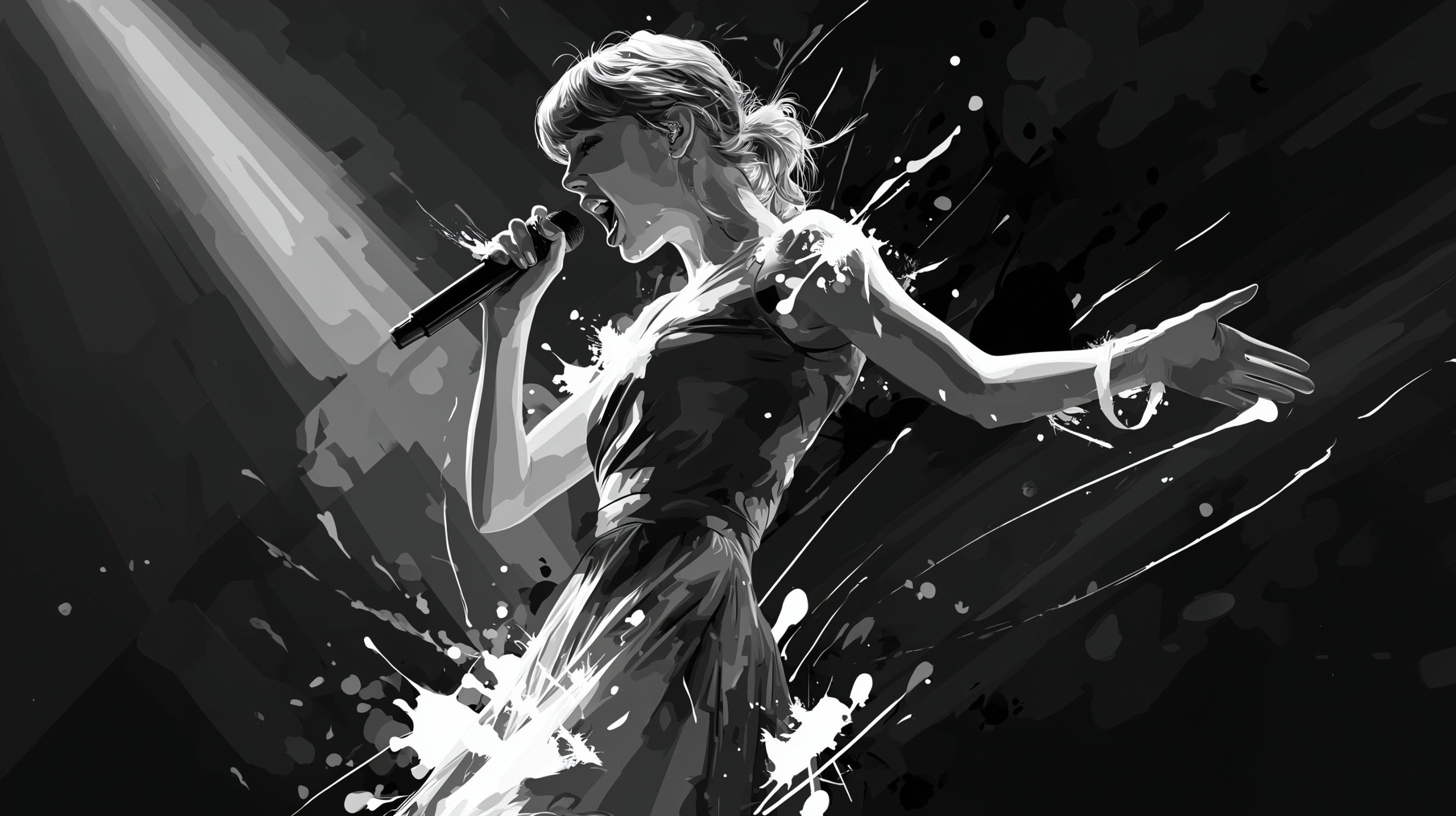
Chapter 1: The 13-Second Silence: When the VMA Became a Battleground
The air at New York’s Radio City Music Hall vibrated with the energy of thousands of applause. On stage, a 19-year-old Taylor Swift held her first Video Music Award in disbelief. The silver astronaut statuette, an icon of pop culture, felt cold and heavy in her hands. It was September 13, 2009, and her music video for “You Belong with Me” had just been crowned Best Female Video, surpassing industry titans like Beyoncé, Lady Gaga, and Katy Perry. Dressed in a one-shoulder evening gown and her hair swept up in an elegant bun, Taylor approached the microphone, her face illuminated by a mixture of surprise and gratitude.
“Thank you very much,” she began, her voice tinged with emotion. “I always dreamed about what it would be like to win one of these someday, but I never thought it would actually happen. I sing country music, so thank you so much for giving me the opportunity to win a VMA.”
At that very moment, a tall figure dressed in black stormed onto the stage. It was Kanye West, an artist as renowned for his musical genius as for his unpredictability. With a swift motion, he snatched the microphone from a stunned Taylor Swift. The audience, which moments before had been celebrating, fell into an expectant silence. What followed was one of the most infamous interruptions in the history of live television.
“I, Taylor, am very happy for you, I’ll let you finish,” West said, with a tone that left no doubt about his displeasure. “But Beyoncé had one of the best videos of all time. One of the best videos of all time!”
The bewilderment on Taylor Swift’s face transformed into a mask of humiliation. The cheers turned into boos aimed at West, who, after his declaration, shrugged and handed the microphone back to a speechless Taylor Swift. Time seemed to stand still. For a long thirteen seconds, the young artist remained silent, her gaze lost in the crowd, as the camera captured her vulnerability and the rawness of the moment. The broadcast cut to a prerecorded video, leaving the audience and viewers at home with the image of a stolen victory and a truncated celebration.
This incident, which lasted less than a minute, became a turning point in Taylor Swift’s career. Beyond the public humiliation, the event propelled her to a new level of fame and scrutiny. The narrative of the innocent victim and the arrogant villain seized the media, but beneath that surface, something more complex was taking shape. In those 13 seconds of forced silence, an archetype was born: that of the silent strategist, the artist who learns to turn wounds into anthems and humiliations into power. This would not be Taylor Swift’s last public confrontation, nor the last time she would use controversy as a catalyst for her art and brand. The VMA incident was her baptism by fire, preparing her for the battles to come, teaching her to navigate the turbulent waters of fame and to control her own narrative—an ability that would become the hallmark of her empire. The journey from that night to becoming the cultural and economic figure she is today is the story of how a country singer-songwriter learned to play the pop game and ultimately rewrite the rules.
Chapter 2: The Girl from Tree Farm: From Pennsylvania to Music Row
Long before her name became synonymous with sold-out stadiums and record-breaking sales, Taylor Alison Swift was a wide-eyed child who grew up in an idyllic and unconventional setting: a Christmas tree farm in Pennsylvania. Born on December 13, 1989, in West Reading, her early years were spent on the Pine Ridge farm, an eleven-acre property where the family business involved cultivating firs and pines for the holiday season. This childhood, almost lifted from a fairy tale, left an indelible mark on her imagination and would become a wellspring of inspiration for her future music, as she later captured in her song “Christmas Tree Farm.”
The farm was not merely a business; it was an entire universe for a girl with an overflowing imagination. Taylor spent her afternoons running among the rows of trees, inventing stories and characters—a practice that would later translate into her ability to craft complex narratives in her songs. Her family, consisting of her father Scott, a financial advisor at Merrill Lynch; her mother Andrea, a marketing executive who left her career to dedicate herself to raising her children; and her younger brother Austin, provided a stable and loving environment. Yet, from an early age, Taylor exhibited a determination and ambition that set her apart from other children her age.
From a very young age, Taylor exhibited a natural inclination toward storytelling. Her maternal grandmother, Marjorie Finlay, had been an opera singer, and the family’s artistic legacy seemed to have found a new vessel in the young Taylor. She spent hours writing poems and stories, and by the age of nine, her interest in musical theater led her to participate in several local productions, including stagings of “Annie” and “Grease.” However, it was the discovery of country music that truly ignited her passion. Artists such as Shania Twain, Faith Hill, and the Dixie Chicks became her idols, and their tales of love, heartbreak, and everyday life resonated deeply within her. Country music, with its emphasis on storytelling and authenticity, was the perfect vehicle for her need to tell stories.
At the age of twelve, a computer technician who visited her home taught her to play three chords on the guitar. That was the catalyst she needed. With those three chords, she composed her first song, “Lucky You,” a ballad about unrequited love that already revealed glimpses of her ability to capture complex emotions in simple lyrics. From that moment on, the guitar became an extension of herself, a vehicle to channel her emotions and observations into melodies and words. She practiced for hours, honing her technique and writing songs about everything around her: her friends, her crushes, her insecurities, and her dreams.
Her family, recognizing her talent and determination, began to support her unconditionally. Her mother, Andrea, became her companion on pilgrimages to Nashville, the epicenter of country music. These journeys, which began when Taylor was only eleven years old, were marathons of hope and rejection. Mother and daughter would drive for hours to Nashville, where Taylor, armed with karaoke demos of her songs, would visit the offices of record labels on Music Row. The scene was always the same: a small girl with a guitar too large for her frame, facing skeptical executives who regarded her with condescension.
Taylor’s initial attempts to carve out a place for herself in Music Row—the renowned district in Nashville housing the major country music record labels and publishing houses—were met with indifference. At just eleven years old, she toured the offices of record companies with demos of her songs, only to be rejected time and again. They told her she was too young and that the market was already saturated with artists like her. Some executives were more blunt: they told her to come back when she had something unique to offer, something that set her apart from the thousands of aspiring country stars arriving in Nashville each year. But rather than being discouraged, the experience strengthened her. She realized that singing other people’s songs was not enough; she had to offer something unique, something no one else could replicate: her own stories.
Back in Pennsylvania, she devoted herself to honing her craft with a discipline uncommon for someone her age. She wrote songs constantly, filling notebooks with lyrics and chords. She performed wherever she was welcomed: local festivals, cafés, fairs, even at the National Karaoke Café in Philadelphia. Each performance was an opportunity to refine her stage presence and connect with the audience. At fourteen, her family made a decision that would change the course of her life. Convinced of their daughter’s potential, they chose to uproot their lives and move to Hendersonville, Tennessee, a town on the outskirts of Nashville. This monumental sacrifice gave Taylor the proximity she needed to fully immerse herself in the city’s music scene.
Her father, Scott, transferred his job at Merrill Lynch to the Nashville office, and the family settled into a house by a lake—a new landscape that would soon find its way into her compositions. The move was an act of faith, a family-wide bet on Taylor’s talent. For her parents, it meant leaving behind friends, community, and the comfort of the familiar. For Taylor, it meant the opportunity to pursue her dream with all her might. The move to Nashville was the ultimate gamble, and it did not take long to pay off. Taylor began collaborating with seasoned industry songwriters, such as Liz Rose, with whom she developed an instant creative chemistry. Together, they wrote some of the songs that would define her debut album, including “You Belong with Me” and “White Horse.”
In 2004, at the age of fourteen, Taylor Swift signed a development deal with RCA Records, becoming the youngest artist to secure a songwriting agreement with Sony/ATV Music Publishing. Yet her ambitions extended beyond this milestone. She did not want merely to sing songs handed to her; she wanted to sing her own. This insistence on authorship led her to part ways with RCA and seek a label that would embrace her as the artist she aspired to be. The girl from the Christmas tree farm had arrived on Music Row not to ask for permission, but to claim her place—and she was prepared to do whatever it took to achieve it.
Chapter 3: The First Chord in Nashville: The Ballad of the Country Girl
Taylor Swift’s tenacity finally found its reward in a small Nashville café called The Bluebird Cafe. This modest venue was, and remains, a sanctuary for songwriters—a place where careers can be born with a single performance. In 2005, during one of those open mic nights, Taylor, just 15 years old, took the stage with her guitar. Among the audience was Scott Borchetta, a music industry executive on the verge of launching his own record label, Big Machine Records. What he heard that night convinced him he had found the inaugural artist for his new venture.
Borchetta offered her a recording contract, but with a condition that demonstrated his faith in her: Taylor would be the first artist signed to Big Machine. It was a risky bet for both. Borchetta was investing in an unknown teenager, and Taylor was entrusting her career to a label that did not yet exist. However, there was an undeniable synergy between Borchetta’s vision and Swift’s ambition. He saw in her not only a talented singer but also a songwriter with an authentic voice and an innate connection to her audience. She saw in him a partner who believed in her artistic vision and would not try to mold her into something she was not.
With the contract signed, Taylor immersed herself in the creation of her debut album. She spent the next two years perfecting her sound and writing songs that captured the essence of adolescence: first love, insecurity, dreams, and disappointments. Her songwriting process was deeply personal; she wrote about her own experiences, her friends, and her observations of the world around her. This brutal honesty became her trademark, a quality that would set her apart from the manufactured pop stars.
The lead single from her self-titled album, “Taylor Swift,” was a bold and strategic choice. The song, titled “Tim McGraw,” was not a direct tribute to the famous country singer, but rather a nostalgic ballad about a fading summer love. The lyrics, evoking images of a “little black dress” and a “dirt road,” were imbued with a bittersweet melancholy that resonated with a generation of young people experiencing similar emotions. The reference to Tim McGraw was a stroke of marketing genius: a way to anchor her music in the country tradition while presenting herself as a fresh, contemporary new voice.
Released in June 2006, “Tim McGraw” was an immediate hit on country radio. The song climbed the charts slowly but steadily, demonstrating the power of word of mouth and Taylor’s growing fan base. The full album, “Taylor Swift,” was released in October 2006 and was an overwhelming success. It debuted at number 19 on the Billboard 200, but it was the album’s longevity that truly astonished the industry. The album remained on the charts for over five years, becoming the album of the 2000s with the most weeks on the Billboard 200.
The album’s success was not based on a single hit. It produced a series of successful singles, including “Teardrops on My Guitar,” “Our Song,” and “Picture to Burn.” Each song told a different story, but all shared the same authenticity and vulnerability that had made “Tim McGraw” a hit. Taylor Swift had arrived on the music scene not as an industry product, but as a force of nature. The guitar-playing girl who had been rejected by the Music Row record labels was now the new princess of country, and her ballad was just beginning.
Chapter 4: The Leap of Faith: From Country Princess to Global Phenomenon
If Taylor Swift’s debut album was an introduction, her sophomore effort, “Fearless,” was a declaration of intent. Released in November 2008, this album propelled her from rising country star to a global phenomenon. “Fearless” not only solidified her success but amplified it to a scale few had anticipated. The album debuted at number one on the Billboard 200 and remained at the top for eleven non-consecutive weeks, becoming the best-selling album of 2009 in the United States.
The success of “Fearless” was propelled by a series of singles that became anthems for a generation. “Love Story,” a modern reinterpretation of “Romeo and Juliet” with a happy ending, became a massive worldwide hit, transcending the boundaries of country music and dominating the pop charts. It was followed by “You Belong with Me,” the song that earned her the infamous VMA, an ode to the girl next door longing for the popular boy. These songs, along with others like “White Horse” and “Fifteen,” showcased Swift’s ability to capture universal emotions with lyrical specificity that made them feel deeply personal.
Critical acclaim was swift to follow. In 2010, “Fearless” made history by winning the Grammy Award for Album of the Year, making Swift, at just 20 years old, the youngest artist ever to receive this honor. The album also swept the country music awards, winning Album of the Year at both the CMA and ACM ceremonies. This level of recognition cemented her status as one of the most significant artists of her generation, a songwriter who was as commercially successful as she was critically acclaimed.
The success of the album translated into her first headlining tour, the “Fearless Tour.” This massive tour, spanning 118 concerts worldwide, was a theatrical spectacle that combined the intimacy of her songs with large-scale production. The tour grossed over $66 million and was seen by more than 1.2 million people, proving that her connection with fans extended far beyond the radio waves. On stage, Swift was a charismatic force, capable of commanding stadiums with the same ease with which she had captivated audiences at the Bluebird Cafe.
After the astronomical success of “Fearless,” Swift faced a new challenge: mounting criticism suggesting that her success was partly due to her collaborators. In response, she made a bold decision for her third album, “Speak Now”: she would write it entirely on her own. Released in 2010, “Speak Now” was a compositional feat, a 14-song album in which every lyric and melody came directly from her. The album was a direct response to her critics and an unequivocal demonstration of her talent as a songwriter.
“Speak Now” continued its streak of success, debuting at number one with over a million copies sold in its first week. The album showcased a growing maturity in its songwriting, featuring tracks like “Dear John,” a ballad exceeding six minutes that detailed a toxic relationship, and “Mean,” a response to her critics that became an anti-bullying anthem. Although still rooted in country, the album increasingly flirted with pop, with songs like “The Story of Us” and “Sparks Fly” hinting at the direction her music would take in the years to come. The leap of faith had paid off. The princess of country had become a global icon, and it was clear that her reign was only just beginning.
Chapter 5: The Autumn of Scars: The Hue of Rupture and Pop Metamorphosis
Following the bold declaration of authorship that was “Speak Now,” Taylor Swift returned in 2012 with an album that reflected the complexity and chaos of a 22-year-old navigating love, loss, and fame. “Red” was not a single-hued album but a mosaic of emotions and sounds, a sonic diary capturing the highs and lows of a broken heart. The title, according to Swift, represented the tumultuous nature of the relationships that inspired the album: “I wrote a song called ‘Red,’ and thinking about what that word means to me, and all the different emotional landscapes it encompasses, was a kind of epiphany. I thought, ‘That’s what this relationship was.'”
Red was the album in which Taylor Swift began to free herself from the constraints of country music. While traces of her roots remained in ballads like “Begin Again,” the album boldly ventured into pop territory. To achieve this new sound, she collaborated with a diverse group of producers, including pop titans Max Martin and Shellback, who helped her craft some of the catchiest hits of her career. This fusion of genres was a daring choice, reflecting her growth as an artist and her desire to experiment with new sounds.
The result was an eclectic and often contradictory album, leaping from the euphoria of the pop anthem “22” to the anguish of the rock-infused “State of Grace.” Yet at the heart of the album lay a song destined to become one of the most revered pieces in her discography: “All Too Well.” This ballad, spanning over five minutes and purportedly chronicling her brief but intense relationship with actor Jake Gyllenhaal, stands as a masterpiece of storytelling. With vivid details and heartrending honesty, the song captures the intimacy of a relationship and the lingering pain of its end. “All Too Well” became an anthem for broken hearts and an irrefutable testament to the power of her pen.
Commercially, “Red” was a powerhouse. It debuted at number one on the Billboard 200 with 1.21 million copies sold in its first week, marking the biggest debut for a female artist in a decade. The album spawned a series of successful singles, including her first number one on the Billboard Hot 100, “We Are Never Ever Getting Back Together,” a bold and catchy pop song that mocked an indecisive ex. It was followed by “I Knew You Were Trouble,” a dubstep-influenced track that surprised many of her fans and demonstrated her willingness to experiment.
The “Red Tour” was yet another massive success, solidifying her status as one of the greatest live performers in the world. The tour, which grossed over $150 million, was a visual spectacle that reflected the sonic diversity of the album. But beyond the numbers and records, “Red” marked a crucial turning point in Taylor Swift’s career. It was the album where she dared to be messy, to be contradictory, to be human. It was the autumn of her scars, a period of pain and growth that prepared her for the pop metamorphosis that was about to come. With “Red,” Taylor Swift was not merely flirting with pop; she was laying the groundwork for her conquest.
Chapter 6: The City of Glass: When New York Became Pop and the Domino Squad
The album “Red” was the transition, but “1989” was the arrival. Released in October 2014, this album marked Taylor Swift’s official transformation from country superstar to pop monarch. The title, a nod to her birth year, was a declaration of her artistic rebirth. Inspired by late 1980s pop music, “1989” was a cohesive and polished synth-pop album that completely abandoned the last vestiges of her country roots. For this project, Swift primarily collaborated with Max Martin and Shellback, the architects behind some of the biggest pop hits of the past two decades, and together they created an album that was both a tribute to a bygone era and an unmistakably modern sound.
The “1989” era was also marked by a geographical shift. In early 2014, Swift moved to New York City, a move that symbolized her newfound independence and embrace of a more cosmopolitan lifestyle. The city became a muse for her, and the album opens with “Welcome to New York,” an optimistic and radiant anthem celebrating the promise of a new beginning. The song, with its pulsing synthesizers and lyrics about “bright lights and the city of dreams,” set the tone for the rest of the album: a bold, bright, and unapologetically pop sound.
The success of “1989” was monumental. The album debuted at number one on the Billboard 200 with nearly 1.3 million copies sold, making Swift the first artist to have three albums sell one million copies in a single week. The album spawned a series of number-one singles, including “Shake It Off,” an anthem for ignoring haters; “Blank Space,” a satire of the media’s perception of her love life; and “Bad Blood,” a high-octane war anthem rumored to be about her feud with Katy Perry. Each single was accompanied by a lavishly produced music video that became a cultural event in its own right.
The “1989” era also witnessed the emergence of Taylor Swift’s “squad,” a group of famous friends that included models, actresses, and singers such as Gigi Hadid, Karlie Kloss, Selena Gomez, and Lorde. The “squad” became a central element of her public image, appearing in her music videos, concerts, and social media. On one hand, the “squad” was a celebration of female friendship and empowerment. On the other, it faced criticism for being exclusive and promoting an unattainable standard of beauty. The perception of the “squad” grew increasingly polarized, and what began as a display of camaraderie evolved into a lightning rod for critiques concerning elitism and authenticity.
Despite mounting criticism, the “1989” era was an undeniable triumph. The album won three Grammy Awards, including her second Album of the Year, making her the first woman to win the award twice. The “1989 World Tour” was a box office success, grossing over $250 million and cementing her status as one of the most dominant live performers on the planet. With “1989,” Taylor Swift had not only conquered the world of pop; she had redefined it in her own image. The girl with the guitar had transformed into a pop mogul, and her reign seemed endless. Yet, at the height of her success, the seeds of a backlash were already being sown.
Chapter 7: The Rebirth of the Serpent: Silent Revenge and Seclusion
At the pinnacle of her career, with the massive success of “1989,” Taylor Swift was the undisputed queen of pop. Yet the very fame that had elevated her to stratospheric heights would soon become a gilded cage. The public perception, which had once adored her as America’s sweetheart, began to sour. Her “squad” was labeled elitist, her romantic relationships subjected to relentless scrutiny, and her carefully crafted image started to be seen as calculated and insincere. But the blow that would make her vanish from the public eye came from a familiar source: Kanye West.
In 2016, West released his song “Famous,” which included the controversial lyric: “I feel like me and Taylor might still have sex / Why? I made that bitch famous.” West claimed he had obtained Swift’s approval for the lyric, a claim Swift vehemently denied through her representative. The dispute escalated when West’s then-wife, Kim Kardashian, intervened. In a move that shook the world of pop culture, Kardashian posted on Snapchat excerpts of a recorded phone call between West and Swift, in which Swift appeared to approve at least part of the lyric. The reaction was immediate and brutal. Swift was branded a liar and manipulator, and the hashtag #TaylorSwiftIsOverParty became a worldwide trend. The snake emoji became the weapon of choice for her detractors, flooding her social media with the symbol of deceit.
The humiliation was total and devastating. Swift, who had built her career on the foundation of authenticity and connection with her fans, was publicly repudiated. The media, which had once celebrated her, now crucified her. Every move she made was analyzed and criticized. Her friendships were questioned, her motivations doubted, and her character was torn apart on the altar of public opinion. For someone who had spent her entire life under public scrutiny, this was the fiercest storm she had ever faced. Instead of retaliating with public statements or attempting to defend herself on social media, she did something no one expected: she disappeared.
On August 18, 2017, Taylor Swift erased all her posts from Instagram, Twitter, and Facebook. Her profiles were left empty, a blank canvas that left her millions of followers bewildered. She stopped giving interviews, canceled public appearances, and withdrew from public life. For nearly a year, the world heard nothing from Taylor Swift. The queen of pop had abdicated her throne, and many wondered if she would ever return. The tabloids speculated about her whereabouts; some claimed she was having a nervous breakdown, others that she was planning her definitive retirement. But the truth was simpler and more powerful: she was processing, healing, and, most importantly, creating.
But in the silence, something was changing. Away from the spotlight, Swift was processing betrayal and humiliation, channeling her anger and pain into new music. She worked with trusted producers and songwriters, experimenting with a darker, more aggressive sound. The music she was creating was not the bright, optimistic pop of “1989”; it was something rawer, more visceral, more honest. She was writing about fame, about betrayal, about revenge, and about the love found amid chaos. She was writing her rebirth.
In August 2017, she broke her silence with a series of cryptic videos featuring a snake—the very symbol that had been used to attack her. The videos, posted on her newly reactivated social media accounts, showed a snake in various poses, without any explanation. Fans and the media went into a frenzy, speculating about their meaning. Days later, on August 24, she released “Look What You Made Me Do,” the lead single from her sixth studio album, *Reputation*. The song was a declaration of war, a dark, electronic anthem of revenge that completely abandoned the bright pop sound of *1989*. “The old Taylor can’t come to the phone right now,” she declared in the song. “Why? Oh, ’cause she’s dead.”
The music video for “Look What You Made Me Do” was a cultural event. Directed by Joseph Kahn, the video was a satire of Swift’s own public image, with Swift portraying different versions of herself throughout her career, from the naive country girl to the pop queen surrounded by her “squad.” In the final scene, all the versions of Taylor Swift confront each other, fighting for control of the narrative. It was a meta commentary on her own fame, a declaration that she was aware of how she had been perceived and was ready to rewrite her story. The video broke the record for most views in 24 hours on YouTube, proving that despite the controversy, her drawing power remained immense.
The album “Reputation,” released in November 2017, marked a radical sonic and thematic shift. With a darker, heavier sound influenced by hip-hop and R&B, the album delved into themes of fame, betrayal, and ultimately, love amidst chaos. Tracks like “I Did Something Bad” and “This Is Why We Can’t Have Nice Things” served as anthems of defiance and revenge, while “Delicate” and “Call It What You Want” revealed a vulnerability that contrasted with the album’s overall hardness. The snake, once a symbol of her downfall, was reclaimed as an emblem of her rebirth. The album was a massive commercial success, debuting at number one with over 1.2 million copies sold in its first week.
The “Reputation Stadium Tour” shattered records, becoming the highest-grossing tour in United States history, grossing over 345 million dollars. The show was a massive production, featuring a giant snake slithering across the stage, stunning visual effects, and an energy that was both aggressive and cathartic. Swift had transformed her humiliation into a spectacle of power, proving that she had not only survived the storm but emerged stronger than ever.
With “Reputation,” Taylor Swift had not only survived the storm but emerged stronger and more defiant than ever. She had taken the narrative that had been used against her and transformed it into her armor. Her withdrawal was not a defeat but a strategic retreat. The rebirth of the serpent was not merely an act of revenge; it was a lesson in power and resilience. The old Taylor was dead, replaced by an artist who no longer sought the world’s approval but was determined to define her own legacy on her own terms.
Chapter 8: The Political Rainbow: Reclaiming the Narrative and Quiet Activism
If “Reputation” was a plunge into darkness, its successor, “Lover,” was a technicolor dawn. Released in August 2019, Taylor Swift’s seventh studio album was an explosion of pastel hues and optimism, a stark contrast to the somber and vengeful aesthetic of her previous era. The album, which she described as “a love letter to love itself,” saw her move away from themes of revenge and public scrutiny to embrace light, joy, and, for the first time explicitly, politics.
For years, Swift had been notoriously apolitical. Her silence, especially during the tumultuous 2016 U.S. presidential elections, drew intense criticism. She was accused of being a passive bystander in a moment of national crisis, prioritizing her brand and sales over her civic responsibilities. However, behind the scenes, a transformation was underway. As later revealed in her 2020 documentary, “Miss Americana,” her decision to break her political silence was the result of an internal struggle and a series of events that compelled her to reevaluate the purpose of her platform.
The turning point came with her 2017 sexual assault trial, in which she testified against a radio DJ who had groped her. The experience, though traumatic, was empowering. It made her realize that she could not expect others to fight for what was right if she herself was not willing to do so. This newfound determination was fueled by her dismay at the political climate in her home state of Tennessee, where Republican Senate candidate Marsha Blackburn had a voting record that Swift considered anti-LGBTQ and anti-woman. Despite strong opposition from her father and team, who feared commercial repercussions, Swift decided she needed to be on “the right side of history.”
The first fruit of this political awakening was the second single from “Lover,” “You Need to Calm Down.” The song, a bright and catchy pop anthem, was a direct rebuke to internet trolls and homophobes. The accompanying music video was a bold celebration of LGBTQ+ culture, featuring a cast of queer stars and a call to action to support the Equality Act. It was a daring and unprecedented moment for an artist of her stature, an unequivocal declaration of her support for the LGBTQ+ community.
However, the reception was mixed. While many praised her bravery and her use of her platform to advocate for equality, others accused her of performative activism. Critics argued that the song trivialized the online harassment she experienced by equating it with the systemic discrimination faced by the LGBTQ+ community. She was accused of “woke-washing,” using gay rights as a marketing tool for her new album. The video, with its trailer park aesthetic and its portrayal of anti-gay protesters as “hillbillies,” was also criticized for alleged classism.
Despite the controversy, “Lover” continued to explore political themes. In “The Man,” Swift tackled the sexism and double standards she had faced throughout her career, imagining what her life would be like if she were a man. The song, with its incisive lyrics and music video in which she transforms into an arrogant businessman, was a biting commentary on misogyny in the entertainment industry and beyond. The album “Lover” was not a political manifesto, but it marked a crucial step in Taylor Swift’s evolution. It was the moment she decided that her voice could be used for more than just telling stories of love and heartbreak. Although her initial activism was tentative and sometimes awkward, it signaled the beginning of a new era in which the world’s biggest pop star was no longer afraid to take a stand.
Chapter 9: The Forest of Melancholy: The Indie Surprise and the Redefined Critique
In the summer of 2020, amid the uncertainty and isolation of the global COVID-19 pandemic, Taylor Swift did something completely unexpected: she released a surprise album. On July 24th, with less than 24 hours’ notice, she announced the release of her eighth studio album, *folklore*. This was neither a bright pop album nor a declaration of war; it was a collection of intimate and melancholic songs, a turn toward an indie-folk sound that no one saw coming. The album, which she described as “a product of isolation,” marked a radical departure from everything she had done before, a testament to her artistic versatility and her need to create in times of crisis.
For “folklore,” Swift collaborated primarily with Aaron Dessner of the indie rock band The National, a move that signaled her intention to explore new sonic territory. The result was an album of acoustic instrumentation, featuring melancholic pianos, gentle guitars, and atmospheric string arrangements. The songs, co-written with Dessner and her longtime producer Jack Antonoff, largely abandoned the autobiographical songwriting for which she was known. Instead, Swift immersed herself in storytelling, creating characters and narrative arcs that intertwined throughout the album. The most notable of these was the “teenage love triangle,” a trio of songs (“cardigan,” “august,” and “betty”) that told the same story from three different perspectives.
“folklore” was a resounding success, both commercially and critically. The album debuted at number one on the Billboard 200 and became the first album to sell one million copies in 2020. But beyond the numbers, the album was hailed as a masterpiece, one of the finest of her career. Critics praised its lyrical maturity, sonic sophistication, and artistic boldness. The album earned Swift her third Grammy Award for Album of the Year, making her the first woman to win the award three times, joining an elite club that includes Frank Sinatra, Stevie Wonder, and Paul Simon.
But the surprise did not end there. Less than five months later, in December 2020, Swift released another surprise album, “evermore,” which she described as the “sister album” to “folklore.” Continuing with the same indie-folk aesthetic and collaboration with Dessner, “evermore” was a deeper exploration of the melancholic forest she had created with its predecessor. The album, which also debuted at number one, was equally acclaimed by critics, solidifying this new chapter in her career as one of the most fruitful and celebrated.
The albums “folklore” and “evermore” marked a turning point for Taylor Swift. At a time when the world was on pause, she discovered a new way of creating—one that was more introspective, more collaborative, and less reliant on the traditional promotional cycle. These albums not only redefined her sound but also reshaped her relationship with critics and audiences alike. By moving away from autobiography and embracing fiction, she freed herself from the burden of having to live her songs. The girl once criticized for writing about her ex-boyfriends was now praised for her ability to craft imaginary worlds. In the forest of melancholy, Taylor Swift found not only a new sound but a new freedom.
Chapter 10: Midnight Nightmares: The Record-Breaking Phenomenon and the Eras Tour
After her foray into introspective folk with “folklore” and “evermore,” Taylor Swift returned to pop with her tenth studio album, “Midnights,” released in October 2022. Described as a conceptual album about “the stories of 13 sleepless nights scattered throughout her life,” “Midnights” marked a return to the synth-pop sound of “1989,” but with a darker and more mature sensibility. The album delved into themes of self-reflection, regret, and anxiety, all wrapped in a bright and atmospheric electronic pop production. It was an instant success, breaking streaming and sales records worldwide.
Midnights became the fastest-selling album of her career, debuting at number one on the Billboard 200 with over 1.5 million album-equivalent units in its first week. The album also made history by occupying the top ten spots on the Billboard Hot 100 simultaneously, an unprecedented feat. The lead single, “Anti-Hero,” became her ninth number one and an anthem for a generation grappling with self-doubt and insecurity. The success of Midnights was further proof of her cultural dominance, a demonstration that even on her tenth album, she continued to find new ways to connect with her audience on a massive scale.
But the phenomenon of “Midnights” was only the prelude to what was to come. In November 2022, Swift announced “The Eras Tour,” a stadium tour that would celebrate her entire career, from her eponymous debut to her latest release. The demand for tickets was so overwhelming that it crashed the Ticketmaster system, prompting a Congressional investigation and a national debate about monopolies in the ticketing industry. The tour, which began in March 2023, became an unprecedented cultural and economic phenomenon.
“The Eras Tour” was not merely a concert; it was an event. Lasting over three hours and featuring a setlist of 44 songs spanning all her musical “eras,” the tour was a spectacle of epic proportions. Each segment of the concert was devoted to a different album, with costumes, stage designs, and choreography that recreated the aesthetic of each era. The tour was hailed by critics as a triumph of live production and a celebration of her remarkable career. Yet its impact extended far beyond the music.
The tour had a massive economic impact on the cities it visited, a phenomenon dubbed “Swiftonomics.” Fans traveled from all over the world to attend the concerts, filling hotels, restaurants, and shops. It is estimated that the tour generated billions of dollars in economic activity, a testament to the power of her fan base and her status as a global cultural icon. The concert film, “Taylor Swift: The Eras Tour,” also broke box office records, becoming the highest-grossing concert movie of all time.
With “Midnights” and “The Eras Tour,” Taylor Swift reached a new level of success, one that established her not only as one of the greatest artists of her generation but also as one of the most influential cultural figures of the twenty-first century. The phenomenon of the midnight nightmares and the celebration of her eras was not merely a moment of commercial triumph; it was the culmination of a career built on the foundation of honest songwriting, bold reinvention, and an unbreakable connection with her fans. The girl with the guitar had become an economic and cultural force, and her story was far from over.
Chapter 11: The War of the Masters: The Legal Battle for the Ownership of the Soul
While Taylor Swift celebrated the success of “Lover” and prepared for her world tour, a battle was brewing in the shadows—one that threatened to wrest control of her own legacy from her grasp. In June 2019, it was announced that Big Machine Label Group, the record label that had been her home for the first thirteen years of her career, had been sold to Ithaca Holdings, a company owned by music mogul Scooter Braun. The sale, valued at over $300 million, included the masters of Swift’s first six albums, from her self-titled debut through “Reputation.” For Swift, this was no mere business transaction; it was a personal and professional betrayal of epic proportions.
The news was a devastating blow. Swift expressed her pain and indignation in a Tumblr post, in which she described the sale as her “worst nightmare.” She revealed that she had tried to buy her masters for years, but Big Machine, under the leadership of Scott Borchetta, had offered her a deal in which she could only “earn” one album at a time for each new album she delivered. She refused to sign a new contract that would have kept her tied to the company that had betrayed her. The sale to Scooter Braun was particularly painful. Braun, known as the manager of artists such as Justin Bieber and Kanye West, had been, according to Swift, a source of “relentless and manipulative harassment” over the years, especially during her dispute with West and Kardashian.
In her post, Swift wrote: “For years, I asked, I begged for the opportunity to own my work. Instead, I was offered the chance to ‘earn’ an album back one at a time, one for each new album I delivered. I wrote and recorded this music. These songs are my diary. Like anyone, I want to own the things I have created.” The post was a rallying cry, a public denunciation of the music industry’s practices that allow record labels to own artists’ work, even when they have been the sole creators. The post went viral, generating millions of reactions and sparking a nationwide debate about artists’ rights.
The dispute over the masters became one of the most significant stories in the music industry, sparking a debate about artists’ ownership of their own work. Swift emerged as a vocal advocate for artists’ rights, using her platform to denounce the predatory practices of the industry. Numerous artists, from Halsey to Kelly Clarkson, expressed their support for Swift and shared their own experiences with unfair recording contracts. The situation grew even more acrimonious when Swift claimed that Borchetta and Braun were preventing her from performing her old songs at the American Music Awards and from using them in her Netflix documentary, “Miss Americana.” The public dispute garnered support from numerous artists and politicians, who united in defense of Swift and artists’ rights.
In November 2019, Swift issued another statement claiming that Borchetta and Braun had prohibited her from performing her old songs at the American Music Awards, where she was to receive the Artist of the Decade award. She also asserted that they had denied her permission to use her music in her Netflix documentary. The statement sparked a massive reaction, with fans organizing protests and artists expressing their outrage. Borchetta responded with his own statement, denying Swift’s accusations and asserting that they had never refused her permission to perform her music. The dispute became a public spectacle, with each side presenting its version of the events.
Amidst the legal battle and public outrage, Swift announced a bold and unprecedented plan: she would re-record her first six albums. In doing so, she would create new versions of her songs that she herself would own, thereby devaluing the original masters held by Braun. It was a radical measure, one that required an enormous amount of time, effort, and resources, but it demonstrated her determination to regain control of her music. The re-recording project, which she dubbed “Taylor’s Version,” was a declaration of independence, a way to rewrite her own history and ensure that her legacy remained in her own hands.
The announcement of the re-recording project was met with enthusiasm by her fans, who pledged to support her by purchasing and streaming only the re-recorded versions of her songs. The strategy was simple yet effective: if fans stopped listening to the original versions and exclusively played the “Taylor’s Version” tracks, the original masters would lose their value. It was a form of grassroots activism, a demonstration of the power of a fan community when mobilized in support of an artist.
In April 2021, she released the first of these re-recorded albums, *Fearless (Taylor’s Version)*. The album was an overwhelming success, debuting at number one on the Billboard 200 and demonstrating the immense support of her fans. The album not only faithfully recreated the original songs but also included six “From the Vault” tracks—unreleased songs written during the original album’s era. These additional tracks, such as “Mr. Perfectly Fine” and “You All Over Me,” became hits in their own right, offering fans a deeper insight into her creative process.
This was followed by “Red (Taylor’s Version)” in November 2021, which included the ten-minute version of “All Too Well,” one of the most revered songs in her discography. The extended version of “All Too Well” was a cultural event, accompanied by a short film directed by Swift that visualized the story behind the song. The track became the longest song to reach number one on the Billboard Hot 100, breaking a record that had been held by Don McLean’s “American Pie” since 1972.
“Speak Now (Taylor’s Version)” was released in July 2023, followed by “1989 (Taylor’s Version)” in October 2023. Each of these albums not only faithfully recreated the original songs but also included “From the Vault” tracks—unreleased songs written during the original era of each album. These additional tracks became cultural events in their own right, offering fans a deeper insight into her creative process and demonstrating that, even in her early years, her songwriting talent was exceptional.
In 2020, Braun sold the masters to Shamrock Holdings, a private investment company, for an estimated value of over $300 million. Swift revealed that Shamrock had approached her with the opportunity to purchase the masters, but Braun would continue to receive profits from the sale—something she was unwilling to accept. In 2025, it was reported that Swift had finally acquired the masters from Shamrock, closing a chapter on one of the longest and most public disputes in the music industry.
The masters war was one of the most challenging battles in Taylor Swift’s career, but it was also one of the most transformative. It forced her to fight for her art, to defend her rights, and to take control of her own destiny. The re-recording project was not merely a commercial strategy; it was an act of defiance, a declaration that artists are not simply products, but creators entitled to own their own work. In the battle for the ownership of her soul, Taylor Swift did not just win; she changed the rules of the game forever, inspiring a new generation of artists to fight for their rights and to refuse contracts that strip them of their work.
Chapter 12: The Department of Tormented Poets: The Final Artistic Evolution and the Challenge of the Shadow
Just when the world believed it had unraveled the enigma of Taylor Swift, she once again changed the rules of the game. At the height of the cultural phenomenon of “The Eras Tour” and amidst her monumental re-recording project, Swift announced her eleventh studio album, “The Tortured Poets Department,” during her acceptance speech at the 2024 Grammy Awards. The announcement, a surprise to both her fans and the industry, proved that her creative well was deeper than anyone had imagined. Released on April 19, 2024, the album was not merely a new body of work but a bold and unfiltered immersion into the complexities of her psyche—a manifesto of her evolution as an artist and as a woman.
“The Tortured Poets Department” emerged as a double album, an anthology of 31 songs that delved into the aftermath of a romantic relationship and the anguish of living under the microscope of fame. Musically, the album blended the synth-pop of “Midnights” with the lyrical sensibility of “folklore” and “evermore,” creating a soundscape that was at once familiar and novel. The songs, mostly written with her trusted collaborators Jack Antonoff and Aaron Dessner, were filled with literary metaphors, historical references, and a brutal honesty that often proved unsettling. The album, as a whole, was a whirlwind of emotions: anger, sorrow, longing, and a dark humor that revealed a new facet of her artistic persona.
The reception of “The Tortured Poets Department” was polarizing. While his most devoted fans embraced it as a masterpiece of vulnerability and lyrical complexity, some critics found it self-indulgent and overburdened. It was accused of wallowing in its own mythology, creating an album so dense with personal history that it became impenetrable to the casual listener. However, commercially, the album was an unprecedented success. It broke streaming records on its first day, became the best-selling album of 2024 in its first week, and further solidified his dominance on the charts. The album proved that, despite the criticism, his connection with his audience was stronger than ever.
Beyond the music, “The Tortured Poets Department” represented a challenge for Taylor Swift herself. At a time when her fame had reached an almost mythological level, the album humanized her in a way no other had. By exposing her insecurities, her mistakes, and her darkest moments, she risked tarnishing the image of perfection she had built over the years. The album was a reminder that behind the global superstar, there was a woman still grappling with heartbreak, anxiety, and the pressure of expectations. It was a declaration that the artist and the person were not always aligned, and that the shadow of fame could be a lonely and tortured place.
“The Tortured Poets Department” was Taylor Swift’s latest artistic evolution, an artist who has refused to be defined by a single sound, a single genre, or a single narrative. It was an act of bravery, a plunge into the depths of her own soul, regardless of the consequences. The album was not merely a collection of songs; it was a testament to her commitment to the art of confession, a reminder that even at the pinnacle of the world, tortured poets still have stories to tell.
Chapter 13: The Legacy of the Archetype: The Economic Machine and the Cultural Architect
Assessing Taylor Swift’s legacy in real time is like trying to capture lightning in a bottle. Her career is a living organism, constantly evolving, continuously redefining the parameters of success and influence. Yet even amid her journey, the contours of her impact are already monumental and multifaceted. Swift has transcended the category of pop star to become a cultural phenomenon and an economic force, an architect of her own mythology, and a figure who has shaped the music industry in her own image.
The economic impact of Swift, often referred to as “Swiftonomics,” is both tangible and astonishing. Her “The Eras Tour” is not merely a series of concerts; it is an economic engine that has revitalized local economies, boosting tourism, hospitality, and retail in every city it visits. Consumer spending associated with the tour amounts to billions of dollars, a testament to the purchasing power of her fan base and her ability to mobilize them. Economic studies have shown that each concert of “The Eras Tour” generates an average of $13 million in direct revenue, excluding the indirect impact on hotels, restaurants, transportation, and local commerce. In cities like Los Angeles, it was estimated that Swift’s six concerts produced a combined economic impact of $320 million, creating more than 3,300 temporary jobs.
The phenomenon of “Swiftonomics” has been so significant that it has attracted the attention of economists and financial analysts. The economic impact of her tour has been compared to the GDP of some small countries. QuestionPro estimated that the total economic impact of the tour could exceed five billion dollars, a figure surpassing the GDP of 50 countries. This level of economic influence is unprecedented for a musical artist and has led some to argue that Swift is not merely a pop star, but an economic institution in her own right.
Beyond touring, her command of the charts, album sales that defy the streaming era, and her influence on consumer choices have made her one of the richest and most powerful women in the entertainment world. Her net worth is estimated at over one billion dollars, a fortune built primarily through her music, tours, and licensing deals. Unlike many other celebrities who diversify their income through product lines or investments in other industries, Swift’s wealth stems almost exclusively from her work as an artist, making her a unique case in the entertainment industry.
But her legacy is not measured solely in dollars and cents. Culturally, Swift has left an indelible mark on a generation. Her music has been the soundtrack to the lives of millions, her lyrics serving as a language to express love, heartbreak, joy, and pain. She has created a narrative universe so rich and complex that it has spawned an ecosystem of analysis and debate, ranging from fan forums to university courses. Academic institutions such as Stanford University, New York University, and Harvard University have offered courses dedicated to the study of her music, cultural impact, and narrative skill. These courses examine everything from her use of literary theory to her influence on politics and social activism.
Her ability to intertwine her personal life with her art has created a new kind of stardom, one in which authenticity—or at least the perception of it—is the most valuable currency. Swift’s fans do not merely consume her music; they engage with it, deciphering clues in her lyrics, analyzing every detail of her music videos, and crafting elaborate theories about the meanings behind her songs. This level of engagement has fostered a fan community that stands as one of the most loyal and active in the entertainment world.
In the music industry, her influence has been equally transformative. Her battle for ownership of her masters and subsequent re-recording project have brought the issue of artists’ rights to the forefront and inspired a new generation of musicians to fight for control over their own work. Artists such as Olivia Rodrigo, Gracie Abrams, Conan Gray, and Maisie Peters have cited Swift as a direct influence, not only on their music but also on their approach to the industry. Her mastery of album release strategies, from surprise drops to viral marketing campaigns, has rewritten the industry playbook. She has demonstrated that it is possible to achieve massive success without compromising artistic vision, and that fans, when nurtured and respected, can be the most powerful force in the industry.
Swift has also been a pioneer in the use of social media and direct communication with her fans. From her early days on MySpace to her current dominance of platforms like Instagram and TikTok, she has utilized social media not only to promote her music but to build a personal relationship with her audience. She has been known to interact directly with fans, inviting them to secret listening sessions before the release of her albums, sending personalized gifts, and responding to their comments on social media. This level of accessibility, combined with her ability to maintain an aura of mystery, has created a unique dynamic between her and her fanbase.
Taylor Swift’s archetype is that of the master strategist, an artist who has skillfully navigated the treacherous waters of fame with a blend of vulnerability and shrewdness. She has transformed wounds into anthems, criticism into fuel, and defeats into victories. She has made mistakes, faced criticism, and been knocked down, yet each time she has risen stronger, wiser, and more determined. Her legacy is not merely that of a talented singer-songwriter or a successful pop star; it is that of a woman who refused to be defined by others, who fought for her art, and in the process, became an icon for a generation.
The story of Taylor Swift is the story of how a girl with a guitar and a dream became a force of nature, a cultural architect whose impact will be felt for decades. It is a story of constant reinvention, resilience in the face of adversity, and the power of authenticity in a world that often rewards superficiality. It is the story of an artist who understood that true power does not come from the approval of others, but from the ability to control your own narrative and create art that resonates with millions around the globe. Ultimately, Taylor Swift’s legacy is not just that of a pop star, but of a pioneer who changed the rules of the game and, in the process, inspired a generation to dream bigger, fight harder, and never give up.
EXTRA SECTION: Notable and Recommended Work
Discografía de estudio
- Taylor Swift (2006)
- Fearless (2008)
- Speak Now (2010)
- Red (2012)
- 1989 (2014)
- Reputation (2017)
- Lover (2019)
- folklore (2020)
- evermore (2020)
- Midnights (2022)
- The Tortured Poets Department (2024)
Regrabaciones (Taylor’s Version)
- Fearless (Taylor’s Version) (2021)
- Red (Taylor’s Version) (2021)
- Speak Now (Taylor’s Version) (2023)
- 1989 (Taylor’s Version) (2023)