
CHAPTER 1: “A Revolutionary Product That Changes Everything”
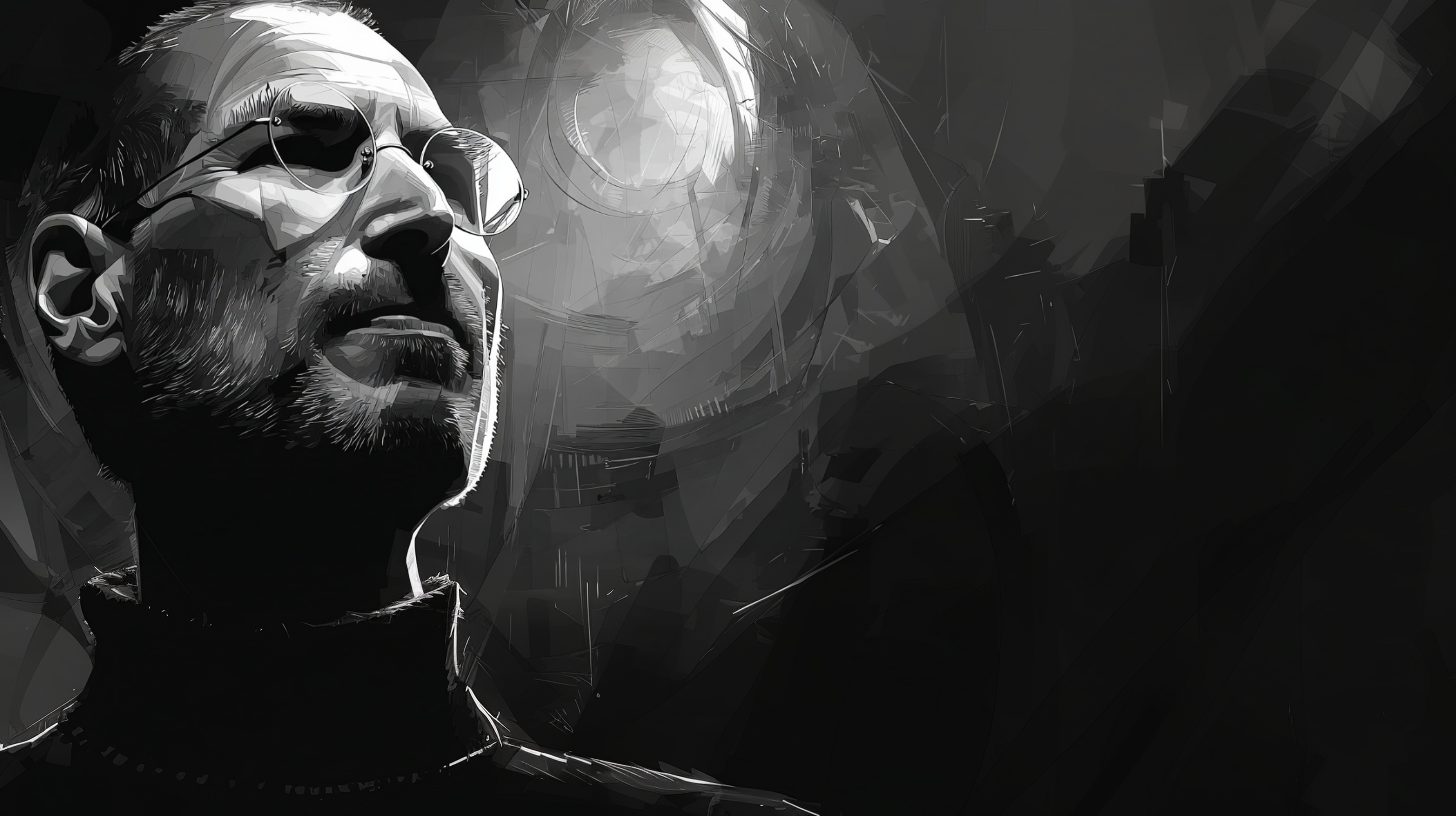
The air at Moscone West in San Francisco was charged with an almost palpable electricity. It was January 9, 2007, and the annual Macworld Conference & Expo was about to begin. But this was no ordinary Macworld. Rumors had been swirling for months, whispers that Apple, the company that had reinvented the personal computer and digital music, was about to do something big. Something that would change the game. At the center of it all, a man dressed in his signature uniform—a black turtleneck sweater, blue jeans, and New Balance sneakers—was preparing to take the stage. That man was Steve Jobs, and he was about to unveil the future.
“This is the day I’ve been waiting for for two and a half years,” Jobs began, his voice resonating with a mix of calm and barely contained intensity. The audience, a blend of journalists, developers, and loyal Apple fans, leaned forward. They knew they were about to witness something special. Jobs, a master of showmanship and storytelling, would not disappoint.
“Every once in a while,” he continued, “a revolutionary product comes along that changes everything. Apple has been very fortunate. We’ve been able to introduce a few of these to the world. In 1984, we introduced the Macintosh. It didn’t just change Apple. It changed the entire computer industry. In 2001, we introduced the first iPod. And it didn’t just change the way we all listen to music, it changed the entire music industry.”
He paused, letting the weight of his words settle. The anticipation in the room was a living organism. “Well, today,” Jobs said, with a smile that barely hinted at the magnitude of what was to come, “we’re introducing three revolutionary products of this class.”
“The first,” he enumerated, “is a widescreen iPod with touch controls. The second is a revolutionary mobile phone. And the third is an innovative Internet communications device.”
An iPod. A phone. An Internet communicator. The audience processed the information, applauding each item. But Jobs was not finished. He repeated the list, hammering the rhythm, building the crescendo. “An iPod, a phone… do you get it? They’re not three separate devices. This is one device. And we’re calling it… iPhone.”
The word hung in the air for a moment before the room erupted in thunderous applause. On the screen behind him, the iconic Apple logo appeared above the word “iPhone.” It was not just a new product; it was a statement. It was the culmination of years of secret research and development, countless hours of work by engineers and designers operating under Jobs’s almost paranoid veil of secrecy. It was Apple’s bold bet to reinvent a product category that, in Jobs’s words, “wasn’t so smart and wasn’t so easy to use.”
This moment was not simply a product launch. It was the embodiment of Steve Jobs’s core philosophy, the belief that had guided him from his parents’ garage to this very stage: the conviction that technology alone is not enough. It is technology married with the liberal arts, married with the humanities, that makes the heart sing. The iPhone was not just a set of features on a spec sheet; it was an experience. It was the promise of a revolutionary user interface, one that eliminated the clumsy plastic keyboard and replaced it with the most natural pointing device in the world: the human finger. It was the audacity to run a desktop operating system, OS X, on a mobile device, offering power and sophistication never before seen.
As Jobs demonstrated the iPhone’s capabilities—the smooth, elastic scrolling, the magic of “multi-touch,” the way the screen effortlessly rotated from vertical to horizontal, the richness of desktop web browsing on a pocket-sized device—it became clear this was more than just an evolution. It was a quantum leap. It was the kind of innovation that only happens when a visionary leader refuses to accept the limits of what is considered possible. A leader who, after being ousted from his own company, returned to save it from the brink of bankruptcy and lead it to unimaginable heights.
On that stage, at that moment, Steve Jobs was not just selling a phone. He was sharing his vision of the future—a future where technology would fade into the background, becoming so intuitive and personal that it would feel like an extension of oneself. He was fulfilling the promise he once read in a quote from one of his heroes, Alan Kay: “People who are serious about software should make their own hardware.” The iPhone was the ultimate expression of that synergy, a unique and cohesive object where hardware and software danced in perfect harmony.
This is the archetype of Steve Jobs: the visionary, the rebel, the relentless perfectionist, the consummate showman. A man who believed that the tools we create, in turn, shape us. The man who set out to leave a mark on the universe. To understand how he reached this pinnacle, to grasp the force that drove him to reinvent not one but multiple industries, we must go back in time. We must explore the life of an adopted child from Mountain View, a young man who dropped out of college and traveled to India in search of enlightenment, an entrepreneur who was overthrown and then returned triumphant. The story of the iPhone is inseparable from the story of Steve Jobs, and to truly understand one, we must begin at the beginning of the other.
CHAPTER 2: “The Adopted Child Who Found His Purpose”
Steve Jobs’ story begins with a paradox: the man who would build one of the world’s most valuable and recognizable brands was born into anonymity, the product of a union disapproved of by their families. Steven Paul Jobs came into the world on February 24, 1955, in San Francisco, California, the son of Joanne Carole Schieble, a young graduate student of Swiss-German descent and Catholic faith, and Abdulfattah “John” Jandali, a Syrian immigrant and political science student from a Muslim family. Their love blossomed at the University of Wisconsin but clashed with the staunch opposition of Schieble’s father, who opposed the relationship because of Jandali’s faith.
Faced with an out-of-wedlock pregnancy and family pressure, Joanne Schieble made a heartbreaking decision: to give her son up for adoption. She traveled to San Francisco to give birth privately, with one clear and firm condition for the adoption agency: her son had to be raised by parents with a college education. A lawyer and his wife were selected, but the couple backed out at the last moment upon learning the baby was a boy, not the girl they had hoped for. Destiny then turned toward a second marriage on the waiting list.
Paul Reinhold Jobs and Clara Hagopian longed to start a family. Paul, a man of German descent who had dropped out of high school, was a mechanic and Coast Guard veteran. Clara, the daughter of Armenian immigrants, was an accountant. They did not have college degrees, a detail that nearly derailed the adoption. When Schieble discovered the Jobs had not attended college, she refused to sign the papers. She only relented weeks later, after an emotional and legal battle, when Paul and Clara solemnly promised that the child would go to college. It was a pact that would define much of Steve’s youth.
The family settled in Mountain View, California, an area that would soon become the epicenter of the technological revolution and come to be known as Silicon Valley. Paul Jobs, a meticulous craftsman, tried to pass on his love of mechanics to his son. He set up a workbench in the garage for Steve, teaching him how to build and take apart electronic devices. “I didn’t really like fixing cars,” Jobs would later recall, “but I was eager to hang out with my dad.” Although young Steve did not share his father’s passion for automobiles, he absorbed a fundamental lesson: the importance of craftsmanship, attention to detail, and care for the parts no one sees. His father taught him that the back of a cabinet or a fence should be as well made as the front. It was a philosophy Jobs would later apply with an almost religious obsession in the design of Apple products.
However, Steve’s childhood was not easy. He was a bright child, but also stubborn and nonconformist. He was bored at school, challenged his teachers, and often got into trouble. His restless mind did not fit into the rigid structure of the educational system. His father, instead of punishing him, blamed the school for not being stimulating enough for his son. This belief in Steve’s exceptionalism, instilled from an early age, forged in him an unshakable confidence in his own ideas and an aversion to authority that would accompany him throughout his life. He felt different, special—a perception reinforced by the knowledge that he was adopted. Jobs recalled telling a neighbor at six or seven years old: “My biological parents were college graduates.” It was a way to process his own narrative, to feel chosen rather than abandoned.
The tension between his precocious intelligence and the conventional school environment reached a breaking point in high school. After being bullied at Crittenden Middle School, Jobs gave his parents an ultimatum: either they took him out of there, or he would quit school. The Jobs family, true to their promise and sacrificing all their savings, moved to a house in Los Altos, in a better school district. It was in this new environment, at Homestead High School, where young Steve Jobs would begin to find the pieces of the puzzle that would define his future. There, at the crossroads of the 1960s counterculture and the emerging technological revolution, the adopted child who felt out of place would begin to forge his own purpose.
CHAPTER 3: “Between Shakespeare and Circuits”
Homestead High School, in the late 1960s, was no ordinary high school. Located in the heart of what was becoming Silicon Valley, its halls buzzed with a unique blend of technological optimism and countercultural fervor. It was in this crucible that Steve Jobs began to forge the dualities that would define his life and work. He was no longer just the troubled kid, but a young man navigating between two seemingly opposite worlds: the precision of electronics and the depth of literature and spirituality.
It was here that he met key figures who would act as catalysts on his journey. Through his friend Bill Fernandez, Jobs was introduced to Steve Wozniak, an electronics genius several years his senior. Wozniak, or “Woz,” was a local legend, a wizard of circuits capable of designing and building complex devices purely for fun. Their meeting was a spark. Jobs did not share Wozniak’s deep technical prowess, but he instantly recognized his genius and, more importantly, saw the potential to turn Woz’s creations into something bigger, something people could use. Jobs brought vision, ambition, and market instinct to Wozniak’s engineering brilliance. Their friendship, cemented by a shared passion for prank calls (using an illegal device called the “Blue Box” that Wozniak had built allowing free long-distance calls) and Bob Dylan’s music, laid the foundation for one of the most important partnerships of the 20th century.
At the same time he immersed himself in electronics, Jobs was swept up by the tide of counterculture. He grew his hair long, experimented with LSD — an experience he would later describe as “one of the two or three most important things I’ve done in my life” — and dove into literature. He devoured Shakespeare and Plato, and was deeply moved by King Lear. An English literature course in his senior year, taught by a charismatic professor, opened his eyes to a new universe of ideas. It was during this time that he began to see himself as someone who could stand at the intersection of the humanities and technology, an idea inspired by one of his heroes, Edwin Land, the inventor of the Polaroid.
True to the promise made to his biological mother, Jobs’s adoptive parents sent him to college. In 1972, he enrolled at Reed College, an expensive liberal arts school in Portland, Oregon. However, his aversion to formal education soon resurfaced. After just one semester, he dropped out, convinced it was a waste of the money his parents had saved their whole lives. But his departure was not a goodbye. He stayed on campus for the next 18 months, sleeping on friends’ floors, returning Coca-Cola bottles for food money, and auditing classes that truly interested him. One of these, a calligraphy course, would have a profound and unexpected impact. Years later, when designing the first Macintosh, Jobs would recall the lessons on serif and sans-serif typefaces, on variable spacing between letters, on what makes great typography great. “If I had never dropped in on that single course in college,” he said in his famous 2005 Stanford commencement speech, “the Mac would never have had multiple typefaces or proportionally spaced fonts.”
In 1974, Jobs’s spiritual yearning took him even further. He left Reed and, after a brief stint working at Atari, a fledgling video game company, he embarked on a journey to India in search of enlightenment. With a shaved head and dressed in traditional Indian clothes, he traveled the country, experiencing extreme poverty and profound spirituality. The trip transformed him. He returned to the United States as a devoted practitioner of Zen Buddhism, a philosophy that shaped his minimalist aesthetic and intuitive approach. Zen taught him the power of focus, the importance of eliminating the superfluous to concentrate on the essential. This mental discipline would become one of his most powerful tools, enabling him to focus Apple on a handful of products and execute them with relentless perfection.
Thus, upon returning to California, the pieces were in place. The young man who had explored the limits of consciousness with LSD, who had studied the beauty of calligraphy, and who had sought truth in the ashrams of India, was ready to reconnect with the electronics genius he had left behind. The fusion of Jobs’s artistic sensibility, his Zen discipline, and Wozniak’s technical skill was about to give birth to a revolution that would begin, like so many Silicon Valley legends, in the modest garage of a suburban home.
CHAPTER 4: “Two Steves and a Garage in Los Altos”
Back in California in 1975, Steve Jobs found himself at a crossroads. His spiritual journey to India had changed him, but it hadn’t provided a clear path. He rejoined the meetings of the Homebrew Computer Club, a group of electronics enthusiasts who gathered in Menlo Park to exchange ideas and showcase their latest creations. It was there that he reconnected with the creative energy of Steve Wozniak. Woz, who worked at Hewlett-Packard, had been busy. In his spare time, driven by a passion bordering on obsession, he had designed a printed circuit board for a personal computer. It wasn’t a complete computer, but it was the heart of one. For Wozniak, it was a technical achievement, a way to show his club peers what was possible. For Jobs, it was an opportunity.
Jobs saw what Wozniak did not: the commercial potential. While Wozniak was happy to give away his designs, Jobs insisted they should sell them. After an intense debate, Jobs convinced Wozniak that they could start a company. Wozniak sold his prized HP-65 calculator, and Jobs sold his Volkswagen van. With initial capital of barely $1,300, on April 1, 1976, along with a third co-founder, Ronald Wayne, who had worked with Jobs at Atari, they signed the papers to create Apple Computer. The name, according to Jobs, was chosen because it sounded “fun, spirited, and not intimidating.” It also had the advantage of appearing before Atari in the phone book.
The new company’s headquarters was not a shiny office, but the garage of Jobs’s parents’ house on Crist Drive in Los Altos. Steve’s childhood bedroom became the office, and the garage the production line. The image of two young twenty-somethings building computers in a suburban garage would become Silicon Valley’s founding myth, an enduring symbol of American innovation and entrepreneurial spirit. Ronald Wayne, fearful of financial risks, left the company just twelve days later, selling his 10% stake for $800—a decision that would cost him billions.
The company’s first product was the Apple I, essentially the circuit board Wozniak had designed. It wasn’t a computer for the mass market. It was sold as a kit for hobbyists, without a power supply, keyboard, or monitor. Jobs landed his first major order from Paul Terrell, owner of The Byte Shop, one of the country’s first computer stores. Terrell ordered 50 units, but with one crucial condition: they had to come fully assembled. This transformed Apple from a seller of circuit boards for hobbyists into a computer company, albeit on a very small scale.
Jobs and Wozniak, along with Jobs’s sister Patty and some friends, spent a feverish 30 days in the garage assembling and testing the boards. It was manual and tedious work. Jobs, true to his nature, took charge of the business side, negotiating with suppliers and managing finances. Wozniak focused on the technical design, refining and improving his creation. The dynamic of their partnership was clear from the start: Wozniak was the brilliant, good-hearted engineer, while Jobs was the relentless and often difficult visionary, the one who pushed everyone beyond their limits.
The Apple I was a modest success. About 200 units were made, selling for $666.66 each (Wozniak liked repeating digits). But its importance lay not in sales, but in what it represented. It was proof that Jobs and Wozniak could create and sell a product. More importantly, it provided them with the income and experience needed to embark on their next project, one that would not only change their lives but also ignite the spark of the personal computer revolution. The work in the Los Altos garage had laid the foundation, but Steve Jobs’s true ambition was just beginning to take shape.
CHAPTER 5: “The Takeoff of the Apple II and the Digital Gold Rush”
The Apple I had been a trial, a proof of concept born from the passion of a hobbyist and the vision of an entrepreneur. The Apple II, however, was a statement of intent. It was the product that transformed Apple Computer from a garage operation into a major force in the nascent computing industry. If the Apple I was the prologue, the Apple II was the first act of the personal computer revolution, and Steve Jobs was its director.
Jobs knew that to reach a broader market, the computer needed to be a complete, standalone product—not a kit for enthusiasts. It had to be friendly, accessible, and aesthetically pleasing. This vision initially clashed with Wozniak’s engineer mindset, who was satisfied with functionality alone. But Jobs was relentless. He insisted on an integrated design, with the keyboard and power supply built into a sleek, lightweight plastic case. He hired an industrial designer, Jerry Manock, to create the enclosure, and spent hours obsessing over every curve, every line, every color. He wanted a machine that didn’t look like an intimidating lab device, but an appliance that could fit into any home or office. This was one of the earliest manifestations of his belief that design is not just how something looks, but how it works.
Wozniak’s technical genius made Jobs’s vision possible. He designed a brilliant and efficient motherboard, but his greatest contribution was the Apple II’s ability to display color graphics—a revolutionary feature at the time. He also included a floppy disk drive, the Disk II, which made loading programs fast and easy, surpassing the slow and unreliable cassette tape systems of the competition. The combination of Jobs’s product vision and Wozniak’s engineering brilliance resulted in a machine that was powerful, easy to use, and attractive.
To bring the Apple II to market, Jobs needed more than his own determination. He needed capital and management experience. In 1977, he secured both from Mike Markkula, a former Intel executive who had retired a millionaire at age 30. Markkula saw Apple’s potential and invested $250,000 in exchange for a stake in the company. But his contribution went far beyond money. He brought business discipline, a business plan, and a marketing strategy. It was Markkula who insisted that Apple should be a lasting consumer brand, and who hired the advertising agency Regis McKenna to create the iconic bitten apple logo and launch a professional advertising campaign.
Unveiled at the West Coast Computer Faire in April 1977, the Apple II was an instant success. It became the first highly successful personal computer, selling millions of units and generating billions of dollars in revenue. Its success was propelled by the debut of the first spreadsheet program, VisiCalc, which transformed the computer from a hobbyist’s toy into an indispensable business tool. The Apple II found its way into schools, offices, and homes across the country, igniting the imagination of an entire generation.
Apple’s growth was explosive. The company went from a two-man startup in a garage to a multibillion-dollar corporation in just a few years. On December 12, 1980, Apple went public in the largest initial public offering (IPO) since Ford Motor Company in 1956. Overnight, Steve Jobs, at just 25 years old, had a net worth of over $200 million. The digital gold rush had begun, and Apple was at its epicenter. The company’s culture reflected its cofounder’s personality: young, arrogant, idealistic, and convinced it could change the world. For Apple employees, they were not just building computers; they were on a mission to empower individuals and challenge the status quo. But as the company grew, so did the tensions. The success of the Apple II had put Jobs on the map, but his next obsession, born from a revealing visit to a high-tech research lab, would test the limits of his vision and leadership.
CHAPTER 6: “The Xerox PARC Visit That Changed the Future”
In late 1979, Apple was a company on the rise, propelled by the unstoppable success of the Apple II. Steve Jobs, however, was not satisfied. His restless mind was already searching for the next big leap, the next revolution. And he found it, not in his own lab, but at the heart of one of the world’s most innovative research centers: Xerox’s Palo Alto Research Center, better known as Xerox PARC.
Xerox, the company dominating the photocopier market, had gathered some of the brightest computer scientists in the country at PARC, giving them freedom and resources to invent the future of the office. And they had done just that. But the parent company, entrenched in its core business, didn’t know what to do with the marvels its own researchers had created. In a deal that would go down in history as one of the greatest corporate strategic blunders, Xerox allowed a young Steve Jobs and a handful of Apple engineers to visit PARC and see its creations in exchange for giving Xerox the opportunity to invest in Apple before its IPO.
What Jobs saw at PARC left him stunned. It was, in his own words, as if “a veil had been lifted from his eyes.” The PARC researchers showed him three things that would change the course of computing forever. The first was object-oriented programming, which allowed software to be created faster and more reliably. The second was networking computers—the idea that devices could communicate with each other. But it was the third demonstration that sparked an epiphany in Jobs: the graphical user interface (GUI).
Instead of the intimidating green or amber text command line that characterized all computers of the time, the Xerox Alto computer had a bitmap display showing images, icons, and overlapping windows. And to interact with it, you didn’t use a keyboard, but a novel device that slid across the desk: the mouse. With the mouse, you could point at an icon, click, and open a program. It was intuitive, visual, and radically different from anything Jobs had seen before. “It was like a wave of water running over me,” he would recall. “Within ten minutes, it was clear to me that all computers would someday work this way.”
Jobs returned to Apple with the fervor of a convert. He immediately realized that Xerox’s vision was limited. The PARC scientists saw the GUI as a tool to improve office productivity. Jobs saw it as a way to democratize computing, to make it accessible and appealing to everyone, not just experts. His obsession focused on taking that brilliant but rough idea and polishing it into an elegant, affordable product for the mass market.
His first attempt to implement this vision was the Lisa project. Jobs took over the project, which was already underway, and reoriented it around the GUI and the mouse. He demanded his engineers create a machine that embodied the elegance and simplicity he had glimpsed at PARC. However, his perfectionism and abrasive management style created tensions within the team. The project was delayed and costs soared. Finally, in 1982, Mike Markkula and Apple’s new CEO, Michael Scott, sidelined Jobs from the Lisa project—a humiliation that left him furious and wounded.
But Jobs did not give up. Stripped of Lisa, he turned his attention to a small, low-cost research project led by Jef Raskin called Macintosh. Raskin envisioned a cheap, easy-to-use “appliance-like” computer. Jobs saw in the Macintosh the opportunity to build his own version of the GUI computer—one that would be better, cheaper, and sleeker than Lisa. He seized the Macintosh project with renewed intensity, assembling a team of young, brilliant engineers and designers whom he treated like a band of pirates on a mission to change the world. The Xerox PARC visit had not only shown Jobs the future of computing; it had given him a cause, an obsession that would consume him for years to come and lead to one of the most iconic products in technology history.
CHAPTER 7: “Lisa: The Failure That Taught the Lesson”
After his eye-opening visit to Xerox PARC, Steve Jobs returned to Apple with an almost messianic mission: to build a computer that embodied the magic of the graphical user interface. His first target was a project already underway, called Lisa, named after the daughter he had with Chrisann Brennan but whose paternity he had not yet publicly acknowledged. Jobs seized the project with his characteristic intensity, determined to make it the vehicle for his new vision.
The Lisa team became the epicenter of Jobs’s obsession with control and perfectionism. He discarded the initial designs and demanded a machine that was not only functionally superior but also aesthetically flawless. He obsessed over every detail, from the curvature of the casing to the sound of the mouse click. However, his vision came at a price, and not just in dollars. His management style, often described as abrasive and tyrannical, created enormous pressure and conflict within the team. He divided the world into “heroes” and “idiots,” and engineers who failed to meet his exacting standards were the targets of his wrath.
Meanwhile, the scope of the project expanded uncontrollably. Jobs wanted Lisa to be the ultimate computer, capable of doing everything he had seen at PARC and more. This led to overwhelming technical complexity and a development cycle that seemed endless. The project’s cost skyrocketed, and the release date was postponed again and again. The machine, equipped with an advanced processor, one megabyte of RAM (a huge amount for the time), and a hard drive, was becoming an engineering marvel—but also a prohibitively expensive product.
The tension between Jobs’s uncompromising vision and the company’s commercial realities reached a breaking point. In early 1982, then Apple chairman Mike Markkula and CEO Michael Scott made a drastic decision. In a company reorganization, they removed Jobs from the Lisa team. It was a public and painful humiliation. Jobs, Apple’s co-founder and visionary, was stripped of control over the project he considered his most important creation. He felt betrayed and sidelined by the very people he had helped enrich.
The Lisa project continued without him and was finally launched in January 1983. Despite being one of the first commercial computers with a GUI and a mouse, it was a resounding commercial failure. Priced at $9,995 (equivalent to over $25,000 today), it was simply too expensive for most businesses and any individual consumer. Moreover, its performance was slow due to the complexity of its operating system. Apple had spent more than $50 million on its development but sold only a few units.
Although Lisa was a financial disaster, its legacy was crucial. It was Apple’s first attempt to bring the GUI to market, and the team learned invaluable lessons about hardware and software design. For Jobs, Lisa’s failure was a bitter but fundamental lesson. It taught him that a great technological vision was not enough; it also had to be accessible and affordable. This was a lesson he would apply with redoubled ferocity to his next project—a small team of “pirates” working on a simpler, cheaper, and ultimately far more revolutionary machine: the Macintosh.
CHAPTER 8: “1984: The Macintosh and the Dawn of the Graphic Era”
Stripped of the Lisa project, Steve Jobs did not sit idly by. With a renewed energy fueled by revenge, he turned his attention to a small, almost clandestine research project within Apple called Macintosh. Originally led by Jef Raskin, who envisioned a simple, affordable “appliance-like” computer, Jobs saw in the Mac the perfect opportunity to build his own version of the graphical user interface computer—one that would be the antithesis of the costly and complex Lisa: sleek, affordable, and above all, “insanely great.”
Jobs transformed the Macintosh team into a sort of elite unit, a band of “pirates” working on the fringes of Apple’s corporate bureaucracy. They hoisted a pirate flag with the Apple logo over one eye on their building, a bold declaration of their rebellious spirit and mission to change the world. Jobs recruited the brightest engineers and designers in the company, seducing them with the promise that they were creating something truly revolutionary. The team worked tirelessly, driven by Jobs’s charismatic and demanding presence, who was involved in every detail—from hardware design to the last line of code.
The Macintosh was the canvas on which Jobs painted his masterpiece of simplicity and elegance. Unlike the Lisa, which had a prohibitive price tag, the Mac’s goal was to be affordable. This required ingenious engineering and bold design decisions. The result was a compact, vertical machine, with the screen and disk drive integrated into a single beige plastic case, featuring a small “smile” beneath the screen. It was friendly and approachable, a stark contrast to the intimidating metal boxes of the era. And, of course, it came with a one-button mouse, a radical simplification of Xerox’s three-button mouse, embodying Jobs’s philosophy of eliminating complexity.
The launch of the Macintosh was as revolutionary as the machine itself. Jobs knew that such an innovative product needed an equally spectacular introduction. He hired film director Ridley Scott, famous for “Alien” and “Blade Runner,” to create a television commercial that would air during Super Bowl XVIII on January 22, 1984. The ad, titled “1984,” was a dystopian cinematic masterpiece. It showed a heroine running through a crowd of shaved-headed men dressed in gray, hypnotically listening to a “Big Brother” on a giant screen. The heroine, representing Apple, hurled a hammer at the screen, shattering it in a flash of light and freeing the crowd. The commercial ended with a text message: “On January 24th, Apple Computer will introduce Macintosh. And you’ll see why 1984 won’t be like ‘1984.’”
The commercial became a cultural phenomenon. It aired only once nationally, but its impact was so profound that it was replayed on news programs across the country for days. It created unprecedented anticipation for the Macintosh’s launch two days later. At Apple’s annual shareholders meeting, an exultant Jobs, dressed in a tuxedo, introduced the Macintosh to the world. He pulled it out of a bag, inserted a floppy disk, and the machine came to life, displaying a series of images and text on its black-and-white screen. Then, with a synthesized voice, the Macintosh itself spoke: “Hello, I’m Macintosh. It’s great to get out of that bag.” The crowd rose to their feet and erupted into thunderous applause. It was pure theater, and Jobs was its master of ceremonies.
The Macintosh, priced at $2,495, was an initial success. Its graphical interface and ease of use captivated the public. Along with the LaserWriter printer, which Apple launched the following year, the Macintosh gave birth to the desktop publishing industry, allowing users to design and print professional-quality documents for the first time. However, despite its brilliance, the Macintosh had limitations. Its 128K memory was insufficient, it lacked a hard drive, and there was little software available. Initial sales, though strong, began to decline. The tension between Jobs’s vision and market realities started to grow, sowing the seeds of a conflict that would soon shake Apple to its core.
CHAPTER 9: “The Fall of the Kingdom: 1985 and Exile”
The launch of the Macintosh in 1984 marked the pinnacle of Steve Jobs’ first act at Apple. However, the initial euphoria soon gave way to harsh reality. Despite its revolutionary design, Macintosh sales failed to meet expectations. The machine was slow, its memory limited, and the lack of software made it a fascinating but impractical toy for the business market, which remained dominated by the IBM PC.
The commercial disappointment of the Macintosh exacerbated the tensions already simmering within Apple. The company was divided into two factions: the Apple II division, the reliable and steady source of the company’s revenue, and the Macintosh division, Jobs’ elite team, which consumed resources and operated with an air of superiority. Jobs, who openly despised the Apple II as an outdated machine, came into direct conflict with the executives managing it.
At the center of the storm was John Sculley. Jobs had personally recruited him in 1983 to be Apple’s CEO, luring him away from the presidency of Pepsi-Cola with a now-legendary question: “Do you want to spend the rest of your life selling sugared water, or do you want a chance to change the world?” Initially, Jobs and Sculley formed a close partnership, almost a brotherhood. Sculley, an experienced marketing executive, was captivated by Jobs’ vision and charisma. But as the Macintosh’s situation deteriorated, their relationship soured.
Sculley, pressured by the board to control expenses and improve profitability, began clashing with Jobs’ management style, which he considered erratic and undisciplined. Jobs, for his part, grew increasingly frustrated with Sculley’s corporate mindset, accusing him of not understanding the product or Apple’s culture. The power struggle reached a critical point in the spring of 1985. With Mac sales in free fall, Jobs attempted a boardroom coup, planning to oust Sculley while he was on a business trip to China.
However, Jobs’ plan was leaked. Sculley, alerted to the plot, canceled his trip and confronted Jobs in a dramatic board meeting on April 10, 1985. Sculley issued an ultimatum: either him or Jobs. The board, made up of investors and executives cultivated by Sculley, sided with him. They voted to strip Jobs of all operational responsibilities, leaving him as a powerless chairman—a figurehead in the company he himself had created.
For Jobs, it was a devastating betrayal. He felt humiliated and expelled from the center of his own universe. For several months, he wandered the Apple offices, a founder in exile, searching for a new purpose. He tried to start a new research group, but his proposals were rejected. The feeling of being banished from his own kingdom was unbearable.
In September 1985, Steve Jobs resigned from Apple. He took with him a handful of loyal employees and, with $7 million of his own money, founded a new company: NeXT Computer. His goal was to build high-performance computers for the higher education and research markets. To the outside world, it seemed like the end of an era. The young visionary who had launched the personal computer revolution had been overthrown. But for Jobs, this forced exile was not an end, but the beginning of an unexpected second act. The period in the “wilderness,” as he would later call it, would be a time of learning, maturation, and ultimately, a redemption no one could have foreseen.
CHAPTER 10: “Pixar: When Animation Found Its Digital Soul”
While struggling to get NeXT off the ground, Steve Jobs stumbled upon an opportunity that, at first glance, seemed far removed from his experience in personal computing. In 1986, George Lucas, the creator of “Star Wars,” needed to sell the computer graphics division of his company, Lucasfilm. This division—a small group of computer and animation geniuses led by Ed Catmull and Alvy Ray Smith—was pioneering the field of computer-generated animation (CGI), but it didn’t fit within Lucasfilm’s core business, which focused on special effects for live-action films.
Jobs, always fascinated by the intersection of technology and art, was intrigued. He saw the potential of their high-end hardware to revolutionize the animation industry. With $10 million of his own money ($5 million to buy the division and $5 million to capitalize the new company), Jobs acquired the group and established it as an independent company: Pixar. Jobs became chairman and principal investor, but busy with NeXT, he initially delegated day-to-day management to Catmull and Smith.
Pixar’s original business plan was not to make movies, but to sell hardware. Their flagship product was the Pixar Image Computer, a high-end machine designed for the medical and government markets. To demonstrate the power of their computer, Pixar’s small animation department, led by a young and brilliant animator named John Lasseter—who had been fired from Disney for his insistence on computer animation—created stunning short films. One of them, “Luxo Jr.” (1986), starring two desk lamps, was a milestone. For the first time, computer-generated objects not only moved realistically but also expressed emotion and told a story. The short was nominated for an Oscar and proved that computer animation could be an art form.
Despite the artistic success of their shorts, Pixar’s core business—hardware sales—was failing. The Pixar Image Computer was too expensive and had too small a market. The company lost money year after year, and Jobs was forced to inject millions of dollars of his own money to keep it afloat. The situation was unsustainable. To survive, Pixar began making television commercials, applying the magic of their animations to products like Life Savers candy and Listerine. These commercials not only kept the company alive but also honed their storytelling and technical skills.
By the early 1990s, it became clear that Pixar’s future was not in hardware but in animation. The company signed a historic deal with Disney to produce three computer-animated feature films. It was a risky bet for both companies. Disney, the giant of traditional animation, was venturing into unknown territory. Pixar, a small startup that had never produced more than a few minutes of animation, faced the challenge of creating a 90-minute film.
The result of that collaboration was “Toy Story.” Released in 1995, the film was an unprecedented box office and critical success. It was not only a technical feat but also a touching and universally appealing story. “Toy Story” changed the animation industry forever, marking the dawn of the CGI era. The week of the film’s premiere, Pixar went public. The IPO was a smashing success, even surpassing Netscape’s that same year. Overnight, Steve Jobs, who had invested about $50 million of his personal fortune in Pixar over a decade, became a billionaire. His stake in the company was now worth over a billion dollars.
The Pixar experience transformed Jobs. He learned to work with a different kind of creative—Pixar’s artists and storytellers, who were as passionate and stubborn as he was. He learned to appreciate the power of storytelling and the importance of collaboration. And, above all, Pixar’s success restored the confidence and prestige he had lost after leaving Apple. The man who had been ousted from Silicon Valley had returned as a Hollywood mogul, a pioneer who had revolutionized not one but two industries. This unexpected triumph laid the groundwork for his even more improbable return to the kingdom he had lost.
CHAPTER 11: “The Return of the King: 1997 and the Resurrection of Apple”
While Steve Jobs celebrated the astronomical success of Pixar, the company he had co-founded, Apple Computer was crumbling. In the twelve years since Jobs’s departure, Apple had lost its way. Under the leadership of John Sculley and his successors, the company had launched a series of confusing and unsuccessful products. The Macintosh’s market share had plummeted, and the operating system, once revolutionary, now seemed outdated compared to Microsoft’s emerging Windows 95. In 1996, Apple recorded losses of nearly a billion dollars. The company was on the brink of bankruptcy, and analysts predicted its imminent demise.
In a desperate attempt to save itself, Apple’s then-CEO Gil Amelio made a decision that would change the course of technology history. Apple needed a next-generation operating system, and rather than building one from scratch, it decided to buy one. Several options were considered, but the final choice came down to two: BeOS, a promising operating system created by former Apple executive Jean-Louis Gassée, and NeXTSTEP, the sophisticated operating system Steve Jobs had been developing at NeXT over the past decade.
In late 1996, in an almost Shakespearean twist of fate, Steve Jobs returned to Apple’s Cupertino campus to present NeXTSTEP to Apple executives. Twelve years after being ousted, the exiled founder returned—not as a supplicant, but as a potential savior. His presentation was a masterclass in charisma and vision. He demonstrated the technical superiority of NeXTSTEP, but more importantly, he sold a future—a vision of what Apple could become again.
On December 20, 1996, Apple announced it would acquire NeXT for $429 million. But the real prize was not the money or the technology; it was Steve Jobs’s return. Officially, Jobs rejoined Apple as Gil Amelio’s “informal advisor.” However, it quickly became clear he had no intention of staying in the background. With the support of a loyal inner circle within the company and the board’s growing impatience with Amelio’s leadership, Jobs began consolidating his power.
In July 1997, the board fired Gil Amelio. In his place, they named Steve Jobs interim CEO, or “iCEO,” as he dubbed himself. The return of the king was official. Jobs moved with relentless speed and determination. At his first major appearance at the Macworld Expo in Boston in August 1997, he stunned the world by announcing a partnership with Apple’s archrival, Microsoft. Bill Gates appeared on a giant screen above the stage to the audience’s boos, while Jobs announced that Microsoft would invest $150 million in Apple and commit to developing versions of Microsoft Office for the Macintosh over the next five years. It was a pragmatic and controversial move, but it sent a clear message: the war was over, and Apple was back in business.
Jobs proceeded to conduct a brutal cleanup of Apple’s product line. He canceled dozens of projects, including the ill-fated Newton, and reduced the company’s product range to just four: a desktop and a laptop for consumers, and a desktop and a laptop for professionals. This laser focus on simplicity and excellence became the hallmark of his second act at Apple.
Perhaps his most significant move was launching a new advertising campaign that captured the company’s renewed spirit. The campaign, called “Think Different,” did not showcase products. Instead, it featured black-and-white images of iconic and rebellious figures like Albert Einstein, Martin Luther King Jr., John Lennon, and Mahatma Gandhi. Jobs’s voiceover (in the original version of the ad) said: “Here’s to the crazy ones. The misfits. The rebels. The troublemakers… Because the people who are crazy enough to think they can change the world, are the ones who do.” The campaign was a masterstroke. It reaffirmed Apple’s identity as a brand for creative, independent thinkers and signaled to the world that Steve Jobs’s rebellious and visionary spirit was back at the helm.
CHAPTER 12: “The Golden Decade: From the iMac to the Digital Empire”
With the helm of Apple firmly in his hands, Steve Jobs wasted no time imprinting his vision. His first major move was the creation of a product that would not only save the company but also redefine the personal computer for the Internet age. To achieve this, he forged one of the most important creative partnerships in the history of technology with a young and talented British designer named Jony Ive.
Jobs discovered Ive in Apple’s design studio, where he felt frustrated and uninspired. Jobs recognized a kindred spirit in Ive, someone who shared his obsession with simplicity, beauty, and the deep connection between form and function. Together, they set out to create a computer that was radically different from anything that existed. The result was the iMac, launched in 1998.
The iMac was a slap in the face to the PC industry, dominated by dull beige boxes. It was an all-in-one machine, with the monitor and computer integrated into a striking translucent plastic case in a blue-green color (Bondi Blue). It lacked a floppy drive, a bold decision that declared that medium obsolete, and was one of the first computers to adopt the USB port as a standard. The iMac was fun, personal, and designed to connect to the Internet in minutes. It was a resounding success, selling millions of units and returning Apple to profitability. More importantly, it made computers cool again.
The iMac was just the beginning of a decade of unprecedented innovation, a “golden decade” in which Jobs and his team launched a series of products that not only dominated their markets but also transformed entire industries. In 2001, Apple entered the music market with the iPod. It wasn’t the first digital music player, but it was the first to do it right. With its iconic click wheel and seamless integration with the iTunes software, the iPod allowed users to carry “1,000 songs in their pocket.” It was a triumph of design and ease of use.
Two years later, in 2003, Jobs took the next logical step by launching the iTunes Music Store. At a time when the music industry was being decimated by digital piracy, Jobs convinced the record labels, who were skeptical, to sell their songs online for 99 cents each. The store was an instant hit, selling one million songs in its first week. Apple had not only created the best music player in the world but also the best way to legally buy music online, establishing an integrated ecosystem that was nearly impossible for competitors to replicate.
Jobs’ “digital hub” strategy, where the Mac acted as the center for managing users’ digital lives (music, photos, videos), was becoming a reality. To complete this vision, Apple needed a place where customers could experience its products firsthand. In 2001, against the advice of many experts who predicted failure, Apple opened its own retail stores, the Apple Stores. Designed with the same attention to detail as its products, the stores were minimalist and welcoming spaces, featuring a “Genius Bar” for technical support. The Apple Stores became a phenomenal success, generating more revenue per square foot than any other retail store in the world and redefining the electronics shopping experience.
Under the hood of this product revolution was Mac OS X, the next-generation operating system based on NeXT technology. Released in 2001, OS X was robust, secure, and visually stunning, with its “Aqua” interface full of transparency and smooth animations. It was the solid foundation upon which all of Apple’s software innovation for the next decade would be built. From the iMac to the iPod and the Apple Stores, the 2000s witnessed the consolidation of Apple’s digital empire, with Steve Jobs as its undisputed architect and visionary. But his greatest act, the one that would cement his legacy as the greatest innovator of his generation, was yet to come.
CHAPTER 13: “The iPhone and the iPad: Redefining What’s Possible”
By the mid-2000s, Apple dominated the world of digital music with the iPod. But Steve Jobs, in his perpetual paranoia and foresight, saw a threat on the horizon: the mobile phone. He knew that sooner or later, phone manufacturers would integrate music players into their devices, rendering the iPod redundant. The only way to avoid being cannibalized by the mobile phone was for Apple to create its own.
The development of the iPhone, codenamed “Project Purple,” began in secret in 2004. Jobs gathered a team of his best engineers and designers and gave them a mission: to create a phone that was light years ahead of anything on the market. The project was so secretive that many who worked on it didn’t even know what the final product was. The team explored two main paths: one based on the iPod’s click wheel and another based on a touchscreen. After months of prototypes, it became clear that the touchscreen was the future.
The challenge was immense. The smartphones of the time, like the BlackBerry and Palm Treo, were clunky, with plastic keyboards and small screens. The idea of a fully touch-based screen was radical. The team had to invent a new technology, “multi-touch,” that allowed users to interact with the screen using multiple fingers—to pinch, zoom, and swipe. They had to slim down Apple’s sophisticated desktop operating system, OS X, to fit into a mobile device, an engineering feat many considered impossible. The project was plagued with technical challenges and dead ends, and the pressure was enormous. Jobs, in his most demanding form, pushed the team to the limit, insisting on perfection in every detail.
On January 9, 2007, at the Macworld Expo in San Francisco, Steve Jobs took the stage to deliver what would become the most famous product launch in history. With masterful control of suspense and storytelling, he announced that Apple was unveiling three revolutionary products: a widescreen iPod with touch controls, a revolutionary mobile phone, and an innovative internet communication device. Then, with a dramatic pause, he revealed that these were not three separate devices, but one: the iPhone. The demonstration that followed was a masterclass. Jobs showed how the iPhone reinvented the phone experience, with features like visual voicemail, and how it offered a full desktop web browsing experience in a pocket-sized device. The audience was mesmerized. It was clear they were witnessing the dawn of a new era.
The iPhone went on sale in June 2007 and was an instant success. People lined up for days to be the first to own one. It wasn’t just a phone; it was a status symbol, an object of desire. The following year, in 2008, Apple launched the App Store, an online marketplace where third-party developers could sell their own applications for the iPhone. The App Store unleashed an explosion of creativity, giving rise to a new “app economy” and transforming the iPhone from a simple communication device into a pocket-sized computing platform with endless possibilities.
Just three years later, while the industry was still absorbing the impact of the iPhone, Jobs did it again. On January 27, 2010, he introduced the iPad. Many skeptics initially dismissed it as a “giant iPhone.” They didn’t understand its purpose. But Jobs saw it clearly. The iPad created an entirely new category of device, a bridge between the smartphone and the laptop. It was perfect for web browsing, reading books, watching movies, and gaming. Like the iPhone, the iPad was a resounding success, selling millions of units and creating a market for tablets that had never existed before.
With the iPhone and the iPad, Steve Jobs had not only saved Apple; he had transformed it into the most valuable and influential technology company in the world. He had fulfilled his promise to be at the intersection of technology and the liberal arts, creating devices that were not only incredibly powerful but also incredibly beautiful and easy to use. He had redefined what was possible, not once, but several times, cementing his legacy as the greatest innovator of his time.
CHAPTER 14: “The Visionary’s Twilight”
At the height of his second act at Apple, as he was reinventing mobile telephony and creating the tablet market, Steve Jobs was fighting a silent and private battle. In October 2003, during a routine medical check-up, a scan revealed a tumor in his pancreas. The diagnosis was a devastating blow, but with a glimmer of hope: it was a neuroendocrine tumor of the pancreatic islets, a rare and much less aggressive form than the common pancreatic adenocarcinoma. This type of cancer was operable and had a far more favorable prognosis.
However, in a decision that baffled his doctors and that he would later regret, Jobs, the man who trusted his own intuition above all else, resisted surgery. For nine months, he tried to fight the disease with alternative methods: vegan diets, acupuncture, herbal remedies, and consultations with psychics. It was a tragic manifestation of his belief in magical thinking and his disdain for conventional wisdom. Only when the tumor had grown and possibly spread did he finally agree to undergo surgery in July 2004.
Although the operation to remove the tumor was initially successful, the cancer had already begun its inexorable march. Over the following years, Jobs’s health visibly deteriorated. His weight loss during public appearances sparked intense media speculation, which Apple sought to downplay. In 2009, his health worsened so much that he had to take a six-month medical leave, during which he underwent a liver transplant. He returned to Apple that same year to launch the iPad, but it was clear he was fragile.
Despite his illness, Jobs continued working with a feverish urgency, overseeing the development of future products and planning the company’s transition. His last major public appearance was in June 2011, when he unveiled plans for Apple’s new futuristic campus in Cupertino, a giant circular building that looked like a spaceship. He appeared gaunt and weak, but his passion and vision remained intact.
In August 2011, recognizing that he could no longer fulfill his duties as CEO, Steve Jobs resigned, recommending his lifelong lieutenant, Tim Cook, as his successor. In his resignation letter, he wrote: “I have always said that if there ever came a day when I could no longer meet my duties and expectations as Apple’s CEO, I would be the first to let you know. Unfortunately, that day has come.”
Steve Jobs died peacefully at his home in Palo Alto on October 5, 2011, surrounded by his family. He was 56 years old. The news of his death triggered a wave of grief and tributes worldwide. Apple stores became impromptu shrines, with people leaving flowers, notes, and bitten apples in homage. World leaders, industry rivals, and millions of ordinary people mourned the loss of a man who had fundamentally changed the way the world communicated, worked, and entertained itself.
Steve Jobs’s legacy is immense and multifaceted. He was a pioneer who launched the personal computer revolution, a visionary who reinvented music, mobile telephony, and computer animation. His obsession with design and user experience raised the standard for the entire tech industry. His ability to anticipate the future and create products people didn’t know they wanted until they saw them was unparalleled. In 2022, he was posthumously awarded the Presidential Medal of Freedom, the highest civilian honor in the United States, in recognition of his indelible impact on American culture and technology. His life—a odyssey of triumphs, failures, exile, and redemption—remains one of the most inspiring and complex stories of our time, a testament to the power of one individual to, as his famous ad said, “think different” and leave a mark on the universe.
APPENDIX: “Featured and Recommended Work”
Products That Defined an Era:
- Apple II (1977): The machine that took the computer out of the hobbyist’s workshop and brought it into schools and homes. Its open architecture and color graphics capability made it the platform for a generation of software developers, including the revolutionary VisiCalc, the first spreadsheet that transformed the PC into a serious business tool.
- Macintosh (1984): With its groundbreaking graphical user interface and mouse, the Macintosh forever changed the way humans interact with computers. It fulfilled the promise of “the computer for the rest of us,” making technology intuitive, accessible, and, for the first time, fun. Along with the LaserWriter, it sparked the desktop publishing revolution.
- iPod + iTunes (2001-2003): At a time when the music industry was being devastated by piracy, Jobs offered a sleek and legal alternative. The iPod, with its brilliant click wheel and capacity for “a thousand songs in your pocket,” became a cultural icon. The iTunes Store proved that people were willing to pay for music if the experience was good enough, creating the model for digital content distribution.
- iPhone (2007): Possibly the most revolutionary product of the 21st century. The iPhone not only reinvented the phone but fused three products into one: a phone, an iPod, and an internet communicator. Its multitouch interface, desktop-class operating system, and later, the App Store, unleashed a new app economy and permanently changed how we live, work, and communicate.
- iPad (2010): When announced, many dismissed it as just a “big iPhone.” Jobs, however, saw a new device category that sat between the smartphone and the laptop. The iPad created the tablet market and proved to be the perfect device for media consumption, web browsing, and light computing tasks in a more intimate and engaging way.
Pixar Films Under His Leadership:
- Toy Story (1995): The world’s first fully computer-animated feature film. Not only a technical feat but a storytelling masterpiece that proved CGI technology could be used to create lovable characters and heartfelt stories. It saved Pixar and changed the course of animation forever.
- Finding Nemo (2003): A visually stunning and emotionally resonant story that broke box office records and won the Oscar for Best Animated Feature. It demonstrated Pixar’s maturity as a studio and its ability to create incredibly detailed and believable underwater worlds.
- The Incredibles (2004): An innovative superhero film exploring themes of family and middle age. It marked a major advance in animating human characters and crafting complex action sequences, cementing Pixar’s reputation as the world’s premier animation studio.
Resources for Further Exploration:
- Official Biography: “Steve Jobs” by Walter Isaacson (2011). Based on more than forty interviews with Jobs and over a hundred with friends, family, rivals, and colleagues, this is the definitive authorized biography.
- Historic Keynotes: Watching Jobs’s product presentations is essential to understanding his genius as a showman and communicator. Especially recommended are the iPhone launch (2007), the iPad launch (2010), and his Stanford commencement speech (2005).
- Documentary: “Steve Jobs: The Man in the Machine” (2015). An Alex Gibney documentary offering a critical and sometimes unflattering look at Jobs’s life and legacy, exploring both his brilliance and contradictions.